

Most Singaporean homeowners pay a 20% to 30% coordination fee hidden inside their renovation quotes without ever realizing they are paying for a middleman rather than the actual workmanship. You likely feel the pressure of getting your BTO or resale flat right the first time, but the fear of hidden markups and poor hacking quality is a reality for many. It’s stressful to balance a budget when you’re unsure if your contractor understands HDB permit requirements or if they’re just another fly-by-night outfit. Understanding the common renovation mistakes to avoid in Singapore is the only way to protect your hard-earned savings from unnecessary technical blunders.
This builder-led guide provides a transparent look at the renovation process to help you achieve a high-quality home without the aesthetic markups. You’ll gain a clear understanding of the technical sequence of work, from masonry to carpentry, while learning how to spot red flags in a quote. We’ll walk you through the essential steps to ensure your 2026 project is functional, compliant with BCA standards, and delivered at a direct factory price.
Key Takeaways
- Protect your budget by setting aside a 10-20% contingency fund and learning to identify hidden “middleman taxes” in design-heavy quotes.
- Avoid legal trouble and structural failure by securing the correct HDB permits and allowing proper curing time for masonry before carpentry begins.
- Identify common renovation mistakes to avoid singapore homeowners often make, such as choosing high-maintenance materials that fail in our humid climate.
- Save on costs by understanding when to hire a direct contractor versus an interior designer for more efficient, factory-priced results.
- Follow a builder-led checklist to ensure your floor plans and 3D drawings are 100% finalized before any hacking or site work commences.
Financial Pitfalls: Mismanaging Your Renovation Budget and Hidden Markups
Many homeowners start their journey with a fixed number in mind, only to see it spiral out of control by the second month. One of the most common renovation mistakes to avoid singapore is failing to account for the actual labor and material costs that define the 2026 market. For resale flats, a 10% to 20% contingency fund is non-negotiable. You aren’t just paying for new cabinets; you’re paying for the potential discovery of leaking pipes or illegal wiring left by previous owners. Without this cash reserve, your project will stall the moment a structural issue appears.
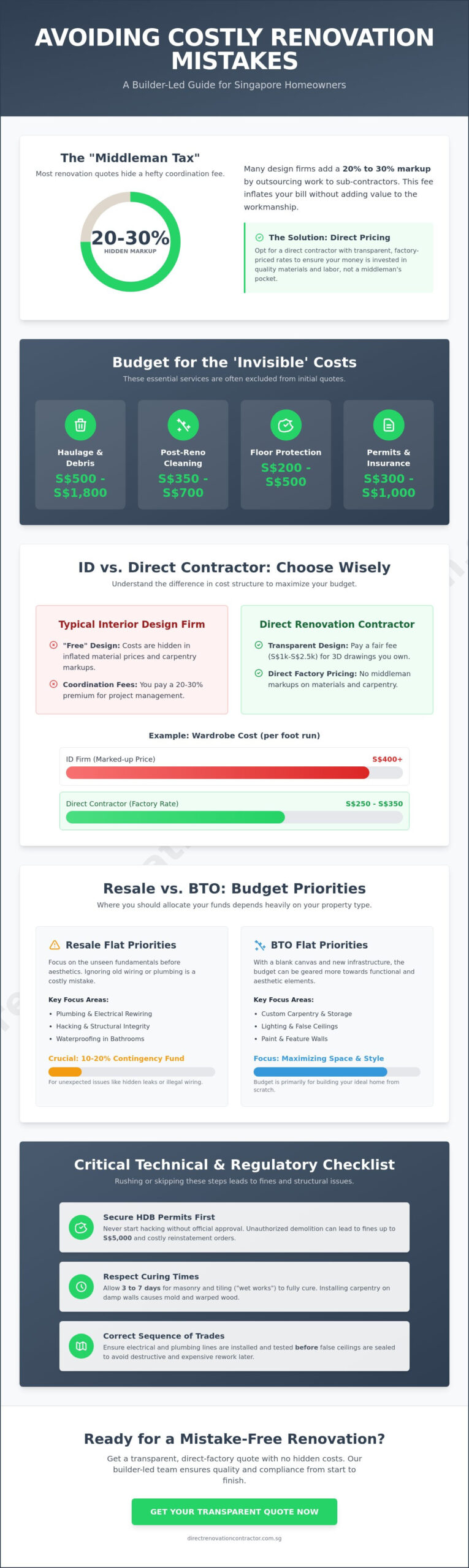
The “Middleman Tax” is another silent budget killer. Many design-heavy firms act as intermediaries, outsourcing the actual work to sub-contractors while adding a 20% to 30% markup on every item. To protect your wallet, opt for fixed-price labor and material contracts. These agreements offer far better protection than variable estimates because they lock in the price of masonry, carpentry, and tiling before the first sledgehammer swings. This transparency is essential for understanding the renovation process and ensuring your money goes into the house, not a middleman’s pocket.
Don’t overlook the “invisible” costs that aren’t usually featured in glossy brochures. These include:
- Haulage and Debris Removal: S$500 to S$1,800 depending on the amount of hacking required.
- Professional Post-Renovation Cleaning: S$350 to S$700 to remove fine construction dust.
- Floor Protection: S$200 to S$500 for corrugated plastic sheets to protect existing tiles.
- HDB/Condo Permits and Insurance: S$300 to S$1,000 for administrative and coverage fees.
The Hidden Cost of ‘Free’ Interior Design
In the Singapore market, “free” design services are a common marketing tactic. These costs are almost always recouped through significant material markups. You can spot this by checking the carpentry section of your quote. If the price per foot run for a wardrobe is significantly higher than the S$250 to S$350 factory rate, you’re likely paying for the “free” design. It’s more cost-effective to pay a separate fee of S$1,000 to S$2,500 for 3D drawings. This allows you to own your design data and take it to a direct contractor who offers transparent, unmarked-up pricing.
Budgeting for Resale vs. BTO Flats
BTO owners usually have the luxury of working with a blank canvas, but resale buyers face deeper financial risks. A major mistake is over-spending on aesthetics like fluted panels while ignoring 20-year-old electrical wiring. Resale renovations require much larger budget allocations for plumbing and electrical rewiring to meet current safety standards. Don’t prioritize a S$5,000 feature wall if your pipes are corroded. A Buffer Fund is the primary defense against unforeseen structural issues.
Technical and Regulatory Blunders: HDB Permits and Sequencing
Skipping permits or rushing the construction schedule is a recipe for legal and structural trouble. In Singapore, HDB regulations exist to protect the building’s integrity and your neighbors’ safety. Ignoring these rules is one of the most costly renovation mistakes a homeowner can make. If you hack a wall without approval, you face fines of up to S$5,000 and the heavy cost of reinstating the structure. Beyond the law, technical sequencing determines the longevity of your home. Rushing “wet work” is a common error. Masonry and tiling require three to seven days to cure fully before carpentry can begin. Installing cabinets against damp walls leads to mold growth and warped wood within months.
Poor coordination of trades also causes unnecessary rework. You must ensure electrical wiring and plumbing pipes are laid and tested before the false ceiling is closed. Once the gypsum boards are up and painted, adding a missed downlight or fixing a pipe leak becomes a destructive, expensive task. For condo owners, MCST compliance is equally vital. Most management offices require a renovation deposit between S$1,000 and S$3,000. They strictly enforce working hours, typically 9:00 AM to 5:00 PM on weekdays, and will stop work immediately if noise levels exceed limits outside these windows.
HDB Hacking and Demolition Rules
Identifying the right walls to remove is critical. Your floor plan uses thick black lines to denote load-bearing walls; these are structural and cannot be touched. Non-structural partitions are shown as thin lines, but even these require an official HDB permit before demolition. For new BTO flats, HDB imposes a 3-year restriction on hacking bathroom wall and floor tiles. This policy protects the original waterproofing membrane. Always verify that your professional is an HDB-registered contractor. This isn’t just a recommendation; it’s a legal requirement under the Housing and Development (Renovation Control) Rules to ensure the worker understands HDB’s structural limitations.
Plumbing and Electrical Planning Errors
If you want to ensure your project follows these technical standards without the headache, consider working with a direct renovation contractor who manages the site personally.
Material Selection: Aesthetics vs. Functionality in Singapore’s Climate
Falling into the “Pinterest Trap” is one of the most common renovation mistakes to avoid singapore. Homeowners often select materials based on beautiful images from temperate climates, forgetting that Singapore’s average relative humidity stays around 84%. Trendy materials like untreated pine or low-grade metals often warp, mold, or rust within 18 months of installation. You need to prioritize technical specifications over visual appeal to ensure your home remains durable in our tropical environment.
Choosing high-maintenance natural stones like marble for heavy-use kitchen countertops is another frequent error. Marble is a porous calcium carbonate; it reacts poorly to acids like lemon juice or vinegar. A single spill left for 20 minutes can result in permanent etching or staining. For a busy Singaporean kitchen where heavy cooking is the norm, engineered quartz or sintered stone provides the necessary heat and stain resistance without the constant need for sealing.
Carpentry and Cabinetry Essentials
The longevity of your kitchen depends on the internal carcass material. Many budget contractors use chipboard or medium-density fibreboard (MDF) to lower costs. These materials act like sponges in humid areas, leading to bloated panels and sagging hinges. You should insist on solid plywood carcasses for all wet areas. These are structurally superior and hold screws more effectively over time.
Pay close attention to the finishing details. Every cabinet door should feature ABS (Acrylonitrile Butadiene Styrene) edging. This 1mm to 2mm thick plastic trim seals the edges of the laminate, preventing moisture from seeping into the wood and causing the laminate to peel. For a deeper dive into technical specs and factory-direct pricing, consult a professional carpenter singapore to avoid middleman markups on your custom units.
Flooring and Wall Finish Mistakes
Flooring choices must match the specific function of each room. While vinyl flooring is popular for its foot-feel and cost, using low-grade vinyl in kitchens is a mistake. If water seeps through the click-lock joints, it can trap moisture against the cement screed, leading to mold growth and “popping” floorboards. Ensure you select a heavy-duty, waterproof grade for any area prone to spills.
Safety is another critical factor often overlooked during the design phase. High-gloss tiles are a major slip hazard in toilets, particularly for the 19.1% of Singapore’s population aged 65 and above. Always check the “R-rating” for slip resistance; an R10 or R11 rating is the standard for bathroom floors. For walls, don’t settle for standard emulsion paint in the toilet. Use specialized anti-mould paint to prevent the black fungal spots that typically appear on HDB bathroom ceilings within six months of a renovation.
The ID vs. Direct Contractor Mistake: Choosing the Wrong Model
One of the most expensive common renovation mistakes to avoid singapore homeowners face is failing to distinguish between an Interior Designer (ID) and a Main Contractor. Most people assume they need an ID for any major overhaul. This assumption often leads to paying a 20% to 30% premium for services you might not actually require. If you already have a clear vision or a collection of reference photos, hiring an ID means you’re paying for a middleman to relay instructions to the people actually doing the work.
An ID functions as a design consultant who manages the aesthetic “look and feel.” A direct contractor is the technical expert who executes the hacking, masonry, and carpentry. For those who want functional quality without the designer price tag, the direct model is more efficient. It’s a myth that direct contractors don’t provide project management or design support. Many modern firms provide technical 3D drawings to ensure the structural layout is sound before the first hammer hits the wall. This technical support bridges the gap between raw labor and high-end design.
Cost savings are significant. By managing sub-contractors yourself and utilizing professional 3D support, you can save roughly S$8,000 to S$15,000 on a standard 4-room HDB flat. These savings come from eliminating the “coordination fees” that IDs typically bake into every line item of your quotation.
The Direct Contractor Advantage
Choosing a direct model gives you immediate access to factory pricing for carpentry and masonry. You aren’t paying for a fancy showroom or a designer’s commission. Communication is transparent because you’re dealing directly with the people executing the labor. This eliminates the “broken telephone” effect where design details get lost between the ID and the site supervisor. For a detailed breakdown of how these models differ, view our direct renovation contractor singapore comparison guide.
Managing Your Own Project (DIY Renovation)
You can manage your own project effectively by using 3D drawings as a technical blueprint. These drawings act as a universal language for sub-contractors. When hiring specialists for plumbing or electrical works, look for HDB-licensed professionals with at least 10 years of local experience. The “Direct Support” model allows you to get a curated list of trusted suppliers, ensuring you don’t fall victim to common renovation mistakes to avoid singapore like hiring unlicensed workers. You can save upwards of S$10,000 on a standard BTO flat by coordinating these trades yourself with the right technical support.
Ready to skip the middleman markups and work with the builders directly? Get a transparent quote from a direct contractor today.
Actionable Checklist: Steps to a Mistake-Free Renovation
A successful renovation isn’t about luck; it’s about following a strict, logical process. To prevent the most common renovation mistakes to avoid singapore, you must treat the preparation phase as the most critical part of the build. Never allow a hammer to touch a wall until your floor plan and 3D drawings are 100% finalized and signed off. Changes made during the hacking or masonry phase often lead to a 20% increase in labor costs and weeks of unnecessary delays.
Before work starts, verify that all HDB, BCA, or MCST permits are approved and displayed at the site entrance. For HDB flats, hacking permits typically require specific structural assessments to ensure no load-bearing walls are compromised. If you live in a condo, your MCST might require a renovation deposit ranging from S$1,000 to S$3,000 before they grant access to your contractors. Managing these approvals early prevents legal fines and stop-work orders that can derail your move-in date.
- Finalize electrical load capacity with your contractor to avoid tripping breakers.
- Ensure all 3D drawings include actual dimensions of your appliances.
- Confirm the delivery dates for “owner-buy” items like tiles, toilets, and kitchen sinks.
- Secure a written work schedule with clear milestones for hacking, masonry, and carpentry.
The Pre-Renovation Walkthrough
Meet your main contractor on-site before the first worker arrives. Bring a measuring tape and the 3D designs to verify every corner. Use chalk or tape to mark out electrical points and plumbing outlets directly on the walls. This visual confirmation prevents misunderstandings that happen when looking at 2D paper plans. You should also confirm the exact sequence of work. For instance, ensure all masonry and painting are completed and dried before carpentry teams bring in your custom cabinets to avoid moisture damage or dust contamination.
Defect Inspection and Handover
The final handover is your last chance to ensure quality before final payment. Use a tapping rod to check for hollow tiles; these can crack or pop up in 2 to 3 years if the cement bond is weak. Check that grout lines are even and that all custom cabinet doors align perfectly without scraping the frames. Test every electrical socket with a plug-in tester and run all taps for 10 minutes to check for slow leaks under the sinks. Refer to our guide on home renovation for a full planning checklist to ensure no step is missed during this high-pressure phase.
By staying disciplined with this checklist, you eliminate the guesswork. A direct contractor approach relies on technical accuracy and clear communication rather than flashy sales pitches. Stick to the plan, verify the work on-site, and don’t rush the final inspection. This is how you ensure your Singapore home is built to last without the typical renovation headaches.
Secure a Practical and Cost-Effective Renovation
A successful home transformation doesn’t happen by accident. It requires strict adherence to HDB regulations and a firm grip on your financial planning. Avoiding the common renovation mistakes to avoid singapore homeowners often make means looking past flashy 3D renders and focusing on technical execution. Whether it’s managing the sequence of hacking and masonry or ensuring your carpentry is built for the local climate, the practical details matter most. Proper planning ensures you don’t overspend on aesthetics that won’t last in our humidity.
Our team eliminates the middleman to put your budget exactly where it belongs: into your property. As HDB-registered contractors, we handle the necessary permits and technical heavy lifting while offering direct factory pricing on carpentry. You won’t find hidden markups or vague line items in our quotes. We prioritize structural integrity and financial transparency so you can move into your new space with total peace of mind. Our focus is on delivering quality results that stay within your S$ budget.
Stop paying for unnecessary overheads and take control of your project today. Get a Direct Contractor Quote and Save on Your Renovation Today. We’re ready to help you build a home that’s as durable as it is affordable.
Frequently Asked Questions
Can I renovate my HDB flat without hiring an interior designer?
You can definitely renovate without an interior designer by engaging a direct contractor for your hacking, masonry, and carpentry needs. This approach saves you the 20% project management fee typically charged by ID firms. You’ll take charge of the design direction, while the contractor ensures the technical work meets HDB’s strict renovation guidelines and structural requirements.
What is the most expensive mistake in a Singapore home renovation?
Changing your layout after hacking has finished is the most expensive error you can make. Altering a floor plan mid-way can add S$10,000 to your expenses due to wasted manpower and materials. This is one of the common renovation mistakes to avoid singapore residents encounter when they rush into a project without a finalized electrical and plumbing plan.
How do I know if a wall in my HDB flat is load-bearing?
Refer to your HDB floor plan and look for thick, solid black lines. These represent load-bearing walls that provide structural integrity to the block. You’re strictly prohibited from hacking these sections. If the lines are thin or dotted, they’re likely non-structural partition walls, but you still need a permit from HDB before any hacking work begins on-site.
Is it cheaper to buy my own renovation materials or let the contractor handle it?
It’s generally more cost-effective to let your contractor source materials through their factory networks. Direct contractors secure wholesale rates that are 10% to 15% lower than retail prices at showrooms. Buying your own tiles or fixtures often leads to coordination issues. If the items arrive broken or late, your renovation timeline will stall, costing you more in labor delays.
What permits do I need for a condo renovation in Singapore?
You must obtain a Letter of Approval from your condo’s Management Corporation Strata Title (MCST) before any hacking starts. Most MCSTs require a renovation deposit of S$2,000 to protect against damage to lifts and hallways. You also need to adhere to specific working hours, usually 9:00 AM to 5:00 PM on weekdays, to avoid heavy fines from the management office.
How long does a typical 4-room HDB BTO renovation take in 2026?
A 4-room BTO renovation in 2026 typically takes between 8 and 10 weeks to complete. The first 3 weeks focus on masonry and electrical wiring, followed by 4 weeks for carpentry fabrication in the factory. The final 2 weeks involve on-site installation and painting. Choosing standard material sizes instead of custom imports can shave 7 days off this schedule.
What should I do if my contractor finds unexpected issues in a resale flat?
Request a written Variation Order (VO) that specifies the exact cost of the repair before the contractor proceeds. Resale units often hide legacy plumbing leaks or hollow floor tiles that only appear after hacking. Don’t agree to verbal price estimates. A professional contractor will document the issue with photos and provide a transparent price for the additional masonry or plumbing work required.
How can I avoid hidden markups in my renovation quote?
Avoid “all-in” packages and insist on a detailed breakdown of every hacking, tiling, and carpentry item. Hidden markups often hide in vague descriptions like “general plumbing.” Working directly with a builder helps you bypass the 25% markup used by design-heavy firms. This transparency helps you navigate the common renovation mistakes to avoid singapore and keeps your budget under control.