
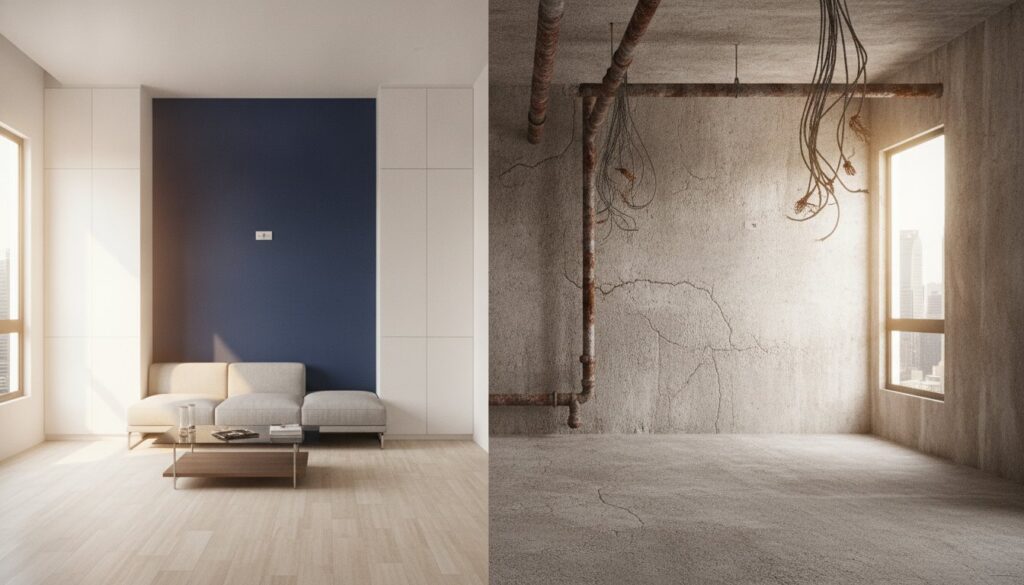
What if the biggest threat to your budget isn’t the price of premium finishes, but the corroded cast-iron pipes hidden behind your resale condo’s walls? With over 1,000 private developments in Singapore now aged 30 years or older, you’re likely facing a complex set of resale condo renovation challenges that require technical expertise rather than just aesthetic flair. It’s frustrating to realize that behind every vintage layout lies a maze of aging electrical systems and strict MCST regulations that can stall your progress before the first hammer swings.
We understand that you want a home that’s structurally sound and legally compliant without the unnecessary markup of a middleman. This survival guide provides a direct contractor’s perspective on navigating the 2026 landscape, from the mandatory CORENET-X digital submissions starting this October to managing the 20% MCST deposit caps for CaseTrust accredited contractors. We’ll preview the essential strategies for handling structural hacking, waterproofing, and masonry works so you can achieve high-quality results while keeping your financial model transparent and predictable.
Key Takeaways
- Identify hidden structural issues and aging legacy systems to effectively overcome common resale condo renovation challenges before they impact your budget.
- Navigate MCST regulations and manage high renovation deposits to prevent administrative delays and maintain a healthy project cash flow.
- Evaluate the technical trade-offs between hacking and overlaying tiles to ensure long-term waterproofing integrity in older bathrooms.
- Structure a realistic 2026 renovation timeline and budget by incorporating a 15% buffer fund for the unexpected defects typical of older units.
- Leverage the direct contractor model to cut out middleman fees and gain direct access to the specialists handling your masonry, electrical, and carpentry works.
Common Technical Pitfalls in Resale Condo Renovations
Renovating an older unit is far more than a cosmetic exercise. It’s a technical deep dive into the history of the building. One of the primary resale condo renovation challenges involves dealing with legacy systems that haven’t been updated in decades. You aren’t just starting with a blank canvas; you’re inheriting years of wear and tear, along with any undocumented modifications made by previous owners. This isn’t just about design; it’s about engineering a home that’s safe to live in.
The “surprise factor” is a reality in every resale project. Once hacking begins, we often uncover hollow tiles where the cement bond has failed, or hidden water seepage that was masked by a quick coat of paint for the sale. A foundational step in understanding the renovation process is accepting that the structural reality behind the walls will dictate your budget and timeline more than your mood board ever will. These technical hurdles require a contractor who prioritizes structural integrity and functional results over aesthetic flair.
The Risk of Concealed Electrical and Plumbing Systems
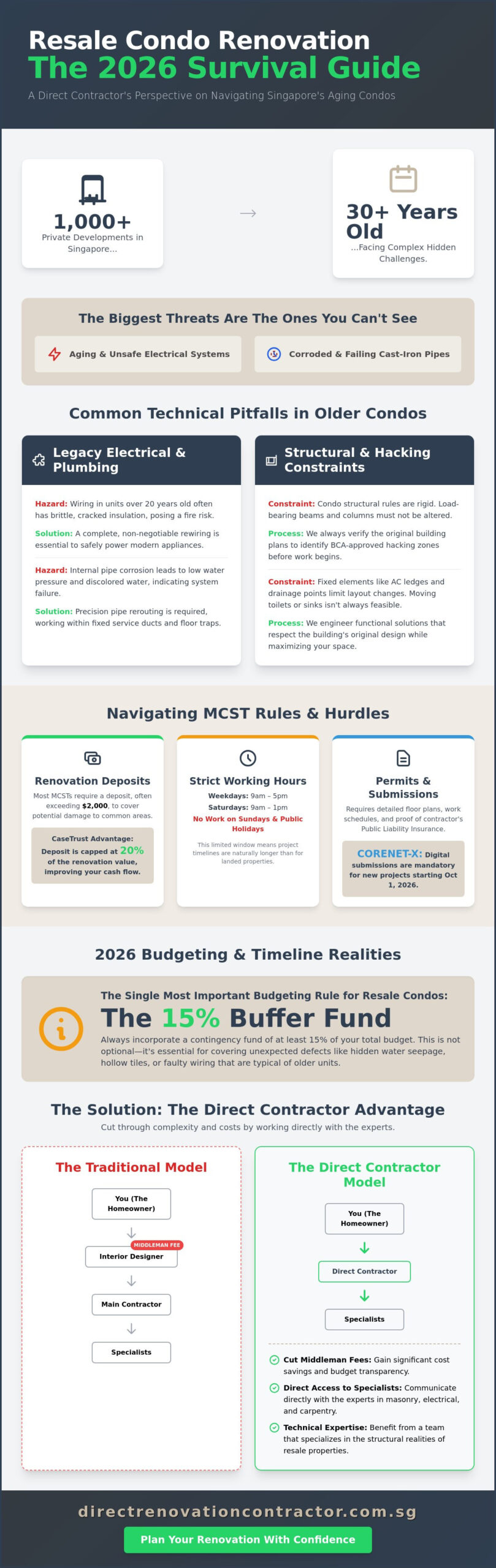
If your condo is approaching the 20-year mark, the electrical wiring is likely a safety hazard. Over time, wire insulation becomes brittle and cracks, which can lead to short circuits or even fires. We don’t suggest patchwork repairs for units this old. A complete rewiring is the only way to ensure your modern kitchen appliances and home automation systems run safely. Similarly, plumbing in older condos often suffers from internal pipe corrosion. If you notice a steady drop in water pressure or slight discoloration in the water, it’s a sign that your internal services are failing. Rerouting these pipes is a precision job. We must work within the original service ducts and fixed floor trap positions, which leaves very little room for error.
Structural Constraints and Hacking Limitations
Condominium structural rules are often more rigid than HDB guidelines. Every development has its own set of load-bearing beams and columns that cannot be touched. We never assume a wall is non-structural based on a visual inspection alone. Our team always verifies the original building plans to identify BCA-approved hacking zones before any site work starts. You must also work around fixed elements like air-conditioning ledges and specific drainage constraints. Moving a sink or a toilet isn’t always possible because the plumbing gradient is dictated by the original floor slab. We focus on finding functional solutions that respect these engineering limits while maximizing your usable space.
Navigating MCST Rules and Administrative Hurdles
In a condominium, your unit isn’t an island. The Management Corporation Strata Title (MCST) acts as the gatekeeper for every hammer swing and tile laid. Unlike HDB renovations where rules are standardized, each condo development has its own set of by-laws. Managing these administrative layers is one of the most overlooked resale condo renovation challenges. If you don’t follow the specific house rules of your estate, the management office has the authority to halt your project or bar your workers from entering the premises.
One of the first hurdles is the renovation deposit. Most MCST bodies require a refundable sum to cover potential damage to common property like lift interiors and corridor flooring. These deposits often exceed $2,000. However, for homeowners using a CaseTrust-accredited contractor, this deposit is capped at 20% of the total renovation value as of 2026. This regulation helps manage your cash flow, but you must still account for this liquidity early in your planning. You’ll also need to respect strict working hours. Renovation work is generally restricted to 9 am to 5 pm on weekdays and 9 am to 1 pm on Saturdays. There’s no work permitted on Sundays or public holidays. This limited window means your project timeline will naturally be longer than a landed property renovation.
Securing Renovation Permits and Deposits
Getting your permit isn’t just about filling out a form. You’ll need to submit detailed floor plans, a clear work schedule, and proof of your contractor’s Public Liability Insurance. Starting 1 October 2026, all new building projects must also navigate the CORENET-X platform for digital submissions. We handle the technical documentation to ensure your application meets these multi-agency standards. To get your deposit back in full, we document the condition of the common areas before work starts. This prevents the MCST from blaming your team for pre-existing scratches in the lift or cracks in the lobby tiles. If you’re looking for a partner who understands these local nuances, our condo renovation packages include full administrative coordination with your management office.
Managing Logistics and Protection Standards
Logistics in a high-rise environment are complex. We use heavy-duty protection for lift lobbies and corridors to prevent fines and disputes. Debris removal is another critical factor. In buildings with only one service lift, we must coordinate with the security team to ensure we don’t hog the lift or block resident access. Beyond the technicalities, managing neighbor relations is essential. High-impact hacking phases are noisy and disruptive. We recommend placing a polite notice at the lift lobby to inform neighbors of the schedule. This simple step often prevents formal complaints to the MCST, keeping your project on track and your relationship with your new community intact.
The Masonry and Plumbing Dilemma: Hacking vs. Overlaying
Masonry work represents the most labor-intensive phase of any project. It’s where your budget meets the hard reality of the building’s age. When facing resale condo renovation challenges, the decision between hacking and overlaying is a technical crossroads. Overlaying involves installing new tiles or vinyl directly over existing ones. This is faster and reduces debris, but it’s not always a viable solution. If the original tiles are hollow or the bonding agent has crystallized over two decades, overlaying simply masks a structural failure. Eventually, the tension will cause your new floor to crack or “pop.”
In older units, specifically those over 15 years old, we generally recommend full hacking. This allows our team to inspect the sub-floor, replace aging screed, and ensure a perfectly level surface. Removing thick, old screed often reveals uneven concrete slabs that require professional self-leveling compounds before any new finishes are applied. While this process adds several days to your 2026 renovation timeline, it’s the only way to guarantee a finish that won’t hollow out. We prioritize these foundational works because they affect the long-term integrity of your home.
To Hack or To Overlay?
Most MCSTs have strict weight limit regulations for floor slabs. Adding a second layer of tiles increases the dead load on the structure. Some management offices explicitly ban double-layer tiling for this reason. You must also verify the existing tile condition. If we detect more than 10% hollow tiles during our site assessment, hacking becomes mandatory. For most resale condo renovation challenges involving aging bathrooms, hacking is the safer bet. It allows for a complete refresh of the waterproofing membrane, which is the only way to prevent costly leakage disputes with the neighbor living below you.
Critical Waterproofing and Tiling Standards
Waterproofing is where technical competence matters most. We perform a mandatory 24-hour flood test for all toilet renovations. Our workers plug the floor traps, fill the area with water, and mark the levels. If the level drops or the unit below reports dampness, the membrane has failed and must be redone. This is a non-negotiable step in our workflow. When selecting materials, look beyond the aesthetics. Check the slip resistance, or R-rating. For wet areas, an R10 or R11 rating is essential for safety. While natural stone offers a premium look, it requires regular sealing. Homogenous tiles are often the more pragmatic choice for high-traffic resale units due to their durability and lower maintenance requirements.
Budgeting and Timeline Management in 2026
Financial planning for resale condo renovation challenges requires a shift from a “design budget” to an “engineering budget.” You aren’t just paying for new cabinets; you’re paying to rectify decades of wear and tear. Most of your capital will go toward foundational works like hacking, rewiring, and plumbing before you even choose a paint color. We recommend a “Buffer Fund” of at least 15% of your total contract value. This isn’t for upgrades; it’s specifically for the surprises we discussed earlier, such as hidden water seepage or hollow sub-floors that only become visible after hacking begins.
Phasing is a pragmatic way to manage cash flow. If your budget is tight, focus on the “dirty” works first. Hacking, masonry, and internal services must be completed now because they’re impossible to redo once you’ve moved in. Cosmetic elements like feature walls or additional carpentry can often be modularized and added later. Regarding your schedule, expect a timeline of 10 to 12 weeks. While a BTO unit might take 6 to 8 weeks, resale condos are slower due to the technical complexity of stripping old materials and adhering to strict MCST “silent days” where no noisy work is permitted.
Managing 2026 Material and Labour Inflation
The 2026 MAS inflation forecast indicates that steady core inflation will continue to pressure the pricing of imported finishing materials, such as premium quartz and timber laminates. Locking in your carpentry prices during the initial contract phase protects you from mid-project spikes caused by global supply chain shifts. While standard modular units are more affordable, custom carpentry remains a significant investment, often accounting for 30% to 40% of the total budget in older resale projects where walls aren’t perfectly straight and require tailored fittings.
Creating a Realistic Project Schedule
You must account for the mandatory “silent days” enforced by most condo managements. No drilling, hacking, or heavy moving is allowed on weekends or public holidays, which effectively cuts your productive working time by nearly 30% each month. Sequencing is critical to avoid bottlenecks. We ensure masonry is fully cured before the electricians and plumbers begin their final fit-out. Navigating these milestones is easier with our Home Renovation in Singapore guide, which details the exact sequence of works required for a smooth handover. To get a transparent breakdown of your project costs without middleman markups, request a resale renovation quote from our technical team today.
Why the Direct Contractor Model Solves Resale Challenges
Many homeowners believe that complex resale projects require an interior designer to manage the chaos. However, most design firms simply outsource the technical labor to the same contractors you could hire yourself. By choosing a direct contractor model, you effectively eliminate the middleman and their associated project management fees. This typically saves you 20-30% on your total project cost. In a year like 2026, where material and labor costs remain high, these savings can be the difference between finishing your project or compromising on essential structural repairs.
Technical accountability is the core of this model. When you face resale condo renovation challenges like legacy plumbing leaks or outdated electrical boards, you need to speak directly to the specialists doing the work. We don’t use sales representatives who lack technical knowledge. Instead, you have a direct line to our site supervisors and master tradespeople. This transparency ensures that your requirements aren’t lost in translation and that the structural integrity of your unit remains the top priority throughout the hacking and masonry phases.
Direct Carpentry and Masonry Control
Working with a carpenter in Singapore directly ensures that your custom fittings are built for the specific quirks of an older building. Older condos rarely have perfectly plumb walls or level floors. A direct carpenter takes precise site measurements and fabricates units to fit your actual space, rather than relying on generic templates. This direct communication also allows for greater flexibility in material selection. You aren’t restricted to a specific showroom partner; you can source your own tiles, vinyl, or laminates without worrying about hidden markups or “recommendation fees” added by an intermediary.
The Direct Renovation Advantage for Condo Owners
We provide a DIY Renovation Support Package designed for savvy homeowners who want to manage their own vision while relying on our technical expertise for the heavy lifting. We take over the administrative burden, including the detailed documentation required for MCST approval and the logistics of debris removal in restricted service lifts. We’ve seen owners save significantly on full resale overhauls by opting for direct masonry and electrical packages rather than bundled ID contracts. This approach prioritizes high-quality workmanship and financial clarity over flashy 3D presentations. If you’re ready to start your project with a partner who values technical skill and straightforward pricing, get a direct quote for your condo renovation today.
Take Control of Your Condo Transformation
Successfully navigating resale condo renovation challenges requires shifting your focus from surface-level aesthetics to the technical realities of your building. By addressing legacy plumbing and electrical systems early and maintaining a 15% buffer fund, you ensure your home is as functional as it is beautiful. Moving forward with a direct contractor model allows you to bypass traditional intermediary markups while gaining direct access to the specialists handling your hacking, masonry, and carpentry works.
Our team provides the technical competence and financial transparency needed for a predictable project. We are BCA-compliant and deeply familiar with MCST regulations, ensuring your renovation meets all local standards without administrative delays. We focus on high-quality workmanship and direct-to-consumer pricing to protect your investment. If you’re ready to build a home grounded in structural integrity and fair pricing, Contact Direct Renovation Contractor for a Transparent Resale Quote today. You have the vision; we have the technical skill to make it a structural reality.
Frequently Asked Questions
Do I need a permit for condo renovation in Singapore?
Yes, you must obtain written approval from your MCST before any work begins. For structural changes or Additions & Alterations (A&A), you also need a permit from the Building and Construction Authority (BCA). Starting 1 October 2026, all new building projects require digital submissions via the CORENET-X platform. We manage these technical submissions to ensure your project complies with both the estate by-laws and national safety standards.
How much is the average renovation deposit for a condo?
While many MCST bodies set their own rates that often exceed $2,000, the deposit is capped at 20% of the total renovation value if you use a CaseTrust-accredited contractor. This refundable sum acts as security against potential damage to common property like lift interiors and lobby flooring. Our team documents the pre-existing condition of these areas to help you secure a full refund without disputes once the project is handed over.
Can I renovate my resale condo without an interior designer?
You can certainly manage your project by working directly with a contractor to save 20% to 30% on middleman fees. This approach is highly effective for homeowners who have a clear design vision and want direct accountability for technical works like hacking, masonry, and electrical wiring. We provide the structural expertise and administrative coordination needed to solve complex resale condo renovation challenges without the added cost of a design consultant.
How long does a full resale condo renovation typically take in 2026?
A comprehensive overhaul for an older unit usually spans 10 to 16 weeks. This timeline accounts for the time needed to strip away legacy materials, rectify hidden defects in plumbing or wiring, and adhere to strict condo “silent days.” Unlike BTO projects, resale units require more intensive site preparation and structural assessment. We provide a logical, process-oriented schedule so you can plan your transition and move-in date with total predictability.
What happens if my renovation causes a leak to the unit below?
You are legally liable for repairing any damage to the neighbor’s property caused by your renovation works. We mitigate this risk by performing mandatory 24-hour flood tests after installing new waterproofing membranes in all wet areas. If a leak occurs, our public liability insurance covers the rectification costs. This protects your relationship with neighbors and ensures that any technical failures are resolved professionally without unplanned expenses on your part.
Is it cheaper to hack or overlay tiles in an old condo?
Overlaying is cheaper in the short term, but hacking is the safer investment for units over 15 years old. Hacking allows us to replace aging screed and inspect the concrete slab for deep-seated water seepage that an overlay would simply hide. Many MCSTs also restrict overlaying because it adds excessive weight to the floor slab. We focus on hacking for older properties to ensure the structural integrity and long-term durability of your new flooring.
What are the common working hour restrictions for condo renovations?
Most developments restrict noisy works to 9 am to 5 pm on weekdays and 9 am to 1 pm on Saturdays. No work is permitted on Sundays or public holidays. These rules are strictly enforced by the management office to maintain the liveability of the estate. We sequence our labor carefully to ensure high-impact phases like hacking and drilling are completed within these narrow windows to prevent fines or project stoppages.
How do I find a reliable direct renovation contractor for my condo?
Look for a local expert with deep experience in handling technical resale condo renovation challenges and a transparent business model. A reliable contractor should offer direct communication with the tradespeople executing the masonry and carpentry rather than through a sales representative. Ensure they provide a clear financial breakdown without hidden markups and have a proven history of navigating MCST regulations and BCA requirements in older private estates.