
Your interior designer’s electrical quote looks reasonable until you realise a licensed electrician for HDB work could have handled the same job directly, without the project management layer built into that price. That markup is real, and most homeowners only discover it after they’ve already signed.
If you’ve been quoted for additional power points, rewiring, or a full electrical overhaul and felt uneasy about what you’re actually paying for, that instinct is worth trusting. The anxiety around HDB permit rejections and the fear of substandard wiring causing long-term safety hazards are legitimate concerns, not overthinking.
This article cuts through the confusion. You’ll learn exactly why HDB regulations require licensed electrical workers, how to verify credentials before anyone touches a single wire in your flat, and how engaging a direct renovation contractor strips out the intermediary fees that inflate most electrical quotes. By the end, you’ll know how to get compliant, safe electrical work done without paying for a middleman you never needed.
Key Takeaways
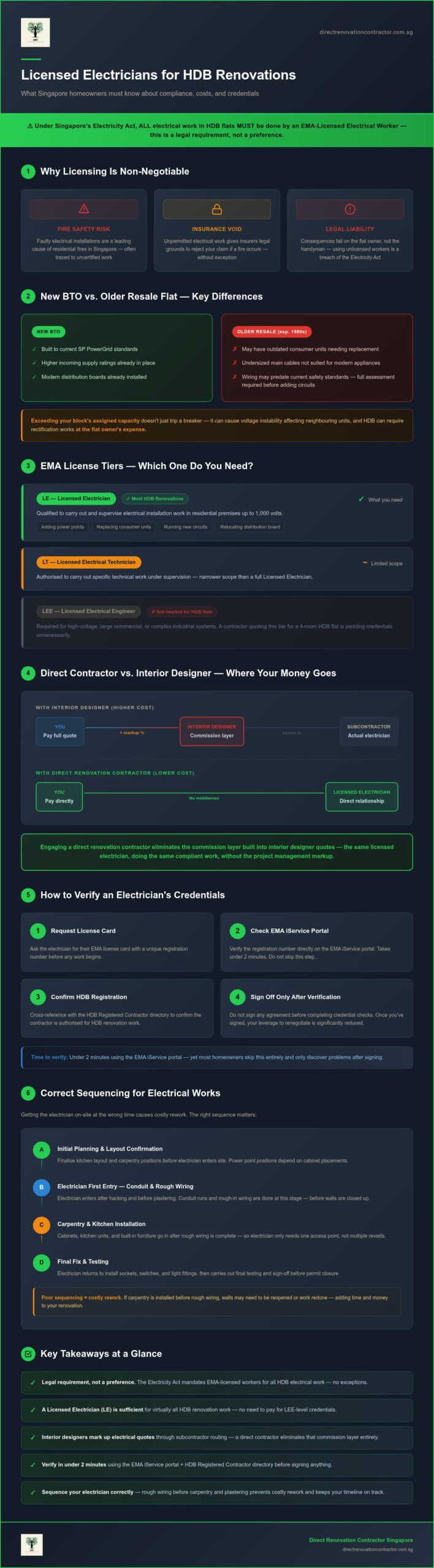
- Engaging a licensed electrician for HDB renovations is a legal requirement under EMA regulations, not a preference — using uncertified workers puts your insurance and safety at serious risk.
- EMA licenses are tiered, and knowing which category of Licensed Electrical Worker your job requires helps you avoid overpaying for the wrong level of expertise.
- Interior designers mark up electrical quotes by routing work through subcontractors — a direct renovation contractor eliminates that commission layer entirely.
- You can verify any electrician’s credentials in minutes using the EMA iService portal and the HDB Registered Contractor directory before signing anything.
- Sequencing your electrician’s site entry correctly around carpentry and kitchen layouts prevents costly rework and keeps your renovation timeline on track.
Why You Must Engage a Licensed Electrician for HDB Renovations
This isn’t a suggestion buried in fine print. Under Singapore’s Electricity Act, all electrical installation work in residential premises must be carried out by a Licensed Electrical Worker registered with the Energy Market Authority. For HDB flats specifically, that requirement is enforced through the permit system before any renovation work can be signed off. Hiring an unlicensed handyman to add power points or reroute wiring isn’t a grey area. It’s a breach of the law, and the consequences land squarely on the flat owner.
Regulatory Compliance and Home Safety
The Electricity Act exists because substandard wiring kills people. Faulty electrical installations are a leading cause of residential fires in Singapore, and many of those incidents trace back to work done without proper certification. Beyond the immediate safety risk, using an uncertified worker voids your home insurance. If a fire starts in your flat and investigators find unpermitted electrical work, your insurer has legal grounds to reject the claim entirely. That’s not a technicality; it’s a clause most policies enforce without exception.
A licensed electrician for HDB work is also required to use HDB-approved materials and wiring standards. This includes the correct cable grades, circuit breaker ratings, and conduit specifications. These aren’t arbitrary preferences. They’re calibrated to the electrical load profiles of HDB blocks, where dozens of units share the same incoming supply infrastructure.
HDB Electrical Loading Limits
Older resale flats, particularly those built in the 1980s, were designed around significantly lower household power consumption. Air conditioning was less common. Induction hobs, multiple refrigerators, and home office setups weren’t factored into the original load calculations. Each HDB block has an assigned electrical loading capacity, and your flat’s share of that capacity is a fixed figure.
The practical difference between a 1980s resale unit and a new BTO matters here:
- New BTOs are built to current SP PowerGrid standards with higher incoming supply ratings and modern distribution boards already in place.
- Older resale flats may have outdated consumer units, undersized main cables, or wiring that predates current safety standards, all of which need assessment before any additional circuits are added.
Exceeding your block’s assigned capacity doesn’t just trip a breaker. It can cause voltage instability that affects neighbouring units, and HDB has the authority to require rectification works at the flat owner’s expense. A Licensed Electrical Worker assesses your existing load before recommending any additions, which is precisely why the certification matters beyond just ticking a compliance box.
EMA License Categories and HDB Permit Requirements
Not every person who calls themselves an electrician holds the same qualifications. In Singapore, the Energy Market Authority issues licenses under a tiered structure, and the tier matters when you’re hiring a licensed electrician for HDB work. Understanding this system takes about five minutes and could save you from hiring someone who’s technically qualified for a different scope entirely.
Understanding the LEW Tiers
The EMA recognises three categories of Licensed Electrical Worker:
- Licensed Electrician (LE): Qualified to carry out and supervise electrical installation work in residential premises up to 1,000 volts. This covers the vast majority of HDB renovation work, including adding power points, replacing consumer units, and running new circuits.
- Licensed Electrical Technician (LT): Authorised to carry out specific technical work under supervision, with a narrower scope than a full Licensed Electrician.
- Licensed Electrical Engineer (LEE): Required for high-voltage installations, large commercial premises, and complex industrial systems. For a 4-room HDB flat, you don’t need this level, and any contractor quoting for one is either confused or padding their credentials.
For virtually every home renovation, a Licensed Electrician is sufficient. The LEE tier is relevant for commercial office fit-outs, not for adding a kitchen circuit or relocating your distribution board.
When a Licensed Electrical Worker arrives on site, they should carry a valid EMA license card with a unique registration number. You can verify this number directly through the EMA iService portal before work begins. It takes two minutes. Don’t skip it.
When Do You Need an HDB Permit?
HDB requires a renovation permit for specific categories of electrical work. These include:
- Installing new 15-amp power points or 20-amp isolators — typically required for air-conditioning units, dryers, and heavy kitchen appliances like induction hobs
- Rewiring works — replacing existing wiring in older resale flats where cables no longer meet current standards
- Relocating the main consumer unit — moving the distribution board to a new position within the flat
The 15-amp rule catches many homeowners off guard. Standard power points in Singapore are rated at 13 amps. Air-conditioners and certain appliances draw more current and require a dedicated 15-amp or 20-amp circuit, which triggers the permit requirement automatically. Adding one without a permit isn’t a minor oversight; it’s unpermitted works that HDB can require you to undo at your own cost.
A renovation contractor who handles electrical wiring and installation directly, rather than routing it through a subcontractor chain, will flag these permit triggers at the quotation stage rather than after work has started. That upfront clarity is worth more than a slightly lower headline price. If you want to understand how direct electrical works fit into a broader renovation scope, explore how a direct renovation contractor structures the full package without the intermediary layer.
The Direct Contractor Advantage: Saving on Electrical Costs
When an interior designer hands you an electrical quote, you’re not looking at the cost of the work. You’re looking at the cost of the work plus their margin on top of it. The ID engages a licensed electrician for HDB compliance purposes, marks up that subcontractor’s rate, and presents the combined figure as a line item in your renovation package. That structure isn’t hidden, exactly, but it’s rarely explained either.
The alternative is straightforward: engage a direct renovation contractor who employs or directly coordinates their own electrical team. No subcontractor chain. No commission layer. The price you receive reflects actual labour and materials, not a managed referral arrangement dressed up as project oversight.
Breaking Down Electrical Point Pricing
Understanding how electrical work is priced helps you evaluate any quote on its merits. Most electrical scopes are broken down by point type:
- Lighting points: Cover ceiling rose wiring for pendant lights, downlights, and feature lighting circuits. Each point includes the wiring run back to the distribution board.
- Power points: Standard 13-amp twin sockets are the baseline. Dedicated 15-amp or 20-amp isolator points for air-conditioners and heavy appliances are priced separately and, as covered earlier, trigger HDB permit requirements.
- Data points: LAN outlets for wired internet connections, increasingly relevant as homeowners move away from relying solely on Wi-Fi for home offices and media setups.
Concealed wiring, where cables are chased into walls and plastered over, costs more than surface trunking because it involves hacking, patching, and repainting. That cost difference is legitimate. What’s less legitimate is when that difference gets inflated further by a middleman margin sitting between you and the actual worker doing the chasing.
Two hidden costs catch homeowners off guard. First, distribution board upgrades: older resale flats often need the consumer unit replaced before new circuits can be added safely, and this isn’t always flagged upfront in lump-sum ID packages. Second, testing and inspection fees required for HDB permit sign-off. A transparent direct contractor itemises both from the start.
Why Direct Coordination Works Better
Beyond cost, direct coordination reduces errors. When you walk the site with the actual electrician rather than relaying instructions through a designer who relays them to a coordinator who relays them to the worker, socket placement gets done right the first time. That matters more than it sounds. Repositioning a concealed power point after plastering means rehacking, repatching, and repainting. That’s not a minor inconvenience; it’s a delay and an added cost that direct communication prevents.
Troubleshooting during the renovation is also faster. If a circuit trips during installation or a point position needs adjusting after cabinets go in, a direct contractor gets the electrician back on site without navigating a subcontractor scheduling chain. For a full breakdown of how this model compares against the traditional ID approach across the entire renovation scope, the Direct Renovation Contractor Singapore: The 2026 Comparison Guide covers it in detail.
How to Verify and Hire a Reliable HDB Electrician
Checking Google reviews before hiring a licensed electrician for HDB work is the renovation equivalent of judging a restaurant by its Instagram photos. Reviews can be managed, incentivised, or simply fake. Government databases can’t be. Two official sources give you everything you need to verify credentials before a single wire gets touched in your flat.
Verification Checklist for Homeowners
Run through these three steps before agreeing to any electrical scope:
- Step 1: Request the LEW license number. Any legitimate Licensed Electrical Worker will provide this without hesitation. It’s a unique registration number issued by the Energy Market Authority. If a contractor deflects or says their worker “doesn’t carry it on them”, treat that as a hard stop.
- Step 2: Cross-reference on the EMA iService portal. Go to the EMA’s official website and navigate to the iService portal. Search the license number directly. The result will show the worker’s name, license category, and current registration status. This takes under two minutes.
- Step 3: Confirm the license is not expired or suspended. An expired license is not a technicality. Work carried out under an expired license carries the same legal and insurance risks as work done by an uncertified person. Check the expiry date on the portal result, not just on the physical card the worker shows you.
You can also cross-check the contractor against the HDB Registered Contractor directory on the HDB InfoWEB. This confirms the firm is authorised to carry out renovation works in HDB flats, which is a separate requirement from the individual electrician’s EMA license. Both checks are necessary; one without the other leaves a gap.
Questions to Ask During the Site Survey
A site survey is your opportunity to assess competence, not just price. The questions below separate contractors who know the job from those who’ll figure it out after they’ve cashed your deposit.
- “How will you handle the HDB permit application?” A competent contractor handles this on your behalf and factors the permit process into the project timeline. If the answer is vague or they suggest you apply yourself, that’s a workflow problem that will cause delays.
- “Do you provide a warranty for the wiring and parts installed?” Ask specifically what’s covered and for how long. Workmanship warranties and parts warranties are different things. Get the answer in writing, not just verbally during the survey.
- “Can you provide a Single Line Diagram if required?” An SLD is a schematic showing your flat’s electrical distribution layout. HDB may require one for certain permit applications, particularly for consumer unit relocations or significant rewiring scopes. A contractor who can’t produce one isn’t equipped for complex electrical work.
Before work starts, insist on an itemised quotation that breaks down labour, materials, permit fees, and any testing or inspection costs separately. A lump-sum figure tells you nothing useful. Also confirm the contractor holds Public Liability Insurance and Work Injury Compensation coverage for their workers. If something goes wrong on site, those policies determine whether the financial exposure lands on them or on you.
Contractors who handle electrical wiring and installation directly, without routing through subcontractors, are better positioned to answer all of these questions clearly and quickly. There’s no coordinator in the middle softening the answers. Get a transparent, itemised electrical quote from a direct renovation contractor and compare it against what you’ve already been offered.
Integrating Electrical Works into Your HDB Renovation Journey
Electrical work doesn’t happen in isolation. It slots into a specific window within the broader renovation sequence, and getting that timing wrong creates rework that costs real money. The electrician enters the site after hacking and demolition are complete but before carpentry, tiling, and plastering begin. That window exists for a reason: concealed wiring needs to be chased into walls and ceiling voids before those surfaces are finished. Once the plasterer has sealed everything up, repositioning a socket means opening the wall again.
Coordinating electrical points with carpentry and kitchen layouts is where most planning errors occur. A power point placed 200mm too far left ends up hidden behind a built-in wardrobe panel. A kitchen isolator positioned before the cabinet heights are confirmed ends up at the wrong level for the appliance it’s meant to serve. These aren’t hypothetical mistakes. They’re the kind of rework that a direct renovation contractor prevents by running the electrical and carpentry scopes in the same conversation, not through separate subcontractor chains that never speak to each other.
Electrical Planning for BTO and Resale Flats
Future-proofing matters more now than it did five years ago. Smart home hubs, motorised blinds, and home EV charging infrastructure all require dedicated circuits or at minimum a conduit pathway to pull cables through later. Planning for these during the first electrical first-fix costs almost nothing. Retrofitting them after renovation is complete is expensive and disruptive. For a detailed walkthrough of how electrical planning fits into the full renovation sequence, the Home Renovation in Singapore: A Practical Guide to Planning and Execution in 2026 covers the complete project timeline.
Common placement mistakes to avoid:
- Sockets behind wardrobes: Confirm all built-in furniture positions before finalising point locations, not after.
- Bedside points too low or too far from the bed head: Mark out the bed position on the floor before the electrician starts first-fix.
- Insufficient kitchen points: Modern kitchens run multiple high-draw appliances simultaneously. Underproviding circuits here means using extension leads permanently, which is both a safety issue and an aesthetic one.
A licensed electrician for HDB work who’s integrated into the renovation team rather than parachuted in as a subcontractor will flag these conflicts before they become problems.
The Final Handover and Safety Testing
Before you release the final payment, conduct a thorough load test. Switch on every circuit simultaneously, including air-conditioning units, the water heater, and kitchen appliances. If a breaker trips under normal household load, that’s a distribution board sizing issue that needs rectification before handover, not after you’ve moved in.
Check that all trunking is properly clipped, sealed, and flush against surfaces. Loose trunking isn’t just untidy; it indicates rushed installation that may reflect the quality of the concealed work you can’t see. Collect your electrical completion certificate and any HDB permit sign-off documents at handover. These records are required for future resale and for any subsequent renovation that touches the electrical system. Store them with your flat’s title documents. Future buyers will ask, and having the paperwork ready protects your resale position.
Direct Renovation Contractor manages licensed electrical teams as part of the full renovation package, which means the sequencing, permit applications, and final inspections are handled within one coordinated scope. No chasing separate contractors for certificates. No gaps in accountability. Get a direct quote that includes electrical wiring and installation as part of your HDB renovation package.
Make Your Next Step Count
The answer to whether you need a licensed electrician for HDB work isn’t complicated: yes, legally and practically, every time. What’s less obvious is how much of your electrical budget disappears into intermediary margins before it reaches the person actually doing the work.
Three things to carry forward from this article. First, verify every electrician’s EMA license number on the portal before work starts, not after. Second, get an itemised quote that separates labour, materials, and permit fees clearly. Third, a direct renovation contractor removes the commission layer that ID-routed electrical scopes quietly build in.
Direct Renovation Contractor works directly with homeowners on HDB BTO and resale renovations, handling electrical wiring and installation as part of a fully coordinated package. Full compliance with EMA and HDB standards, no hidden commissions, and pricing that reflects the actual cost of the work.
Get a transparent quote for HDB electrical works directly from us and see exactly what you’re paying for before you commit to anything.
Frequently Asked Questions
Does HDB provide a free electrician for power trips?
No, HDB doesn’t provide a free electrician for power trips in your flat. Electrical faults within your unit are the flat owner’s responsibility. HDB’s maintenance scope covers common areas and shared infrastructure, not individual unit wiring. For a tripped breaker, you’ll need to engage a licensed electrician privately, either through a direct renovation contractor or an independent LEW.
If the trip affects your entire block or multiple units simultaneously, that points to an issue with the incoming supply infrastructure, which SP PowerGrid handles. Contact SP PowerGrid at 1800-778-8888 for supply faults at the block level.
Can I do my own electrical wiring if I am a DIY enthusiast?
No. Singapore’s Electricity Act prohibits unlicensed individuals from carrying out electrical installation work, regardless of personal skill level. Changing a light bulb or swapping a socket faceplate is generally acceptable, but running new wiring, adding circuits, or modifying your distribution board requires a Licensed Electrical Worker registered with the EMA. There’s no DIY exemption for residential premises.
The risk isn’t just legal. Incorrectly installed wiring is a fire hazard, and any damage traced back to unpermitted work voids your home insurance. The cost of hiring a licensed electrician for HDB work is far lower than the liability exposure of doing it yourself.
How much does it cost to rewire a 4-room HDB resale flat in 2026?
We don’t publish specific pricing here because electrical rewiring costs vary significantly based on the flat’s existing wiring condition, the number of circuits required, whether the distribution board needs replacing, and whether concealed or surface trunking is used. Quoting a figure without a site assessment would be misleading.
What you should insist on is an itemised quotation that separates labour, materials, permit fees, and testing costs as individual line items. Any contractor quoting a lump sum for a full rewire without a site visit first isn’t giving you a real number. Get a direct quote from a renovation contractor who handles electrical wiring in-house for a figure that reflects your flat’s actual scope.
What is the difference between an HDB registered contractor and an EMA licensed worker?
These are two separate credentials that serve different purposes. An HDB registered contractor is a firm authorised by HDB to carry out renovation works in HDB flats. This is a company-level registration. An EMA Licensed Electrical Worker is an individual certification issued to a specific person, confirming they’re qualified to carry out electrical installation work under the Electricity Act.
You need both in place for compliant HDB electrical work. The contractor firm must be HDB-registered, and the individual physically doing the electrical work must hold a valid EMA license. One without the other leaves a compliance gap. Check both the HDB InfoWEB contractor directory and the EMA iService portal before work starts.
Why does my HDB flat keep tripping after I installed a new aircon?
A new air-conditioning unit draws significantly more current than standard appliances, and if it’s been connected to an existing general-purpose circuit rather than a dedicated 15-amp or 20-amp isolator point, that circuit is likely overloaded. Older resale flats are particularly vulnerable because their distribution boards were sized for lower household loads than modern usage demands.
The fix isn’t resetting the breaker repeatedly. A licensed electrician needs to assess whether the aircon requires a dedicated circuit, whether the existing breaker rating is adequate, and whether the distribution board itself has capacity for the additional load. Running an aircon on an undersized circuit is a fire risk, not just an inconvenience.
Is it mandatory to change the DB box during an HDB renovation?
It’s not automatically mandatory, but it’s frequently necessary in older resale flats. If your existing consumer unit uses older rewirable fuse technology rather than modern circuit breakers, or if it doesn’t have sufficient ways to accommodate new circuits for aircon or kitchen appliances, replacement becomes a practical requirement rather than an optional upgrade.
A licensed electrician will assess the existing distribution board during the site survey and advise whether it can support your planned electrical scope. If a DB box replacement is needed, it must be factored into the HDB permit application. Contractors who don’t flag this upfront often surface it mid-renovation as a variation cost, so confirm the board’s condition before signing any quote.
How long does it take to get an HDB electrical permit approved?
HDB typically processes renovation permit applications within three to five working days for straightforward scopes. More complex applications involving rewiring or distribution board relocation may take longer if HDB requests additional documentation. The permit must be approved before electrical works begin, so this timeline needs to be built into your renovation schedule, not treated as an afterthought.
A direct renovation contractor who handles permit applications as part of their standard workflow submits the application at the right stage and tracks approval status without you needing to chase it. Delays usually happen when contractors submit incomplete applications or when the permit scope doesn’t match the actual works planned on site.
Can a licensed electrician sign off on work done by someone else?
No. A Licensed Electrical Worker can only certify work they personally carried out or directly supervised. Signing off on work done by another person, particularly an unlicensed one, is a serious breach of EMA regulations and exposes the LEW to license suspension or revocation. It also doesn’t make the underlying work compliant; the certification is only valid when it reflects actual supervised installation.
This matters practically because some contractors attempt to reduce costs by having unlicensed workers do the bulk of the installation and bringing in a licensed electrician only for the paperwork. That arrangement is non-compliant and carries the same legal and insurance risks as having no licensed electrician involved at all. Confirm that the LEW on your project is present on site throughout the installation, not just at sign-off.