
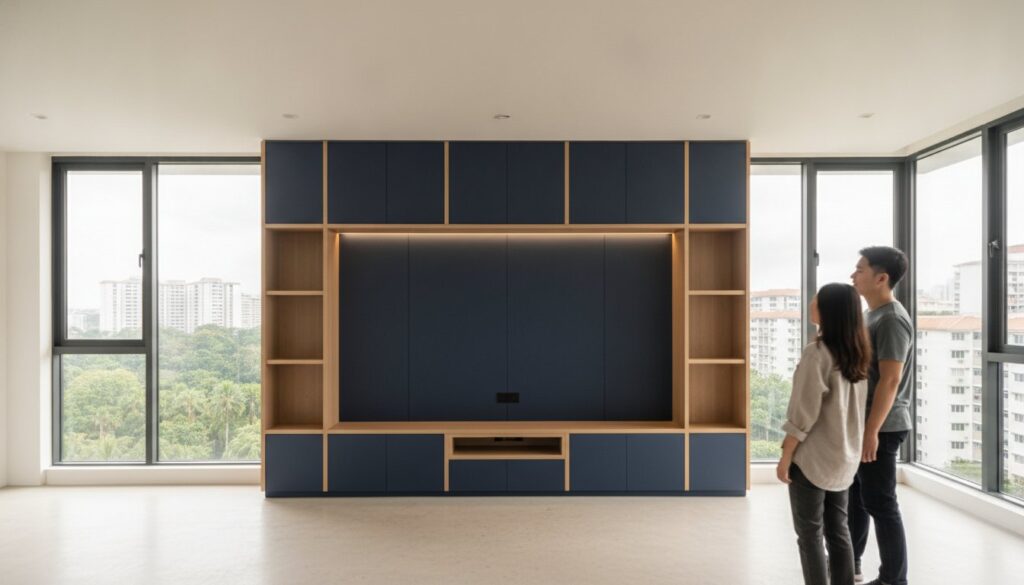
What if the 30% markup on your new kitchen cabinets isn’t paying for better wood, but simply for an interior designer’s coordination fee? It’s a common realization for Singapore homeowners who find themselves paying premium prices for standard materials. You likely feel the same anxiety over hidden costs and technical jargon like ABS edging or carcass types that seem designed to confuse rather than clarify. It’s frustrating to worry that your expensive custom wardrobe might use subpar plywood or fail to meet HDB’s latest 2026 loading limits.
This article serves as your ultimate guide to shortlisting a custom carpentry contractor, helping you bypass middlemen and secure high-quality, factory-direct results. You’ll learn how to verify a contractor’s technical competence and ensure transparent pricing without undisclosed commissions. We’ll preview the essential steps for checking BCA licenses, understanding material durability, and managing a smooth installation process that respects your budget and your home’s structural integrity. By the end, you’ll have the technical knowledge to identify a reliable partner who values functional results over flashy presentations.
Key Takeaways
- Eliminate middleman markups by sourcing directly from local factories, ensuring your budget pays for material quality rather than designer coordination fees.
- Use The Ultimate Guide to shortlisting a customer carpentry contractor to evaluate technical specifications, ensuring you receive moisture-resistant plywood and durable ABS edging.
- Verify a contractor’s technical competence by visiting their physical workshop and reviewing a portfolio of actual on-site installations in HDB and condo units.
- Avoid the “cheap plywood” trap by scrutinizing quotes for vague material descriptions and ensuring all internal carcass finishes are clearly defined.
- Secure a precise fit for your custom cabinetry by following a structured process that includes final on-site measurements and detailed 3D architectural drawings.
Custom Carpentry in Singapore: Why Direct Contractors Offer Better Value
Many Singapore homeowners start their renovation journey by visiting interior design showrooms. While these firms offer beautiful 3D renders, they rarely own the machinery that builds your cabinets. Most IDs act as intermediaries, sub-contracting the work to various fabrication workshops. By skipping this middleman, you can redirect your budget toward better materials like moisture-resistant plywood or high-end Blum hardware instead of paying for a coordination markup. This is why The Ultimate Guide to shortlisting a customer carpentry contractor prioritizes the direct-to-factory model for savvy renovators.
This shift is part of a growing “Direct-to-Homeowner” movement in 2026. Homeowners are realizing that technical expertise is more valuable than a lifestyle pitch. The Ultimate Guide to shortlisting a customer carpentry contractor emphasizes finding a partner who understands the structural realities of your flat. Whether it’s managing the HDB floor loading limit of 150kg per square meter or ensuring your kitchen cabinets meet current height regulations, a direct contractor provides the technical transparency you need. There’s a distinct lack of pretension in this approach; it’s about functional results and financial clarity.
The Middleman vs. Direct Contractor Model
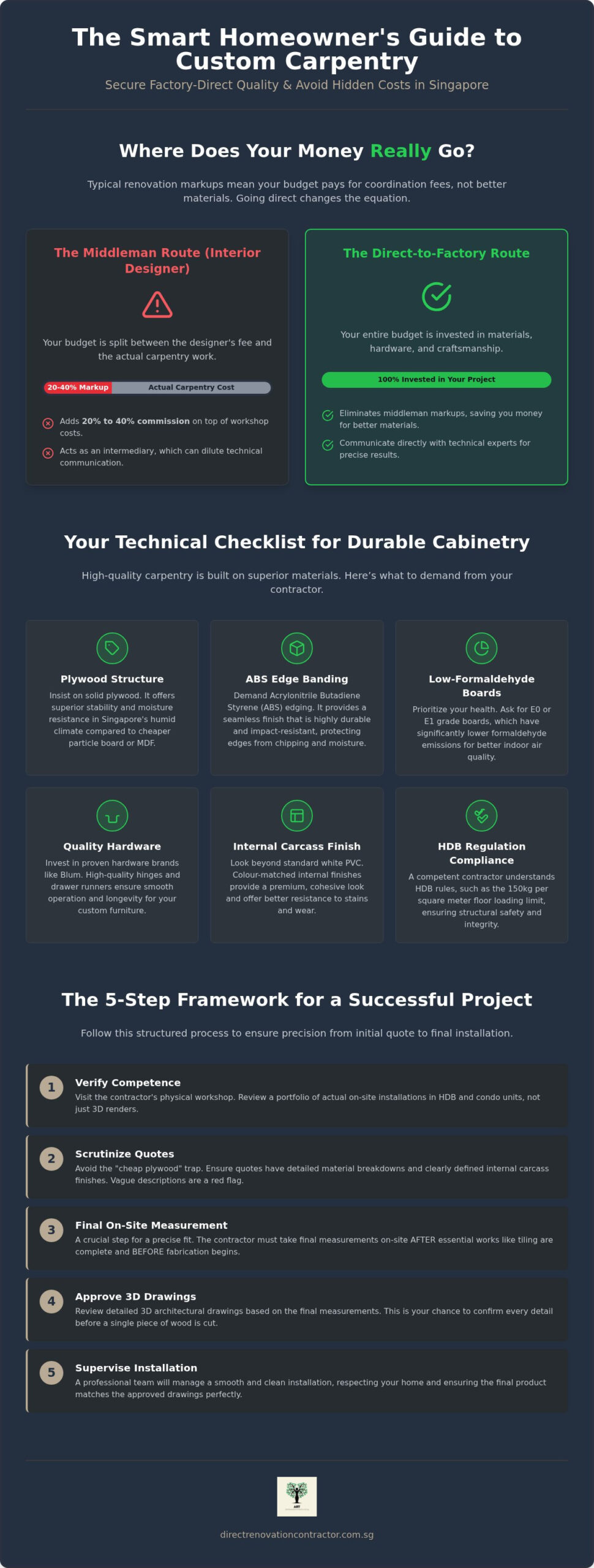
The primary difference between an ID and a direct contractor is where your money goes. IDs typically add a 20% to 40% commission on top of the workshop’s quote. If you’re managing a 4-room HDB renovation where carpentry accounts for a large portion of your budget, that markup is significant. Understanding what is carpentry in the local market involves recognizing that the value lies in the fabrication, not the sales pitch. Direct contractors offer a straightforward financial model. You pay for the labor, the wood, and the hardware. There are no undisclosed fees or hidden commissions. Technical communication is also sharper. You’re talking directly to the person who knows exactly how a casement door will swing or how a suspended TV console is anchored to the wall.
Maximizing Value in 2026 Residential Projects
In compact HDB BTO and condo layouts, every millimeter counts. Custom work isn’t just a luxury; it’s a space-saving necessity. A professional carpentry contractor singapore acts as a technical partner to help you maximize storage in tight corners or awkward niches. By going direct, you can afford higher-spec internal carcasses, such as colour-matched PVC or heavy-duty drawer runners, without exceeding your budget. This pragmatic approach ensures your home is durable and functional, focusing on structural integrity rather than just aesthetics. You’ll get a kitchen or wardrobe built to last, backed by the honesty of a local expert who stands by their workmanship.
The Technical Shortlist: Evaluating Materials, Hardware, and Craftsmanship
Identifying the right materials is the backbone of a durable home. This technical deep dive within The Ultimate Guide to shortlisting a customer carpentry contractor focuses on the structural components that separate high-quality builds from budget shortcuts. Using a professional framework for shortlisting contractors allows you to vet specialists based on their material transparency rather than just their sales pitch. You’re looking for a partner who prioritizes structural integrity over aesthetic fluff.
Material Specifications for Long-Term Durability
Solid plywood remains the gold standard for Singapore’s humid environment. While particle board or MDF might be cheaper, they’re susceptible to moisture absorption and swelling, especially in kitchens and bathrooms. Plywood’s layered construction provides the necessary stability to withstand our tropical weather. Beyond the wood itself, you should ask about formaldehyde levels. Reputable contractors now offer E0 or E1 grade boards, which significantly reduce toxic emissions in your living space. This is a critical factor for indoor air quality that many homeowners overlook.
The finish of your cabinet’s internal carcass also matters. While standard white PVC is cost-effective, colour-matched finishes provide a cohesive look and better resistance to stains. Regardless of the finish, ensure your contractor uses ABS edging for all exposed sides. This 1mm to 2mm thick plastic strip is machine-pressed to seal the wood, preventing the laminate from chipping or peeling over time. It’s these small technical details that determine the lifespan of your custom wardrobe or kitchen cabinets.
The Role of Premium Hardware
Hardware is the engine of your cabinetry. If the hinges fail, the entire cabinet becomes a nuisance. Shortlist contractors who prioritize reputable brands like Blum or Hettich. These manufacturers provide soft-close hinges and heavy-duty drawer runners that are engineered for longevity. Unbranded hardware often loses its tension or begins to sag within 24 months, leading to misaligned doors and frustrating repairs. A direct contractor who values their reputation will be transparent about the hardware brands they include in their quote.
Choosing heavy-duty tracks is particularly vital for kitchen drawers that hold heavy cast-iron pots or stacks of ceramic plates. If you’re planning a specific project, checking a direct carpentry price guide can help you understand how material upgrades impact your bottom line. Always confirm that your contractor includes these premium hardware options as standard rather than hidden add-ons later in the project.
The 5-Step Framework for Shortlisting Carpentry Contractors
Shortlisting a contractor requires a technical vetting process that looks beyond a low price. This section of The Ultimate Guide to shortlisting a customer carpentry contractor provides a repeatable framework to separate local experts from intermediaries. By following these five steps, you’ll ensure your project is handled by a direct specialist who values structural integrity and financial transparency.
- Step 1: Verify the physical workshop. A genuine direct contractor operates out of industrial hubs like Paya Ubi or Sungei Kadut. If they can’t provide a workshop address for a visit, they’re likely outsourcing the work.
- Step 2: Review on-site installations. 3D renders are marketing tools. Ask for photos of actual HDB or condo installations to inspect joint precision and laminate alignment.
- Step 3: Test for technical “Straight-Talk”. During your consult, ask about specific carcass materials or the difference between casement and sliding door tracks. A pro gives clear, technical answers without fluff.
- Step 4: Analyze quote transparency. Look for itemized “per foot run” (pfm) rates. Avoid contractors who hide costs in vague lump sums.
- Step 5: Check HDB Registered status. It’s mandatory for HDB renovations. Verify their listing in the Directory of Renovation Contractors and confirm their warranty terms in writing.
Verifying Factory-Direct Capabilities
The most important question you can ask is “Where is your workshop?” Many firms claim to be direct but are actually renovation contractors who sub-contract everything. A true main contractor with direct factory ties has hands-on control over the fabrication process. When reviewing their portfolio, look for technical details like how they handle evaluating craftsmanship and safety in their workshop environment. High-quality work shows in the neatness of the ABS edging and the absence of visible glue lines at the joints. These markers indicate a workshop that prioritizes technical precision over mass production.
Decoding the Carpentry Quote
Singapore carpentry is typically priced using “per foot run” (pfm). For example, a standard kitchen cabinet might be quoted at S$120 pfm for top or bottom units. A transparent quote should clearly list what this includes. Don’t just look at the wood; check if plumbing reconnection, dismantling of old cabinets, and worktop installation are part of the price. Beware of “lump sum” traps. These often hide the use of inferior materials like particle board instead of solid plywood. A straight-talking contractor provides an itemized breakdown so you know exactly what you’re paying for. You can compare these figures against a carpentry contractor singapore price guide to ensure you’re receiving fair market value. This level of detail is essential for The Ultimate Guide to shortlisting a customer carpentry contractor to help you maintain financial clarity throughout your renovation.
Red Flags to Watch for When Reviewing Carpentry Quotes
Reviewing a carpentry quote requires a critical eye for technical detail to avoid costly mistakes. While previous sections of The Ultimate Guide to shortlisting a customer carpentry contractor focused on proactive vetting steps, identifying what to avoid is equally vital for your project’s success. A quote that seems like a bargain often hides structural shortcuts that compromise your home’s safety and durability. You’re looking for a partner who provides a clear financial model, not one who hides costs behind vague terminology.
- The “Cheap Plywood” Trap: Quotes that are significantly below the market average are a major warning sign. This usually indicates the use of moisture-sensitive particle board or low-grade plywood that will warp in Singapore’s humidity.
- Vague Material Descriptions: If a quote uses terms like “Standard Wood” or “Local Laminate” without specifying high-pressure laminate (HPL) brands or E0/E1 formaldehyde standards, the contractor is likely cutting corners.
- Lack of Technical Sketches: Professional contractors use 3D drawings to bridge the gap between your vision and the workshop’s output. Refusal to provide these documents suggests a lack of technical planning.
- Missing Warranty Terms: A reliable workshop provides a clear, written warranty period covering hardware failure and structural integrity. Absence of this seal of quality is a significant risk.
The Danger of “Cowboy” Contractors
Technical incompetence often reveals itself before the first piece of wood is cut. During a site visit, observe if the contractor uses professional laser measuring tools or relies on a basic tape measure for complex corners. Inaccurate site measurements lead to massive gaps that are later hidden with unsightly filler panels, ruining the seamless look of your custom wardrobe. Verbal promises regarding hardware brands like Blum are another common tactic used by “cowboy” contractors. Without these brands explicitly listed in the itemized quote, you’ll likely find unbranded, inferior substitutes installed in your kitchen cabinets.
Financial Red Flags
Protecting your capital is as important as protecting your home’s structure. You should never pay a deposit higher than 20% to 30% before any work begins. Demanding a high upfront payment is a sign of poor cash flow or a “fly-by-night” operation. Always verify the contractor’s UEN through the Accounting and Corporate Regulatory Authority (ACRA) to ensure they have a registered business address in Singapore. A professional payment schedule must be tied to specific project milestones, such as the delivery of carcasses to the site, rather than arbitrary dates. This ensures you only pay for work that has actually been completed.
If you’re unsure about the technical specifications in a quote you’ve received, it’s safer to consult a transparent Direct Renovation Contractor Singapore who provides itemized pricing and technical clarity from the start.
Finalizing Your Choice: From 3D Drawings to On-Site Installation
The Installation Phase: What to Expect
High-quality custom cabinetry is fabricated in a controlled workshop environment and only assembled on-site to maintain precision and reduce dust in your home. This installation phase typically lasts between 3 to 7 days. During the handover, you should conduct a thorough technical walkthrough rather than just a visual inspection. Check that all doors and drawers align perfectly without rubbing against each other. Test the soft-close functionality of every hinge and runner to ensure smooth operation. Inspect the ABS edging for visible glue residue or peeling at the corners. Finally, ensure all internal carcasses are clean and securely anchored to the walls or floor.
The Direct Renovation Contractor Singapore Advantage
For homeowners managing their own projects, our DIY Renovation Support Package provides the technical clarity needed to bypass ID markups safely. We provide the detailed architectural 3D drawings required for precise factory fabrication and offer access to a curated list of reliable sub-contractors for your home renovation. This model ensures your budget is spent on high-quality materials and skilled labor rather than coordination fees. It’s a pragmatic choice for savvy homeowners who value structural integrity and financial transparency. Start your project with a direct quote that prioritizes technical competence and honest communication today.
Start Your Direct Carpentry Journey with Technical Confidence
Choosing the right partner for your home renovation requires looking past flashy showrooms and focusing on a workshop’s technical output. You’ve learned how to identify high-quality moisture-resistant plywood, verify physical factory locations, and avoid the common traps of vague lump sum quotes. By following The Ultimate Guide to shortlisting a customer carpentry contractor, you can secure a home that balances structural integrity with financial transparency.
Our factory-direct model eliminates the markups typically charged by intermediaries. We prioritize clarity through transparent itemized quoting and provide 3D drawings as part of our DIY support packages to ensure a perfect on-site fit. This pragmatic approach ensures your budget goes directly into the craftsmanship and materials that define your home’s longevity. You don’t have to settle for unbranded hardware or subpar wood when you work directly with the source.
Ready to bypass the middlemen? Get a Direct Carpentry Quote and Save on ID Markups Today. Your savvy renovation journey starts with a straight-talking partner who values functional results and honest communication.
Frequently Asked Questions
How much does custom carpentry typically cost for a 4-room HDB flat in 2026?
Industry data suggests custom carpentry typically accounts for 30% to 50% of a total renovation budget. For a 4-room HDB flat in 2026, where total renovation costs average between S$52,500 and S$66,000, your carpentry spend depends on the volume of built-in storage. This range reflects current material costs and labor rates in the local market. You should set aside a 10% contingency buffer for unforeseen technical adjustments.
Is it better to hire an interior designer or a direct carpentry contractor?
Hiring a direct carpentry contractor is better if you prioritize technical control and want to avoid the 20% to 40% markup charged by interior designers. Designers act as coordinators, but a direct workshop manages the fabrication and installation. This guide, The Ultimate Guide to shortlisting a customer carpentry contractor, highlights that direct engagement ensures your budget pays for material quality rather than undisclosed intermediary commissions.
What is the difference between “per foot run” and “linear metre” in carpentry quotes?
Per foot run (pfm) is the industry standard in Singapore, while linear metre is more common in international contexts. One linear metre is approximately 3.28 feet. Most local workshops in Paya Ubi or Sungei Kadut quote in pfm to provide a more granular breakdown of costs for your kitchen cabinets or wardrobes. Always confirm which unit your contractor is using before signing to avoid calculation errors.
Can I provide my own hardware (like Blum hinges) to the contractor?
You can provide your own hardware, but most contractors advise against it because it complicates the warranty process. If a self-sourced hinge fails, the carpenter won’t cover the labor or transport for the replacement. It’s often more pragmatic to let the contractor supply reputable brands like Blum or Hettich. This ensures the hardware is covered under their standard structural and functional warranty terms.
How long does the entire custom carpentry process take from design to installation?
What should I do if my custom cabinets start sagging after a year?
Sagging is often a result of using inferior particle board or exceeding the weight capacity of the internal shelves. If your cabinets fail within a year, you should immediately contact your contractor to invoke the warranty. Professional workshops provide a clear warranty period for structural integrity. This is why The Ultimate Guide to shortlisting a customer carpentry contractor emphasizes checking for a registered business address and UEN verification.
Do I need HDB permits for custom built-in wardrobes?
You generally don’t need a specific HDB permit for standard built-in wardrobes or kitchen cabinets. However, you must engage a contractor listed in the HDB Directory of Renovation Contractors for any work in your flat. Permits are required if your carpentry involves hacking walls, shifting plumbing points, or altering electrical wiring. Always verify these regulatory requirements with your contractor before work begins on your site.
What is ABS edging and why is it better than standard PVC edging?
ABS edging is a high-grade thermoplastic trim that is significantly more durable than standard PVC edging. It’s 1mm to 2mm thick and provides superior resistance to heat and impact, which is essential in Singapore’s humid kitchens. Unlike thin PVC strips that peel or chip easily, ABS is machine-pressed to create a seamless, long-lasting seal. This technical detail prevents moisture from entering the plywood core and causing rot.