
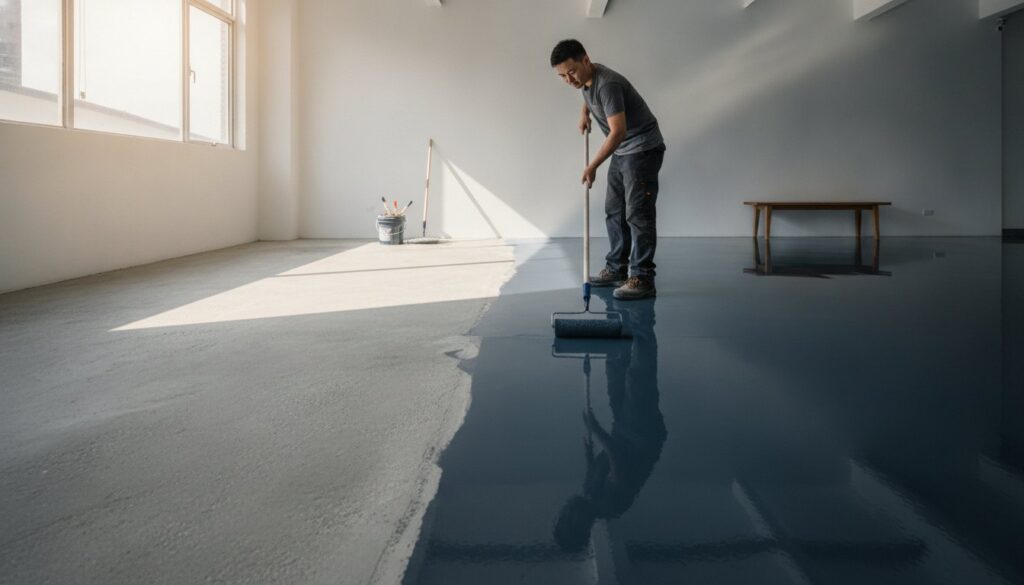
Most Singapore business owners believe that doing it themselves is the fastest way to save money, but the real cost of a failed floor finish often exceeds the price of a professional job. If you are searching for How To DIY Epoxy Painting On Concrete Floor In My Commercial Unit In Singapore?, you have likely realized that constant concrete dusting is ruining your inventory or that interior designer quotes include hidden markups you would rather avoid. It’s frustrating to deal with a workspace that looks unprofessional, and we understand the pressure to minimize downtime while keeping your renovation budget lean.
This guide will help you master the technical steps of DIY epoxy application while clarifying the critical cost-performance trade-offs unique to our local industrial landscape. You’ll learn exactly how to handle surface preparation, ensure compliance with the new 2026 formaldehyde-free regulations, and achieve a durable, oil-resistant finish that meets workplace safety standards. We’re breaking down the process from site assessment to final curing so you can decide if a DIY approach or a direct-to-contractor model is the right move for your unit.
Key Takeaways
- Learn why industrial grinding and proper surface preparation are the most critical phases for achieving a durable, commercial-grade finish.
- Master the technical requirements of How To DIY Epoxy Painting On Concrete Floor In My Commercial Unit In Singapore? while accounting for local humidity and moisture levels.
- Evaluate the “invisible costs” of DIY projects, including equipment rental and waste disposal, compared to the transparent pricing of a direct-to-contractor model.
- Identify common pitfalls like improper mixing and moisture entrapment that often lead to peeling or “ribboning” in local industrial units.
- Understand how to align your flooring choice with BCA safety standards and landlord requirements for a professional reinstatement or handover.
The Reality of DIY Epoxy Painting for Singapore Commercial Units
Understanding the technical requirements of your floor is the first step toward a successful project. Commercial-grade Epoxy resins are not just thick paints; they are two-part systems consisting of a resin and a hardener that create a chemical bond with the concrete substrate. For business owners asking How To DIY Epoxy Painting On Concrete Floor In My Commercial Unit In Singapore?, it is vital to recognize that industrial spaces face stresses residential floors never see. You need a system that offers high-traffic durability, oil resistance, and total dust-proofing to protect your inventory and machinery.
Singapore’s tropical climate adds a layer of complexity to any flooring project. High humidity and ambient heat significantly impact resin curing times and adhesion. If the concrete slab contains trapped moisture, the epoxy will likely bubble or delaminate within weeks. At Direct Renovation Contractor Singapore, we often see DIY attempts fail because these environmental factors were ignored. Our direct-to-owner model focuses on these technical realities, providing professional-grade results without the heavy markups typically added by interior designers who outsource the manual labor.
Industrial vs. Residential Epoxy: What You Need to Know
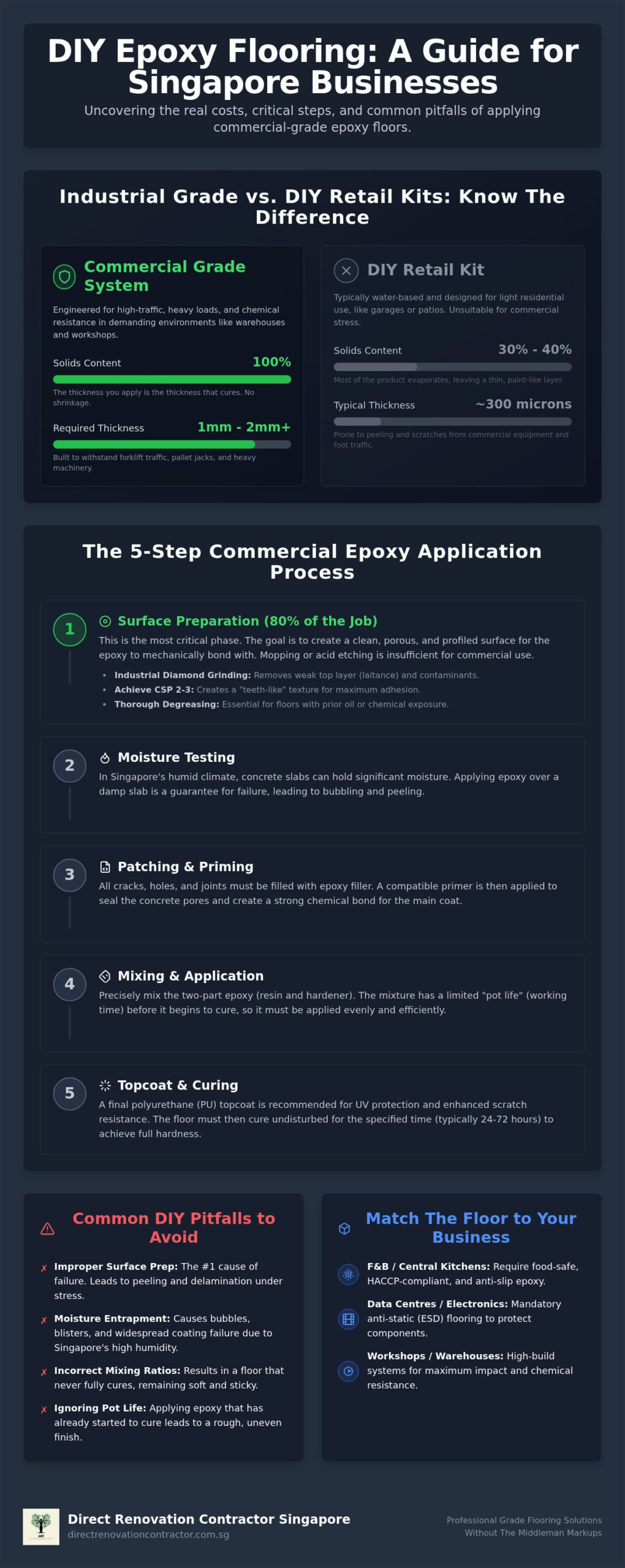
The biggest difference lies in the solids content. Most DIY kits found in hardware stores are water-based with low solids content, often around 30% to 40%. Commercial units require 100% solids epoxy to withstand heavy loads. This ensures the thickness you apply is the thickness that remains after the floor dries. While a retail boutique might only need a coating of 200 to 300 microns, a warehouse or logistics hub requires 1mm to 2mm of thickness to handle forklift traffic. We also recommend a polyurethane topcoat for units with loading bays, as it provides essential UV protection and superior scratch resistance compared to epoxy alone.
Common Use Cases in the Singapore Market
Your specific industry dictates the type of epoxy system you should install. Central kitchens and F&B units must use food-safe, HACCP-compliant epoxy that can withstand frequent washdowns and organic acids. For electronics manufacturing or data centres, anti-static (ESD) flooring is mandatory to protect sensitive components from electrostatic discharge. If you are operating a heavy-duty workshop in Tuas or a similar industrial estate, you need a high-build system designed for impact resistance and chemical spills. Choosing the wrong system for your specific use case is a common mistake that leads to early floor failure and expensive reinstatement costs during your next tenancy handover.
The Step-by-Step DIY Epoxy Application Process
Successful application depends on a strict sequence of events. If you are learning How To DIY Epoxy Painting On Concrete Floor In My Commercial Unit In Singapore?, you must treat the preparation as 80% of the job. Skipping a single step in the cleaning or testing phase will lead to delamination, which is far more expensive to fix than doing it right the first time. The process requires a methodical approach that respects the chemical nature of the materials and the specific environmental conditions of our local industrial units.
- Step 1: Surface Preparation. This involves removing every trace of oil, grease, and old paint using industrial equipment.
- Step 2: Moisture Testing. You must confirm the slab is dry enough to accept a coating.
- Step 3: Patching and Priming. Seal all cracks with epoxy filler and apply a primer to create a chemical bond.
- Step 4: Mixing and Application. Combine the resin and hardener, then apply it within the strict “pot life” window.
- Step 5: Topcoating and Curing. Add a final protective layer with anti-slip additives for safety compliance.
Surface Preparation: Why Mopping Isn’t Enough
Residential kits often suggest acid etching, but in a commercial setting, this is rarely sufficient. You need a mechanical “profile” for the epoxy to grip. We recommend achieving a Concrete Surface Profile (CSP) of 2 or 3. Diamond grinding is the only reliable way to reach this state. It grinds away the top layer of “laitance” (weak, milky concrete) and opens the pores of the slab. If your unit previously housed a workshop, you must use industrial degreasers to pull deep-seated oil out of the concrete before grinding. Without this mechanical teeth-like texture, your new floor will eventually peel off in large sheets under the weight of pallet jacks or trolleys.
The Application Window: Timing and Temperature
In Singapore, heat and humidity are your biggest enemies. High temperatures accelerate the chemical reaction, shortening your “pot life” significantly. We advise applying the resin during the coolest part of the day, typically in the late evening. This timing helps prevent “outgassing,” a phenomenon where air trapped in the concrete pores expands as the building warms up, creating bubbles in your wet finish. Ensure your unit is well-ventilated to manage the strong odors, but keep the area free from dust and insects during the first few hours of curing. Safety is paramount; always use a respirator and gloves to mitigate the health risks associated with exposure to epoxy resin and its vapors. If the logistics of renting industrial grinders and managing chemical windows seem too complex, our team provides professional painting services directly to owners without the usual interior designer markups.
DIY vs. Hiring a Direct Renovation Contractor: Cost Comparison
Many business owners start by asking How To DIY Epoxy Painting On Concrete Floor In My Commercial Unit In Singapore? because they want to minimize their renovation spend. While the initial savings on labor seem attractive, the “invisible costs” of a DIY project often surprise first-timers. You aren’t just buying a few cans of resin; you’re paying for industrial equipment rental, specialized PPE, and disposal fees for the hazardous concrete dust generated during grinding. If the application fails due to moisture entrapment or improper mixing, the cost to strip and re-do the floor is usually double the original professional quote.
A direct contractor provides a middle ground that balances quality with financial transparency. By removing the interior designer’s 20% to 30% markup, you get professional-grade results at factory-direct pricing. This model is built for the savvy business owner who values technical competence over flashy presentations. While a DIY project might consume three or four weekends of your time, a professional team typically completes a standard commercial unit in a 48-hour turnaround, allowing your business to remain operational with minimal downtime.
The DIY Budget Breakdown
Your DIY budget must include more than just the epoxy kit. Commercial-grade resins and primers are specialized products that cost significantly more than standard floor paints. You also need to budget for daily rental fees for diamond floor grinders and industrial vacuums, which are necessary to achieve the required Concrete Surface Profile (CSP). When you total the high-solids resin, specialized rollers, respirators, and machinery hire, the average DIY cost per square foot often nears the price of a professional installation without offering any of the same performance guarantees.
The Direct Contractor Advantage
Direct Renovation Contractor Singapore leverages bulk material sourcing to keep costs low. We pay less for premium Mapei or BASF resins than a retail consumer would, and we pass those savings directly to you. Our model eliminates the middleman, ensuring that every dollar you spend goes into the materials and the manual labor required for a lasting finish. This approach is particularly beneficial for commercial units where structural integrity and cost-effectiveness are the top priorities.
Professional installation also provides essential warranty coverage, which is a major asset during commercial lease handovers or JTC inspections. Landlords often require proof of professional workmanship to satisfy fire safety and workplace health regulations. You can see how these savings compare by reviewing our direct renovation contractor singapore guide, which breaks down the financial model of working without an intermediary. This transparency ensures you know exactly what you’re paying for, from the surface prep to the final topcoat.
Avoiding Common DIY Pitfalls in Singapore’s Climate
Singapore’s high humidity is the primary reason most DIY projects fail within the first six months. If you’re tackling How To DIY Epoxy Painting On Concrete Floor In My Commercial Unit In Singapore?, you must account for the moisture moving through your concrete slab. Moisture entrapment occurs when water vapor rises from the ground and hits the impermeable epoxy layer. This vapor pressure causes the coating to bubble and eventually pop. Another frequent error is improper mixing. If the resin and hardener aren’t blended perfectly, you’ll see “ribboning,” which are sticky, unhardened streaks that never dry. This ruins the finish and requires a total strip-down and restart.
You also can’t ignore the re-coat window. Most industrial epoxies require the second coat to be applied within a specific timeframe, usually between 12 and 24 hours. If you wait too long, the first layer becomes too hard and smooth for the next one to bond chemically. This leads to inter-coat delamination where the top layer simply peels off like a sheet of plastic. We often see this in local units where owners try to spread the work over two separate weekends, effectively killing the chemical bond between layers.
Moisture Vapor Transmission (MVT) Testing
A simple plastic sheet test is your best defense against moisture failure. Tape a 2-foot by 2-foot piece of clear plastic to the floor and seal all edges with duct tape. After 24 hours, check for condensation under the plastic or a dark spot on the concrete. If moisture is present, you must use a specialized moisture barrier primer before the main epoxy coat. Older industrial estates in Singapore often suffer from “rising damp” because the original vapor barriers under the concrete slabs have deteriorated over the decades. Without a proper barrier primer, even the most expensive epoxy will eventually fail.
Managing Air Quality and Dust
Dust is the enemy of a mirror-smooth epoxy finish. Any particles floating in the air will settle into the wet resin, creating a sandpaper-like texture that’s impossible to clean. Using HEPA-filtered vacuums during the diamond grinding phase is mandatory for commercial units to keep the workspace clean. It also protects your lungs from silica dust. Many high-solids epoxies have high VOC levels, so ensure your ventilation plan doesn’t violate building fire safety codes or affect neighboring units. If these technical hurdles and climate risks seem overwhelming, contact Direct Renovation Contractor Singapore for professional commercial office renovation services that guarantee a flawless, compliant finish.
Professional Results for Your Commercial Reinstatement
While the technical challenge of How To DIY Epoxy Painting On Concrete Floor In My Commercial Unit In Singapore? is significant, the administrative stakes are often higher. Landlords, JTC, and HDB maintain strict expectations for unit conditions during both occupancy and handover. A botched DIY floor doesn’t just look poor; it can lead to failed inspections and the forfeiture of your security deposit. Professional epoxy systems are engineered to meet the TR 121 standard introduced in 2024, ensuring low VOC emissions and compliance with the 2026 national ban on formaldehyde in interior coatings. These regulations are critical for maintaining a safe workplace and avoiding legal complications with local authorities.
At Direct Renovation Contractor Singapore, we focus on delivering floors that pass every regulatory hurdle. We understand that commercial units in industrial parks require specific anti-slip ratings to comply with BCA safety standards. Our team manages the entire process from heavy-duty diamond grinding to the final curing phase, using a direct-to-owner model that keeps your costs predictable. We eliminate the layers of project management fees typically charged by design firms, providing you with high-performance flooring that meets the rigorous demands of logistics, manufacturing, or retail operations. We prioritize functional results.
Ensuring Reinstatement Compliance
Most commercial leases include a clause requiring the tenant to return the unit to its original state or a “tenantable” condition. If you’ve applied an unapproved or peeling DIY coating, the landlord may charge you for the full cost of professional removal and resurfacing. Professional documentation of your flooring installation, including material specifications and safety data sheets, is essential for a smooth handover. You can find more details on managing these requirements in our guide to reinstatement work singapore, which covers the essential steps for protecting your deposit.
Customizing Your Commercial Floor
A professional installation allows for functional customizations that are difficult to achieve with basic DIY kits. This includes the precise application of safety yellow lines, bay markings for warehouses, and designated pedestrian walkways that are mandatory in many industrial settings. We also offer flake systems and metallic finishes if you want to integrate your brand colours into the floor’s aesthetic without sacrificing durability. If your project involves more than just the floor, consider contacting a main contractor singapore to manage a full office fit-out. We provide transparent, unmarked-up quotes that prioritize structural integrity and long-term value for your business unit.
Securing a Durable Finish for Your Business Unit
Deciding between a self-managed project and hiring professional help requires a clear understanding of the technical risks involved. You now have a practical framework for How To DIY Epoxy Painting On Concrete Floor In My Commercial Unit In Singapore?, from the necessity of diamond grinding to the dangers of moisture entrapment in our local climate. While the hands-on approach offers a sense of control, the hidden costs of industrial equipment rental and the risk of early floor failure often outweigh the perceived savings. A durable, oil-resistant floor is essential for maintaining workplace safety and ensuring a smooth reinstatement when your lease eventually ends.
Direct Renovation Contractor Singapore specializes in industrial-grade epoxy systems and commercial reinstatement. Our direct-to-owner model removes unnecessary interior designer markups, providing you with technical expertise and factory-direct pricing. We focus on structural integrity and compliance so you can focus on running your business. If you’re ready to upgrade your workspace without the middleman commissions, Get a Direct, Unmarked-Up Quote for Your Commercial Flooring Today. It’s time to build a foundation that supports your operational needs for years to come.
Frequently Asked Questions
Can I apply epoxy over existing floor tiles in my commercial unit?
Yes, but it requires specific preparation. You must grind the tile surface to remove the glaze and create a mechanical profile. Use a high-bond primer designed for non-porous surfaces. Most industrial epoxies won’t bond to smooth ceramic or porcelain without this mechanical tooth. If tiles are loose or cracked, they must be replaced or removed first to prevent the epoxy from cracking over time.
How long do I need to wait before driving a forklift on new epoxy?
You should wait at least 72 hours for light foot traffic and 7 to 10 days for heavy machinery like forklifts. Full chemical cure usually takes a minimum of one week in Singapore’s humid climate. Driving heavy loads too early can cause permanent indentations or cause the coating to delaminate from the concrete. Always check the manufacturer’s technical data sheet for specific curing windows before resuming operations.
What is the difference between epoxy paint and epoxy coating?
Epoxy paint is usually a one-part acrylic product with a small amount of epoxy added for marketing; it’s thin and wears out quickly. An epoxy coating is a two-part resin system consisting of a resin and a hardener that chemically bonds to the floor. For those asking How To DIY Epoxy Painting On Concrete Floor In My Commercial Unit In Singapore?, it’s important to choose a 100% solids coating for industrial durability.
Is a permit required for flooring works in Singapore commercial buildings?
Internal flooring works generally don’t require a BCA permit, but you must check your building’s Management Corporation Strata Title (MCST) or landlord guidelines. Some industrial estates have specific rules regarding noise during diamond grinding or the use of high-VOC materials. Always submit a work application to your building management before starting to ensure compliance with fire safety and waste disposal protocols. This prevents unnecessary fines or work stoppages.
How do I maintain an epoxy floor to ensure it lasts 10+ years?
Regular cleaning with a soft-bristled broom and a pH-neutral cleaner is essential. Avoid using harsh acidic or alkaline chemicals that can dull the finish over time. For high-traffic commercial units, use walk-off mats at entrances to trap abrasive grit. Periodically inspect the floor for deep scratches or chips and repair them immediately. This prevents moisture from getting under the coating and causing larger sections to peel or bubble.
Can epoxy be applied on a damp concrete floor?
No, epoxy should never be applied to a damp floor as it will fail to bond. Moisture prevents the resin from penetrating the concrete pores, leading to bubbles and peeling. If you have a ground-floor unit with rising damp, you must apply a specialized moisture vapor barrier primer first. Always perform a plastic sheet test or use a moisture meter to confirm the slab’s dryness before starting the application process.
What should I do if my DIY epoxy floor starts bubbling?
You must wait for the area to dry, sand down the bubbles until you reach solid concrete, and re-apply the coating. Bubbling is usually caused by outgassing or moisture entrapment. If the issue is widespread, it indicates a systemic failure in surface preparation or environmental control. In such cases, the most cost-effective solution is often mechanical grinding to remove the failed layer before starting over with a professional-grade system.
How much does a professional direct contractor charge for epoxy per square foot?
Fees vary based on the floor’s condition and the specific epoxy system required for your industry. A direct contractor offers a more economical model by removing the middleman markups typically found in design-heavy firms. Factors affecting the quote include the extent of diamond grinding needed, the thickness of the resin layers, and any specialized additives like anti-slip textures or ESD-safe properties required for your commercial unit’s specific operational needs.