
Did you know that approximately 60% of BCA submissions for landed property renovations receive a Plan Reject Letter on the first round? It’s a sobering statistic that highlights the technical complexity of upgrading a home in Singapore. You probably want a modern, structurally sound space, but you’re likely tired of the high markups charged by middleman interior designers who often lack the technical expertise to handle structural permits. It is frustrating to feel like you’re paying more for project management than for the actual masonry and carpentry.
This 2026 guide helps you master your landed property renovation singapore project by cutting out the fluff and focusing on direct contractor efficiency. We promise to show you how to manage URA and BCA requirements while achieving significant cost savings through direct sourcing. We will cover everything from the mandatory CORENET X digital submissions to the critical 50% GFA rule that separates a simple A&A from a full reconstruction. By the end, you’ll have a clear roadmap to a high-quality home without the unnecessary designer fees.
Key Takeaways
- Learn the critical technical difference between A&A and Reconstruction, specifically how the 50% GFA rule impacts your project’s regulatory path.
- Navigate the updated 2026 URA and BCA requirements, including the transition to mandatory CORENET X digital submissions for all structural works.
- Identify how the direct contractor model for your landed property renovation singapore removes hidden interior designer commissions to maximize your budget.
- Master the coordination of essential trade works, from structural masonry and hacking to specialized custom carpentry fabrication.
- Discover a pragmatic approach to project management using 3D architectural drawings and direct labor sourcing for a transparent renovation process.
Understanding Landed Property Renovation: A&A vs. Reconstruction
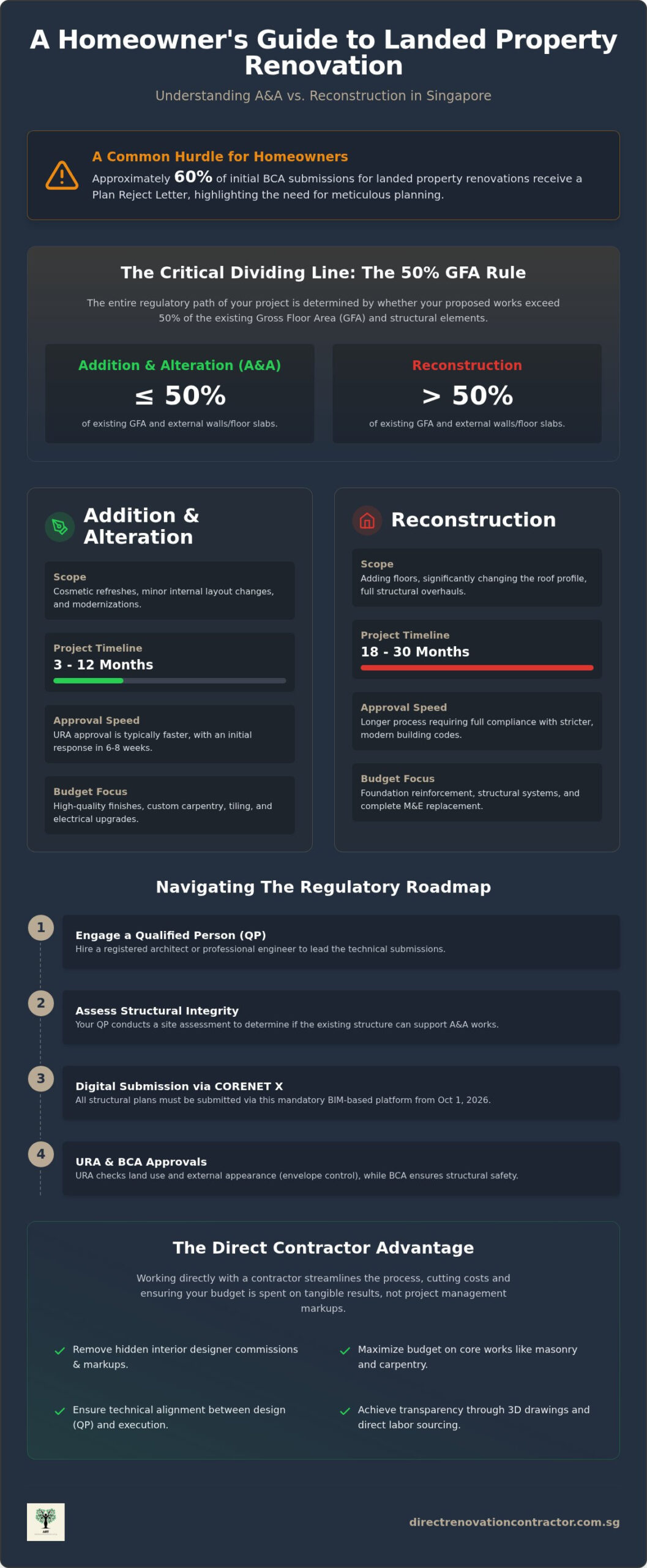
Before you start your landed property renovation singapore journey, you must understand the regulatory threshold that separates a simple upgrade from a major project. The Urban Redevelopment Authority (URA) and Building and Construction Authority (BCA) categorize works into two main buckets: Addition & Alteration (A&A) and Reconstruction. The difference isn’t just terminology; it dictates your entire budget and timeline. If your proposed works don’t exceed 50% of the existing Gross Floor Area (GFA) and you aren’t replacing more than 50% of external walls or floor slabs, it’s A&A. Anything beyond that is Reconstruction. Choosing the wrong category early on often leads to a Plan Reject Letter (PRL), which can stall your project for months.
Assessing your building’s structural integrity is a pragmatic first step. Older terrace houses, which are a staple of the Architecture of Singapore, may have foundation issues that make A&A risky. You should engage a Qualified Person (QP), such as a registered architect or professional engineer, to conduct a site assessment. If the existing columns are weak, trying to save money through A&A might lead to higher costs later when structural failures occur during hacking. A direct contractor can work with your QP to ensure the masonry and hacking works align with the structural limits of the existing house.
When to Opt for A&A Works
A&A works are ideal if you’re looking for a cosmetic refresh or minor internal layout changes. Since you aren’t fundamentally changing the house’s footprint, URA approval is typically faster, often taking 6 to 8 weeks for an initial response. It’s a cost-effective route for terrace or semi-detached owners who want to modernize their landed property renovation singapore project without the heavy price tag of a full structural overhaul. You can focus your budget on high-quality tiling and custom carpentry instead of foundation reinforcement. Most A&A projects can be completed within 3 to 12 months, depending on the complexity of the internal masonry and electrical upgrades.
The Scope of Reconstruction and Rebuilds
Reconstruction becomes mandatory when you’re planning to add additional floors or change the roof profile significantly. Reconstruction refers to works where the increase in GFA exceeds 50% of the original house. This path requires full compliance with current BCA building codes, which are often stricter than those in place when your home was first constructed. While a full rebuild takes 18 to 30 months, it ensures your property’s structural and electrical systems meet modern safety standards. This is the preferred choice for homeowners who want to maximize their land’s potential or completely reconfigure the building’s orientation for better natural light and ventilation. For homeowners seeking a similar level of dedication to quality and bespoke detail, Maverick Design and Construction serves as an excellent example of how boutique luxury custom home builders manage complex, high-end reconstructions.
Navigating Singapore Regulatory Requirements (URA and BCA)
Navigating the regulatory landscape is the most critical phase of any landed property renovation singapore project. You can’t just start hacking walls once you buy the property. The Urban Redevelopment Authority (URA) regulates the external appearance and land use, ensuring your home fits the neighborhood’s zoning. Meanwhile, the Building and Construction Authority (BCA) focuses on structural safety. You’ll need a Qualified Professional (QP), typically an architect or engineer, to act as your liaison. They submit the plans via CORENET X, which becomes the mandatory BIM-based platform starting October 1, 2026. This digital shift means your plans must be highly accurate from day one. Failing to secure these approvals results in heavy fines or demolition orders. Detailed home renovation planning ensures you don’t fall into these legal traps.
Envelope Control Guidelines for Landed Houses
URA uses an envelope control system rather than strict floor-to-floor heights. This defines a three-dimensional limit within which your house must stay. Depending on your location, you’re restricted to a 2-storey or 3-storey height limit. You also need to account for setbacks, which are the mandatory distances from the road and neighboring boundaries. A savvy owner works with their QP to maximize the Gross Floor Area (GFA) by utilizing attic spaces and basements that fit within this envelope. This approach increases your living space without violating land-use laws. It’s a pragmatic way to add value to your property without exceeding the physical footprint of the land.
Structural Permits and Safety Clearances
Before any major work begins, you must obtain a Permit to Carry Out Building Works. Not every minor change requires this; you can check the BCA renovation approval requirements to see what qualifies as exempted work. However, for landed homes, most hacking and demolition works involve structural elements that require technical supervision. In 2026, expect the approval timeline to range between 12 to 20 weeks. This includes 6 to 8 weeks for URA’s first response and another 14 to 28 working days for BCA’s initial plan check. If you are planning a landed property renovation singapore project, understanding the timeline is essential for managing your temporary housing and cash flow. If you’re looking for a partner who understands these technicalities, our team can guide you through a direct contractor approach to keep the process transparent and structurally sound.
Design & Build vs. Direct Renovation Contractor Model
Most homeowners believe a high-end interior design firm is mandatory for a landed property renovation singapore project. This assumption is often expensive. Traditional design firms typically operate on a design-and-build model where they act as intermediaries. While this sounds seamless, it usually involves a 20% to 30% management fee hidden within the line items of your quote. You aren’t just paying for design; you’re paying a markup on every bag of cement and every electrical socket installed by their sub-contractors. By contrast, the direct contractor model focuses on technical execution and financial transparency. You pay for the actual labor and materials without the added layers of middleman commissions.
Choosing a direct renovation contractor singapore gives you a significant advantage in clarity. You deal directly with the people managing the masonry and carpentry fabrication. This eliminates the “telephone game” where design instructions are lost between the ID and the actual tradesmen on-site. For savvy owners who want a high-quality build without the lifestyle branding costs, we offer a DIY Support Package. This provides the technical foundation you need to manage your own project while benefiting from our established trade expertise.
The Savings of Direct Sourcing
Direct sourcing is the most effective way to protect your budget during a landed property renovation singapore. When you work directly with a contractor, you gain direct access to material suppliers for flooring and tiling. You don’t pay a premium for the contractor to “select” materials that are already available at local industrial parks like Paya Ubi. Eliminating the standard 20% to 30% coordination fee allows you to reallocate those funds toward higher-grade finishes or more robust structural works. This is especially impactful for masonry and electrical works, which are the most labor-intensive parts of a landed home upgrade.
Utilizing 3D Drawings and DIY Support
Our DIY Support Package bridges the gap between professional oversight and cost-saving management. We provide 3D architectural drawings that act as the definitive blueprint for your sub-contractors. These 3D drawings allow owners to visualize results while maintaining control over the build. Instead of guessing how a structural change will look, you have a precise visual reference to guide the masonry and carpentry teams. We also provide a curated list of reliable sub-contractors for specialized trades like plumbing and glass installation. This ensures you have a team of vetted professionals working under your direction, backed by our technical drawings.
Key Renovation Works for Landed Properties
A landed property renovation singapore project demands a higher level of technical coordination than typical high-rise units. You aren’t just dealing with internal walls; you’re managing the entire building envelope. This includes heavy-duty hacking, structural wall extensions, and complex multi-storey utility systems. For instance, electrical rewiring in a three-storey semi-detached house requires a strategic distribution board layout to prevent voltage drops and ensure safety across all levels. Similarly, plumbing works must account for water pressure management, often requiring booster pumps for upper-floor bathrooms to maintain consistent flow.
External works are equally critical for maintaining the property’s value and structural health. Your renovation scope should include these essential areas:
- Roofing inspection and tile replacement to prevent long-term water ingress.
- Waterproofing of flat roofs and balconies using high-grade torch-on membranes.
- Driveway tiling with heavy-duty pavers capable of supporting vehicle weight without cracking; for homeowners interested in the quality standards of residential concrete work, learn more.
- External painting with weather-resistant coatings to protect against Singapore’s humidity.
Custom Carpentry and Bespoke Cabinetry
Landed homes often feature high ceilings that standard retail furniture cannot accommodate. This is where specialized carpenter singapore services become essential. We focus on fabricating large-scale wardrobes and kitchen cabinets that maximize vertical space. By using high-quality internal carcasses paired with durable laminates or quartz tops, we ensure your fixtures last for decades. Our direct factory fabrication model means your cabinetry is built to exact site measurements at our workshop, avoiding the gaps and misalignments common with mass-produced options.
Masonry, Tiling, and Structural Integrity
Masonry is the backbone of any landed property renovation singapore. When hacking structural walls, we use heavy-duty temporary supports to maintain the building’s stability throughout the process. Tiling choices must be pragmatic. You need non-slip, durable tiles for external porches and large-format porcelain for internal living areas. Waterproofing is another non-negotiable area. We apply multi-layer waterproofing systems to bathrooms and flat roofs, as leaks in a landed property can cause extensive damage to the structural slabs and electrical conduits below. If you want to ensure your home’s structural integrity is handled by experts, get a direct quote for your landed renovation from our technical team.
Executing Your Landed Renovation with Direct Renovation Contractor
Direct Renovation Contractor Singapore operates as a straightforward partner for homeowners who value technical skill over flashy presentations. We aren’t here to sell you a lifestyle; we’re here to build a structurally sound home. Based in Paya Ubi Industrial Park, our team brings local expertise to every landed property renovation singapore project. We understand the nuances of Singapore’s construction landscape and the specific demands of landed estates. Our identity is rooted in the practicalities of manual labor and material installation, ensuring that your project is handled by those who actually do the work.
Our Process for Landed Projects
Our process is designed for clarity and order, following the actual sequence of a construction project. It begins with an initial site visit where we assess the structural feasibility of your plans and any potential URA constraints. We don’t guess; we measure. This assessment is vital for identifying whether your goals align with the 50% GFA rule discussed earlier in this guide. Following the site assessment, you receive a detailed quotation with transparent breakdowns for every trade. There are no undisclosed fees or “miscellaneous” charges. Every line item for masonry, electrical wiring, and carpentry is clearly priced at direct contractor rates.
Once the project commences, we provide on-site management to ensure every phase of the build maintains technical compliance with BCA standards. We manage our curated list of sub-contractors directly, providing hands-on involvement at every stage. This hands-on approach is supported by our 3D architectural drawings, which serve as the technical blueprint for the entire team. We prioritize functional results, ensuring that the structural integrity of your home is never sacrificed for aesthetic flair. This chronological approach creates a sense of order and predictability, which is comforting when facing a complex makeover.
Why a Direct Model Wins in 2026
In 2026, managing rising material costs is a priority for every homeowner. Our direct model adapts to these market shifts by leveraging direct supply chains, cutting out the middleman markups that often inflate traditional ID quotes. You get the technical authority of a main contractor singapore without the unnecessary ID fluff or intermediary commissions. This model allows for greater financial transparency, as you pay for the actual labor and materials required for your landed property renovation singapore.
By eliminating the 20% to 30% management fees typical of design-heavy firms, you can invest more in premium finishes like custom carpentry fabrication or high-grade tiling. Our local expertise ensures that all works meet the latest regulatory requirements, including the transition to mandatory CORENET X digital submissions. If you’re ready to modernize your home with a transparent, technical partner, contact us for a direct, no-nonsense renovation quote today. We deliver high-quality workmanship at fair prices, helping you achieve a modern home without the unnecessary markups.
Start Your Landed Home Transformation with Technical Clarity
Successful renovation outcomes depend on two things: technical competence and financial transparency. You now have the roadmap to navigate the 50% GFA threshold and the mandatory CORENET X digital submissions required for any landed property renovation singapore project. By choosing a direct contractor model, you eliminate the undisclosed commissions that typically inflate design-heavy quotes. You gain direct access to trade specialists who prioritize the structural integrity of your home over flashy lifestyle branding.
Our team at Paya Ubi focuses on delivering high-quality masonry and custom carpentry without the middleman markup. We provide fixed-price contracts for labor and materials, ensuring you don’t face unexpected costs mid-build. Whether you’re planning a minor A&A or a major structural overhaul, we offer the technical authority needed to execute your vision efficiently. You shouldn’t have to settle for high markups when you can work directly with the experts who manage the site every day.
Get a Direct Landed Renovation Quote from the Experts and take the first step toward a modern, well-built home. It’s time to build with honesty and precision.
Frequently Asked Questions
How long does a landed property renovation typically take in Singapore?
A standard landed property renovation singapore project timeline depends on the work scope. A&A works usually take between 3 to 12 months to complete. If you’re doing a full rebuild, expect a duration of 18 to 30 months from the start of the approval process to the issuance of the Temporary Occupation Permit. These timelines include the 12 to 20 weeks required for URA and BCA to process structural permits before building works can commence.
Do I really need an interior designer for a landed house A&A?
You don’t need an interior designer if you have a clear vision and want to avoid high markups. A direct contractor handles the technical execution of masonry, carpentry, and electrical works directly. For owners who need visual guidance, our DIY Support Package provides 3D architectural drawings. This allows you to manage the project yourself while utilizing a curated list of specialized sub-contractors for trade-specific tasks, saving you the 20% to 30% management fees charged by design firms.
What is the difference between A&A and a full rebuild under URA rules?
The distinction lies in the 50% threshold. An Addition & Alteration (A&A) project must not exceed 50% of the existing Gross Floor Area or involve replacing more than 50% of external walls and floor slabs. If your project exceeds these limits, URA classifies it as reconstruction or a full rebuild. This classification is critical because reconstruction requires full compliance with current building codes, which significantly impacts your overall budget and the complexity of the approval process.
How much can I save by hiring a direct renovation contractor?
Hiring a direct contractor typically saves you the 20% to 30% markup that interior design firms add to labor and material costs. Since we source materials directly and manage our own carpentry and masonry teams, you pay only for the actual work performed. These savings allow you to reallocate your budget toward higher-quality finishes or more extensive structural works without paying intermediary commissions or undisclosed project management fees that often inflate traditional renovation quotes.
What are the most common hidden costs in landed property renovations?
Hidden costs often arise from unforeseen structural repairs, such as reinforcing weak foundations or columns discovered during hacking. Upgrading electrical loads and plumbing systems for multi-storey properties can also add expenses if they aren’t assessed early. Additionally, professional fees for the Qualified Person and the costs for mandatory submissions via CORENET X are sometimes overlooked. A transparent, fixed-price contract helps mitigate these risks by detailing every trade’s scope before the first wall is hacked.
Do I need BCA approval for internal hacking works in my landed home?
Yes, you generally need BCA approval for any hacking that involves structural elements like load-bearing walls, columns, or beams. While minor non-structural works may be exempt, landed properties often have complex structural systems where hacking can impact the building’s stability. You must engage a Professional Engineer to assess the site and submit plans. Carrying out unauthorized structural works can lead to enforcement action and complications when you eventually sell the property.
Can I stay in my landed house while the renovation is ongoing?
Staying in the property is usually not recommended for a major landed property renovation singapore project. Hacking and masonry works create significant dust, noise, and safety hazards. Electrical rewiring and plumbing overhauls often require shutting off essential utilities for extended periods. If your renovation is restricted to a small, isolated wing of the house, it might be possible, but most owners find it more pragmatic to arrange temporary housing to avoid the disruption of a construction site.
What is included in a typical landed property renovation package?
A comprehensive package includes structural masonry such as tiling and hacking, custom carpentry for kitchens and wardrobes, and full electrical and plumbing installations. It also covers external works like roofing, waterproofing, and painting. Our model focuses on providing these services directly. We bundle labor and material supply into a transparent contract, ensuring you have a clear understanding of the renovation timeline and the specific materials used, from vinyl flooring to quartz cabinet tops.