
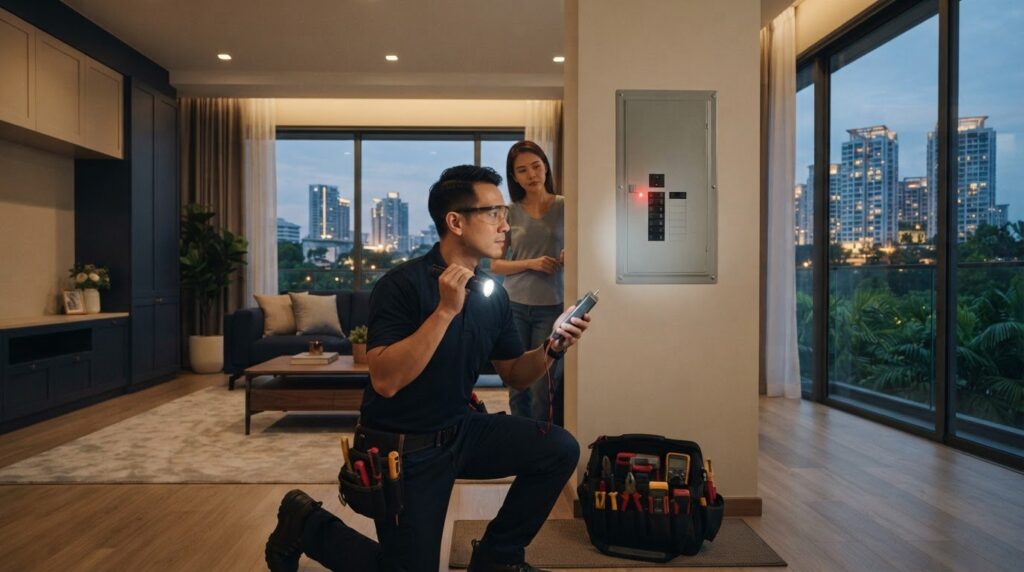
A tripped circuit breaker is a warning, not a reset button to keep pressing. If power suddenly cuts out, you may wonder whether an appliance caused the problem or whether there’s a fault in the wiring. If you’re searching “emergency electrician Singapore, power trip repair,” focus first on safety, not on restoring power.
This guide covers what you can safely observe without opening electrical enclosures or handling wiring, and when to stop troubleshooting. If a breaker trips again immediately, or you notice sparks or a burning smell, don’t reset it again. Electrical installation, repair and maintenance work in Singapore must be carried out by a Licensed Electrical Worker (LEW).
You’ll learn how to respond to a power trip, recognise signs that need qualified attention, and prepare useful information for an assessment. Recurring electrical issues may relate to an appliance, a circuit or the wider installation. If electrical work is part of a planned renovation, including it in the project scope can help coordinate it with other work.
Key Takeaways
- Put people and visible hazards first during a power trip. Stop using affected equipment and isolate power only if it’s safe to do so.
- Overloads, faulty appliances, short circuits and earth-leakage faults can all cause a trip. Don’t assume the breaker itself is the problem.
- Note which rooms are affected, what appliances were in use and any warning signs. Leave wiring and electrical enclosures to a Licensed Electrical Worker.
- Repeated trips, heat, unusual odours, buzzing or visible damage are reasons to stop DIY checks and arrange a qualified assessment.
- If electrical concerns form part of a planned renovation, include wiring and installation in the wider project scope. Direct Renovation Contractor Singapore’s direct-contractor model aims to help reduce intermediary costs, with a stated renovation savings goal of 20-30%.
Emergency Electrician Singapore: Power Trip First Steps
Put people and hazards first. Don’t rush to restore power before you understand what happened. Stop using the affected appliance, keep people away from anything that looks damaged, and observe from a safe distance. If there are no warning signs and the breaker is accessible in a dry, safe area, one cautious reset may be appropriate. Never touch exposed wiring, wet equipment or damaged electrical components.
- Stop using the equipment that was operating when the power went off. Don’t unplug it if the plug, socket or surrounding area is wet, hot, sparking or damaged.
- Look for warning signs without approaching or opening electrical fittings. Note whether the outage affects one room or several, and whether there is smoke, an unusual odour, buzzing or visible damage.
- Isolate power only if you can safely reach the relevant switch or breaker. If there’s any doubt, keep clear and seek qualified help.
Which power-trip warning signs need urgent attention?
A simple loss of power, with no visible damage, smoke, unusual smell or other warning signs, is different from an immediate hazard. Treat smoke, fire, electric shock, exposed conductors, sparks or a burning odour as urgent. Keep away from the affected area and don’t touch equipment or wiring. For fire or serious injury, contact Singapore’s emergency services. Don’t approach a hazard to locate or operate a switch.
A trip alone doesn’t identify the cause. A short circuit is one possible fault, but you can’t confirm it just by looking at a breaker. If the outage affects an entire block or neighbourhood, SP Group’s 24-hour hotline is 1800-778-8888. For a fault within one flat, arrange an assessment by a Licensed Electrical Worker (LEW).
Is it safe to reset a tripped circuit breaker?
Consider a single reset only if there are no warning signs, the area around the distribution board is dry and undamaged, and you can operate the breaker without touching exposed parts. Don’t open the board or handle wiring. If you’re unsure, leave the breaker alone and seek qualified assistance. A reset restores power; it doesn’t prove the underlying fault has been fixed.
If the breaker trips again, stop. Don’t keep resetting it or switch it back on to test appliances. Repeated tripping can signal a fault that needs proper assessment. All electrical installation, repair and maintenance work in Singapore must be carried out by an LEW. If you’re searching “emergency electrician Singapore, power trip repair,” use the warning signs to decide when to stop and seek qualified help. The priority is a safe assessment, not repeated attempts to restore power.
Common Power Trip Causes: Appliances, Circuits, and Electrical Faults
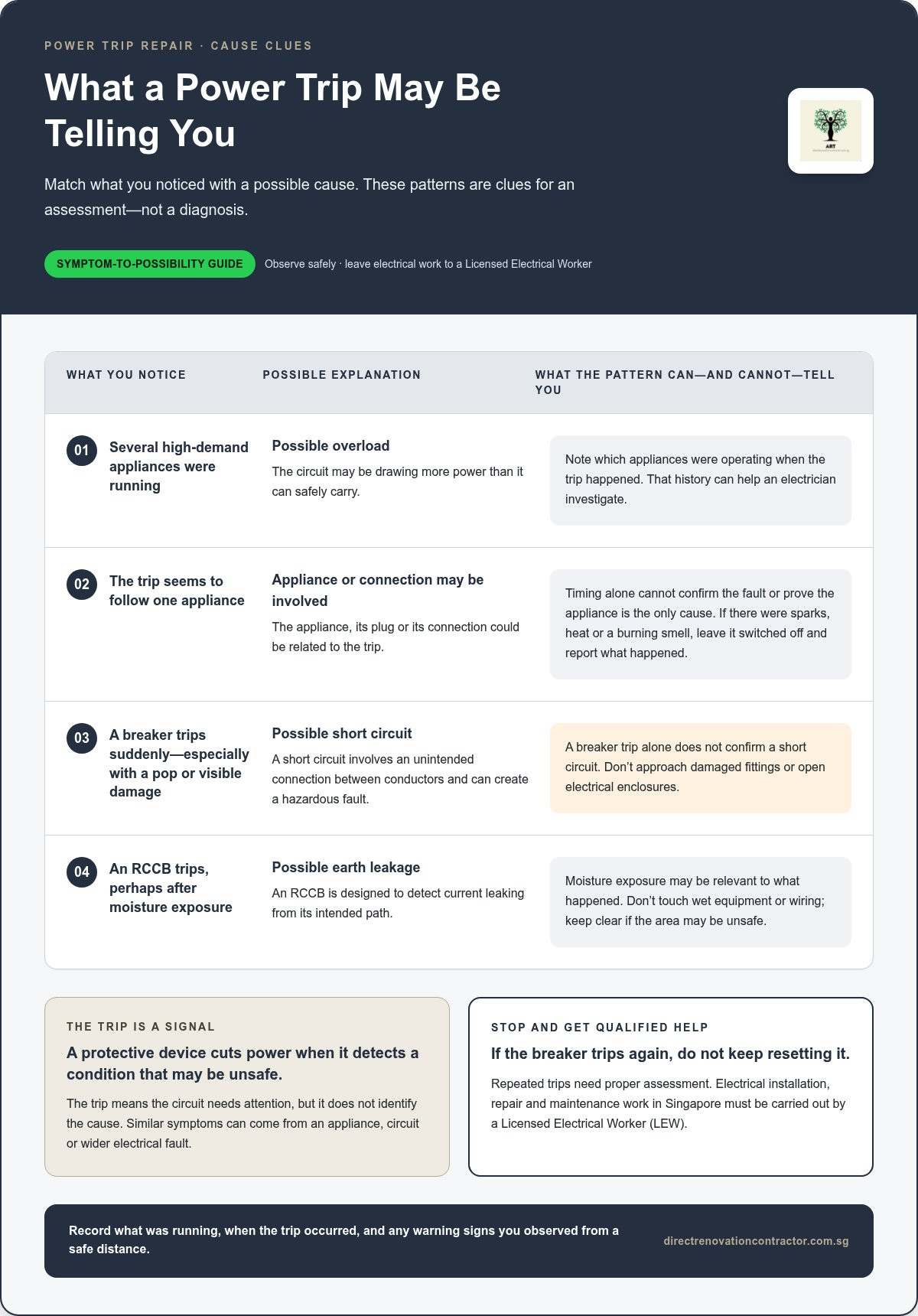
A power trip is a protective interruption: a safety device cuts power when it detects a condition that may be unsafe. The trip tells you that the circuit needs attention, but it doesn’t identify the cause. An overload, a faulty appliance, a short circuit or an earth-leakage fault may be involved. These possibilities can produce similar symptoms, so treat them as clues rather than a remote diagnosis.
Use the pattern you noticed to describe the issue, not to decide what needs replacing. This symptom-to-possibility guide can help you keep useful notes for a qualified assessment:
| What you notice | Possible explanation |
|---|---|
| The trip happens while several high-demand appliances are running | An overloaded circuit may be drawing more power than it can safely carry. |
| The trip seems to follow one appliance | The appliance, its plug or its connection could be involved, but the pattern alone can’t confirm the fault. |
| A breaker trips suddenly, especially alongside a pop or visible damage | A short circuit is one possibility. It involves an unintended connection between conductors and can create a hazardous fault. |
| An RCCB trips, perhaps after moisture exposure | Earth leakage may be involved. The device is designed to respond to current leaking from its intended path. |
How can an appliance trigger a power trip?
Several high-demand appliances operating at once can place a heavy load on the same circuit. If the trip appears linked to one appliance, that timing is useful information for an electrician, not proof that the appliance is the only cause. Don’t plug it in again to test it if you noticed sparks, heat or a burning smell. Leave it switched off and report what happened.
What can repeated trips indicate about wiring or protection?
A distribution board houses protective devices for circuits in the home. A circuit breaker interrupts power when it detects an abnormal condition; an RCCB, or residual current circuit breaker, is designed to detect current leakage. Repeated trips can relate to an appliance, circuit, wiring or protective device. They need qualified assessment, not more resets. Singapore’s Energy Market Authority (EMA) electrical safety guidelines advise engaging a Licensed Electrical Worker (LEW) for electrical work.
A temporary overload may stop once demand falls, but a recurring trip needs assessment. Note what was running and when the trip occurred. That history can help an LEW investigate without guesswork. If you’re searching “emergency electrician Singapore, power trip repair,” focus on having the fault assessed safely rather than trying to identify or repair wiring yourself.
If repeated electrical issues are part of a planned home upgrade, they can be considered alongside planned electrical wiring and installation within a wider renovation scope.
Power Trip Repair: Safe Checks Versus Electrical Work
For safe power trip repair, your role is to observe and report, not to find the fault by opening electrical equipment. Note which rooms lost power, what appliances were running and whether there are visible warning signs. Leave testing, dismantling and repair to a qualified professional. Collect information from a safe distance, but don’t touch components or try to prove a suspected cause.
Resident observations
Record the time the power went off and which rooms or outlets appear affected, without touching them.
Note appliances that were already in use. Don’t switch them back on just to see whether the trip happens again.
Describe what you can see or smell, such as scorch marks, smoke or a burning odour. Don’t approach to inspect closely.
From a safe position, note whether the breaker appeared to trip immediately or after an appliance started, if you observed this naturally.
Work requiring qualified expertise
Opening the distribution board, removing covers or reaching inside electrical enclosures.
Handling conductors, wiring, sockets or damaged electrical components.
Testing circuits, tracing faults or replacing a breaker or other electrical part.
Bypassing, holding in place or otherwise defeating a protective device.
What information should you note before requesting help?
Write down when the trip occurred, which areas lost power and what equipment was operating at the time. If the breaker appeared to trip as an appliance started, record that sequence only if you observed it naturally. Don’t recreate the fault. Describe visible damage, unusual sounds, heat, smoke or odours plainly. Report what you noticed, not what you think caused it.
Why should electrical fault-finding stay with qualified professionals?
Electrical parts can remain hazardous even when some power is off. Opening covers or handling conductors can expose you to electric shock, cause a short circuit or create a fire risk. In Singapore, electrical work must be performed by a Licensed Electrical Worker (LEW); check the current Energy Market Authority requirements for the work involved. A general overview of causes and prevention of short circuits can help explain why damaged wiring and unsafe modifications matter, but it isn’t a substitute for local assessment.
For background on how wiring is arranged in a home, see this home electrical wiring guide. It’s useful context, not a repair checklist. Whether you’re searching for an emergency electrician in Singapore or information about power trip repair, limit your checks to safe observations. Don’t open the distribution board, remove a cover, handle a conductor or bypass protection. Share what you recorded with a qualified professional so they can assess the issue safely.
When a Power Trip Keeps Happening: A Practical Next-Step Plan
A repeat trip is a reason to stop testing and arrange a qualified assessment. Don’t keep resetting the breaker to restore power temporarily. The pattern can help an electrician investigate, but it can’t confirm whether the issue is an appliance, one circuit or the wider installation.
- Stop unsafe use. Leave any appliance associated with the trip switched off. If you see heat damage, sparks, smoke or wet electrical equipment, keep clear and don’t touch it.
- Record the pattern. Note the time, affected rooms, appliances already in use and whether the trip happened as an appliance started or after it had been running. Don’t switch equipment on again to reproduce the event.
- Keep affected equipment off. Don’t move a suspect appliance to another socket as a test. Leave the breaker off if it has tripped again.
- Arrange qualified assessment. Share your observations with a Licensed Electrical Worker (LEW), who can assess the installation safely.
If a breaker trips again, leave it off until the cause has been assessed by a qualified professional. Repeated trips, hot components, unusual odours, buzzing or visible damage mean household checks should end. These signs don’t identify a specific fault, but continuing to experiment can increase the risk of shock, fire or further equipment damage.
What should you do if the breaker trips again?
Leave the breaker off and don’t make repeated attempts to reset it. Keep people away from damaged, hot or buzzing equipment, and avoid wet areas around electrical fittings. If there’s smoke, fire or someone has received an electric shock, follow the Singapore Civil Defence Force’s official emergency instructions. For an outage affecting an entire block or neighbourhood, contact SP Group’s 24-hour hotline at 1800-778-8888.
A trip that seems to follow one appliance gives the LEW a useful detail, but it doesn’t prove that the appliance is the cause. If several rooms or circuits are affected, record that too. Multiple areas going off may point to a different part of the installation than a single appliance-related pattern, but only an assessment can establish what is happening. If you’re looking for an emergency electrician in Singapore, power trip repair should start with safe fault assessment, not further DIY testing.
How can renovation planning address recurring electrical concerns?
Once immediate safety concerns have been handled, a recurring pattern can inform planned electrical wiring and installation as part of a broader renovation scope. For example, notes showing repeated trips in the same area can be shared when discussing how electrical work fits alongside other planned changes. Renovation planning is separate from emergency response and shouldn’t delay urgent action. A Singapore home renovation planning guide can help you organise the wider project. Direct Renovation Contractor Singapore uses a direct-contractor model and states an aim to help clients save 20-30% on renovation projects by eliminating intermediary fees. For planned work, explore renovation planning with a direct contractor.
Planning Electrical Work During a Singapore Home Renovation
A recurring power trip needs qualified assessment before it becomes a renovation discussion. If there’s smoke, heat, buzzing, a burning smell or visible damage, treat the situation as an immediate safety concern and follow the appropriate emergency guidance. Don’t wait for a renovation to address a hazard. Once the immediate issue has been made safe, a repeated pattern may be useful context when planning electrical wiring and installation as part of a wider home upgrade.
This distinction matters. A search for “emergency electrician Singapore, power trip repair” reflects an urgent fault; renovation planning is for coordinating work that forms part of a future project. One should not be used as a substitute for the other.
How does planned electrical work fit into renovation?
Include electrical concerns early in the renovation conversation. Explain which areas have had recurring issues, what you observed and whether the concern is already being assessed. This keeps the work visible in the project scope rather than leaving it as an afterthought. Define the electrical work for the property and coordinate it with the wider renovation plan.
Sequencing and clear communication matter. Discuss the intended scope before work begins, and make sure the parties involved understand how electrical work relates to the rest of the renovation. This supports clearer coordination without assuming that a particular wiring change or repair is automatically required. For an HDB flat, the HDB renovation guide provides relevant planning context; other property types need a plan suited to their renovation scope.
What does a direct-contractor renovation model mean?
A direct-contractor model means homeowners work directly with the renovation contractor coordinating the project, rather than relying on intermediary layers to manage the relationship. This can make the scope and communication more straightforward. Direct Renovation Contractor Singapore states that its model aims to reduce intermediary fees and help clients save 20-30% on renovation projects. That is a stated aim, not a guaranteed saving for every project; the final cost depends on the agreed scope.
For a practical discussion, keep the renovation brief specific: identify the affected areas, share any assessment findings, and explain how the electrical concern fits into the work you’re planning. This gives the project team a clearer starting point without mistaking renovation coordination for emergency response or technical fault diagnosis.
If the immediate safety issue has been addressed and you’re planning a wider home upgrade, explore renovation planning with a direct contractor. The focus is on coordinating planned work and clarifying the project scope.
Plan the Next Step With Confidence
If an electrical concern has been assessed and you’re considering a wider renovation, use what you’ve learned to plan deliberately. Keep notes on the areas affected and any professional findings, then include them in the renovation brief. That gives the project team useful context and helps align planned electrical work with the rest of the scope. An emergency electrician in Singapore addresses an immediate fault, while renovation planning supports future work.
A direct-contractor model gives homeowners a straightforward way to discuss renovation scope and coordination. Direct Renovation Contractor Singapore states that eliminating intermediary fees supports its aim of helping clients save 20-30% on renovation projects. This is an aim, not a guaranteed saving for every home or scope.
Ready to plan the wider work? Explore renovation planning with Direct Renovation Contractor Singapore and take your next step with a clearer brief.
Frequently Asked Questions
What should I do first when the power trips in my home?
First, make sure everyone is clear of anything that looks hot, wet or damaged, then check whether the outage is limited to your home or affects nearby units too. Don’t use candles near wiring or electrical equipment; use a torch if you need light. Make a quick note of what was running before the trip. That can help distinguish a local issue from a wider outage when you seek assistance.
Is it safe to reset a circuit breaker after a power trip?
A single reset may be reasonable only if there are no warning signs and you can reach the breaker safely in a dry area. If power returns, leave any suspected appliance switched off rather than immediately putting it back into use. A breaker that trips again should stay off until an electrician assesses the issue. Never force a switch, remove the distribution-board cover or try to hold a breaker in position.
Why does my circuit breaker keep tripping?
A breaker may trip because of an overloaded circuit, a faulty appliance, a short circuit, earth leakage or another problem with the circuit or protective equipment. The timing and area affected can help an electrician investigate, but they don’t prove the cause. For example, a trip limited to one area is useful information, not confirmation that the fault is in that room. Don’t open the board to investigate.
Can a faulty appliance cause a power trip?
Yes. An appliance with an electrical fault may cause a protective device to trip, and the timing can offer a clue. If the trip happened as a particular appliance started, note that detail and leave the appliance off. Don’t test it in another socket or continue using it if its plug or casing is damaged, unusually hot, sparking or giving off an odour. A qualified assessment is needed to identify the actual fault.
What should I do if I smell burning after a power trip?
Keep away from the suspected source and don’t touch the appliance, socket or wiring. Don’t pour water on electrical equipment or try to restore power. If you see smoke or flames, move everyone to safety and follow Singapore Civil Defence Force emergency instructions. If there’s no visible fire but the burning smell remains, leave the affected equipment off and arrange qualified electrical assessment before using that circuit again.
When should I stop troubleshooting a power trip myself?
Stop as soon as the breaker trips a second time, or if you notice heat, buzzing, a burning smell, sparks, moisture or visible damage. Don’t try to narrow down the cause by repeatedly switching appliances on and off. If you’re searching “emergency electrician Singapore, power trip repair,” use the details you observed to explain the situation, and leave inspection or repair of electrical parts to a Licensed Electrical Worker.
Can renovation work address recurring electrical problems?
It can be considered as part of planned electrical wiring and installation, but renovation shouldn’t be used as a substitute for addressing an active hazard. First arrange qualified assessment and keep a record of the affected areas and findings. If you later plan a broader upgrade, include that information in the renovation scope so electrical work can be coordinated with the rest of the project. The required work should follow professional assessment, not guesswork.