
One wrong swing of a sledgehammer into a load-bearing wall can cost you up to S$5,000 in HDB fines before you even choose your floor tiles. It’s a common fear for Singaporean homeowners who just want to move into their BTO or resale flat without legal drama. You likely feel that the official guidelines are buried under technical jargon that makes it hard to distinguish between simple masonry and restricted structural work. It’s frustrating when you’re caught between wanting a dream home and fearing a ‘stop work’ order because of misunderstood hdb renovation permit requirements.
We’re here to clear the confusion with a no-nonsense guide for 2026. You’ll gain a clear list of what needs a permit, from hacking walls to changing floor finishes, and understand why the typical 21-day approval timeline matters. We’ll also show you how working with a direct contractor removes the middleman and ensures your paperwork is filed correctly the first time. This guide covers the essential rules and technical steps to keep your renovation on track and your budget safe from hidden penalties.
Key Takeaways
- Avoid S$5,000 fines and mandatory reinstatement costs by understanding the strict legal framework governing HDB renovations in 2026.
- Identify which high-impact works, such as floor replacement and wall hacking, fall under mandatory hdb renovation permit requirements.
- Save time and money by knowing which aesthetic upgrades, including custom wardrobes and kitchen cabinets, can be completed without any HDB permits.
- Learn the professional protocol for permit applications, from preparing 3D drawings to engaging a registered contractor as your representative.
- Safeguard your home by utilizing the Directory of Renovation Contractors (DRC) to find reliable, HDB-approved experts who prioritize technical competence.
Why HDB Renovation Permits are Non-Negotiable in 2026
Renovating a flat in Singapore isn’t just about aesthetics; it’s a matter of structural safety and legal compliance. The Housing and Development Board (HDB) enforces strict guidelines because every flat is part of a larger, interconnected high-rise structure. One wrong move during a kitchen hack could jeopardize the safety of your neighbors above and below you. Understanding the latest hdb renovation permit requirements ensures your home remains a safe investment and avoids costly legal entanglements.
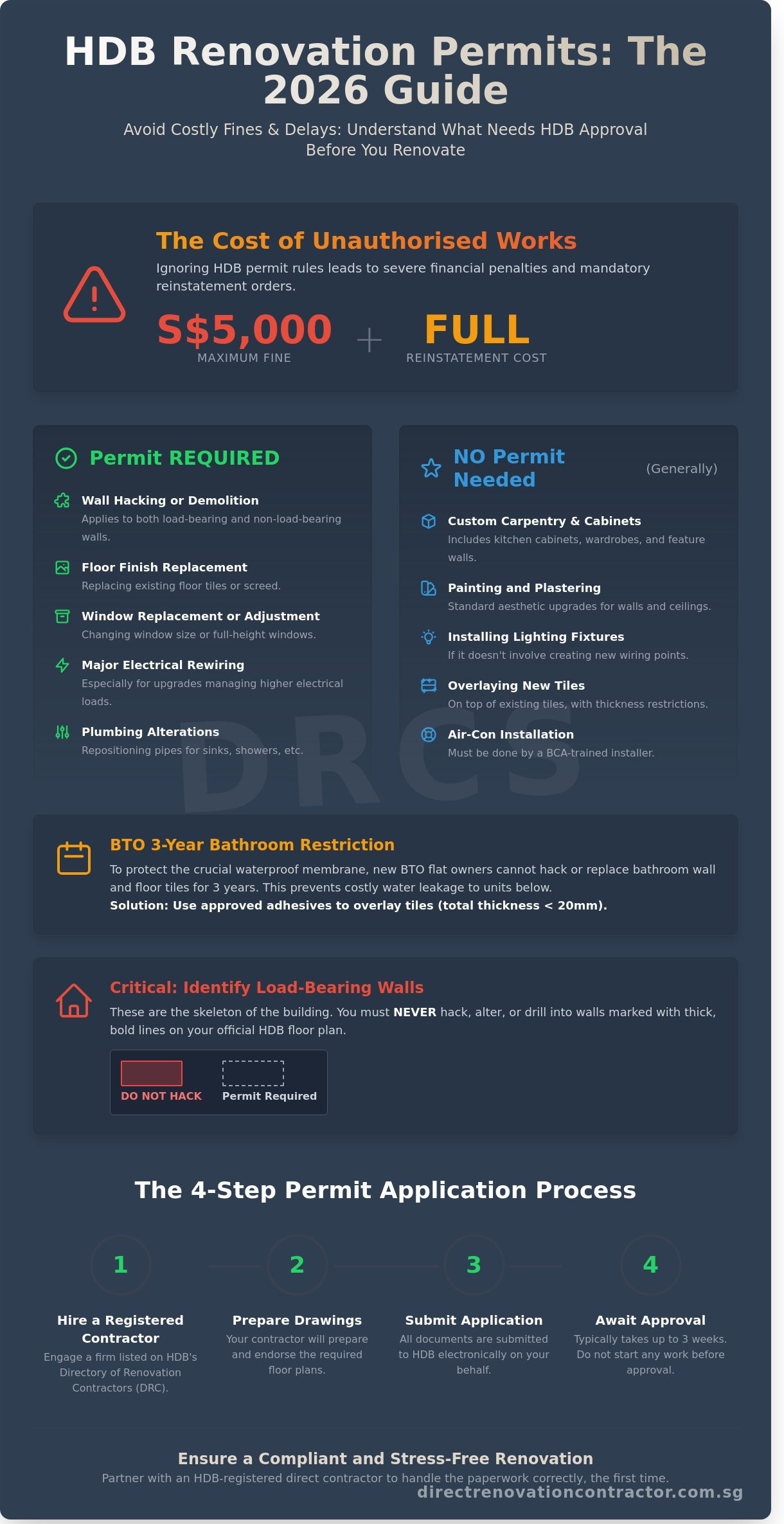
The consequences of performing unauthorized works are severe. Homeowners who bypass the permit process face fines of up to S$5,000. Beyond the fine, HDB will issue a mandatory reinstatement order. This means you’ll have to pay a contractor to tear down your new renovation and restore the flat to its original state at your own expense. We’ve seen cases where homeowners lost over S$15,000 in wasted materials and labor costs because they didn’t wait for a simple permit approval. It’s a financial risk that simply isn’t worth taking.
To keep the industry professional, HDB maintains the Directory of Renovation Contractors (DRC). You must only hire a contractor from this list. These firms have undergone specific training to understand the structural limitations of HDB blocks. As a direct contractor, we handle the technical submission for you. This ecosystem ensures that the person swinging the sledgehammer knows exactly where the hidden water pipes and electrical conduits are located. Hiring an unregistered “cowboy” contractor is the fastest way to get your project shut down by authorities.
In 2026, regulations have tightened specifically around fire safety and electrical load management. Many older flats in estates like Ang Mo Kio or Clementi were built with a 30-amp or 40-amp electrical capacity. Modern homeowners often want to install multiple air-conditioning units and high-wattage induction hobs. Without a permit and a proper load assessment, you risk tripping the entire floor’s power or, worse, causing an electrical fire. The hdb renovation permit requirements now mandate a licensed electrician’s endorsement for these upgrades to prevent grid overloads.
The 3-Year Restriction Rule for BTO Flats
New BTO owners face a mandatory three-year waiting period before they can hack or replace bathroom floor and wall tiles. HDB imposes this rule to protect the water-tight membrane installed during construction. If you puncture this membrane too early, you’ll likely cause water leakage into the unit below. You can still personalize your space by installing overlay tiles using approved adhesives, provided the total thickness doesn’t exceed 20mm. This pragmatic approach allows for design flexibility without risking structural water damage.
Load-Bearing vs. Non-Load Bearing Walls
Identifying which walls you can remove is the most critical part of your floor plan analysis. Load-bearing structures are marked with thick, bold black lines on your official HDB floor plan. These are absolute “No-Go” zones. You cannot hack columns, beams, or pre-cast reinforced concrete (RC) walls as they support the weight of the entire building. Even for non-load bearing walls, which appear as thin lines, you still need a professional assessment. A permit is required to ensure the proposed hacking doesn’t affect the overall stability or the safety of the gas and water pipes hidden within the wall cavity.
A Breakdown of Work Scopes Requiring Mandatory HDB Approval
Understanding hdb renovation permit requirements is the first step to avoiding heavy fines or orders to reinstate your flat to its original condition. HDB classifies specific works as “controlled,” meaning they impact the structural integrity, external facade, or fire safety of the building. You can’t simply start hacking walls because you want an open-concept kitchen. Every major structural change must be documented and approved through the HDB portal before a single hammer swings.
Most structural works require a professional engineer (PE) to certify that the changes won’t compromise the building’s stability. For example, while you can remove non-load-bearing internal partitions, you must never touch reinforced concrete (RC) walls, columns, or beams. These are the skeleton of the block. If you’re unsure which walls are safe to remove, consult the official HDB renovation guidelines to identify load-bearing structures in your floor plan.
Hacking and Masonry: The High-Risk Zone
Hacking is the most common area where homeowners run into permit issues. If you plan to remove a wall to create a larger living space, your contractor must submit a formal request. For BTO flats, there’s a 3-year restriction on hacking floor and wall tiles in bathrooms to protect the waterproofing membrane. If you ignore this, you risk causing leaks in the unit below, which leads to costly legal disputes.
Masonry work also has strict weight limits. HDB restricts the thickness of new floor finishes to a maximum of 50mm, including the screed and tiles. This prevents excessive weight from straining the floor slabs. Since 2015, HDB has mandated the use of pre-packed screed for all dry areas like bedrooms and living rooms. This material is factory-mixed for consistency and reduces dust pollution during the renovation process. If you want a clear breakdown of costs for these works, our team provides direct factory pricing with no hidden fees.
Window Replacement and Safety Barriers
Windows are part of the building’s facade, so you can’t install any design you like. You must engage a BCA-approved window contractor who is also registered with HDB. All replacement windows must follow the original color and proportion of the flat’s design to maintain a uniform look. For high-rise units, safety is the priority. Casement windows must have stainless steel rivets to prevent them from falling off, a regulation strictly enforced since 2004.
Homeowners often ask about invisible grilles or balcony enclosures. While invisible grilles are generally allowed, they must follow specific spacing and material standards. Regarding the “Interaction Balcony” found in newer BTO projects, HDB released updated rules for 2026. These enclosures must use approved louvers or glass panels that allow for 50 percent natural ventilation when closed. This ensures the unit remains breathable and safe in the event of a gas leak.
- Plumbing and Gas: Relocating pipes or installing a new gas water heater requires a permit. Only PUB-licensed plumbers and City Energy-approved installers can perform these tasks.
- Electrical Rewiring: While a permit isn’t always needed for minor socket additions, full rewiring requires a Licensed Electrical Worker (LEW). They must submit an HDB renovation permit application if the work involves hacking walls for concealed wiring.
- Raising Floor Levels: If you’re using mortar to raise a floor (like in a balcony or bathroom), you must stay within the 50mm thickness limit to avoid structural overloading.
Failing to secure the right hdb renovation permit requirements can lead to a fine of up to S$5,000. It also makes it difficult to sell your flat later, as HDB inspectors will flag unauthorized works during the resale valuation. We handle the paperwork for our clients to ensure every hacking and masonry job is fully compliant with the latest 2024 regulations. This direct approach saves you from the stress of administrative errors and ensures your home is both beautiful and legal.
Common Renovation Works That Do Not Require a Permit
Homeowners often feel overwhelmed by the paperwork involved in meeting hdb renovation permit requirements. The good news is that many aesthetic and functional upgrades don’t need official approval from the Housing & Development Board. Understanding these exemptions allows you to move faster with your project and avoid unnecessary delays. According to HDB’s official renovation guidelines, works that don’t affect the structural integrity of the building or change the external facade usually skip the application process altogether. This means we can start work on your unit the moment you collect your keys and provide us with the site measurements.
Internal painting and wallpapering are the simplest ways to change your home’s vibe without a permit. You have total freedom to choose any color or texture for your walls. Similarly, replacing internal doors for bedrooms and toilets is a permit-free task. However, you must remember that the main entrance door is an exception. Because it serves as a critical fire barrier, you can’t replace it without a permit, and the new door must be fire-rated. For internal doors, we simply ensure the new frames don’t damage the surrounding wall structure during the installation process.
The Carpentry Loophole: Maximizing Space Without Permits
Custom carpentry is the most powerful tool for homeowners looking to bypass hdb renovation permit requirements while still achieving a high-end look. Since built-in wardrobes, kitchen cabinets, and feature walls are considered furniture fixtures rather than structural changes, they don’t require HDB’s green light. We specialize in designing these units to fit your specific floor plan. In older resale flats built before 1990, we take extra care with weight distribution. We ensure that heavy floor-to-ceiling cabinets don’t exceed the floor loading limit of 150kg per square meter. If you’re looking for layout ideas, you can explore our custom carpentry options to see how we maximize storage without hacking a single wall.
False Ceilings and L-Boxes
Installing a false ceiling or an L-box is a pragmatic way to hide electrical conduits and air-con trunking without the need for expensive wall hacking. These installations are permit-exempt but must follow specific technical standards. The most critical rule is the height; your finished ceiling must remain at least 2.4 meters above the floor level. This ensures your home maintains adequate ventilation and doesn’t feel cramped. If your HDB unit is equipped with fire sprinklers or smoke detectors, we ensure the false ceiling doesn’t block them. We maintain a 500mm clearance around every sprinkler head to comply with SCDF safety regulations. Using false ceilings also allows us to install recessed LED downlights, giving you a modern lighting setup at a factory price without the need for complex structural permits.
Choosing permit-free works doesn’t mean you’re compromising on quality. As a direct contractor, we focus on the technical precision of these installations. We handle everything from the initial measurement to the final installation in our own workshop. This direct model eliminates middleman markups and ensures that even “simple” works like painting or carpentry are executed with professional-grade durability. By focusing on these exempt areas, you can complete a significant portion of your home makeover in a shorter timeframe, often within 10 to 14 working days.
Once the dust from your renovation has settled, professional cleaning is the final step to making your new space truly liveable. For expert help with carpet and upholstery care, you can find out more about the specialist services offered by Darcy Bespoke Cleaning.
Step-by-Step Guide to Applying for Your HDB Renovation Permit
Getting your paperwork in order is just as critical as the actual masonry or carpentry work. You can’t simply start hacking walls the moment you get your keys. Following the official process ensures your home remains structurally sound and compliant with the Housing & Development Board’s standards. Most homeowners find that understanding the hdb renovation permit requirements early prevents costly delays that can stall a project for weeks. The process is digital and systematic, designed to protect the integrity of the entire block.
- Engage an HDB-registered contractor: You cannot apply for the permit as an individual homeowner. HDB rules state you must hire a firm listed on the Directory of Renovation Contractors (DRC) to act as your representative.
- Prepare technical documents: Your contractor needs a copy of the official floor plan. You’ll also need 3D drawings or sketches that clearly highlight proposed changes, such as wall hacking, plumbing rerouting, or new floor finishes.
- Submit via the e-Portal: The contractor logs into the HDB Renovation e-Portal using their corporate digital identity. Once they’ve uploaded the plans, you’ll receive an SMS notification to log in via Singpass and acknowledge the application.
- The Approval Window: Approval times vary based on the complexity of the work. Simple floor tiling might take only 3 working days, while major structural alterations can take up to 21 working days for a thorough technical review.
- Post the Notice of Renovation: Once the permit is granted, you’ll receive a ‘Notice of Renovation.’ You must print this and display it prominently outside your flat unit for the entire duration of the works.
The Contractor’s Role in the Application
HDB mandates the DRC requirement to ensure that only qualified professionals handle structural modifications. Homeowners aren’t permitted to apply personally because the board requires a technical guarantee that the works won’t compromise the building. You’ll need to provide your contractor with your purchase documents and specific dates for the project. At Direct Renovation Contractor Singapore, we handle the full e-submission for every client. Because we operate as a direct factory-link business, we manage the technical hdb renovation permit requirements ourselves without hiring third-party consultants, which keeps your costs transparent and low.
Timeline and Communication with Neighbours
Singapore law requires you to give your neighbours a 3-day heads-up before any noisy work starts. This isn’t just a courtesy; it’s a regulation. Noisy works like hacking or heavy drilling are strictly restricted to between 9:00 AM and 5:00 PM on weekdays. You cannot perform noisy tasks on weekends, public holidays, or even weekday evenings. If HDB rejects your permit application, it’s usually because the proposed hacking is too close to a load-bearing column. In these cases, we act quickly to appeal by providing revised masonry plans or alternative layout solutions that meet safety codes.
Don’t let permit delays ruin your move-in timeline. Speak with our expert team at Direct Renovation Contractor Singapore to handle your application and renovation with zero middleman markups.
Ensuring Compliance: Why You Must Hire an HDB Registered Contractor
The Directory of Renovation Contractors (DRC) is the only official registry you should trust when planning your home makeover. It acts as a vital safety net for homeowners. HDB maintains this list to ensure that contractors understand the structural integrity of HDB blocks. Every company on this list has completed the mandatory Renovation Contractor Training Course. This training covers essential technical knowledge, such as which walls are load-bearing and where hacking is strictly prohibited. If you hire someone outside this directory, you are breaking the law. Under the Housing and Development (Renovation Control) Rules, homeowners who engage unregistered contractors face a fine of up to S$5,000. Beyond the legal risk, an untrained worker could cause structural damage that compromises the entire building, leading to astronomical repair costs that your insurance will likely refuse to cover.
Choosing a “cheap” handyman from a random social media ad often leads to long-term financial pain. These unregistered individuals cannot apply for the necessary permits. They might suggest doing the work “quietly” to avoid hdb renovation permit requirements, but this is a dangerous gamble. HDB inspectors frequently conduct spot checks in BTO estates and resale blocks. If they find unauthorized hacking or plumbing alterations, they will issue a cessation order. You will be forced to reinstate the flat to its original condition at your own expense. A registered direct contractor provides a clear paper trail, professional accountability, and the technical competence to do the job right the first time.
Verifying a contractor’s status is a simple process that you must perform before signing any contract or handing over a deposit. Follow these steps to protect your investment:
- Visit the HDB website and use the “Search for Renovation Contractor” e-Service.
- Enter the company’s full name or their Unique Entity Number (UEN).
- Check the “License Status” to ensure it is currently active and not suspended.
- Review their “Infringement History” to see if they have accumulated demerit points for past safety violations.
Direct Contractor vs. Interior Designer: The Permit Edition
Many Interior Design (ID) firms operate as project management agencies rather than actual builders. When you hire an ID, they often outsource the technical labor to sub-contractors. This creates a middleman situation where you pay a 15% to 25% markup on labor and materials. In this model, the ID handles the hdb renovation permit requirements by passing the paperwork to their sub-con, adding a service fee for the coordination. A direct contractor model is different. We employ the masons, carpenters, and electricians directly. We handle all technical submissions and permit applications as part of our core labor supply. You get factory-direct pricing on masonry and carpentry without hidden coordination fees or middleman markups.
Final Handover and Compliance Check
Your renovation journey officially ends only after a final compliance check. HDB renovation permits have strict expiry dates; typically 3 months for new BTO flats and 1 month for resale units. Once the work is finished, you must conduct a joint inspection with your contractor. Ensure that every hacking activity, window installation, or plumbing change matches the approved plans exactly. Closing the permit involves notifying HDB of the completion. If you leave a permit open or deviate from the approved drawings, you may face issues when you eventually try to sell the property. Our team ensures all works are documented and compliant, giving you total peace of mind.
To complement this documentation, consider using HomeGuard to maintain a structured inventory of your newly renovated home, helping you catalog your belongings and property value for future insurance needs.
Take Control of Your 2026 Renovation Project
Navigating hdb renovation permit requirements doesn’t have to be a source of stress. You’ve learned that structural hacking and major plumbing works require HDB approval to avoid penalties of up to S$5,000. It’s also clear that hiring an HDB-registered contractor isn’t just a recommendation; it’s a legal necessity for your peace of mind. By working directly with the builders, you eliminate the 20% to 30% middleman markups common with interior design firms. This ensures your budget goes toward quality materials rather than sales commissions.
Direct Renovation Contractor (DRC) offers a straightforward path to your dream home. As an HDB-registered firm, we handle the technical compliance and paperwork so you don’t have to. You benefit from direct factory carpentry prices and a transparent breakdown of every S$ spent on masonry, tiling, or electrical work. We believe in honest labor and clear communication without any hidden fees. Our team focuses on structural integrity and technical precision to deliver a home that lasts.
Get a Transparent Renovation Quote from an HDB Registered Contractor
Your journey toward a beautiful, compliant home starts with a single, honest conversation. We look forward to building your future space together.
Frequently Asked Questions
How long does it take for HDB to approve a renovation permit in 2026?
HDB typically approves renovation permits within 3 to 14 working days from the date of submission. For standard works like flooring or window replacement, you can expect an approval letter in about 3 days. Complex works involving wall hacking or structural changes may require the full 14-day window. We submit all applications via the HDB e-Service portal to ensure your project stays on schedule and avoids unnecessary delays.
Can I hack a wall in my HDB flat without a permit?
No, you cannot hack any wall in your HDB flat without a written permit. HDB requires a professional assessment to ensure the wall isn’t load-bearing. Hacking structural walls can compromise the building’s integrity and is strictly prohibited. We handle the submission of floor plans and technical drawings to HDB to verify which walls are safe for demolition before any hacking starts on your site.
What happens if I renovate my HDB flat without a permit?
Carrying out works without a permit is considered an unauthorized renovation and is a serious offense. You can face a fine of up to S$5,000 under the Housing and Development (Renovation Control) Rules. Additionally, HDB will require you to restore the flat to its original condition at your own expense. This leads to wasted costs and significant delays in your moving-in timeline, so it’s best to follow the rules from the start.
Do I need a permit to change my HDB bathroom floor tiles?
Yes, you must obtain a permit before changing bathroom floor tiles to ensure the waterproofing membrane is correctly replaced. HDB imposes a 3-year warranty period on waterproofing for new BTO flats. If you hack the tiles within this period, you void the warranty. Our masonry team follows HDB’s strict guidelines, including the mandatory 24-hour water ponding test to prevent future leaks into the unit below.
Are there specific quiet hours for HDB renovations?
Quiet hours for HDB renovations are strictly enforced from 9:00 AM to 6:00 PM on weekdays. Noisy works like hacking, drilling, and floor polishing are prohibited on Saturdays, Sundays, and Public Holidays. General renovation work that doesn’t create loud noise can sometimes occur on Saturdays until 6:00 PM, but we recommend sticking to weekday schedules to avoid neighbor complaints and potential stop-work orders from HDB officers.
Can I hire a contractor who is not HDB-registered?
It’s illegal to engage a contractor who isn’t listed in the Directory of Renovation Contractors (DRC). Both the homeowner and the unregistered contractor can be prosecuted for this breach. As a direct contractor, we maintain our HDB registration to ensure all hdb renovation permit requirements are met legally. This protects you from poor workmanship and ensures the contractor is accountable to HDB’s safety standards and technical requirements.
Is a permit required for installing a kitchen cabinet or wardrobe?
You don’t need a permit for standard carpentry work like installing kitchen cabinets, wardrobes, or shoe racks. These are considered non-structural additions that don’t affect the building’s integrity. However, we ensure that your carpentry doesn’t block essential access points or fire safety routes. If your kitchen renovation involves moving gas pipes or electrical points, separate approvals from licensed technicians and SP Group are required before we begin work.
How much does an HDB renovation permit cost?
HDB doesn’t charge a fee for the renovation permit itself, but there’s a non-refundable administrative fee of approximately S$21.80 paid during the online application. While the permit is free, you’ll need to budget for the debris removal and conservancy fees charged by the Town Council, which typically range from S$50 to S$200. We provide transparent pricing for these costs in our initial quotation so there are no hidden charges later.