
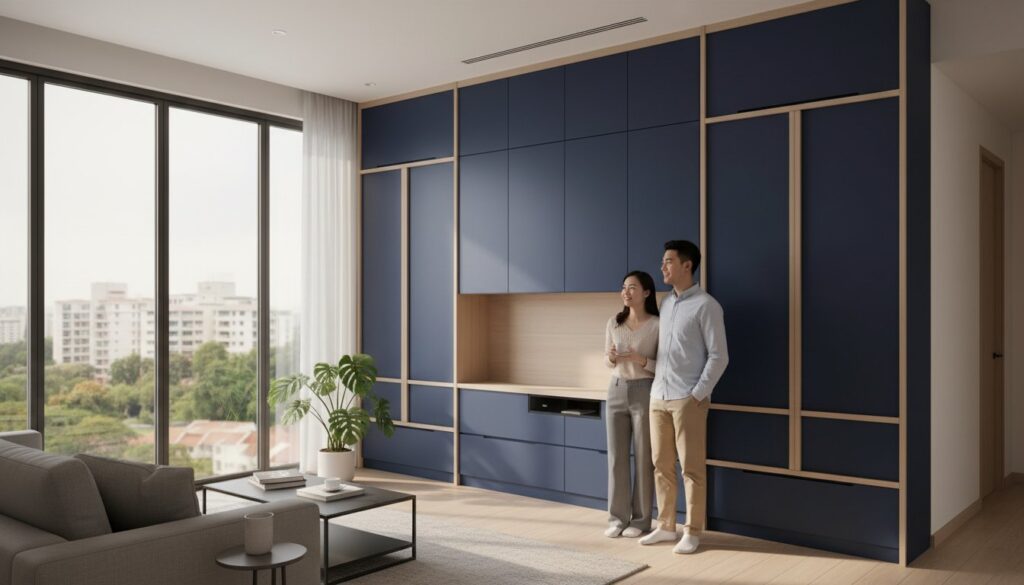
Paying a 30% markup for a middleman to manage your renovation doesn’t guarantee better cabinets; it just guarantees a higher bill. Most homeowners in Singapore feel the sting of opaque quotes where coordination fees hide the actual cost of wood and labor. You want a wardrobe that won’t sag after two years and a kitchen that handles daily heavy use without the hinges coming loose. Finding a reliable carpenter singapore homeowners can trust often feels like a gamble between overpriced design firms and workshops that use confusing technical jargon.
We agree that you shouldn’t have to choose between affordability and craftsmanship. This 2026 guide teaches you how to bypass middleman markups by working directly with a carpentry workshop to secure factory-direct pricing on premium materials. You’ll learn exactly how to spot the difference between durable solid-core plywood and cheap hollow-core alternatives. We’ll break down the linear foot pricing model and provide a clear roadmap to getting custom furniture that remains structurally sound for at least 10 years.
Key Takeaways
- Learn how to save 20% to 30% on your renovation by cutting out middleman markups and working directly with a fabrication workshop.
- Identify the most durable materials for the local climate, including moisture-resistant solid plywood and high-pressure laminates for HDB and condo interiors.
- Master the “per foot run” (pfr) pricing model to accurately calculate your budget and avoid hidden costs in your 2026 renovation.
- Discover how a skilled carpenter singapore can maximize your living space through bespoke built-ins tailored to your home’s specific dimensions.
- Understand the complete fabrication timeline, from initial site measurement to final installation, to ensure your project stays on schedule.
Understanding Custom Carpentry in Singapore Homes
Custom carpentry refers to bespoke furniture built to the exact dimensions of a specific living space. In the context of Singaporean real estate, this involves fabricating units that fit perfectly within HDB flats, condominiums, or landed properties. Unlike mass-produced items, these fixtures are constructed from scratch to address the unique layout of a room. The skilled trade of carpentry has shifted from basic timber framing to high-end cabinetry that focuses on maximizing utility in tight urban environments.
Choosing a carpenter singapore residents can work with directly is often the most cost-effective way to manage a renovation. While a general renovation contractor oversees the entire project, including hacking, masonry, and electrical work, the carpenter focuses specifically on the wood-based fixtures. Hiring a direct carpenter allows you to avoid middleman markups often found in interior design packages. This direct relationship ensures technical accuracy, especially for essential scopes like kitchen cabinets, floor-to-ceiling wardrobes, TV consoles, and shoe racks that must withstand the local humidity.
Custom built-ins are a necessity rather than a luxury in Singapore. Most BTO flats and modern condos feature structural beams or odd-angled corners that standard furniture cannot accommodate. By utilizing custom work, you eliminate “dead space” and create a seamless look that makes a small room feel larger and more organized.
The Evolution of Carpentry in 2026
By 2026, the industry has moved toward sustainable practices. Most homeowners now demand low-VOC (Volatile Organic Compound) laminates and adhesives to ensure better indoor air quality. We also see a massive surge in smart home integration. Modern cabinetry now includes built-in wireless charging pads, motorized wardrobe tracks, and integrated LED sensor lighting. Off-the-shelf furniture fails to meet these specific storage needs because it lacks the structural integrity to support heavy appliances or the precision to hide complex wiring systems.
Built-ins vs. Loose Furniture
Permanent fixtures offer distinct advantages for HDB and condo dwellers. While loose furniture is portable, built-in carpentry increases the resale value of a property by providing “move-in ready” storage solutions. Custom work is non-negotiable in specific scenarios, such as when you need to wrap a cabinet around a prominent structural pillar or create a bay window seat.
- Pros of Built-ins: Maximizes vertical space, hides unsightly pipes, and creates a cohesive aesthetic.
- Cons of Built-ins: Higher initial cost and cannot be moved if you relocate.
- Value Add: High-quality carpentry using solid plywood and high-pressure laminates ensures the fixtures last for 10 to 15 years, outperforming cheaper particle-board alternatives found in retail stores.
Direct Carpenter vs. Interior Designer: Which is Right for You?
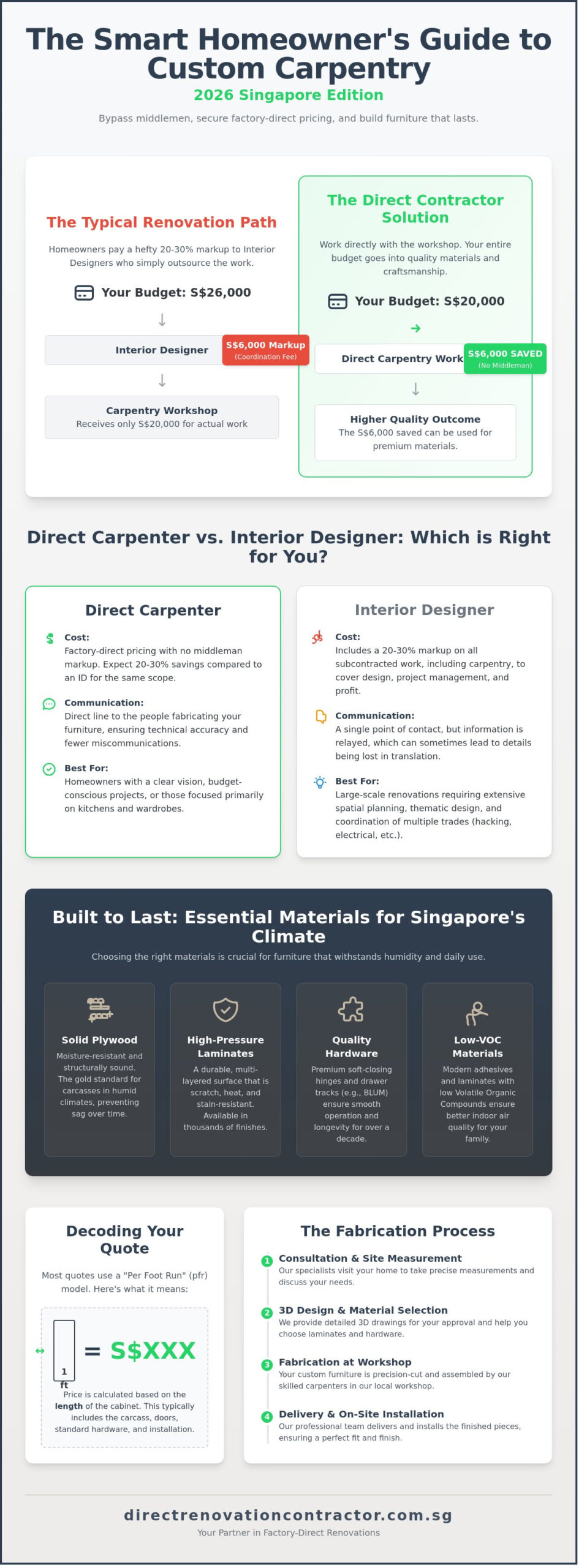
Choosing between an Interior Designer (ID) and a direct carpenter singapore often comes down to how much you’re willing to pay for project management. Most ID firms in Singapore don’t own their own workshops. Instead, they act as intermediaries who subcontract the fabrication to external workshops. This creates a “Middleman Markup,” where the ID adds 20% to 30% on top of the actual carpentry costs to cover their design fees and profit margins. For a S$20,000 carpentry package, you could be paying S$6,000 just for the coordination service.
Direct contractors offer factory prices because they own the fabrication facility. You’re dealing with the people actually cutting the wood and applying the laminates. This model is ideal if you have a clear vision of what you want or if you’re working with a strict budget. If you need complex spatial planning or a high-concept aesthetic that requires a single “creative director” for the whole house, an ID might be worth the premium. However, for most BDB or BTO kitchen and wardrobe projects, going direct is the most pragmatic financial choice.
The Cost Structure of a Direct Contractor
The “no-markup” pricing model is straightforward. You pay for the materials, the labor, and a transparent fee for installation. Because there’s no middleman taking a cut, direct contractors are often more flexible with material upgrades. You might find that your budget allows for premium internal carcasses or high-end BLUM hardware that would have been too expensive through a design firm. You can find a full breakdown of these savings in our Direct Renovation Contractor Singapore comparison guide.
Managing the Project Yourself
There’s a common misconception that you need an ID to see what your home will look like. Most modern contractors provide 3D drawings and technical blueprints as part of their service. These drawings focus on practicalities, ensuring your cabinets don’t block power points or air-con trunking. While you’ll need to spend a little more time coordinating between the carpenter and other trades like electricians, the trade-off is a significantly lower bill and better technical execution.
Technical competence often trumps design flair when it comes to long-term durability. We align our fabrication processes with BCA’s construction quality standards to ensure that every joint and finish is built to last. A well-built cabinet from a seasoned builder will always outlast a “pretty” one built with inferior methods. If you have your floor plan ready, you can get a direct carpentry quote to see the price difference for yourself.
Essential Materials: Plywood, Laminates, and Hardware Explained
Choosing the right materials is the most critical decision you’ll make when hiring a carpenter singapore. While aesthetics matter, the structural integrity of your built-ins depends entirely on what sits underneath the surface. In our local climate, using the wrong substrate leads to sagging shelves and mold growth within 24 months of installation.
Why Material Choice Matters in Singapore Humidity
Singapore’s average humidity level often exceeds 80 percent, making chipboard and Medium Density Fibreboard (MDF) poor choices for permanent fixtures. These materials are essentially compressed sawdust and glue; they soak up moisture like a sponge, causing cabinets to swell and hinges to pop out. We recommend solid plywood for all custom carpentry, especially in HDB toilets where water contact is frequent. Plywood’s cross-grain layers prevent warping and provide a much stronger grip for screws, which also helps deter termite infestations. High-pressure laminate stands as the most cost-effective protective layer for 2026 homes.
For the internal carcass, you’ll need to decide between standard PVC and color-matched interiors. White PVC remains the pragmatic choice because it’s easy to clean and makes it simpler to find items in dark corners. However, for a high-end feel, many homeowners now select woodgrain or grey PVC to match the external laminate. This removes the “cheap” contrast when you open your wardrobe or kitchen drawers.
Hardware: The Difference Between Smooth and Squeaky
Hardware is the engine of your furniture. Skimping on hinges for heavy floor-to-ceiling wardrobe doors is a mistake that leads to misaligned panels and annoying squeaks within the first year. We prioritize brands like Blum or Hettich because their soft-close mechanisms are tested for 200,000 opening cycles. If you’re building a wardrobe and worry about trapped moisture or musty smells, consider a pole system wardrobe. These offer superior ventilation compared to traditional built-ins and are easier to reconfigure as your lifestyle evolves.
When planning your layout, remember that heavy-duty drawer runners are non-negotiable for pot drawers and pantry units. For more technical details on choosing the right runners and lift systems for your cooking space, check our guide on Kitchen Cabinets Singapore. Investing in quality hardware ensures your investment remains functional long after the renovation ends. Here are the three main laminate types to consider for 2026:
- Standard Laminate: Best for vertical surfaces with low impact.
- High-Pressure Laminate (HPL): Superior durability for high-traffic areas.
- Anti-Fingerprint Matte: A premium 2026 trend that uses electron-beam curing to resist oily smudges.
A reliable carpenter singapore won’t just sell you the prettiest finish; they’ll insist on the right foundation to handle the daily wear and tear of a local household.
Estimating Your Carpentry Budget and Timeline for 2026
Budgeting for a home renovation shouldn’t feel like guesswork. Most carpenter singapore professionals use the “pfr” or per foot run model to calculate costs. This linear measurement focuses on the length of the cabinetry along the wall rather than the depth. When you review a quote, check if it includes essential hardware like soft-close hinges or if those are “add-ons” that inflate the final bill. You’ll also need to account for the 9% GST, haulage fees for moving materials up to your unit, and dismantle fees if you’re replacing old cabinets. These hidden costs can add S$500 to S$2,000 to a mid-sized project if they aren’t disclosed upfront.
Lead times in 2026 generally span four to six weeks. This period includes the initial site measurement, off-site fabrication at the local workshop, and the final two-day installation. Dealing with a direct contractor often trims this timeline. There’s no middleman relaying messages between a designer and the workshop, which reduces the risk of communication errors that cause delays.
Calculating Linear Foot Pricing
To estimate your wardrobe cost, measure the length of your wall in feet. A standard 8-foot wall requires an 8-foot wardrobe. Height significantly changes the math. A full-height wardrobe reaching a standard 2.6-meter HDB ceiling costs more than a half-height shoe cabinet because of the additional carcass material and door panels. For 2026, market rates for standard HDB kitchen cabinets often sit between S$120 and S$180 per foot run for base units. This depends on your choice of laminate and internal carcass material, such as solid plywood versus chipboard. The same per foot run model applies when budgeting for a custom tv console singapore homeowners are increasingly choosing over off-the-shelf units that leave awkward gaps and tangled cable messes.
The Installation Process: What to Expect
Everything starts with the site measurement. We use laser levels to account for uneven floors or slanted walls common in older HDB flats. Precision here prevents gaps between your cabinet and the ceiling. On installation day, expect significant noise and fine sawdust. A professional team always lays down corrugated cardboard or floor protection before starting. Once the units are up, check every door. Hinges should be silent, and drawer runners must glide without resistance. If a door looks crooked, it’s usually a simple hinge adjustment away from being perfect.
Working with Direct Renovation Contractor for Bespoke Carpentry
Choosing a carpenter singapore homeowners can trust often involves looking past flashy showroom displays to find technical expertise. At Direct Renovation Contractor, we operate a direct-to-factory model that removes the standard 20% to 35% markups typically applied by interior design firms. You pay for the actual materials and skilled labor, not for a middleman’s project management fee or office overhead. This transparency applies to both residential BTO projects and complex commercial fit-outs.
Our workshop is centrally located in Paya Ubi. This local presence is a significant advantage for our clients. It allows for strict oversight and immediate quality control that offshore factories cannot match. You’re welcome to see the progress of your cabinets or wardrobes, ensuring the wood grade and laminate quality meet the exact specifications promised in your contract. We don’t hide behind stock photos; we show you the raw materials and the craftsmanship in person.
For those who prefer a hands-on approach, our DIY support package is designed to help you manage your own carpentry project. We provide the technical builds and professional advice, while you handle the coordination. This service is ideal for savvy homeowners who want bespoke results without paying for a full-scale renovation manager.
Our Direct Carpentry Process
We’ve streamlined our workflow to ensure clarity from the first measurement to the final installation. Our process includes:
- Consultation and 3D Support: We provide 3D drawing support to help you visualize your storage solutions and ensure the dimensions fit your floor plan perfectly.
- Material Selection: You get direct access to our curated list of high-quality laminate and stone suppliers, including brands known for durability and heat resistance.
- Site Coordination: Our team handles the precise measurements on-site to account for uneven walls or floor levels.
If you’re ready to secure factory-direct pricing for your home, you can book a site visit through our Direct Carpentry Singapore portal.
Why Trust a Direct Contractor?
Working with a carpenter singapore expert means prioritizing structural integrity over abstract design trends. We focus on the load-bearing capacity of shelves and the longevity of soft-close hinges. You’ll have direct communication with the people actually building your furniture, which eliminates the “lost in translation” errors common when working through a salesperson. Every piece we fabricate adheres strictly to HDB renovation guidelines and commercial reinstatement standards. We build furniture that stays functional for decades, not just until the end of a warranty period.
Build Your Custom Home Without the Middleman Markups
Navigating the renovation market in 2026 requires a practical approach to your budget and material choices. You now understand that hiring a carpenter singapore directly can save you significant costs by removing the standard 20% to 30% coordination fees often charged by third-party firms. Quality carpentry relies on the technical selection of solid plywood and durable laminates, ensuring your cabinets and wardrobes withstand the local humidity. We manage the entire fabrication process from our workshop at Paya Ubi Industrial Park, providing direct oversight for HDB, condo, and commercial projects across the island. This localized control means you receive factory pricing with zero hidden charges. Our team focuses on functional, high-quality builds that prioritize your specific storage needs over abstract design concepts. You deserve a straightforward renovation process where technical skill and financial transparency come first. It’s time to stop paying for unnecessary markups and start investing in workmanship that lasts. Let’s get your project moving with the right expertise and fair pricing.
Get a direct factory-price carpentry quote today and secure your 2026 renovation timeline with a team that values honest workmanship.
Frequently Asked Questions
What is the average cost of custom carpentry for a 4-room BTO in 2026?
In 2026, custom carpentry for a standard 4-room BTO typically ranges from S$18,000 to S$32,000 for a full suite including kitchen cabinets, wardrobes, and TV consoles. These figures account for the 9% GST and recent 5% increases in raw material costs like timber and laminates. Your final price depends on the total running feet of the built-ins and the complexity of the internal configurations you choose.
Is it cheaper to hire a carpenter directly or an interior designer?
Hiring a direct carpenter is usually 20% to 30% cheaper than engaging an interior designer because you eliminate middleman commissions and design fees. Designers often add a markup to carpentry quotes to cover their project management time and 3D rendering services. By working directly with a carpenter singapore factory, you pay for the actual materials and labor without these additional overhead costs.
How long does custom carpentry installation take for an HDB kitchen?
Installation for a standard HDB kitchen takes between 3 to 5 working days once the site is ready for assembly. This follows a 2 to 3 week fabrication period at the workshop where your cabinets are pre-cut and edged. On-site work includes mounting the carcasses, installing the worktops, and aligning the doors to ensure every hinge and drawer runner operates smoothly.
What is the difference between solid plywood and chipboard for cabinets?
Solid plywood is the standard for quality Singaporean carpentry because it resists moisture and holds screws far better than chipboard. Chipboard, often found in flat-pack furniture, tends to swell and sag when exposed to our 80% average humidity. We use 18mm solid plywood for all cabinet structures to ensure your built-ins last for 10 years or more without structural failure or warping.
Do I need HDB permits for custom built-in wardrobes?
You don’t need a specific HDB renovation permit for custom built-in wardrobes as they’re considered non-structural timber works. However, you must ensure the installation doesn’t involve hacking existing walls or relocating electrical points without a permit. Your contractor must also stick to HDB’s 9:00 AM to 6:00 PM renovation timing rules to avoid noise complaints and potential fines from the authorities.
Can a direct carpenter provide 3D drawings for my renovation?
Most direct contractors provide technical shop drawings that focus on measurements and internal layouts rather than photorealistic 3D visualizations. While some modern workshops now offer basic 3D sketches for a small fee, the primary focus is on functional blueprints. If you need high-end renders, it’s best to have your own designs ready before approaching a carpenter singapore for the actual fabrication work.
What warranty should I expect for custom carpentry in Singapore?
You should expect a 12-month warranty on workmanship and a lifetime warranty on internal hardware like BLUM hinges or drawer runners. This 1-year period covers common issues like door misalignment or laminate peeling that usually appear within the first few months of use. Reliable builders provide a written contract that clearly states these terms to protect your investment against manufacturing defects.
How do I maintain my custom cabinets to prevent mould in Singapore weather?
To prevent mould, keep a 2cm gap behind your cabinets for airflow and place moisture absorbers like Thirsty Hippo inside closed compartments. Singapore’s high humidity makes wood susceptible to fungal growth, so you’ll need to wipe down surfaces with a dry cloth at least once a week. Never use soaking wet mops near the base of your cabinets as standing water can seep into the kickplates and cause rot.