

What if the first step in dealing with an electrical fault is to describe what is happening, rather than guess at a repair? A flickering light, a failed power point or a planned installation can disrupt daily routines. Searching “ad hoc electrician Singapore” or “electrician services Singapore” may still leave you unsure what details to provide.
That uncertainty is understandable. Electrical work can involve wiring, access and coordination with other trades. A clear description helps define the job without attempting unsafe repairs or relying on a vague service label.
This guide explains how to describe symptoms, recognise warning signs that call for prompt attention, and prepare details that make quotations easier to compare. It also covers planning electrical wiring and installation alongside renovation work in HDB flats, condominiums, landed homes and commercial spaces. When electrical work is part of a larger project, coordinating the scope with related trades can help keep decisions and pricing clear.
Key Takeaways
- For an ad hoc electrician Singapore search or electrician services Singapore query, describe the fault or installation you need. The label alone doesn’t define urgency or scope.
- Help assess the work by noting the affected location, symptoms, desired outcome and any access constraints.
- Compare quotations by checking the task, included work, materials, exclusions and follow-up responsibilities, not just the headline figure.
- For renovation work, settle the layout and electrical requirements before coordinating trades. Changes to wiring, lighting or power points can affect finishes.
- Direct Renovation Contractor Singapore includes electrical wiring and installation in renovation projects, coordinating the scope with related work and focusing on transparent pricing.
Ad hoc electrician Singapore: identify the electrical problem before choosing a service
A one-off electrical issue can be disruptive, but “ad hoc” doesn’t indicate whether it’s dangerous, complicated or limited to one component. Before deciding what work may be needed, note what happened, where it happened and whether the problem is continuing. This gives you a clearer starting point for discussing electrician services Singapore without attempting to diagnose the fault yourself.
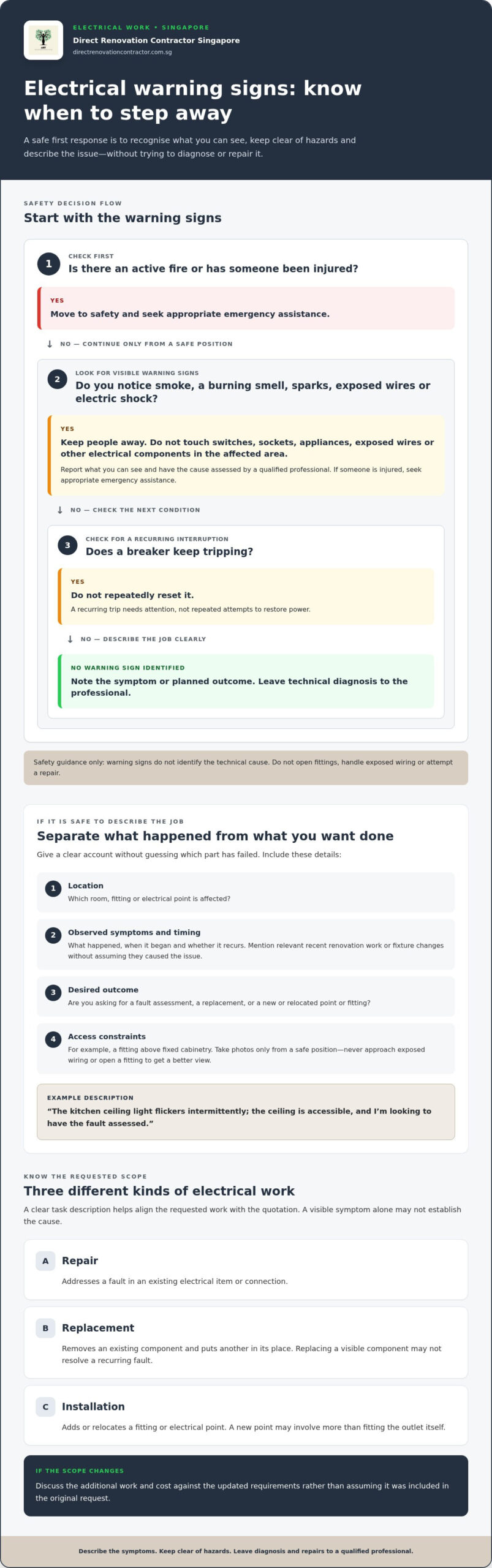
Keep safety separate from troubleshooting. Smoke, a burning smell, sparking, exposed wires or an electric shock are serious warning signs, not reasons to investigate wiring yourself. Keep people away from the affected area and avoid handling switches, sockets, appliances or other electrical components there. If there’s smoke, fire or an injury, move to safety and seek appropriate emergency assistance.
- Smoke or a burning smell: Treat either as a potential hazard, even if the smell or smoke stops.
- Sparks or exposed wiring: Stay clear. Don’t touch the wire, socket or nearby electrical equipment.
- Electric shock: Keep away from the affected equipment and get appropriate emergency assistance, particularly if someone is injured.
- A breaker that keeps tripping: Don’t repeatedly reset it. A recurring trip needs attention, not repeated attempts to restore power.
These signs indicate a need to prioritise safety, but they don’t identify the technical cause. Don’t open fittings, handle exposed wiring or try to repair a fault. If an area feels unsafe, keep others out and report the visible symptoms clearly.
Which electrical symptoms need immediate attention?
Smoke, burning smells, sparking, exposed wires and electric shock all call for a cautious response. Move people away and don’t touch electrical components or try to locate the fault. If there’s an active fire or someone is injured, seek emergency assistance. This is general safety guidance, not a diagnosis. The cause and required work must be assessed by a qualified professional.
What counts as an ad hoc electrical job?
An ad hoc electrical job is a discrete task, such as assessing a faulty socket, adding an electrical point or installing a planned light. It differs from renovation-wide electrical work, which coordinates wiring and installations across a larger project. A single visible fault may not tell the whole story. If it recurs, the underlying issue may need investigation rather than simply replacing a component.
When describing a job, distinguish the symptom from the result you want. “The socket sparks when used” reports an observation. “Install a new point beside the desk” describes a planned outcome. Avoid assuming which part has failed. Understanding Electrical Wiring can provide background on how wires and associated devices fit into an installation, but it shouldn’t be used as a guide to hands-on repairs.
If you’re searching for an ad hoc electrician Singapore, start with a clear account of the issue, not just the service label. For planned renovation work, electrical wiring and installation can be considered alongside the wider project scope, since changes to points or lighting may affect other work and finishes.
Electrician services Singapore: understand the work scope and safety questions
A useful work description gives the professional a starting point without attempting to diagnose the fault. State the affected location, what you observed, the outcome you want and any access constraints. For example: “The kitchen ceiling light flickers intermittently; the ceiling is accessible, and I’m looking to have the fault assessed.” This is clearer than “the electricity is not working” and leaves technical conclusions to the person carrying out the assessment.
A clear work scope helps align the requested work with the quotation. It distinguishes the task from any additional work that may be identified during assessment. If the scope changes, discuss the work and cost against the updated requirements rather than assuming they were included in the original request.
What details help describe an electrical job?
Record when the issue began, whether it happens repeatedly, and which room, fitting or point is affected. Note recent renovation work or changes to electrical fixtures if relevant. Mention practical access constraints, such as a fitting above fixed cabinetry. Photos can help show the location, but only take them from a safe position. Don’t touch equipment, open fittings or approach exposed wiring to get a better view.
Keep the description factual. “The socket stopped working after the room was repainted” reports timing and context; it doesn’t prove the paintwork caused the fault. For planned work, state the intended result, such as adding a point at a specified wall or installing a light at a marked location. Don’t guess at wiring routes or try to inspect behind a fitting.
How do repair, replacement, and installation differ?
A repair addresses a fault in an existing electrical item or connection. Replacement removes an existing component and puts another in its place. Installation adds or relocates a fitting or electrical point. These are different scopes. Replacing a visible component may not resolve a recurring fault, while a new point may involve more than fitting the outlet itself. Symptoms alone can’t establish the cause, so leave technical assessment to the professional.
In Singapore, electrical work must be performed or supervised by an Energy Market Authority (EMA)-licensed electrical worker. The EMA’s Singapore Electrical Safety Regulations provide local safety information. This requirement applies whether the work is a repair, replacement or installation. A concise job description doesn’t replace professional assessment.
When comparing electrician services Singapore, describe the same intended task and site conditions each time. For renovation-related wiring and installation, a direct contractor can coordinate electrical requirements with other renovation work. Explore electrical wiring and installation within renovation projects to see how this work can fit into a broader scope.
How to compare electrician services in Singapore without comparing unlike quotes
A lower headline quote doesn’t necessarily mean the same work for less. One description might cover only fitting a component, while another includes preparation, installation and testing. Compare written scopes for the same requested outcome, rather than relying on service labels such as “repair” or “installation.”
Record each quotation under the same headings. This simple framework helps show what is included, what is excluded and where the scopes differ:
- Task: What outcome is requested, and where will the work take place?
- Included work: What preparation, removal, installation or testing is described?
- Materials: Which materials or components are stated, if any?
- Exclusions: What related work is specifically outside the quoted scope?
- Follow-up responsibilities: What happens if the stated work is completed but the original issue remains, where this is addressed in writing?
Mark anything not described as unstated rather than assuming it comes with the job. A comparison is useful only when it reflects the wording of each quote, not what you think a standard service should include.
What should an electrical quotation describe?
Check that each quote identifies the work location and requested task. Then compare any stated materials, preparation, installation, testing and exclusions. For example, a quote for a new light point should explain its scope without relying on the label “lighting work.” Don’t assume testing, making good or a particular material is automatically included. Compare only what each written description says.
How can you make two quotes comparable?
Write one neutral description of the task and desired result, then use it as the reference for each scope. Separate essential work from optional suggestions so the core comparison stays clear. If the descriptions differ, note the difference instead of treating the headline totals as directly comparable. This helps you see whether the gap reflects different work, materials, exclusions or follow-up responsibilities.
For instance, if the goal is to replace an existing fitting, a quote describing replacement may not match one that also includes additional preparation or changes to the surrounding installation. The difference isn’t automatically a problem, but it should be clear before you decide. For a recurring fault, a scope focused only on replacing a visible component may also differ from one that includes further investigation.
When comparing an ad hoc electrician Singapore request or broader electrician services Singapore, focus on the outcome and documented scope first. For renovation projects, a direct contractor can coordinate electrical work with related trades. Explore Direct Renovation Contractor’s direct renovation approach to understand how direct coordination fits into a renovation project.
When should electrical work be planned as part of a renovation?
Plan electrical changes before finishes are installed. A new light point, relocated socket or revised wiring route can affect ceiling works, carpentry, wall finishes and painting. Settling the intended layout early gives the renovation team a chance to coordinate the work sequence and reduce avoidable rework. This is a planning approach, not a promise of a particular project timeline.
How electrical work fits the renovation sequence
Use this sequence to define and coordinate the scope:
- Define the layout. Confirm where furniture, appliances and work areas will sit so lighting and electrical points can be planned around how the space will be used.
- Identify electrical requirements. List planned changes to points, lighting and wiring, and note which existing fittings will remain.
- Coordinate trades. Discuss how electrical work relates to hacking, carpentry and ceiling work before those areas are closed or finished. Painting and other finishes can then follow the relevant installation work.
- Review the scope. Check that the agreed work reflects the layout and identifies any related trade coordination needed.
This sequence helps surface practical conflicts early. For example, a ceiling light location may need to be considered alongside a false ceiling, while a power point behind planned cabinetry may be inconvenient once the carpentry is installed. Mapping requirements before wiring routes are concealed makes them easier to coordinate with the rest of the project.
A broader Singapore home renovation planning and execution guide can help you place electrical decisions within the overall renovation process. The key is to make the intended outcome clear before dependent work proceeds, then align the electrical scope with the relevant trades.
What changes between HDB, condo, landed, and commercial projects?
Property type and building requirements can affect how work is planned and whether approvals apply. HDB flats have specific renovation requirements. For example, HDB rules can restrict embedding wires in structures, and some new 15-amp power points may require a permit. Review the current requirements for the proposed work rather than assuming the same approach applies to every property. The HDB renovation guide provides relevant planning context for flat owners.
Condominiums may also have building-level renovation procedures, while landed homes and commercial spaces can have different layouts, access conditions and project coordination needs. These are planning considerations, not a substitute for checking the requirements that apply to the specific property and proposed work.
For renovation projects involving electrical wiring and installation, Direct Renovation Contractor coordinates the electrical scope with related renovation work. Plan electrical work as part of your renovation project to keep the intended layout and trade sequence connected.
How Direct Renovation Contractor handles electrical work within renovation projects
Direct Renovation Contractor Singapore provides electrical wiring and installation as part of its renovation services for residential and commercial spaces. The company can coordinate the electrical scope with related work such as ceiling installation, carpentry, hacking and painting, keeping project requirements connected as the renovation is planned.
This section focuses on electrical work within renovation projects rather than standalone call-outs. If you searched “ad hoc electrician Singapore, electrician services Singapore” while planning a wider renovation, consider whether the electrical changes can be scoped alongside the rest of the work. A clear brief helps identify what is planned, where it is needed and how it relates to other trades.
What the direct-contractor model means for electrical scope
Direct Renovation Contractor Singapore works directly with homeowners on renovation projects. Its model focuses on avoiding interior-designer middleman fees and providing transparent, unmarked-up pricing. The company aims to help clients save 20-30% on renovation projects by eliminating those fees. This is an aim, not a guaranteed saving; costs depend on the agreed scope and project requirements.
A clearly defined electrical scope supports practical coordination. Planned lighting can be considered alongside ceiling work, while power point locations can be coordinated with the carpentry layout. This makes it clearer which wiring and installation tasks form part of the renovation and how they relate to other trades.
For electrician services Singapore as part of a renovation, discuss the electrical requirements alongside the wider project scope. Clear descriptions reduce uncertainty about planned work and give the renovation team a useful basis for coordinating related tasks.
What to prepare before discussing a renovation project
Prepare a few practical details before the project discussion:
- Property type: HDB flat, BTO, condominium, landed home or commercial space.
- Planned electrical changes: New or relocated points, lighting changes or wiring requirements.
- Affected areas: The rooms or work zones involved and any relevant access constraints.
- Wider renovation needs: Related work such as carpentry, ceiling installation, hacking or painting.
- Desired outcome: Describe how you want the space to function, rather than attempting a technical diagnosis.
Defined requirements give the discussion a practical starting point. They connect the electrical installation to the intended layout and related trades, while leaving technical decisions to the appropriate professionals. If you’re comparing an “ad hoc electrician Singapore, electrician services Singapore” search with a renovation-wide plan, a clear brief can focus the discussion on the work your project needs. Discuss your renovation project with Direct Renovation Contractor Singapore to plan the electrical scope alongside the wider renovation work.
Turn your renovation plans into a clear next step
Put your intended changes in writing as a practical next step. Note which areas you want to improve, how you expect to use them and what other renovation work may affect the electrical layout. You don’t need to identify technical causes or prescribe wiring solutions. A clear brief gives the project discussion a useful starting point and keeps decisions tied to how the finished space needs to work.
If you’re weighing an ad hoc electrician Singapore, electrician services Singapore search against a wider renovation plan, consider whether the electrical work is best scoped alongside the rest of the project. Direct Renovation Contractor Singapore undertakes electrical wiring and installation as part of residential and commercial renovation work, with a direct-contractor approach focused on transparent, unmarked-up pricing.
Discuss your renovation project with Direct Renovation Contractor Singapore to take the next step with a clearer plan. A well-defined brief can make the conversation more focused and help you move ahead with confidence.
Frequently Asked Questions
What is an ad hoc electrician service?
An ad hoc electrical job is a discrete task arranged outside a wider renovation, such as assessing a fault or adding a fitting. The phrase describes the job, not how urgent or complex it is. A search for “ad hoc electrician Singapore, electrician services Singapore” may bring up different types of work, so define the result you need. Direct Renovation Contractor Singapore provides electrical wiring and installation as part of renovation services.
When should I call an electrician for an electrical problem?
Arrange professional attention if a fault recurs, a power point stops working or lights behave unusually. Smoke, a burning smell, sparking, exposed wiring or electric shock are serious warning signs. Keep people away from the area and seek appropriate emergency assistance if there is an active fire or injury. Don’t touch electrical components or repeatedly reset a breaker that keeps tripping. Leave technical assessment and repair to a qualified professional.
How much does an ad hoc electrician cost in Singapore?
The cost depends on the task, access, materials and conditions at the property, so a general figure may not reflect your job. For renovation work, Direct Renovation Contractor Singapore scopes electrical wiring and installation within the wider project. If comparing an “ad hoc electrician Singapore, electrician services Singapore” search with a renovation quotation, compare written descriptions of the same requested outcome and note what each scope includes or excludes.
Can an electrician install a new power point during renovation?
Yes, a new power point can be planned as part of electrical installation during renovation. Decide its intended position based on how the room and appliances will be used, and coordinate it with cabinetry and finishes before those works are completed. The installation must meet applicable requirements and be handled by an appropriately qualified electrical worker. For HDB flats, some new 15-amp power points may require an HDB permit.
What should I tell an electrician before arranging electrical work?
Describe the property type, affected room or area, what you observed and the result you want. Include when the issue began, whether it recurs, and any recent renovation or fixture changes that may be relevant. Mention access limits, such as fixed cabinetry near the work area. Photos may help show the location, but take them only from a safe position without touching equipment, fittings or wiring.
Is electrical work better planned during a renovation?
Planned electrical changes are easier to coordinate before finishes conceal wiring routes or restrict access. For example, deciding where a desk or appliance will sit can inform point placement before carpentry and wall finishes are complete. Include the intended changes in the renovation scope so related work can be considered together. If a need comes up after renovation, describe the desired result and leave technical decisions to a qualified professional.
Do HDB and condo electrical works follow the same requirements?
Not necessarily. Applicable safety requirements still matter, but property-specific rules and procedures can differ. HDB has additional requirements for work in its flats, including restrictions on embedding wires in structures and permit requirements for some installations. Condominiums may have their own building renovation procedures. Identify the property type and proposed work early so relevant requirements can be considered before the installation is planned.