

What if the renovation warranty period isn’t the only date that matters? If you’re asking “how long does renovation warranty cover?”, the answer depends on the work involved, the written terms and when you report a problem. A stated period can sound reassuring, but it won’t tell you by itself whether a leaking pipe, loose cabinet hinge or faulty fitting is covered.
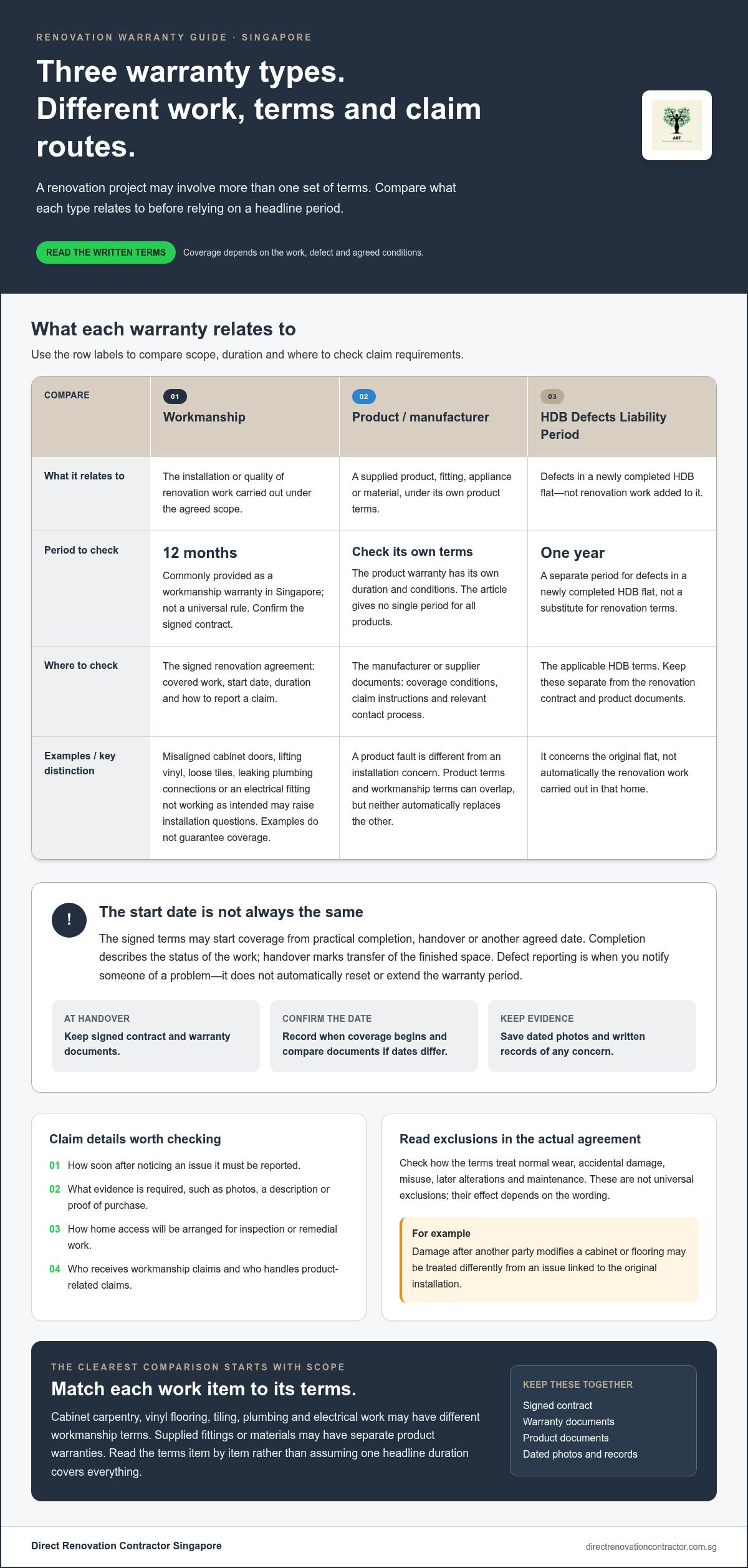
It’s reasonable to expect clear protection after paying for renovation work. In Singapore, contractors commonly provide a 12-month workmanship warranty, but coverage and conditions can differ between contracts. This is separate from the one-year Defects Liability Period for a newly completed HDB flat, which relates to defects in the flat rather than renovation work you’ve added.
This guide explains what workmanship and product warranties may cover, what can affect their duration, and how exclusions, start dates and claim procedures should be recorded. You’ll also learn what to check before work begins, so you can compare written terms with less guesswork. A clearly scoped renovation agreement makes it easier to see which work is covered and what to do if a defect appears.
Key Takeaways
- To understand how long does renovation warranty cover, look beyond the headline period and identify which work and defects the written terms apply to.
- Separate workmanship terms from manufacturer or supplier warranties, since each may have different claim documents and contact processes.
- Before accepting the terms, check exclusions, the start date, how to report an issue and what happens after you submit a claim.
- Keep dated photos and written records so you can describe when a concern appeared and which renovation work it relates to.
- A clearly itemised renovation scope makes it easier to match each work item to its relevant warranty terms.
How long does a renovation warranty cover in Singapore?
There’s no single duration for every renovation contract. If you’re asking, “how long does renovation warranty cover?”, start with the signed terms. They should identify the work covered, the warranty’s start date and duration, and how to report a claim. A 12-month workmanship warranty is commonly cited as an industry standard in Singapore, but it isn’t a universal rule or a substitute for the terms agreed for your project.
Renovation warranty cover is a written contractual assurance that specified renovation work or supplied items will be addressed under stated conditions for a defined period. A contractor’s workmanship terms concern the installation or quality of the work performed. A product or manufacturer warranty applies to the product itself and is governed by its own documentation. One doesn’t automatically replace the other.
Why renovation warranty periods vary
The scope, type of work, materials and contract wording all affect what protection applies. A contract might set out terms for cabinet carpentry separately from vinyl flooring, tiling, plumbing or electrical work. Supplied fittings or materials may have separate product warranties, with their own conditions and claim channels.
One project can therefore have several coverage periods and claim requirements. Read the terms item by item rather than assuming one headline duration covers everything. Check that the documents describe the relevant work and distinguish workmanship terms from product warranties.
When does the warranty period usually begin?
The start date depends on the signed terms. Some documents may refer to practical completion, others to handover or another agreed date. These milestones aren’t interchangeable: completion describes the status of the work, handover marks the transfer of the finished space, and defect reporting is when you notify someone of a problem. Don’t assume a defect-reporting date resets or extends the warranty period.
At handover, keep a copy of the signed contract, warranty documents and any record stating when coverage begins. If the date appears in more than one document, compare the wording and note any differences. Clear records make it easier to track the applicable period and follow the claim process if an issue appears later.
For new properties, keep renovation warranties separate from any HDB or developer defects liability period. Those cover the original property under separate terms, not automatically the renovation work added to it.
What does a Singapore renovation warranty cover, and what may be excluded?
A renovation warranty doesn’t automatically cover every problem that appears after work is completed. Coverage depends on the specific work, the type of defect and the written terms. If you’re wondering how long does renovation warranty cover, the scope matters as much as the stated period. The agreement should clarify which work is covered and how to report an issue.
Workmanship defects versus product faults
A workmanship concern relates to how agreed work was carried out. For example, a cabinet door that doesn’t align properly, vinyl flooring that lifts, tiles that come loose, a plumbing connection that leaks or an electrical fitting that doesn’t operate as intended may raise questions about installation. These examples don’t guarantee coverage. The contract and facts of the issue determine whether the warranty applies.
A product fault is different. A supplied fitting, appliance or material may have its own manufacturer or supplier warranty, with separate coverage conditions and claim instructions. The contractor’s workmanship terms and a product warranty can overlap, but they aren’t interchangeable. Check the relevant documents and the work involved before deciding which terms apply.
Common exclusions and claim conditions to look for
Read the signed agreement to see how it treats normal wear, accidental damage, misuse, later alterations and maintenance. These aren’t universal exclusions, and their effect depends on the wording. For instance, damage after another party modifies a cabinet or flooring may be handled differently from an issue linked to the original installation. Check the actual terms rather than relying on verbal summaries.
Look for practical claim requirements too. The written terms may specify:
- How soon after noticing an issue you must report it.
- What evidence to provide, such as photos, a description or proof of purchase.
- How access to the home will be arranged to inspect or address the reported problem.
- Who receives the claim for workmanship concerns and who handles product-related claims.
Keep your contract, product documents and dated photos together. These records help you explain what happened and when. If a disagreement arises, Singapore’s Ministry of Trade and Industry outlines a dispute resolution framework that includes routes consumers may consider, such as CASE and the Small Claims Tribunals.
A clear work scope makes these distinctions easier to follow. Review clearly scoped renovation work to see how defined work items can support a more straightforward discussion of what the written terms cover.
How do renovation warranty terms differ across work and products?
A renovation project can have several sets of warranty terms, not one blanket promise that covers every item equally. The contract may address workmanship, while supplied products have separate manufacturer or supplier documents. Items you buy separately may sit outside the renovation contract altogether. To answer “how long does renovation warranty cover?”, first match the issue to the relevant work item and document.
| Category | Document that governs | Claim route to check | What to verify |
|---|---|---|---|
| Renovation workmanship | Signed contract, scope of works and any written workmanship terms | The contact or process named in the agreement | Covered work, duration, start date, exclusions and reporting steps |
| Products supplied as part of the renovation | Product warranty, invoice or warranty information, alongside the renovation contract | The route stated in the product terms, which may involve the supplier or manufacturer | Product model, coverage conditions, claim deadline and required proof |
| Items purchased separately | Receipt, product warranty and any installation record | The seller or manufacturer identified in the product documents; check separately how installation concerns are handled | Who purchased the item, what the product warranty covers and whether installation is addressed elsewhere |
Workmanship terms for renovation trades
Workmanship terms are easier to apply when the renovation scope describes each trade clearly. For carpentry, it can identify the cabinets or wardrobe work included. For tiling, flooring, plumbing and electrical work, look for descriptions that distinguish the installation from the materials or fittings used. An itemised scope helps connect a reported issue to the relevant work instead of leaving “renovation” as an overly broad category.
For example, a concern about a cabinet door may relate to carpentry work or a supplied hinge. A flooring issue could involve the installation or the flooring product itself. The written scope and warranty documents help show which terms to review without assuming the answer in advance.
Manufacturer warranties and renovation contractor terms
Product warranties can have different conditions, time periods and claim routes from workmanship terms. Keep receipts, product details, manuals, warranty documents and installation records together. Product cover doesn’t automatically replace workmanship terms, and workmanship cover doesn’t automatically replace product cover. Check each document for what it covers, the evidence required and who receives the claim.
Before signing, compare the scope against the warranty documents. If a supplied product or separately purchased fitting isn’t clearly accounted for, it may be unclear which terms apply. Clear descriptions and records make it easier to trace an issue to the relevant work or item.
What should homeowners check before accepting renovation warranty terms?
Review the warranty wording before renovation starts, not after a defect appears. The answer to “how long does renovation warranty cover?” depends partly on details that are easy to miss in a contract, including which work is covered, when the period begins and how you must report a problem. Use this checklist to compare the terms and understand what you’ll need to do if an issue arises.
Warranty clauses to record in the renovation agreement
- Scope: Check that covered work is described specifically. Separate items such as kitchen cabinet carpentry, flooring, tiling, plumbing and electrical work are easier to identify than a broad phrase like “renovation works.”
- Duration: Record the stated cover period for each relevant work item or product. Don’t assume every part of the project has identical terms.
- Start date: Find the event that begins the period, such as a date or project milestone. Make sure the agreed date is written down.
- Exclusions: Note how the agreement treats wear, accidental damage, alterations, misuse and maintenance. Check the precise wording rather than assuming a general rule.
- Reporting method: Record where and how to submit a claim, any notice deadline, and what information or evidence is required.
- Response process: Look for what happens after a report, including any inspection or access arrangements and how updates will be communicated.
If a verbal explanation differs from the document, ask for the agreed wording to be included in the signed terms before work proceeds. An itemised agreement links each promise to a defined work item and reduces ambiguity. For planning the wider project, use a home renovation planning guide alongside an HDB renovation guide where relevant, so warranty checks fit into your overall preparation. Keep general guidance separate from contract terms: your agreement governs the specific terms you’ve accepted.
How to document and report a defect
At handover, note visible defects and keep a copy of the handover record. Take clear, dated photographs of any issue, and write down when you first noticed it. Describe the location, affected work item and observable problem plainly. For example, state which cabinet door is misaligned or where flooring has lifted, rather than guessing at the cause.
Follow the reporting method and timing stated in your agreement. Keep copies of the contract, handover records, relevant product documents, messages, photographs and the claim you submitted. A simple dated record helps you explain what changed and when, keeping the discussion tied to the written scope and terms.
Clear scopes and written communication make warranty terms easier to understand from the outset. Plan your renovation with a clear work scope before committing to the project.
How a clearly scoped renovation project makes warranty terms easier to understand
A clear scope gives you a practical reference point if a concern appears after handover. It shows what work was agreed, which areas or items it involved, and what materials were specified. That context helps you compare the reported issue with the relevant contract and warranty terms, rather than relying on a general description of the renovation.
Why a detailed scope helps after handover
Consider a project that includes kitchen cabinet carpentry, vinyl flooring and plumbing work. If each work item and its location are described clearly, it’s easier to identify whether a later concern relates to the cabinet installation, flooring work or a plumbing connection. Records of materials and agreed work can also help distinguish an installation question from one about a supplied product.
At handover, keep notes and supporting records organised by work item. A dated photo of a completed area, a written handover note and the relevant scope description can help explain what was completed and where. These records don’t guarantee a defect-free renovation or determine whether a claim is covered. They provide a clearer starting point for discussing the issue against the written terms.
Plan renovation work with clear expectations
A direct-contractor model can make the project scope and communication more straightforward because renovation execution is carried out directly for homeowners. Clear descriptions of carpentry, flooring, painting, electrical or plumbing work help keep agreed tasks visible through planning, execution and handover. Transparent pricing without intermediary markups also makes the financial scope easier to understand, although it doesn’t establish a particular warranty or coverage period.
This clarity matters when asking, “how long does renovation warranty cover?” The answer still comes from the written terms for the relevant work or product. A well-defined scope helps you locate those terms and understand what they refer to, while organised handover records make it easier to describe a concern if one arises.
For your next renovation, review the work scope, pricing and handover documentation together before the project begins. Explore Direct Renovation Contractor Singapore’s renovation approach and project services to see how clearly defined work can support a more transparent planning process.
Make your renovation terms clear before work begins
There’s no single answer to “how long does renovation warranty cover” in Singapore. The duration and conditions depend on the written terms for the specific work or product. Before committing, check the scope, start date, exclusions and claim process, and keep product documents and handover records together.
Workmanship terms and manufacturer warranties may cover different things, so don’t assume one project-wide period applies equally to every item. A clearly itemised scope helps you connect a concern to the relevant work and review the right documents. It can’t prevent every defect, but it gives both sides a clearer basis for discussing one.
Direct Renovation Contractor Singapore carries out residential renovation work across carpentry, flooring, painting, electrical and plumbing, with transparent pricing and no intermediary markups. Explore the renovation approach and plan your project with a clearly defined scope.
Explore renovation services and plan your project with clear scope. A little clarity before work starts can make the whole process easier to manage.
Frequently Asked Questions
Is there a standard renovation warranty period in Singapore?
A 12-month workmanship warranty is commonly described as the industry standard in Singapore, but it doesn’t automatically apply to every renovation agreement. The contract sets the terms for the work you’ve commissioned, and product warranties may have different periods and conditions. Compare the written terms for each item rather than relying on a general statement about what contractors usually provide.
What does a renovation contractor warranty usually cover?
A contractor’s workmanship warranty may cover specified defects in how agreed renovation work was carried out, subject to the contract’s conditions. Examples to check against the written scope include a cabinet door that doesn’t align, loose tiles, lifted flooring, a leaking plumbing connection or an electrical fitting that isn’t working as intended. These examples don’t guarantee coverage. The actual terms, defect and cause matter.
Does a renovation warranty cover materials and appliances?
Not necessarily. A contractor’s workmanship terms and a manufacturer or supplier warranty may be separate. The product warranty may govern a supplied appliance, fitting or material, while the renovation agreement addresses installation work, depending on its wording. Check the documents for the product covered, claim route, conditions and required proof. Keep receipts, manuals, product details and installation records together so you can identify the relevant terms.
When does a renovation warranty period start?
The start date depends on the signed agreement. It may refer to a stated date or project milestone, so don’t assume completion, handover and defect-reporting dates mean the same thing. Record the agreed start date and keep the contract and handover documents. For a newly completed HDB flat, the separate one-year Defects Liability Period begins on the date of key collection; it doesn’t set the start date for a contractor’s renovation warranty.
Can I claim for renovation defects after handover?
You may be able to report a renovation defect after handover if it falls within the relevant written terms and you follow the stated claim process. Handover doesn’t, by itself, explain whether a particular issue is covered. Check the duration, exclusions, reporting deadline and evidence requirements in the agreement. Also identify whether the concern relates to workmanship or a product, since separate warranty documents may apply.
What should I do if I find a defect after renovation?
Document the issue promptly and follow the reporting method in your agreement. Take clear, dated photographs, note when you first noticed the problem, and describe the location and affected work item without guessing at the cause. Send the report through the stated claim channel and keep copies of your message, contract, handover records and any replies. Check the terms for deadlines, evidence requirements and access arrangements.