
Why are you paying a middleman to manage a job that a licensed electrician can do directly for a fraction of the price? Many homeowners find themselves blindsided by unexpectedly high electrical point charges and hefty markups from interior designers. If you’re wondering How To Save on Lights Installation Costs in Singapore?, the answer isn’t just about finding cheaper bulbs. It’s about cutting out the intermediary commissions that inflate your renovation bill and understanding the local industry landscape.
We understand that managing HDB electrical regulations and sourcing safe, NEA-compliant fixtures can feel overwhelming. You want a home that looks professional without the designer price tag. This article provides a clear strategy to help you source affordable fixtures and explains why working with a direct contractor ensures technical competence and financial transparency. You’ll discover professional secrets to slashing your lighting installation budget without compromising on safety or aesthetics in your Singapore home. We’ll provide a breakdown of typical installation costs and a strategy to find direct contractors who value quality workmanship over high-concept markups.
Key Takeaways
- Strategic layout planning, such as using minimalist designs and looping circuits, helps minimize the total number of installation points and reduces wiring labor costs.
- Sourcing fixtures directly from overseas platforms can offer significant savings, provided you verify local NEA “tick” energy efficiency ratings and safety standards.
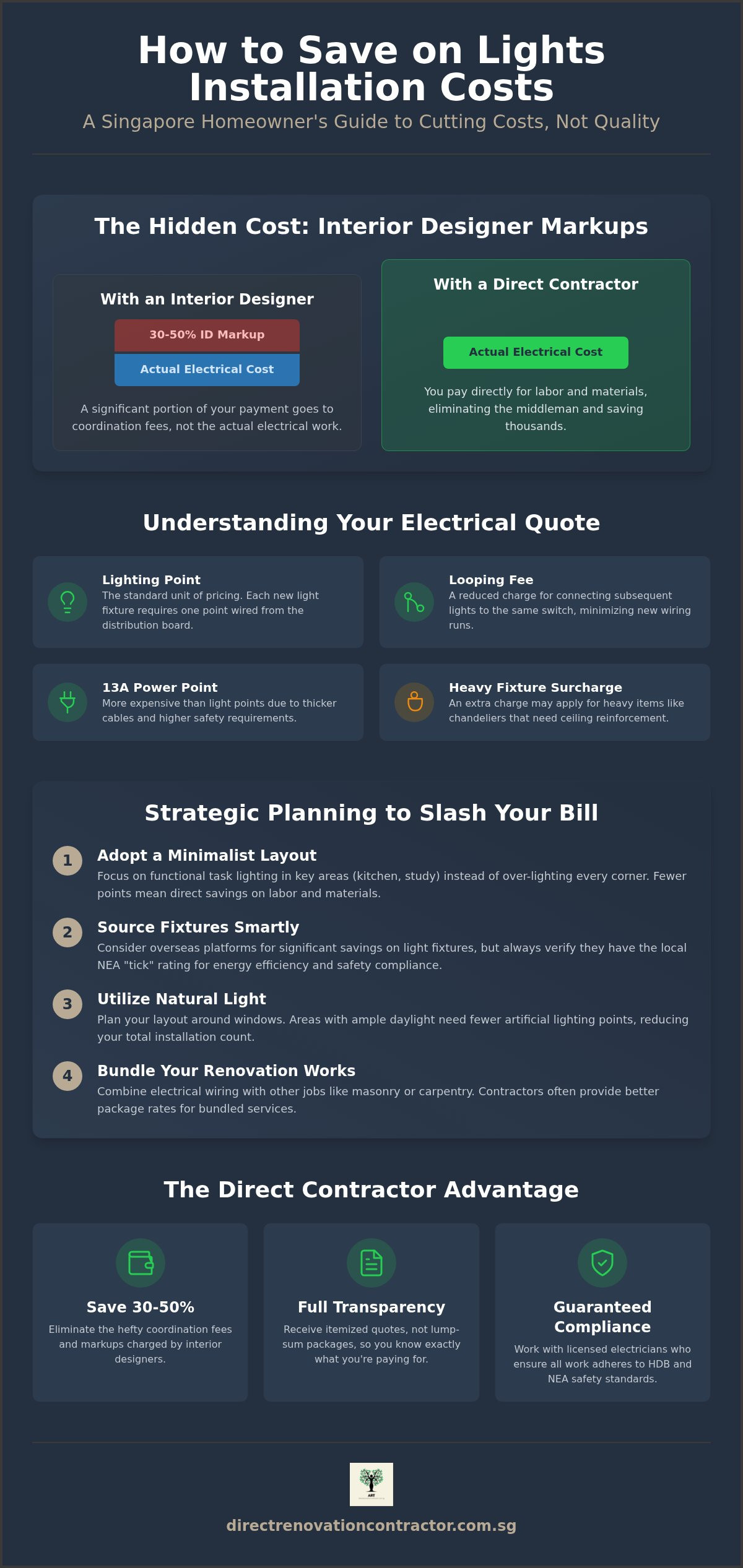
- Discover How To Save on Lights Installation Costs in Singapore? by engaging a direct renovation contractor, which removes the 30-50% markup typically charged by interior designers.
- Practical labor hacks like using creative trunking solutions and bundling electrical wiring with other masonry or carpentry works can help you secure better package rates.
Understanding Lighting Installation Costs in Singapore
In the Singapore renovation market, the standard unit for pricing is the “lighting point.” Every light fixture you see in a showroom requires a corresponding point to function. Contractors typically charge based on the number of points they need to wire from your Distribution Board (DB) to the ceiling. If you want to know How To Save on Lights Installation Costs in Singapore?, you must first distinguish between labor-only fees and material-inclusive quotes. A labor-only quote assumes you provide the wiring and conduits, which is rare for residential projects. Most homeowners opt for material-inclusive quotes, where the contractor provides the cables, trunking, and mounting hardware.
As of July 2026, we see prices for electrical components shifting due to updated safety standards and the Mandatory Energy Labelling Scheme (MELS). Having a solid understanding of lighting principles helps you decide where to place these points effectively. You should also watch out for hidden costs like looping fees. While the first light point on a switch costs a set amount, subsequent lights “looped” to the same switch are often cheaper but still carry a per-point charge. Heavy fixtures, such as large chandeliers, might also incur extra mounting charges if the ceiling requires structural reinforcement to meet safety requirements.
The Anatomy of an Electrical Quote
Quotes usually differentiate between point-to-point wiring and surface-mounted installations. Surface-mounted works use PVC trunking, which is faster and cheaper because it avoids hacking into concrete. Under HDB regulations, wiring cannot be embedded in reinforced concrete slabs or beams. This means surface-mounted trunking is often the only legal option for certain areas. New 13A power points are priced higher than lighting points because they require thicker cables and more robust circuit protection. If you’re renovating a resale HDB, relocating existing points can be as expensive as installing new ones, as it involves extending old wiring and patching walls.
Why Interior Designer Markups Inflate Your Bill
Hiring an interior designer (ID) often adds a 20 to 30 percent coordination fee to your electrical bill. This markup covers their time spent talking to the electrician, but it doesn’t change the quality of the technical work. Direct contractors eliminate this middleman. This is a primary way How To Save on Lights Installation Costs in Singapore? because you pay for the actual labor and materials rather than a management fee. Be wary of “lump sum” lighting packages. These often hide the true cost of individual points, making it harder to spot markups. Itemized quotes are the only way to ensure financial transparency and guarantee that you aren’t paying for “ghost” points that don’t exist in your actual floor plan.
Strategic Planning to Reduce Installation Points
Strategic planning is the most effective way to answer How To Save on Lights Installation Costs in Singapore? without sacrificing the quality of your home’s ambiance. Many homeowners make the mistake of over-lighting every corner, which leads to a massive bill for wiring labor. A minimalist lighting layout focuses on placing points only where they are functionally necessary. By reducing the total number of points from the start, you directly lower the cost of materials and the time spent by the electrician on-site. We often advise clients to prioritize task lighting in work areas like kitchens and study rooms while using fewer, more powerful fixtures for general areas.
Utilizing “looping” strategically is another technical method to keep costs down. Instead of running a new wire from the distribution board for every single light, several fixtures can be looped together on a single circuit. This minimizes the amount of cabling required and simplifies the installation process. You should also consider the impact of natural light. If your HDB or condo unit has large windows or a favorable orientation, your daytime lighting requirements will be lower. Planning for this allows you to skip unnecessary points near windows. Future-proofing your layout is equally vital. It’s cheaper to install a few extra points now during a direct renovation project than it is to call an electrician back for hacking and rewiring in two years when you realize you’ve under-lit a space.
False Ceiling vs. Surface Mounted: The Cost Debate
The choice between a false ceiling and surface-mounted lights significantly impacts your budget. A full false ceiling allows for recessed downlights, which look sleek but carry a labor premium because the electrician must cut holes and secure fixtures within the cavity. L-box false ceilings offer a middle ground; they provide a space for cove lighting along the perimeter while keeping the center of the room clear. For those on a strict budget, surface-mounted track lights are the best option for HDB flats. They require minimal wiring points but allow you to aim multiple light heads in different directions, providing high coverage for the price of a single electrical point.
Grouping Lights for Efficiency
Efficiency isn’t just about the bulbs; it’s about how you group them. You can use 2-way or 3-way switches to control the same set of lights from different locations, such as at both ends of a hallway, without necessarily multiplying the point charges. Strategic placement of task lighting, like under-cabinet LEDs in the kitchen, reduces the need for high-wattage ambient light that consumes more power. A lighting circuit is a dedicated path of electrical wiring that connects multiple light points to a single circuit breaker, requiring careful load management to prevent tripping the distribution board. By grouping fixtures logically, you ensure that your electrical system remains safe and your installation costs stay within a reasonable range.
Sourcing Fixtures: Local Shops vs. Overseas Platforms
Cheap fixtures often become a liability rather than a saving. A low-quality LED driver might fail within six months; this forces you to pay for a technician’s visit and labor all over again. When you calculate the total cost of ownership, spending slightly more on a reputable local brand often proves more economical than replacing a “bargain” unit twice. We always recommend that clients look for fixtures with replaceable drivers to avoid discarding the entire unit when a single component fails.
The True Cost of Overseas Sourcing
Buying from overseas isn’t always a straightforward win for your budget. Shipping costs for fragile items like glass pendants or long track rails can be high, and there’s always a risk of breakage during transit. Many local electricians also apply a “contractor surcharge” for installing non-standard overseas fixtures. These units often use different mounting brackets or wiring colors that don’t align with Singapore’s standards. This requires more time and specialized labor to install safely. Without a local warranty, you’re on your own if a component fails, which means paying full price for repairs or a complete replacement later.
Smart Lighting: Investment or Expense?
Smart home integration is a major trend in 2026, but it can be a trap if not planned correctly. If you want to know How To Save on Lights Installation Costs in Singapore? while going smart, focus on smart switches rather than individual smart bulbs. Smart switches allow you to control standard LED fixtures, which are significantly cheaper to buy and replace. This approach is more cost-effective for whole-home automation because one switch controls multiple light points on a single circuit. In the long run, an integrated system using smart switches offers a better ROI by reducing the frequency of bulb replacements and simplifying the overall wiring complexity.
Practical Labour Savings and Technical Hacks
Hacking concrete walls is one of the most expensive labor components in any renovation. If you want to know How To Save on Lights Installation Costs in Singapore?, you should focus on minimizing the need for concealed wiring. Concealed wiring requires labor-intensive hacking, plastering, and repainting. Instead, utilize creative trunking solutions. Surface-mounted PVC trunking is faster to install and costs significantly less. By planning your layout to follow existing structural lines, you can make these conduits almost invisible. This approach prioritizes functional results without the high price tag of masonry work.
Bundling your electrical works with other trades is another pragmatic way to reduce costs. When you engage us for electrical wiring and installation alongside painting or partition works, you often qualify for better package rates. Contractors can optimize their manpower schedules when multiple tasks are handled under one contract. The best time to install your fixtures is after the first coat of paint is dry but before the final touch-up. This prevents rework and protects your new lights from dust generated during other renovation phases. It also ensures that the electrician isn’t fighting for space with other workers on-site.
Clear communication with your electrician prevents over-quoting. Provide a marked-up floor plan showing exact point locations and fixture types before the site visit. This allows the contractor to give an accurate, itemized quote rather than a padded estimate that accounts for unknown variables. When you provide clear technical requirements, you project an image of a savvy homeowner who values financial transparency, which often leads to more competitive pricing.
Trunking and Casing Secrets
Surface-mounted trunking doesn’t have to look messy. Many homeowners embrace an industrial aesthetic, using black-painted conduits as a design feature. If you prefer a cleaner look, paint the trunking the exact same shade as your walls or ceiling. This “hidden” look costs almost nothing extra but provides a professional finish. External casing is generally 30 to 50 percent cheaper than concealed wiring because it eliminates the masonry work required to hide cables inside reinforced concrete walls.
Navigating HDB and MCST Regulations
Always ensure your total lighting load doesn’t exceed the amperage allotted to your unit’s distribution board. Following HDB and MCST regulations is a long-term cost-saving measure. If you install heavy chandeliers without the proper permits or structural support, you risk expensive reinstatement orders from authorities later. EMA-licensed contractors understand these local requirements and will ensure your installation meets the CP5 wiring standards. This technical competence protects your safety and prevents the need for costly legal or structural corrections down the road.
The Direct Contractor Advantage for Singapore Homeowners
The most significant factor in How To Save on Lights Installation Costs in Singapore? is the business model of the professional you hire. Choosing a direct contractor instead of an interior designer (ID) immediately removes the intermediary commissions that typically inflate renovation bills. IDs often add a management fee to every electrical point installed, which can increase your total cost by 20 to 30 percent. When you work directly with us, those savings are passed on to you because we don’t have the overhead or the commission structures of design-heavy firms.
Direct communication with the person actually doing the wiring is another practical advantage. In many ID-led projects, technical details get lost in translation between the designer and the sub-contractor. This leads to errors in switch placement or incorrect circuit loading. By speaking directly to our team, you ensure that every lighting point is placed exactly where you need it. We provide transparent, unmarked-up pricing for electrical components and labor, ensuring you only pay for the materials used in your home and the skilled work required to install them.
Consider a typical case study of a 4-room BTO lighting package. A standard layout might involve 25 lighting points and several power points. In an ID-managed project, the markup on these items alone can add hundreds to your final invoice. A direct contractor approach keeps the project lean. We focus on the technical integrity of the installation and ensure all works comply with local regulatory standards without adding unnecessary coordination fees. This straightforward financial model is the most effective way to manage a tight renovation budget.
Why Direct Renovation Contractor Singapore is Different
We believe that technical competence should include clear planning. We provide professional 3D drawings to help you visualize your lighting layout before any wiring begins. This prevents expensive changes halfway through the project. You also gain access to our curated list of reliable material suppliers who provide NEA-compliant fixtures. Our priority is functional, high-quality workmanship rather than charging flashy design fees for simple installations. We speak the language of local trade and value the structural integrity of your home above all else.
How to Get Started with Your Lighting Reno
To get an accurate electrical quote, start by preparing your floor plan with your desired light placements clearly marked out. A site walk-through is essential before signing any contract; this allows us to assess the existing DB capacity and identify any potential structural challenges. For a broader look at how to manage your project, refer to our Home Renovation Singapore Guide. This resource helps you coordinate your lighting installation within the wider context of your 2026 renovation timeline, ensuring every phase of your home makeover is handled with technical precision and financial clarity.
Take Control of Your Lighting Renovation Budget
Successful home improvements rely on technical competence and financial transparency. By choosing a direct-to-owner approach, you successfully eliminate the 20 to 30 percent markups commonly added by interior designers. Strategic planning, such as minimizing electrical points and opting for creative trunking solutions, is the most practical answer to How To Save on Lights Installation Costs in Singapore? without sacrificing the structural integrity of your home. Focus on sourcing NEA-compliant fixtures and working with experts who prioritize functional results over high-concept design fees.
You can achieve a professional, well-lit space while maintaining a lean budget. Our team ensures that every wiring task meets local regulatory standards, providing you with peace of mind and long-term reliability. Don’t let hidden commissions or vague quotes derail your renovation plans. It’s time to partner with a straightforward professional who values hard work and honest pricing. We’re here to ensure your project stays on track and within your financial goals.
Get a Transparent Lighting Installation Quote from Direct Renovation Contractor Singapore and enjoy HDB-registered professional workmanship with direct factory-to-home savings. We’re ready to help you build a brighter, more cost-effective home today.
Frequently Asked Questions
What is the average cost per lighting point in Singapore for 2026?
In the 2026 renovation market, the industry average for installing a single light point, including wiring and a switch, typically ranges between S$60 and S$200. This cost varies depending on whether you choose surface-mounted PVC trunking or concealed wiring. To understand How To Save on Lights Installation Costs in Singapore?, always request an itemized quote that separates labor from material costs to ensure you aren’t paying for hidden markups.
Can I install my own lights to save on costs in an HDB flat?
No, you cannot legally perform your own electrical installations in an HDB flat. Singapore law requires all electrical work on fixed wiring systems to be carried out by an Energy Market Authority (EMA) licensed worker. While DIY might seem like a way to save, it risks your safety and violates strict HDB regulations. Non-compliance can lead to heavy fines or complications during the future sale of your property.
Is it cheaper to use track lights or downlights in a living room?
Track lights are generally more cost-effective than downlights for most living rooms. A single electrical point can power an entire track with multiple adjustable heads, which minimizes wiring labor. In contrast, recessed downlights require individual points and the added expense of a false ceiling. Choosing track lights is a practical way to achieve high coverage while keeping your installation budget lean and transparent.
Why do contractors charge more for installing chandeliers?
Contractors charge more for chandeliers because they require significantly more assembly time and specialized safety reinforcements. These fixtures are often heavy and need structural support to meet local safety standards. The installation process demands higher precision and risk management compared to a standard ceiling light. You’re paying for the technical skill required to ensure the fixture is securely mounted and the wiring is correctly balanced.
Does a false ceiling significantly increase lighting installation costs?
Yes, installing a false ceiling will notably increase your total lighting budget. Beyond the cost of the ceiling itself, you’ll pay a labor premium for cutting recessed holes and securing fixtures within the cavity. It also involves additional plastering and painting works. Homeowners looking for How To Save on Lights Installation Costs in Singapore? often opt for surface-mounted solutions or L-box designs to avoid these cumulative expenses.
What should I look for in an electrical quote to avoid hidden fees?
Always check for an itemized breakdown that clearly lists looping fees, transport charges, and material specifications. A transparent quote should distinguish between the cost of new points and the relocation of existing ones. Be wary of lump-sum figures that don’t explain what happens if additional wiring is needed on-site. Ensure the quote explicitly states whether HDB permit applications and the disposal of old fixtures are included.
Are LED strips more expensive to install than traditional bulbs?
LED strips are typically more expensive to install because they require specialized drivers and more complex mounting. Unlike standard bulbs that fit into ready-made sockets, LED strips often need to be custom-cut, soldered, and integrated into cabinetry or coves. The labor involved in hiding the drivers and ensuring even heat dissipation adds to the technical difficulty, making the overall installation more labor-intensive than traditional lighting.
How much can I save by hiring a direct contractor instead of an interior designer?
You can typically save between 20 to 30 percent on your electrical bill by hiring a direct contractor. Interior designers usually add a management markup or coordination fee on top of the actual electrician’s rates. By working directly with a licensed professional, you eliminate these intermediary commissions. This direct-to-owner model ensures you pay only for the technical expertise and materials used in your home renovation.