
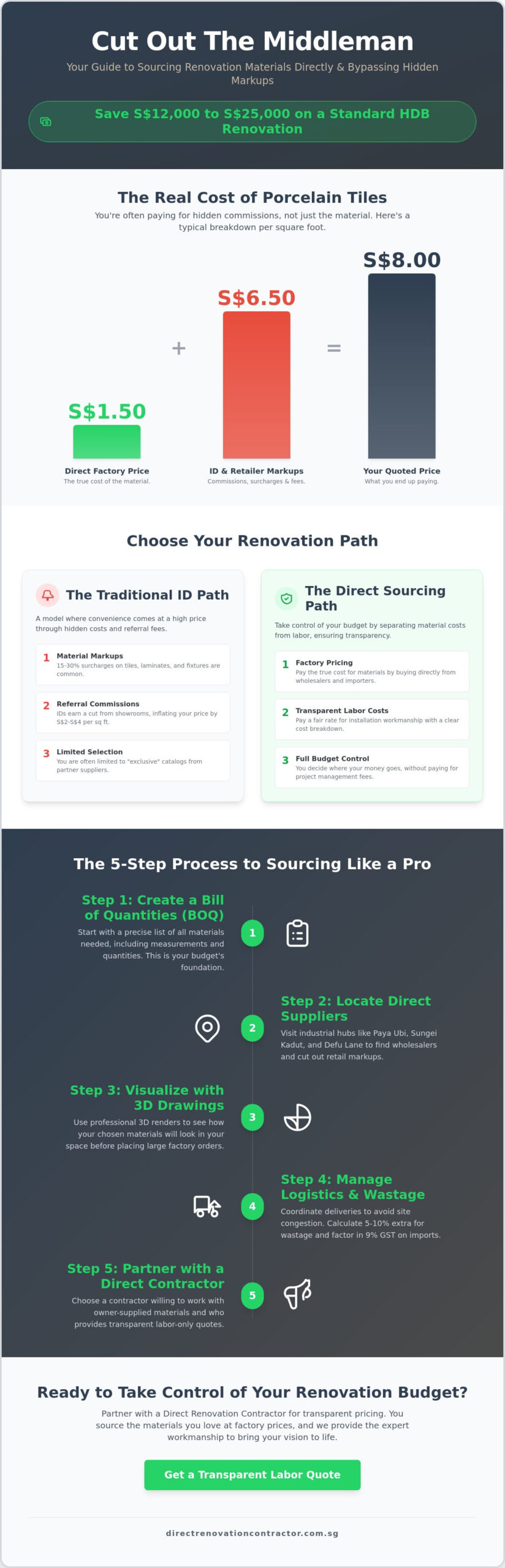
Why are you paying S$8 per square foot for porcelain tiles when the factory price is closer to S$1.50? Many homeowners want to know how to source renovation materials directly but hesitate because they fear the technical complexity of managing a supply chain. You likely suspect that hidden markups are inflating your quote, yet the confusion over “per foot run” measurements and delivery logistics keeps you stuck. It’s a common anxiety, but paying a 30% premium for a middleman doesn’t always guarantee better workmanship or higher quality brands.
If you want to lower your costs, you need a clear roadmap to bypass these markups. This guide provides the exact steps to secure factory pricing on everything from vinyl flooring to kitchen cabinets. We’ll explain how to handle the 9% GST on imports, manage wastage calculations, and coordinate with a direct contractor who is willing to work with owner-supplied items. You can save between S$12,000 and S$25,000 on a standard HDB renovation by following this process. We’ll start with the technical Bill of Quantities and move through the logistics of direct procurement.
Key Takeaways
- Understand the financial difference between interior designer referral commissions and the transparent pricing model of a Direct Renovation Contractor Singapore.
- Locate high-quality suppliers in industrial and wholesale districts to cut out retail markups.
- Follow a professional 5-step roadmap on how to source renovation materials directly, starting with a precise Bill of Quantities (BOQ) to manage your budget.
- Identify potential logistics risks and learn how to coordinate deliveries to avoid site congestion and ensure your materials are ready when the hacking ends.
- Use professional 3D drawings and technical support to visualize your material choices before committing to large factory orders.
Table of Contents
- Understanding the Direct Sourcing Model vs. Interior Designer Markups
- Where to Source Renovation Materials Directly in Singapore
- The 5-Step Process to Sourcing Like a Professional
- Managing Risks: Logistics, Wastage, and Warranties
- The Smart DIY Approach: Direct Renovation Contractor Support
Understanding the Direct Sourcing Model vs. Interior Designer Markups
Most homeowners assume an Interior Designer (ID) quote is a fixed price for “design.” In reality, a large portion of that quote covers referral commissions and material markups. When an ID brings you to a tile showroom or hands you a laminate catalog, they aren’t just acting as a stylist. They’re often acting as a reseller. This middleman structure adds layers of cost that don’t contribute to the structural quality of your home. You’re paying for the convenience of their selection rather than the material itself.
Learning how to source renovation materials directly is the most effective way to reclaim your budget. By separating labor from material procurement, you gain full control over what you spend. For a standard 4-room HDB flat, the financial impact is significant. Homeowners who bypass these markups often see savings between S$10,000 and S$30,000. These are real dollars you can reinvest into higher-grade finishes, better appliances, or simply keep in your bank account. It turns the renovation from a luxury service into a manageable project.
This DIY approach requires a basic understanding of materials management principles. You aren’t just shopping; you’re coordinating supply chains. It makes the most sense when you have a clear vision and want to avoid the “project management fees” that IDs tack onto every light fixture and floor tile. It’s about taking ownership of the technical details to ensure your money goes toward actual workmanship.
Where the Markups are Hidden
The markups aren’t always obvious. They’re often baked into the unit price of the items you select. Common areas where you’ll find these hidden costs include:
- Laminate surcharges: Many IDs use “exclusive” catalogs. These are often the same products available at factory prices elsewhere, but with a 15% to 25% surcharge added for the “convenience” of the selection process.
- Masonry markups: When you select tiles from major showrooms through an ID, the price you see often includes a hidden commission for the designer. This can add S$2 to S$4 per square foot to your tiling costs.
- Fixture fees: Even electrical and plumbing fixtures are subject to “coordination fees,” which can inflate the cost of a simple tap or socket by 30%.
The Direct Contractor Advantage
Choosing a Direct Renovation Contractor Singapore changes the dynamic. We don’t charge sales commissions or hide fees in material costs. Instead, we provide a transparent breakdown of labor charges for hacking, tiling, and carpentry. This model prioritizes technical workmanship over abstract design concepts. You pay the factory price for your materials, and you pay us a fair rate for the installation. This transparency ensures you know exactly where every cent of your S$50,000 or S$80,000 budget is going. You get the same high-quality brands without the inflated price tag.
Where to Source Renovation Materials Directly in Singapore
Knowing how to source renovation materials directly means looking past the glitzy retail showrooms. Most of the real action happens in Singapore’s industrial clusters. If you want factory prices, you need to visit Paya Ubi, Sungei Kadut, and Defu Lane. These areas house the warehouses and fabrication workshops that actually supply the Interior Designers. By going straight to the source, you cut out the retail markup and gain access to a wider inventory that isn’t filtered through a designer’s preference or limited catalog.
For tiling and masonry, major showrooms are helpful for inspiration. However, boutique importers in industrial estates often carry high-quality porcelain tiles at lower price points because they have lower overheads. When it comes to carpentry, don’t rely on a small laminate booklet. Visit the large-format galleries of laminate suppliers. Seeing a full 1.2m by 2.4m sheet allows you to understand the pattern repetition and texture before it’s glued to your cabinets. For bathroom and kitchen fixtures, look for wholesale distributors of sanitary ware in areas like Toh Guan or Changi to find genuine brands without the boutique price tag.
Surfaces and Countertops
Direct stone suppliers are your best bet for Quartz, Sintered Stone, and Granite. When you buy here, you’ll encounter the “Per Foot Run” (pfr) pricing model. This is a linear measurement used by factories to calculate the cost of your kitchen top or vanity. Understanding pfr prevents you from being overcharged by middlemen who might quote a lump sum without technical justification. You can compare engineered stone brands side by side and see the raw slabs before they are cut. This transparency ensures you get the exact brand and grade you paid for.
Flooring and Wall Finishes
Sourcing vinyl flooring directly from local stockists can save you a significant amount on a whole-house installation. You need to decide between a supply-only contract or a supply-and-install arrangement. In a supply-only deal, you buy the boxes of vinyl and your direct renovation contractor handles the laying. This is often the most cost-effective route. For wall finishes, specialized distributors for paint and feature wall materials offer technical advice that retail staff often lack. They can tell you exactly how many liters you need based on your floor plan, which reduces wastage and prevents over-ordering.
The 5-Step Process to Sourcing Like a Professional
Direct sourcing isn’t a casual shopping trip; it’s a technical procurement process. To master how to source renovation materials directly, you must move beyond the “just go to the shop” advice often found on online forums. You need a data-driven approach to ensure you don’t overbuy or purchase specifications that your contractor cannot install. Following a structured sequence prevents the logistical errors that lead to site delays and budget blowouts.
First, finalize your home renovation plan with 3D drawings. These drawings define the exact scope of materials. Once the plan is set, request a detailed Bill of Quantities (BOQ) from your main contractor. A BOQ is a document that lists every item required, from the total square footage of vinyl to the specific number of hinges for your wardrobe. It is your shopping list and your primary tool for price comparison.
Take your BOQ and floor plan to the industrial clusters in Singapore. Request “Supply Only” quotes from at least three different suppliers to establish a price benchmark. Don’t rush into a deposit. Always verify stock availability and lead times. If a specific sintered stone slab takes 4 weeks to arrive but your kitchen installation starts in 2 weeks, you’ll face costly site delays and potential re-scheduling fees from your workers. Only place an order once the timeline aligns with your project schedule.
Creating Your Bill of Quantities
A professional BOQ includes a 10% wastage allowance for tiles and masonry. This accounts for breakages during cutting and ensures you have spares for future repairs. For carpentry, measurements are usually in linear footage. Be specific about hardware like soft-close hinges or internal PVC finishes. If you don’t specify these, you might end up with basic hardware that doesn’t meet your expectations. Your BOQ should also list technical requirements like slip-resistance ratings (R-ratings) for bathroom tiles to ensure safety and HDB compliance.
Navigating Showroom Consultations
When you enter a showroom, ask for “Owner Sourced” pricing immediately. This signals that you’re managing the procurement yourself and expect the net price without designer commissions. Always check batch numbers on tiles. Different batches of the same model can have slight color variations that become obvious once installed. Finally, request physical samples. Bringing a tile or laminate sample to your actual site is the only way to see how it looks under your home’s specific lighting conditions, which can differ significantly from showroom spotlights.
Managing Risks: Logistics, Wastage, and Warranties
Learning how to source renovation materials directly isn’t just about the initial purchase; it’s about managing the risk that follows. When you bypass an Interior Designer, you inherit the responsibility of quality control. This creates what we call the “Responsibility Gap.” If a mixer tap you purchased arrives with a manufacturing defect, your contractor isn’t liable for the replacement labor. You’ll have to pay for the hacking and re-installation yourself. This is the trade-off for securing factory pricing, and it requires a high level of technical oversight from the homeowner.
Storage is another major hurdle, especially in a compact HDB BTO. Delivering 60 boxes of tiles during the hacking phase is a logistical error. It creates a safety hazard and blocks the workers from moving efficiently. You must coordinate with your contractor to ensure materials arrive exactly when the masonry team is ready to start. If you run out of tiles mid-installation because you didn’t account for the 10% wastage rule, you face a “batch mismatch” risk. The next batch from the factory might have a slight color variation, leaving a visible line across your floor. If you’re unsure about managing these technical quantities, look for a Direct Renovation Contractor Singapore who provides a precise Bill of Quantities to guide your purchases.
Delivery and On-Site Management
Scheduling “Just-in-Time” deliveries is the only way to manage a small site effectively. Don’t allow suppliers to dump materials at the lift lobby without your presence. You must verify item counts and check for visible damage immediately upon unloading. For heavy materials like large format tiles or quartz stone slabs, ensure the supplier provides “doorstep delivery.” Some wholesale prices only include delivery to the ground floor, leaving you to figure out how to transport 200kg of stone up to your unit.
Warranty and After-Sales
You must distinguish between a product warranty and an installation warranty. Your supplier covers the former; your contractor covers the latter. If a vinyl plank pops up because of poor adhesive application, that’s an installation issue. If the plank fades after three months, that’s a product defect. Keep a digital record of all batch numbers and receipts. This documentation is vital if you need to order matching replacements for future repairs or if you need to negotiate labor-only terms for replacement works with your contractor.
The Smart DIY Approach: Direct Renovation Contractor Support
Our team at Direct Renovation Contractor Singapore uses professional 3D drawings to help you visualize your material choices before you place a non-refundable factory order. Seeing your selected quartz slab and cabinet laminates in a digital render prevents expensive aesthetic mistakes. This approach allows you to eliminate the “ID Tax,” which often accounts for a significant portion of a total project cost. Instead of paying for abstract design concepts, you’re paying for technical documentation and site supervision. You maintain full control over your brand selections while we handle the heavy lifting of masonry, hacking, and carpentry installation.
Professional Documentation for DIY Success
Success in a direct-source project depends on the quality of your instructions. We provide detailed technical drawings for every carpenter singapore homeowners engage through our network. These drawings include exact measurements for internal shelving, drawer heights, and hinge placements. We also map out electrical and plumbing points early in the process. This mapping is critical; it ensures your imported kitchen mixer or smart toilet has the correct water pressure and power supply ready. By establishing a clear scope of work on paper, we prevent the “hidden charge” disputes that often plague owner-managed renovations.
Direct Access to Our Network
When you work with us, you aren’t just getting a labor team. You’re gaining access to an established network of suppliers and sub-contractors centered around Paya Ubi Industrial Park and Sungei Kadut. We offer transparent labor-only quotes for homeowners who prefer to buy their own materials. This means you pay the factory price for your vinyl or tiles, and you pay us a fixed, transparent rate for the masonry and installation. Even if you manage the procurement, we provide professional site supervision. We’re on-site to check that your deliveries are correct and that the workmanship meets HDB and BCA standards. It’s the most reliable way to achieve a high-end finish on a direct-contractor budget.
Take Control of Your Renovation Budget
Direct sourcing is no longer a logistical secret held by industry insiders. By following a technical Bill of Quantities and visiting industrial hubs like Paya Ubi, you can secure factory pricing that bypasses traditional middleman markups. Success requires a shift from passive consumer to active project manager. You’ve learned how to source renovation materials directly, from calculating the 10% masonry wastage to coordinating just-in-time deliveries for your HDB or condo unit. These steps empower you to save thousands while ensuring your home features the exact brands and quality levels you’ve chosen.
We are here to provide the technical expertise needed to turn your sourced materials into a finished home. Our team at Direct Renovation Contractor Singapore operates out of Paya Ubi Industrial Park, offering fixed-price labor contracts with zero hidden fees. We focus on structural integrity and transparent workmanship rather than abstract design concepts. Get a transparent, direct contractor quote for your renovation today and start your project with a partner who values financial clarity. Your vision for a high-quality, cost-effective home is entirely achievable with the right roadmap.
Frequently Asked Questions
Can I really save money by sourcing my own renovation materials?
Yes, you can typically save 20% to 30% on material costs by purchasing directly from suppliers. By bypassing the Interior Designer’s referral commission, you access factory pricing. For a standard 4-room HDB flat, this often translates to total savings between S$12,000 and S$25,000. You pay only for the raw material and the specific labor to install it, ensuring full transparency in your budget.
What are the most common materials homeowners source directly in Singapore?
Homeowners most frequently source porcelain tiles, vinyl flooring, kitchen appliances, and sanitary ware. Many also buy quartz or sintered stone slabs for countertops from industrial suppliers in Sungei Kadut or Paya Ubi. Lighting fixtures and ceiling fans are also common direct purchases. Learning how to source renovation materials directly for these high-ticket items provides the highest financial return for your effort.
Will a renovation contractor agree to install materials I bought myself?
Most direct renovation contractors are happy to install owner-supplied materials as long as the technical specifications are provided. We provide “labor-only” quotes for masonry, carpentry, and electrical works to accommodate this. You must ensure the materials arrive on-site when the workers are ready to avoid downtime charges. Clear communication regarding the Bill of Quantities is essential for a smooth project handover.
How do I calculate how many tiles I need for my HDB kitchen?
Measure the total wall and floor area in square meters and convert it to square feet by multiplying by 10.76. You must add a 10% wastage allowance to account for corner cuts and potential breakages during the masonry process. If your kitchen floor is 100 square feet, order 110 square feet of tiles. This ensures you have enough stock from the same batch number to maintain color consistency.
What happens if the materials I source arrive damaged or incorrect?
You are responsible for inspecting all owner-supplied items immediately upon delivery at the site or lift lobby. If a tile is cracked or a tap is the wrong model, you must coordinate the exchange with your supplier. Your contractor is not liable for manufacturing defects or transport damage for items they didn’t supply. This is a critical part of knowing how to source renovation materials directly without causing site delays.
Do direct suppliers offer delivery to HDB flats and condos?
Most industrial suppliers offer delivery to HDB flats and condos, but you must check if they provide doorstep or ground floor service. Some wholesale prices only include delivery to the loading bay. You might need to pay an additional “thigh-carry” fee if the item doesn’t fit in the lift or if stairs are involved. Always verify these logistical details before placing your deposit to avoid unexpected costs.
Is it better to source my own custom carpentry or use a contractor’s workshop?
It’s usually better to use a contractor’s in-house workshop for custom carpentry to ensure precise on-site measurements. While you can buy ready-made carcasses elsewhere, custom wardrobes and kitchen cabinets require technical adjustments that only a builder can manage. Sourcing your own laminates and hardware like soft-close hinges is a smart middle ground. This allows you to control material quality while professional carpenters handle the installation.
How do I handle the warranty for materials I bought directly?
The warranty for direct-sourced materials is split between the product supplier and the installation contractor. The supplier covers manufacturing defects, such as a leaking heater tank or a discolored floor plank. The contractor handles installation issues, like a loose tile or a misaligned cabinet door. Keep all digital receipts and batch numbers to facilitate future claims. This documentation is vital for any after-sales service or repairs.