
Handing back your office keys shouldn’t feel like a legal gamble, yet many tenants lose their entire security deposit because they underestimate the technical complexity of local regulations. Meeting the office reinstatement requirements singapore landlords demand involves more than just a quick demolition job. It’s a precise process of restoring a space to its original bare shell condition while navigating strict building management rules. You’re likely feeling the pressure of a looming lease expiry and the fear of hidden costs from middleman contractors who don’t prioritize your bottom line.
We understand that you want a transparent, no-nonsense handover that satisfies both your landlord and the authorities. This guide provides a clear roadmap to mastering the technical and fire safety standards required for a successful exit. We will explain the critical SCDF Fire Code 2023 amendments taking effect on September 2, 2026, and clarify when you actually need BCA submissions or a Qualified Person. You’ll learn how to manage your timeline and technical obligations to secure a full deposit recovery without the typical headaches or last-minute penalties.
Key Takeaways
- Define “original condition” and “bare-shell” to align with standard Singapore commercial lease obligations and avoid legal disputes.
- Identify the technical scope of hacking and demolition works required to clear out partitions, built-in carpentry, and custom installations.
- Master the office reinstatement requirements singapore authorities mandate for fire safety, including SCDF-compliant sprinkler and smoke detector relocation.
- Establish a 4-6 week planning timeline and conduct joint site walks to prevent last-minute penalties or security deposit forfeiture.
- Save on project costs by engaging a direct contractor to remove intermediary commissions and ensure clear communication with the technical work teams.
Understanding Office Reinstatement Clauses in Singapore Lease Agreements
Most commercial lease agreements in Singapore include a specific clause that dictates how you must return the unit. This isn’t just a courtesy; it’s a legal requirement. When you sign the contract, you’re agreeing to bear all costs for returning the space to its original state. Landlords, especially those managing REIT-owned buildings, often use a “Make Good” clause. This serves as a comprehensive catch-all. It ensures the landlord doesn’t have to deal with any leftover clutter or specialized installations that might not suit the next tenant’s needs. If you’ve installed heavy-duty safes, server room cooling, or custom floor tiling, the “Make Good” clause ensures you bear the full financial burden of their removal. Understanding these office reinstatement requirements singapore property owners enforce is the first step to protecting your capital.
The legal obligation is absolute. Even if the landlord intends to renovate the unit for the next tenant, they can still legally demand that you return it to the bare shell state first. This often feels redundant to tenants, but it’s a standard practice to ensure a clean slate for the next occupant. The Building and Construction Authority (BCA) plays a critical role here. Any structural changes, such as removing a load-bearing wall or altering the floor slab, require professional oversight to meet structural standards. Ignoring these requirements can lead to fines that far exceed the cost of the reinstatement itself.
Decoding the “Original Condition” vs. “Bare Shell” Standards
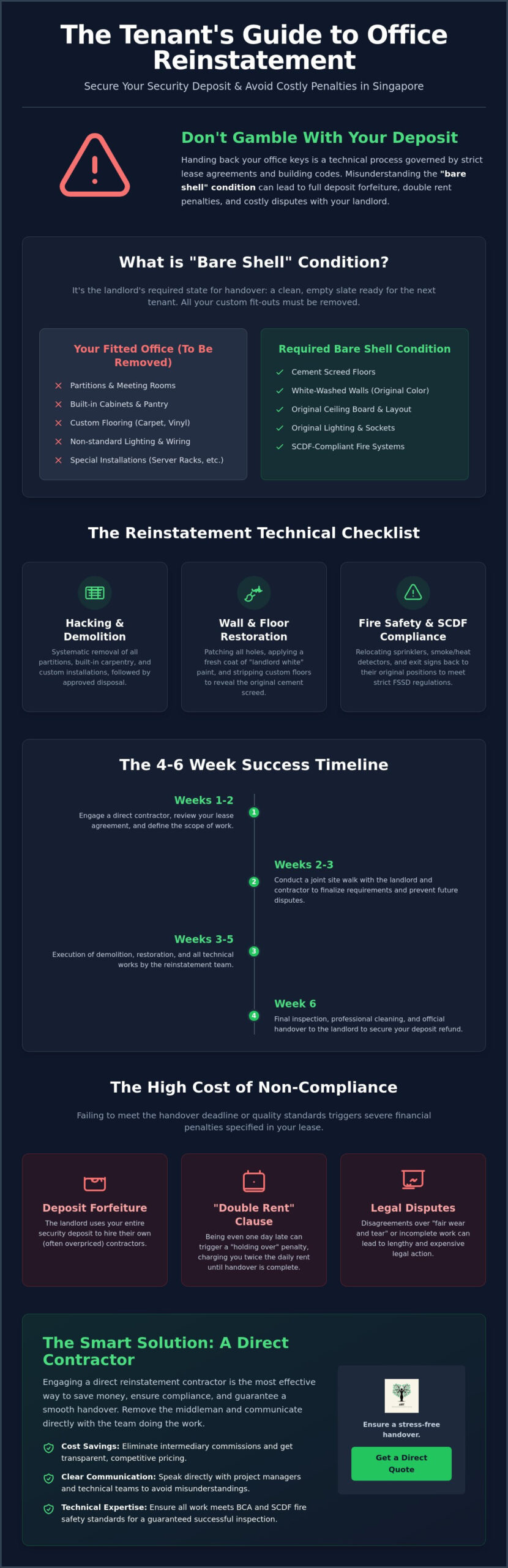
A “bare shell” state is the standard benchmark for most handovers. This typically means the office must have cement screed floors, white-washed walls, and an open ceiling layout with original fire safety fixtures intact. You can’t just leave your high-end partitions or custom pantry behind because you think they add value. To a landlord, these are simply obstacles to the next lease. Unless you have explicit written consent for an “as-is” handover, everything must go. Disputes often arise over “fair wear and tear,” but in a reinstatement context, the landlord usually expects the unit to look brand new. If there’s a scratch on a window frame or a chip in the floor, it’s often your responsibility to fix it.
The Consequences of Non-Compliance and Delayed Handover
Failing to meet the handover deadline is a massive financial risk. Many Singapore leases include a “Double Rent” or “Holding Over” clause. If you’re even one day late, the landlord can charge you twice the daily rate until the unit is officially cleared. Beyond that, the landlord will likely use your security deposit to hire their own contractors if your work is substandard. Since landlords don’t shop around for the best price, these costs are usually significantly higher than what you’d pay a direct contractor. Meeting the office reinstatement requirements singapore landlords set is the only way to ensure your security deposit is returned in full without legal recourse under commercial property law.
The Technical Scope: Standard Office Reinstatement Requirements
Technical compliance is the bridge between a messy construction site and a successful handover. While your lease agreement outlines your statutory obligations for leases, the physical work involves a systematic demolition process. Most office reinstatement requirements singapore landlords enforce start with hacking and demolition. This includes removing temporary partitions made of gypsum, glass, or plywood. You must also dismantle all built-in carpentry. Items like reception desks, pantry cabinets, and custom shelving aren’t considered assets by the next tenant; they’re obstructions that must be cleared and disposed of at an approved NEA dumping ground.
Restoring the walls and floors requires more than just a superficial cleanup. You’ll need to patch every hole left by wall mounts, shelving, or decorative fixtures. Standard practice dictates a fresh coat of “landlord white” paint across all wall surfaces to ensure uniformity. Flooring restoration is equally intensive. If you’ve installed vinyl, carpet tiles, or raised floor systems, these must be stripped away. This often leaves behind stubborn adhesive or uneven surfaces that require professional grinding and screeding. If you’re unsure about the extent of hacking needed for your unit, consulting a commercial office renovation specialist can help you identify which structures are landlord-owned and which must be removed.
M&E Restoration: Electrical and Plumbing Systems
Mechanical and Electrical (M&E) restoration is where many tenants face unexpected costs. You must terminate all additional power points and return the Distribution Board (DB) to its original factory layout. This isn’t a job for general laborers; it requires a licensed electrician to ensure the circuitry is safe. All data cables, including Cat6 wiring and fiber patches, must be pulled out from the trunking. If you’ve added a pantry, you’ll need to cap off plumbing points and restore the original drainage flow to prevent future leaks that could jeopardize your deposit recovery.
Flooring and Ceiling Compliance
Ceiling works involve restoring acoustic tiles and removing any false ceiling extensions or bulkheads you added during your fit-out. Landlords are particularly strict about the ceiling grid. You must replace any stained or cracked tiles and ensure all T-bars are perfectly aligned to the original specifications. Lighting is another critical checkpoint. All specialized track lighting or designer pendants must be replaced with the standard landlord-issued LED or fluorescent units. Finally, floors must be ground down to remove glue residue, ensuring a level, bare cement surface that is ready for the next tenant’s flooring choice.
Navigating SCDF Fire Safety and FSSD Requirements
Fire safety isn’t just a checkbox on your lease; it’s a regulated requirement that can halt your handover if ignored. The Singapore Civil Defence Force (SCDF) oversees all fire-related systems in commercial buildings. You must ensure that any modifications made during your tenancy are reverted to the original building plan. As of September 2, 2026, new amendments to the Fire Code 2023 have come into full effect, following a grace period that began earlier in March. These updates make compliance even more critical for tenants vacating premises. If your fit-out involved changing fire-rated doors or partitions, you must engage specialized professionals to ensure the integrity of the building’s fire compartments is maintained.
Successfully meeting the office reinstatement requirements singapore landlords expect requires a deep understanding of SCDF fire safety plan approval. You can’t simply hack away partitions and leave the sprinklers where they are. Every change to the internal layout impacts the Fire Safety Certificate (FSC) of the building. If your reinstatement work is found to be non-compliant, you face more than just a lost deposit; you face potential legal liabilities. This is why fire safety restoration is considered the most technical part of any office handover.
Sprinkler and Detector Relocation
When you added rooms or partitions, you likely moved sprinklers to ensure coverage within those smaller spaces. Removing those walls creates coverage “dead spots” or redundant spray patterns that violate the Fire Code. You must relocate these sprinklers and smoke detectors back to their original grid positions as specified in the base building drawings. This work must be performed by SCDF-registered contractors who understand the technical nuances of the system. Once the pipes are moved, a pressure test is mandatory to ensure there are no leaks before the ceiling tiles are closed up. This technical step is vital for a smooth handover.
FSSD Submissions and the Qualified Person (QP)
A Qualified Person (QP), such as a registered architect or professional engineer, is required if your reinstatement involves modifications to the fire safety systems. The QP manages the formal submission to the Fire Safety and Shelter Department (FSSD). They’ll oversee the process of obtaining a “Notice of Completion” for the works, which serves as your proof of compliance to the landlord. You must also verify that all exit signs and emergency lighting are functional. These units often have battery backups that fail over time; replacing them is a standard part of the restoration scope to ensure the unit is safe for the next occupant.
Planning and Cost-Saving: Avoiding Reinstatement Pitfalls
Effective cost management starts long before the first hammer hits a wall. Most tenants wait until the final month of their lease to look for a contractor, which often leads to rush charges and poor negotiation leverage. To meet the office reinstatement requirements singapore landlords demand without overspending, you should start the process at least 4-6 weeks before your lease expiry date. This lead time allows for a thorough site survey and the acquisition of necessary permits from the building management. Start early. It’s that simple. Rushing the process almost always results in mistakes that the landlord will use as a reason to withhold your security deposit.
Conducting a joint pre-reinstatement site walk with the landlord or the MCST is a critical step. This walk-through ensures both parties are on the same page regarding what needs to be removed and what can stay. During this meeting, you can identify existing damages that were present before your tenancy. Documenting these with photos prevents you from being charged for repairs you aren’t responsible for. You must also ensure your contractor handles waste management properly. All renovation debris must be sent to NEA-compliant disposal sites. If you need a team that handles the heavy lifting and the paperwork, our hacking and demolition works service ensures a clean site that meets all regulatory standards.
The Ideal 4-Week Reinstatement Timeline
A structured timeline prevents the “double rent” penalty mentioned earlier. In Week 1, focus on the site survey, permit applications, and SCDF or BCA assessments. Weeks 2 and 3 are for the physical work: demolition, M&E termination, and structural restoration. Finally, Week 4 is reserved for painting, deep cleaning, and the final joint inspection. This buffer week is essential for fixing any minor touch-ups the landlord might request during the final walkthrough.
Negotiating with Landlords to Reduce Work Scope
You don’t always have to hack everything back to a bare shell. If you’ve installed high-quality items like energy-efficient air-con units or premium flooring, pitch these as “value-adds” to the landlord. They might agree to keep them for the next tenant, saving you the cost of removal. Another option is “Cash in Lieu.” If the landlord plans to renovate the entire floor anyway, they might accept a cash payment instead of requiring you to perform the actual reinstatement. This is often cheaper and faster than hiring a crew to restore a space that will be immediately torn down again.
Why Choose a Direct Contractor for Office Reinstatement in Singapore
Choosing the right partner is the final hurdle in meeting the office reinstatement requirements singapore landlords mandate. Many tenants mistakenly hire interior design (ID) firms for this task. While ID firms excel at aesthetics, reinstatement is a technical demolition and restoration job. By hiring a direct contractor, you eliminate the 20-30% markup typically added by intermediaries who simply outsource the work to teams like ours. You’re paying for management fees that don’t add value to a bare-shell restoration. We provide transparent pricing because we own the equipment and employ the workers directly, ensuring you don’t pay for undisclosed commissions.
The Direct Contractor Advantage for Commercial Tenants
Faster response times are critical when you’re facing a potential “double rent” penalty for late handover. Direct contractors can mobilize teams quickly because there’s no multi-layered approval process. We also maintain a firm grasp on office renovation cost Singapore benchmarks, ensuring our quotes are grounded in current market reality. Our teams have a proven track record with MCST and building management requirements across various Grade A and B offices. We know the specific permit procedures and after-hours work restrictions for major commercial hubs, which prevents costly administrative delays.
Ensuring High-Quality Workmanship for Successful Handover
Workmanship quality is the primary factor that prevents landlord “re-work” claims. A sloppy paint job, visible holes in the walls, or poorly patched cement floors will be rejected during the final inspection. We apply the same precision to commercial projects that we do to high-standard home renovation projects. This ensures all surfaces are smooth, M&E points are safely terminated, and the unit is returned in a condition that leaves no room for dispute. This level of care is your best guarantee for a full security deposit recovery. Contact Direct Renovation Contractor for a transparent office reinstatement quote today.
Secure Your Deposit with Professional Reinstatement
Navigating the office reinstatement requirements singapore landlords mandate doesn’t have to be a source of financial stress. You’ve seen that a successful handover relies on clear communication and a deep understanding of technical fire safety standards. By starting your planning at least six weeks before your lease ends and conducting joint site walks, you eliminate the guesswork that leads to security deposit disputes. Compliance with SCDF and BCA regulations is the only way to guarantee a smooth exit without the risk of holding-over penalties.
We help tenants return their units to bare shell condition without the typical overhead of interior design firms. Our direct contractor model saves you 20-30% on fees. We provide transparent, fixed-price contracts and possess extensive experience in MCST and SCDF compliance. You don’t need to deal with middlemen or hidden markups to get the job done right. Get a Direct, No-Markup Office Reinstatement Quote today to ensure your handover is handled with technical competence. We’re ready to help you close this chapter and move on to your next space with total confidence.
Frequently Asked Questions
What is the average cost of office reinstatement in Singapore?
Industry estimates for a basic reinstatement in 2026 typically range between S$10 to S$20 per square foot. If you’re required to return the space to a complete bare shell condition, costs often increase to between S$35 to S$50 per square foot. These figures vary based on the volume of hacking required and the complexity of the mechanical and electrical termination works involved.
Do I need a permit for office reinstatement work?
Yes, you must obtain a permit from the building management or MCST before any work begins. You’ll need to submit a Method of Statement and reinstatement drawings for their approval. While a new BCA building plan isn’t usually required for bare-shell restoration, you will need professional submissions if the work involves structural changes or modifications to the building’s fire safety systems.
Can I hire any contractor for office reinstatement?
You can choose your own contractor, but they must meet specific office reinstatement requirements singapore landlords and building managers set. The contractor usually needs to be SCDF-registered to handle fire protection systems and must possess adequate Public Liability Insurance. Some buildings maintain a list of pre-approved contractors, so always check your fit-out manual before signing an agreement.
How long does a typical office reinstatement take?
A standard 2,000 square foot office typically takes 7 to 10 working days to reinstate. Larger premises exceeding 10,000 square feet can take 3 to 4 weeks depending on the extent of the built-in carpentry and partition walls. You should always factor in an additional week for the final joint inspection and any minor touch-ups requested by the landlord.
What happens if the landlord is not satisfied with the reinstatement?
The landlord can withhold your security deposit to cover the costs of hiring their own contractors to fix the deficiencies. In many cases, you may also be charged “holding-over” rent, which is often double the standard rate, for every day the unit remains unaccepted. This is why a detailed joint inspection and professional workmanship are vital for a clean handover.
Is it possible to skip reinstatement if the next tenant wants my fit-out?
Yes, you can skip the work if you obtain the landlord’s explicit written consent for an “as-is” handover. This usually happens if the incoming tenant signs an indemnity form taking over the responsibility for the existing fit-out. Without this legal documentation, your office reinstatement requirements singapore obligations remain in effect regardless of what the next tenant prefers.
What are the SCDF requirements for office reinstatement?
The primary requirement is returning all fire safety systems, including sprinklers and smoke detectors, to their original positions as per the building’s base plan. Under the Fire Code 2023 amendments effective September 2, 2026, all fire-rated compartments must be restored. You’ll likely need a Qualified Person to certify that the fire protection coverage is compliant and that no “dead spots” exist in the open layout.
What is a joint inspection in the context of reinstatement?
A joint inspection is the final walkthrough conducted by the tenant, the contractor, and the landlord or MCST representative. During this session, all parties verify that the space has been restored to the agreed-upon condition. Once the landlord signs the inspection report, it serves as formal acceptance of the unit, triggering the process for your security deposit to be returned.