
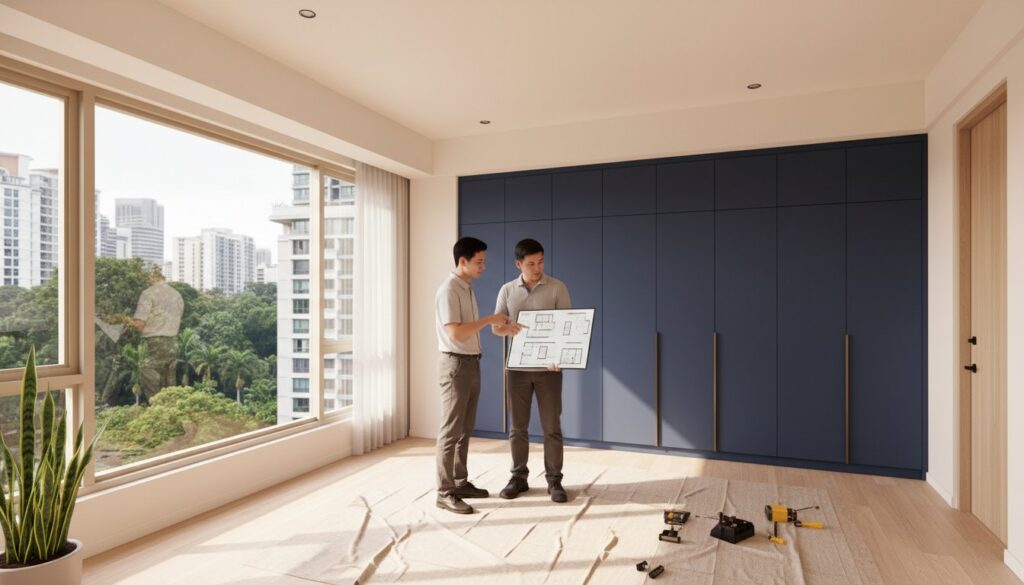
That 30% markup on your interior design quote isn’t paying for better materials; it’s the price of a middleman sitting between you and the actual builders. Most Singaporean homeowners realize too late that they’ve overpaid for project management they could’ve handled themselves with the right partner. Finding a reliable renovation contractor who owns their own carpentry factory and tiling team is the only way to ensure your S$60,000 budget actually goes into your home instead of someone else’s commission.
We understand that the fear of “cowboy” contractors and the headache of navigating HDB renovation permits can make the direct route seem daunting. You want a home that’s built to last, delivered on time, and priced fairly without hidden “coordination fees” appearing on the final invoice. This 2026 guide teaches you how to bypass the fluff, verify technical credentials, and manage a stress-free renovation for your HDB, condo, or office. We’ll walk through the specific checklists you need to guarantee quality workmanship and full compliance with local building regulations.
Key Takeaways
- Understand the financial benefits of the direct-to-builder model, allowing you to bypass interior design markups for more transparent, factory-direct pricing.
- Identify the essential technical services required for your project, including hacking, masonry, and bespoke carpentry managed directly by a hands-on team.
- Learn the exact steps to verify a renovation contractor using the HDB Directory of Renovation Contractors to ensure legal compliance and structural safety.
- Access the 2026 cost guide for BTO and resale flats to estimate your renovation budget accurately using current Singapore market benchmarks.
- Discover how to prioritize high-quality workmanship and functional results over expensive lifestyle marketing to maximize the value of your home renovation.
Direct Renovation Contractor vs. Interior Designer: Which is Right for You?
Deciding between a direct renovation contractor and an interior designer (ID) is the first major hurdle for Singaporean homeowners. A direct contractor is a hands-on builder. They manage sub-trades like electricians, plumbers, and tilers directly. They act as the general contractor on-site, focusing on the technical execution of your floor plan. An ID functions differently; they prioritize the “look and feel” and act as a project manager who coordinates various vendors. This service comes at a premium that many homeowners find unnecessary once they understand the mechanics of a build.
The price gap is substantial. Hiring a direct renovation contractor typically saves you 20% to 30% compared to an ID firm. For a standard 4-bedroom HDB renovation with a budget of S$60,000, this means keeping S$12,000 to S$18,000 in your bank account. This saving happens because you’re cutting out the middleman markup. You’re paying for materials and labor, not for a firm’s marketing budget or a designer’s commission. You need to decide if you require a design visionary to create a mood board or a technical expert to ensure your masonry is level and your plumbing is sound.
The Hidden Costs of the ID Model
ID firms rarely charge a transparent, flat design fee. Instead, they bake their profits into itemized costs. You might pay S$150 per foot run for kitchen cabinets that cost S$110 at the carpentry factory. Direct contractors often own their own workshops in areas like Sungei Kadut or Defu Lane. This allows them to offer factory prices. Many ID firms also collect referral fees from tile and lighting shops, which can add 10% to 15% to your material costs without you ever seeing it on an invoice.
When to Choose a Direct Contractor
If you’re a BTO owner with a functional layout in mind, a direct renovation contractor is the logical choice. You don’t need an expensive consultant to tell you where a wardrobe fits in a standard 93sqm flat. Resale flat owners also benefit from this direct model. Older units often hide structural issues behind walls. You want a builder who understands hacking, masonry, and HDB load-bearing requirements. If you have a clear vision and basic floor plan, the direct model ensures your budget goes into the quality of the cement and wood rather than into 3D renderings.
Choosing the direct route requires more involvement from you during the planning stage. You’ll need to provide the measurements and specify your material choices. However, the reward is a home built to your exact specifications without the inflated price tag. It’s a pragmatic approach for the savvy Singaporean homeowner who values technical competence over stylistic flair. You get the same HDB-licensed quality, but you keep the “middleman fee” for your furniture or appliances.
Core Services: What a Professional Renovation Contractor Handles
A professional renovation contractor acts as the lead builder and site manager for your home transformation. They don’t just hire workers; they translate technical blueprints into a livable space while managing the critical sequence of works. In a standard Singaporean home project, the timeline must be rigid. You can’t install custom wardrobes before the flooring is level, and you can’t finish electrical wiring after the walls are painted. A seasoned contractor ensures that plumbers, electricians, and painters move in and out of the site without clashing. This coordination prevents costly rework and keeps the project within the typical 8 to 12-week timeline for a standard BTO flat.
Technical execution forms the backbone of their service. This includes the installation of new electrical points, rewiring for resale flats, and complex plumbing for kitchen sinks or master bathrooms. These aren’t just cosmetic changes. They involve adhering to PUB and EMA standards to ensure your home remains safe and functional for decades. By working with a direct builder, you remove the middleman markup often found in design firms, allowing your budget to go toward higher-grade materials like copper piping or branded circuit breakers.
Masonry and Hacking Works
Hacking is the loudest and most regulated phase of any project. Before a single wall is touched, your renovation contractor must secure the necessary HDB permits. It’s vital to check that your firm is listed on the Directory of Renovation Contractors to ensure they understand structural integrity and load-bearing constraints. Once hacking is complete, masonry begins. This involves “wet works” like leveling floors with cement screed and tiling bathrooms with precise 2mm grout lines. Proper masonry also includes essential waterproofing, where a 24-hour flood test is conducted to prevent future leaks into your neighbor’s unit.
Custom Carpentry and Fabrication
Carpentry is often the largest expense in a Singaporean renovation because it maximizes vertical space in compact apartments. A direct contractor usually operates their own factory, providing S$90 to S$120 per foot run for kitchen cabinets without retail markups. You’ll need to choose between internal carcasses made of PVC or plywood and select durable countertops. Quartz is a popular choice for its stain resistance, though Sintered Stone is gaining 15% more market share due to its superior heat resistance. Precision is non-negotiable here; on-site measurements must be accurate to the millimeter to ensure wardrobes fit perfectly against HDB ceiling beams.
This principle of direct, specialized work extends to other critical installations like doors, which impact security, insulation, and aesthetics. While local suppliers are key, observing how specialists in other markets operate can provide valuable insights into quality. For example, professional installers like Liberty Door Repair in the Atlanta area focus exclusively on ensuring doors are fitted correctly for long-term performance—a best practice for any major renovation.
Flooring choices also require a pragmatic approach based on your lifestyle. Vinyl flooring is a cost-effective option, often priced between S$3.50 and S$6.00 per square foot, offering water resistance and a quick “click-and-lock” installation. If you prefer the premium feel of homogenous tiles, your contractor manages the logistics of ordering, delivery, and the labor-intensive process of laying them. For those seeking an industrial look, cement screeding provides a raw aesthetic, though it requires a skilled hand to prevent cracking over time. If you’re unsure which material suits your floor plan, you can request a direct quote to compare material costs for your specific unit size.
Managing debris is the final, often overlooked, part of the core service. A professional team organizes regular haulage trips to dispose of construction waste at approved NEA sites. They also apply floor protection using corrugated plastic sheets to protect your new finishes during the “dirty phase.” This systematic approach ensures the site remains safe for workers and minimizes friction with your neighbors during the noisy periods of the renovation.
How to Verify a Renovation Contractor in Singapore
Verification is your primary defense against renovation scams and substandard workmanship. You shouldn’t take a firm’s word for their expertise. Start by checking the HDB Directory of Renovation Contractors (DRC). This isn’t just a recommendation; it’s a legal requirement for anyone working on HDB flats. As of May 2024, the HDB maintains strict oversight to ensure that every registered renovation contractor understands the structural limitations of public housing. This prevents unauthorized hacking that could compromise the entire building’s safety.
Technical works require specific licenses beyond a general business registration. For window installations or replacements, the firm must be a BCA-approved window contractor. If your project involves structural changes, you need a Professional Engineer (PE) to endorse the plans. Don’t settle for digital photos. A reputable builder will invite you to view ongoing project sites in industrial hubs like Paya Lebar or Ubi. These areas are the heart of Singapore’s renovation trade. Seeing a site in person allows you to inspect the quality of masonry and the precision of carpentry before you sign a contract.
CaseTrust accreditation provides an extra layer of financial security. Firms with this mark have undergone rigorous auditing of their sales practices and financial health. They’re required to protect your deposit through an insurance bond. This means if the company closes down, your money is safe. It’s a hallmark of a business that values transparency over quick profits.
The Importance of HDB Registration
Only HDB-registered builders can legally perform renovations in HDB flats. This regulation exists to protect the structural integrity of the block. If you engage a non-registered builder, you face a fine of up to S$5,000. HDB also holds the right to stop all works immediately. Use the HDB e-Service to enter the company’s name or UEN. This tool shows their track record and any demerit points they’ve accumulated for safety violations or poor conduct over the last 24 months.
Red Flags to Avoid
Be wary of quotes that fall 30% below the market average. This is often a “low-ball” tactic used to secure a deposit before adding “hidden costs” later. Compare these figures against the 2026 Renovation Cost Guide to ensure you aren’t being overcharged or lured by an unsustainable price. Another major red flag is a demand for a 50% upfront deposit. Standard industry practice is a 10% to 15% down payment upon signing.
Legitimate contractors maintain a physical office or a showroom. This is where you select your tiles, laminate finishes, and quartz tops. A renovation contractor who only meets in coffee shops or at your home lacks the infrastructure to manage a complex project. Without a physical presence, you have no recourse if the project stalls. Ensure the business has a valid ACRA registration that matches their office address. A local expert who owns their own carpentry factory or warehouse is always a safer bet than a middleman with just a laptop and a website.

2026 Renovation Cost Guide: Budgeting for Your Singapore Home
Setting a realistic budget for 2026 requires looking at current labor trends and material supply chains. Prices have moved past the volatility of 2022, but inflation keeps costs steady. For a standard BTO flat, your renovation contractor will typically quote based on floor area and the extent of carpentry. Expect to pay between S$38,000 and S$48,000 for a 3-room BTO. A 4-room BTO generally ranges from S$48,000 to S$65,000; while 5-room units often start at S$65,000 and can reach S$90,000 for full-scale works.
Resale flats command a 30% to 40% premium over BTOs. This isn’t just for aesthetics. You’re paying for the removal of the old to make way for the new. Hacking and hauling fees for a 4-room resale flat now average S$8,000 to S$12,000. Rewiring is non-negotiable for units older than 20 years, costing roughly S$4,000 to S$7,000 depending on the number of points. Plumbing overhauls add another S$3,500 to S$5,500 to your bottom line.
- BTO 4-Room: S$48,000 – S$65,000 (Standard)
- Resale 4-Room: S$75,000 – S$110,000 (Full Overhaul)
- Condo (3-Bedroom): S$50,000 – S$85,000 (Excluding MCST fees)
- Office Reinstatement: S$15 – S$30 per square foot
Condo renovations involve hidden administrative costs. Most MCSTs require a refundable renovation deposit ranging from S$2,000 to S$5,000. You’ll also pay for lift protection and daily cleaning fees. For commercial spaces, reinstatement is a major factor. Returning a unit to its original state involves removing partitions and fire safety systems, which can cost S$20,000 for a mid-sized office. Always check your tenancy agreement for these specific requirements before signing a contract.
To avoid middleman markups and get the most value for your budget, it’s best to work with a direct renovation contractor who manages their own factory and workers.
BTO vs. Resale Renovation Budgets
BTOs are easier on the wallet because the base is ready. You don’t need to spend S$10,000 just to clear out old tiles. Resale budgets get eaten up by “invisible” work. This includes leveling uneven floors after hacking and replacing old copper pipes. We recommend setting aside 15% of your resale budget specifically for these structural surprises. Don’t skimp on electrical wiring; it’s a safety necessity, not a design choice.
Factors That Drive Up Renovation Prices
Material choice is the biggest variable. Swapping local vinyl for Italian marble can triple your flooring costs instantly. Custom carpentry is the second major driver. A full-height wardrobe costs about S$250 to S$350 per foot run. If you’re removing walls, you’ll likely need a Professional Engineer (PE) endorsement. PE fees for structural checks usually range from S$1,500 to S$3,000 per application. These costs are fixed and don’t include the actual construction work. Keep your design simple to keep your costs manageable.
The Direct Renovation Contractor Advantage: Quality Without the Markup
Choosing a renovation contractor shouldn’t be a guessing game of hidden markups and aesthetic fluff. We operate on a strict “No-ID” model. This means you aren’t paying for a designer’s expensive showroom rent or their typical 20% to 30% project management fee. We pass those savings directly to you. Our pricing stays transparent because we believe homeowners deserve to know exactly where their money goes. We list every item clearly, from the exact number of running feet for your kitchen cabinets to the specific square footage of hacking required. You see the raw labor and material supply costs without the typical industry padding that inflates final bills.
If you’re a homeowner who enjoys the creative process but lacks the technical network, we provide the necessary structural support. We offer professional 3D drawings to help you visualize your space before the first sledgehammer hits a wall. Beyond just drawings, we provide access to our established sub-con networks for specialized works like electrical wiring, plumbing, and window installation. You maintain control over the design vision while we handle the heavy lifting and technical coordination. Visit our office at Paya Ubi Industrial Park for a straightforward consultation. We won’t show you mood boards; we’ll show you material samples and technical blueprints that reflect the reality of your site.
Our Direct Carpentry Workshop
We eliminate the middleman by fabricating all cabinetry in our own local facility. This gives us 100% control over the materials used, such as high-pressure laminates and solid plywood carcasses. Most ID firms outsource this work to external workshops and add a 15% markup for the referral. By handling carpentry ourselves, we ensure every cabinet is built to last. We focus on the technical details like ABS edging and durable internal PVC finishes. You get custom options that fit your HDB or Condo layout perfectly without paying retail prices. Our carpenters work directly with our project managers to ensure measurements are accurate to the millimeter, reducing the risk of installation errors on site.
Similarly, for those seeking insights into how these quality standards are maintained in the UK, you can visit Horns Construction to explore professional building and renovation services in West London.
Start Your Renovation Journey
Every successful project begins with a detailed, itemized quote. We don’t believe in “lump sum” packages that hide inferior materials or cut corners on masonry. Our process is logical and predictable. We start with a precise on-site measurement to identify any structural constraints. Next, we move to technical drafting and material selection. Once the HDB or management permits are secured, we execute the hacking, masonry, and carpentry in a coordinated sequence. We provide regular updates so you’re never left wondering about the status of your home. If you’re ready for a no-nonsense approach to your home makeover, Get a direct renovation quote for your HDB or Condo today. We focus on getting the job done right, on time, and within the agreed budget.
Secure Your 2026 Renovation with Direct Pricing
Choosing a professional renovation contractor shouldn’t be a gamble with your life savings. By moving away from the traditional interior design model, you’re eliminating the 20% to 30% markups often hidden in coordination fees. Since our inception at Paya Ubi Industrial Park, we’ve focused on technical execution rather than flashy sales pitches. You’re paying for actual hacking, masonry, and tiling work, not a designer’s office rent. As an HDB Registered Contractor, we ensure every structural change meets Singapore’s 2026 safety standards. Our factory-direct carpentry pricing means your kitchen cabinets and wardrobes come straight from our workshop to your home; this cuts out middleman costs entirely. Transparency is our baseline; we provide clear breakdowns so you know exactly where every S$1 is spent. You deserve a home built on solid workmanship and honest rates. Take the first step toward a stress-free handover today.
View Our 2026 HDB Renovation Packages and Save on ID Fees
We look forward to building a high-quality home that fits your budget perfectly.
Frequently Asked Questions
Do I really need an interior designer for my HDB renovation?
You don’t need an interior designer if you already have a clear vision for your home layout and material choices. A direct renovation contractor handles the actual construction, masonry, and carpentry without the 20% to 30% markup typically charged by design firms for project management. If you prioritize functional quality and cost savings over high-concept mood boards, working directly with a builder is the most efficient choice for your HDB flat.
How long does a typical 4-room HDB BTO renovation take in 2026?
A standard 4-room HDB BTO renovation in 2026 takes between 8 and 12 weeks to complete from the first day of site works. This timeline includes 2 weeks for site measurement and material selection, 4 weeks for wet works like tiling, and 3 weeks for custom carpentry installation. Factors like the complexity of your electrical plan or the availability of specific quartz countertops can shift the handover date by 7 to 14 days.
What is the difference between a main contractor and a sub-contractor?
A main contractor is your primary point of contact who holds the HDB license and manages the entire project from start to finish. Sub-contractors are specialized tradespeople, such as plumbers or electricians, hired by the main firm to perform specific technical tasks. By hiring a direct renovation contractor who employs their own in-house tiling and carpentry teams, you eliminate middleman fees and ensure better quality control across all site works.
Can a direct contractor help with HDB renovation permit applications?
Yes, any HDB-registered contractor is authorized to submit permit applications on your behalf through the HDB e-Core portal. We handle the technical drawings and structural requirements needed for hacking walls or changing floor finishes. Most standard permits are approved within 3 to 7 working days, allowing us to begin site preparation and demolition works immediately after the approval letter is issued.
Is it cheaper to buy my own materials like tiles and lights?
Buying your own lights and bathroom accessories often saves you 15% compared to firm markups, but you should let your contractor source basic materials like tiles and cement. Contractors receive trade discounts of 10% to 20% at major suppliers like Hafary or Soon Bee Huat that aren’t available to retail walk-in customers. Plus, we handle the logistics and replacement of any cracked tiles, which saves you the S$100 delivery fee for small replacement orders.
What happens if there are defects after the renovation is completed?
You should receive a formal 12-month warranty period covering workmanship defects such as hollow tiles or misaligned cabinet hinges. We conduct a joint site inspection during the final handover to document any issues on a punch list. Under Singapore’s standard renovation contracts, the contractor must rectify these documented defects within 14 to 21 days before the final 5% retention sum is released.
Why are resale flat renovations so much more expensive than BTOs?
Resale renovations cost 40% to 60% more than BTO projects because they require extensive hacking and haulage services. You’ll spend an average of S$8,000 to S$12,000 just on stripping old floor tiles, built-in wardrobes, and kitchen cabinets. Additionally, older resale units often need a complete electrical rewire and new plumbing pipes to meet current safety standards, which adds another S$5,000 to your total budget.
How much deposit should I pay a renovation contractor upfront?
You should never pay more than a 10% to 15% initial deposit to confirm your renovation slot. A transparent payment schedule follows project milestones, such as 30% after hacking is done and 30% after wet works are finished. Always keep a final 5% to 10% retention sum until all defects are fixed. This structure protects your funds and ensures the builder stays motivated to complete the project to your satisfaction.