

What if the S$30,000 bank limit isn’t the real reason your renovation budget feels tight? Since the Monetary Authority of Singapore (MAS) maintains this strict cap on renovation loans, many homeowners find themselves scrambling for cash when the bills for furniture and appliances arrive. It’s a common struggle to balance high interest rates against the need for quality work. You’re likely looking for renovation loan options singapore that don’t leave you with a massive out-of-pocket bill before the first tile is even laid.
We agree that financial transparency is just as important as the quality of your masonry or carpentry. This guide shows you how to secure the lowest interest rates for 2026 and explains exactly what your loan can cover, from hacking to electrical wiring. You’ll learn how to distinguish between reno loans and personal loans to avoid unnecessary debt. By the end of this article, you’ll have a clear plan to stretch your budget and achieve a professional finish without the middleman markups.
Key Takeaways
- Navigate the 2026 landscape for renovation loan options singapore and understand why banks strictly cap financing at S$30,000 or six times your monthly income.
- Compare the latest interest rates from major local banks against instant funding alternatives from digital players like Trust and GXS to secure the best deal.
- Learn the strict bank definitions of “fixed” versus “movable” assets to ensure your funding is applied correctly to masonry and carpentry rather than restricted furniture.
- Discover how to stretch your S$30,000 loan by 20-30% by bypassing middleman markups and working directly with a factory-price contractor.
- Streamline your application process with a practical checklist of required documents, from signed quotations to CPF statements, for a hassle-free approval.
Understanding Renovation Loan Options in Singapore for 2026
A renovation loan is a specialized bank product designed specifically for home improvements like hacking, masonry, and carpentry. These loans differ from standard credit lines because the funds are restricted to specific works that increase the value or livability of your property. To understand the foundational mechanics of what is a loan, you should recognize that these are typically unsecured products where the bank does not take your house as collateral. In the current market, exploring renovation loan options singapore requires a focus on technical scope and financial transparency to avoid overextending your debt.
Homeowners in 2026 are moving toward “Eco-renovation” loans. Many local banks now offer preferential interest rates, often 0.5% to 1% lower than standard rates, if your project includes green features. This includes installing EV chargers in landed properties, using low-VOC paints, or fitting energy-efficient LED lighting. Most financing in this sector remains unsecured, meaning your eligibility is tied to your income and credit score rather than the equity in your home.
The S$30,000 Cap: What You Need to Know
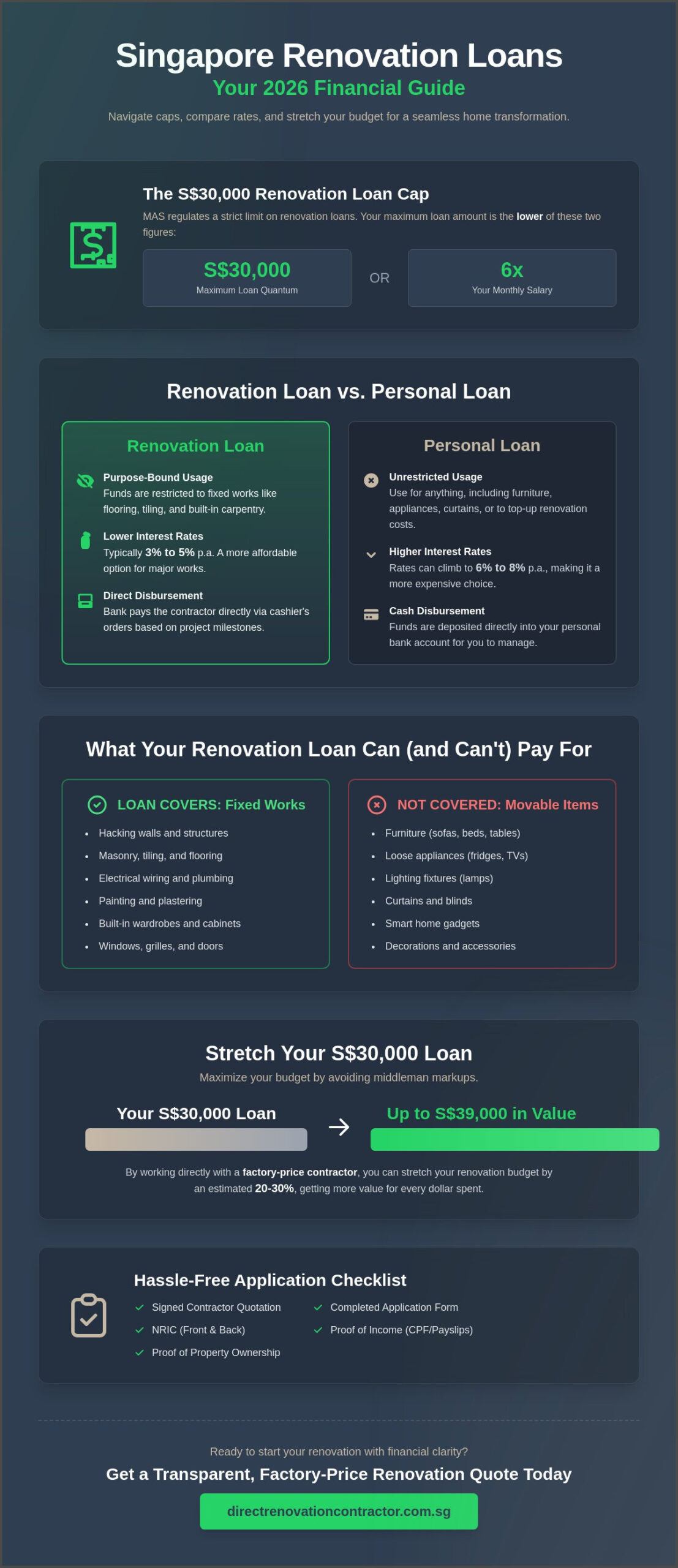
The S$30,000 cap is a standard MAS-regulated limit for specific reno loans. Banks strictly enforce this ceiling or limit the loan to six times your monthly salary, whichever is lower. This industry-wide restriction means that for large-scale projects involving extensive structural changes or premium materials, the loan might only cover a portion of the total cost. Banks calculate your maximum eligibility using the Total Debt Servicing Ratio (TDSR), which currently mandates that your total monthly debt obligations cannot exceed 55% of your gross income. If you’re renovating a 5-room HDB flat or a terrace house, you’ll likely need to supplement this loan with cash savings.
Renovation Loan vs. Personal Loan
Interest rates are the primary reason to choose a dedicated reno loan. These specialized loans are typically 1% to 3% cheaper than personal loans. Banks offer these lower rates because the loan is purpose-bound. Unlike a personal loan where the cash is deposited into your savings account, a renovation loan is disbursed directly to your contractor in stages. This ensures the money is spent on the property as intended.
- Interest Rates: Reno loans usually range from 3% to 5% p.a., while personal loans can climb to 6% or 8% p.a.
- Disbursement: The bank issues cashier’s orders to your contractor based on the quotation you provide.
- Usage: Reno loans cover “fixed” works like flooring, tiling, and built-in wardrobes.
You should consider a personal loan only as a “top-up” for non-fixed items. Since reno loans cannot be used for furniture, curtains, or loose appliances like refrigerators and washing machines, a personal loan fills that gap. Using the right renovation loan options singapore for the heavy lifting and a smaller personal loan for the finishing touches is a common strategy for savvy homeowners.
Comparing the Best Renovation Loans in 2026
Finding the right renovation loan options singapore requires looking past the advertised monthly installment. In 2026, the local lending market has shifted toward a mix of traditional stability and digital speed. While major banks remain the standard for heavy structural work, digital lenders now dominate the space for smaller, modular projects. You’ve got to weigh the upfront fees against the long-term interest to see which path fits your specific renovation scope.
Standard Bank Loans (DBS, OCBC, UOB)
Local banks like DBS, OCBC, and UOB are the most reliable choices for full-scale overhauls involving masonry, electrical rewiring, and extensive carpentry. In 2026, expect the Effective Interest Rate (EIR) to hover between 4.7% and 5.4% for most applicants. These banks often run promotional “flash deals” for existing mortgage customers, sometimes slashing the rate by another 0.2%. It’s a common mistake to ignore the handling fees. Most institutions charge between 1% and 2% of the approved loan amount as an admin cost. The DBS renovation loan is a frequent choice for many homeowners because it simplifies the application process through MyInfo and offers clear insurance coverage for the loan duration.
Digital and Alternative Lenders
Digital banks like Trust and GXS have gained significant ground for homeowners doing “light” renovations. If you’re just looking to refresh your kitchen cabinets or install new flooring, these platforms offer instant approval without the mountain of paperwork. The main advantage here is flexibility. You can choose repayment tenures from 1 to 5 years, which helps you balance your monthly cash flow without being locked into a rigid structure. Digital lenders are particularly useful for DIY projects where you’re buying materials separately. However, be aware that their interest rates can be slightly higher than traditional banks if you don’t have a high credit score.
When you’re comparing renovation loan options singapore, keep these three factors at the top of your checklist:
- Processing Fees: A 1% fee on a S$30,000 loan means S$300 is deducted before you even receive the funds.
- Late Payment Penalties: These can be as high as S$80 to S$100 per instance in 2026, which quickly eats into your renovation budget.
- Insurance Premiums: Most banks require a one-time insurance payment to cover the outstanding loan in case of death or total disability.
Sustainability is another major factor in 2026. Many banks now offer “Eco-aware” loans that provide interest rebates if you use low-VOC paints or install Grade 5 energy-efficient appliances. Since we focus on transparent pricing and direct contractor rates, we often see homeowners save even more by combining these green loan rebates with our factory-direct carpentry options. Choosing sustainable materials doesn’t just help the environment; it keeps your long-term utility bills and loan interest lower.
What Can Your Renovation Loan Actually Pay For?
Singapore banks maintain a strict line between fixed assets and movable items. You cannot treat a renovation loan like a standard personal loan. Lenders only fund works that add permanent value to the property. This means you can’t use the funds to buy a S$4,000 designer sofa or a smart fridge. If you compare renovation loans across different banks, you’ll find they all adhere to these basic MAS guidelines to ensure the loan stays tied to the home’s structure. This protects the bank’s interest and ensures the money is spent on the property itself.
Banks often conduct site inspections to verify progress. They don’t always release the full amount upfront. Instead, they disburse payments in stages based on completed works. If an inspector finds that the carpentry you claimed for hasn’t been started, they’ll withhold the next tranche of cash. This is why it’s vital to have a transparent, itemized quotation from the start. We provide clear breakdowns as a direct contractor so your bank knows exactly what they’re paying for. This prevents the “middleman” confusion that often stalls loan disbursements. Understanding your renovation loan options singapore requires knowing exactly what fits into the bank’s “allowable” bucket.
Allowable Works: The Green List
The green list includes any renovation work that is “built-in” or permanent. Banks want to see that the money is going into the flat’s bones. These items include:
- Flooring and tiling: Installation of vinyl, tiles, or parquet across the living room and bedrooms.
- Built-in carpentry: Custom kitchen cabinets, floor-to-ceiling wardrobes, and permanent TV consoles.
- Electrical and plumbing: Full rewiring of the unit, new pipe works, and basic bathroom fixtures.
- Structural works: Painting, hacking existing walls, and masonry work required for layout changes.
Prohibited Items: What Requires Cash
Anything that isn’t bolted down or permanently attached to the house is usually excluded. You’ll need to set aside separate cash or use a personal loan for these items. Prohibited costs include:
- Freestanding furniture: Beds, dining tables, and loose shelving units.
- Household appliances: Washing machines, refrigerators, and ovens.
- Soft furnishings: Curtains, blinds, and decorative lighting fixtures.
- Air-conditioning: Most banks consider AC units movable equipment rather than fixed renovation work.
It’s best to plan your cash flow early to avoid hitting a wall midway through your project. For a complete breakdown of what’s necessary for your project, refer to our guide on Home Renovation in Singapore. We focus on these essential works to ensure your loan application remains straightforward and your home stays functional.
Strategic Budgeting: Stretching Your S$30,000 Loan
In Singapore, most banks cap renovation loans at S$30,000 or six times your monthly salary. When you’re working with a fixed ceiling, your choice of partner determines how much “house” you actually get. Many homeowners don’t realize that hiring an interior designer (ID) often introduces a 20% to 30% middleman tax on every sub-contractor service. When you evaluate the renovation loan options singapore provides, you want that capital going into your floor tiles and kitchen cabinets, not into a firm’s overhead or design commissions.
Eliminating ID Markups
Direct contractors operate their own workshops. This means you get factory-direct pricing on carpentry, which is usually the most expensive part of a BTO or resale renovation. Paying for “design fees” with borrowed money is financially inefficient because you’re paying interest on a service that doesn’t add physical value to the property. You can see a full breakdown of these savings in this Direct Renovation Contractor Singapore Comparison. By cutting the middleman, your S$30,000 loan can cover an entire kitchen and built-in wardrobes for three bedrooms, rather than just the kitchen alone.
The Direct Contractor Advantage
How to Apply for a Renovation Loan: A Step-by-Step Checklist
Securing the right financing requires more than just a good credit score. Banks in Singapore follow a strict verification process to ensure funds are used specifically for home improvements. You must have a signed renovation contract ready before you even log into a bank portal. This document serves as the primary evidence for your loan amount. While evaluating the various renovation loan options singapore banks provide, you’ll notice that most applications are now handled digitally via Singpass for faster processing.
Most homeowners don’t realize that the bank never hands the cash to you directly. Instead, the bank pays the contractor in stages, often via cashier’s orders or direct transfers. This disbursement process protects the lender and ensures the money goes into your tiles, cabinets, and wiring rather than personal expenses. You’ll need to submit your contractor’s invoices to the bank at each milestone to trigger these payments.
Document Preparation
Singapore Citizens and PRs must prepare a specific set of documents to avoid delays. You’ll need your NRIC, the last 15 months of CPF contribution history, and your latest Income Tax Notice of Assessment. If you’ve just collected your keys, include your HDB Sales Order or a Property Tax Bill as proof of ownership. Banks are very particular about the details of your project.
- HDB and MCST Approvals: Many banks won’t release the first tranche of funds until you provide a valid HDB renovation permit or MCST approval for condo units.
- Itemized Quotations: Your contractor must provide a breakdown of costs. Vague descriptions like “living room works” will lead to rejection. Banks want to see specific costs for hacking, masonry, carpentry, and electrical wiring.
- Income Proof: Salaried employees usually need three months of payslips, while self-employed individuals must provide two years of tax assessments.
Detailed paperwork is the only way to ensure your renovation loan options singapore application gets approved on the first try. Missing a single signature on the quotation can set your timeline back by weeks.
Finalizing Your Project with Direct Renovation Contractor
We understand that the administrative side of a home makeover can be overwhelming. As a direct contractor, we eliminate the middleman, which means our quotes are straightforward and meet all banking requirements. We provide the itemized, transparent documentation you need to satisfy bank officers and secure your funding quickly. Our team is well-versed in HDB regulations and local building standards, ensuring that every line item on your quote is legitimate and necessary.
We assist homeowners by providing clear, professional contracts that facilitate smooth loan disbursements. Whether you’re renovating a BTO flat or a resale condo, our pragmatic approach ensures your project stays on budget and on schedule. You can Get a direct renovation quote for your loan application today and take the first step toward your dream home with total financial clarity.
Secure Your 2026 Home Transformation with Smart Financing
Navigating the various renovation loan options singapore homeowners have available requires a focus on both bank interest rates and the accuracy of your contractor’s quote. Most local banks cap renovation loans at S$30,000 or six months of your monthly income. You’ll need a precise, itemized breakdown of costs for hacking, tiling, and carpentry to secure approval without delays. Choosing a direct contractor eliminates the middleman markups that often inflate project costs by 20% to 30%.
Direct Renovation Contractor brings over 20 years of local experience as an HDB-registered firm. We provide the transparent, factory-direct pricing you need to make your loan go further. Our team handles the technical details and provides the documentation required by all major Singaporean financial institutions. We focus on quality workmanship and honest communication so your HDB or BTO project stays on track and within budget. You’ll get a clear picture of your expenses before the first hammer swings.
Get a Transparent Quote for Your Renovation Loan Application
Take the first step toward your new home today. We’re ready to help you build a space that lasts with practical solutions and fair pricing.
Frequently Asked Questions
Can I take multiple renovation loans from different banks?
You cannot take multiple renovation loans from different banks for the same property. Banks in Singapore use Credit Bureau Singapore (CBS) reports to verify your existing credit lines and ensure you don’t exceed the regulatory limit. The total borrowing cap is usually S$30,000 or six times your monthly salary across all banks combined. If your project requires more funding, you’ll need to explore other renovation loan options singapore offers, such as personal loans, to bridge the gap.
What is the typical interest rate for a renovation loan in Singapore in 2026?
Typical interest rates for renovation loans in 2026 range from 3.8% to 5.2% per annum. These rates are generally lower than personal loans because the funds are restricted to specific works like hacking, masonry, and carpentry. It’s important to compare the Effective Interest Rate (EIR) rather than just the advertised flat rate. The EIR provides a more accurate picture of your borrowing costs by accounting for processing fees and the reducing balance of your loan.
How long does it take for a renovation loan to be approved?
Approval typically takes between 1 and 5 working days provided your documentation is in order. You’ll need to submit your NRIC, latest 12 months of CPF contribution history, and a signed renovation contract from your contractor. At Direct Renovation Contractor, we provide transparent, itemized quotes quickly so you can start the application process without delay. Once the bank approves the loan, they usually disburse the funds via cashier’s orders made out directly to the contractor.
What happens if my renovation costs exceed the S$30,000 loan limit?
If your renovation costs go beyond the S$30,000 limit set by the Monetary Authority of Singapore, you must pay the difference in cash or take a personal loan. Personal loans don’t have the same spending restrictions but often carry higher interest rates, sometimes exceeding 6% or 7% p.a. We recommend focusing your loan budget on essential structural works first. This includes electrical wiring, plumbing, and built-in carpentry, while using cash for loose furniture or decorative items.
Do I need to be the owner of the property to apply for the loan?
You must be the legal owner or a joint owner of the property to qualify for a renovation loan. Banks require proof of ownership through your HDB MyInfo portal or a copy of the Sales and Purchase Agreement for private properties. If the property is under joint names, the application can be made by one owner or both as joint applicants. This ensures the bank is financing a permanent improvement to an asset you actually own.
Are there any processing fees for renovation loans?
Most banks in Singapore charge a one-time processing fee of 1% of the approved loan amount. This fee is usually deducted from the first disbursement, so you won’t receive the full amount in your bank account or cashier’s order. Some lenders also include a small administrative fee or a mandatory insurance premium to cover the loan in case of unforeseen events. Always read the fine print to avoid hidden costs that can eat into your renovation budget.
Can I use my CPF to pay for my renovation loan installments?
You cannot use your CPF savings to pay for renovation loan installments. CPF funds are strictly allocated for housing loan repayments, stamp duties, and legal fees related to the property purchase itself. Renovation is viewed as a personal expense rather than a core housing necessity by the government. You’ll need to ensure you have sufficient monthly cash flow to handle the repayments throughout the tenure of the loan.
What is the maximum tenure for a renovation loan in Singapore?
The maximum tenure for a renovation loan in Singapore is 5 years. Choosing a longer tenure reduces your monthly installment amount but increases the total interest you’ll pay over the life of the loan. Most homeowners opt for a 3 to 5-year period to balance affordability with interest costs. We suggest calculating your monthly commitments carefully to ensure the loan doesn’t strain your household finances during the 60-month repayment period.