

That 25% project management fee on your renovation quote isn’t a design charge; it’s a convenience tax you’re paying to avoid the stress of coordination. Learning how to manage your own renovation project is the single most effective way to keep your budget under control while ensuring your BTO or resale flat meets your exact standards. You likely feel that hiring an Interior Design firm is the only way to avoid a scheduling disaster or a rejected HDB permit application. It’s a common fear, especially when a single mistake in the hacking or plumbing sequence can lead to thousands of dollars in rectification costs.
We’re here to tell you that with the right framework, you don’t need a middleman. This guide provides the 2026 Direct Contractor Roadmap to help you master the sequence of works and coordinate sub-contractors like a pro. You’ll gain direct control over material quality and eliminate hidden markups from your final bill. We’ve mapped out a clear timeline of works, from initial MCST approvals and HDB permits to the final carpentry handover, so you can renovate with total confidence and technical clarity.
Key Takeaways
- Eliminate the 20-40% middleman markup by adopting a direct contractor model that prioritizes technical quality and financial transparency.
- Navigate HDB renovation permits and MCST regulations with ease to ensure your project remains compliant and avoids unnecessary site delays.
- Master the critical sequence of works and learn how to manage your own renovation project by coordinating hacking, plumbing, and electrical phases like a pro.
- Gain the confidence to decode contractor quotes and identify “provisional sums” to ensure you only pay fair S$ rates for materials and labor.
- Bridge the gap between DIY management and professional results by utilizing factory-direct carpentry and technical 3D planning support.
The Direct Approach: Why Manage Your Own Renovation Project in 2026?
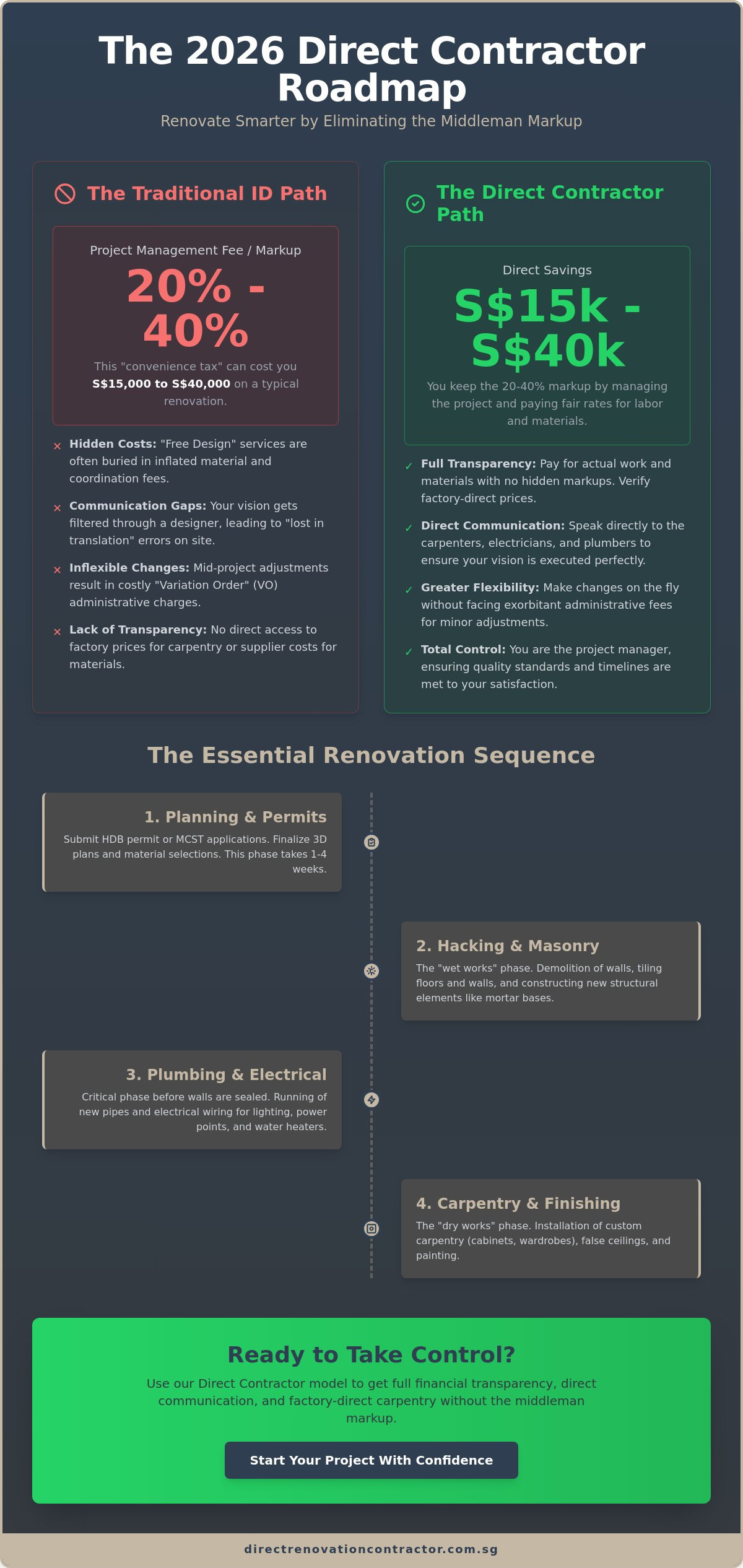
In the 2026 Singapore property market, savvy homeowners are shifting away from traditional design firms to regain control over their budgets. Managing your own renovation means you act as the primary project coordinator. Instead of hiring a single firm to handle everything, you source and manage individual trades like electricians, plumbers, and tilers yourself. This model isn’t just about being hands-on; it’s a strategic financial move. Most Interior Design (ID) firms in Singapore add a 20% to 40% markup on top of sub-contractor rates to cover their overheads and profit. By learning how to manage your own renovation project, you effectively keep that S$15,000 to S$40,000 in your own pocket.
For a broad overview of home improvement, it’s clear that taking control requires a larger time commitment but offers unmatched financial clarity. In 2026, with the rise of transparent pricing platforms and direct-to-factory carpentry options, the “Direct Contractor” model has become the gold standard for Singaporeans who value functional quality over expensive mood boards.
Direct Contractor vs. Interior Designer (ID)
An ID provides 3D visualizations and handles the scheduling. A direct contractor focuses on the technical execution of masonry, carpentry, and hacking. Don’t be fooled by “Free Design” marketing. These costs are almost always hidden within inflated material prices or “coordination fees.” For a standard BTO flat with a predictable layout, the ID’s design fee is often unnecessary. Resale flats are more complex due to aging pipes and old wiring, but a seasoned contractor can handle these technical requirements without an ID’s artistic markup. You provide the vision; the contractor provides the craft.
The Core Benefits of Going Direct
Choosing the direct route eliminates the “black box” of renovation pricing. You get full transparency over material origins and can verify factory prices for items like quartz countertops or custom wardrobes. This approach removes the middleman who often adds a premium to every tile and tap you select.
- Direct Communication: You speak directly to the person performing the masonry or carpentry. This eliminates “lost in translation” errors that occur when an ID miscommunicates your needs to the site foreman.
- No Hidden Markups: You pay for the actual labor and materials. There are no “management fees” disguised as material costs.
- Flexibility to Pivot: If you change your mind about a power point location or a paint color mid-way, you won’t face the heavy “Variation Order” (VO) administrative fees that ID firms typically charge.
By 2026, the tools available to homeowners make this process more manageable than ever. If you’re willing to spend a few hours a week on-site, understanding how to manage your own renovation project is the most effective way to ensure your S$50,000 renovation actually looks like a S$50,000 renovation, rather than a S$35,000 job with S$15,000 in commissions.
Mastering the Logistics: HDB Permits, MCST Rules, and 3D Planning
Learning how to manage your own renovation project requires a firm grasp of local regulations and technical planning. You aren’t just picking colors; you’re acting as the project manager who ensures the site stays legal and the neighbors stay happy. In Singapore, failing to secure the right permits can lead to heavy fines or orders to reinstate the property to its original condition.
Regulatory Compliance and Permits
If you’re renovating a flat, you must hire an HDB registered contractor for any structural or hacking works. These professionals understand which walls are load-bearing and which are non-structural. Approval timelines for HDB permits typically range from 7 to 21 working days, so submit your applications at least a month before your target start date.
For private condo owners, the Management Corporation Strata Title (MCST) dictates the workflow. You’ll usually need to place a renovation deposit, often ranging from S$1,000 to S$3,000, which is refundable if no common property is damaged. MCST rules are strict about:
- Working Hours: Most condos restrict noisy works to 9:00 AM – 5:00 PM on weekdays only.
- Lift Protection: Contractors must install base and side protection in the service lift before moving materials.
- Debris Management: Daily clearing of the common lobby is mandatory to avoid town council or management fines.
While Singapore has strict local laws, checking global standards for consumer protection from renovation fraud reminds us that clear documentation and vetting are your best defenses against project failure.
Visualising the Space Without an ID
Since you’re bypassing an Interior Designer, you must provide sub-contractors with technical 3D drawings. These aren’t just for aesthetics; they serve as your “technical contract.” A 3D render shows exactly where a power socket sits or how high a kitchen backsplash rises. Without these, you’ll face “I thought you wanted it there” excuses that lead to costly rework.
Use your floor plans to map out electrical and plumbing points early. Identify structural constraints like thick beams or load-bearing walls that cannot be touched. When you work with a direct contractor
The Essential Sequence of Works: Coordinating Your Renovation Timeline
Understanding the logical flow of a site is the most critical skill when you learn how to manage your own renovation project. Mistakes in sequencing lead to expensive re-work and wasted materials. A standard Singapore home renovation follows a five-phase structure that ensures no trade interferes with the work of another.
- Phase 1: Hacking and Demolition. We clear the old structures first. This includes removing floor tiles, hacking walls, and dismantling old built-in cabinets. Ensure your contractor secures the necessary HDB or MCST permits before the hammers start swinging.
- Phase 2: First-Fix M&E. Electricians and plumbers run concealed wires and pipes. This must happen while the walls are bare and before any plastering or tiling begins.
- Phase 3: Masonry and Wet Works. This involves floor leveling, wall plastering, and tiling. In Singapore’s humid climate, expect a 4 to 7 day drying period for cement screed before any flooring can be laid.
- Phase 4: Carpentry and Painting. Once the site is dry and clean, we apply the first coat of paint. Custom cabinets are then brought in for installation.
- Phase 5: Final-Fix and Cleaning. We install light fixtures, switches, and taps. The project concludes with a professional chemical wash to remove construction debris and grout haze.
Why Order Matters: Avoiding Re-work
Your electrical wiring must be completed before the false ceiling goes up. If you forget a data point or a downlight cable, the ceiling specialist has to cut holes in finished gypsum boards. This adds S$200 to S$500 in unnecessary repair costs. We also advise installing air-conditioning indoor units only after heavy masonry and sanding are finished. Fine dust from cement and wood can clog new filters and damage cooling coils. Always lay heavy-duty floor protection before your carpentry arrives. Moving large cabinets can easily chip brand-new tiles if the floor isn’t shielded properly.
Managing Lead Times for Materials
Successful project management relies on your ability to look ahead. Order your tiles and sanitary ware at least 4 weeks before the masonry phase starts. Delays in tile delivery can stall your entire project for weeks because the plumber and carpenter can’t start until the floor is set. For custom furniture, the fabrication timeline is strict. A carpenter singapore can only take final measurements after the flooring and wall plastering are done. From that point, expect a 14 to 21 day lead time for factory fabrication. Understanding these gaps is essential when you’re figuring out how to manage your own renovation project without hitting a dead end.
Managing Sub-Contractors Without the Middleman Markup
Learning how to manage your own renovation project means stepping into the role of a site supervisor. You’re responsible for the timeline and the quality of the finish. Communication must be technical and direct. Don’t tell a worker to “make the wall look nice.” Instead, specify that you want a smooth plaster finish or a specific tile grout width. If you’re vague, you’ll get results that don’t match your vision.
Examine every quote for “provisional sums.” These are estimated costs for items not yet finalized. If a contractor quotes S$2,000 for tiles as a provisional sum but your actual material choice costs S$3,500, you’re on the hook for the difference. Always ask for a breakdown of exclusions like haulage fees or debris removal. These can add S$500 to S$1,500 to your final bill if they aren’t listed upfront. Setting a strict payment schedule is your best leverage. A typical 10-40-40-10 split keeps the project moving. Never pay 100% upfront; hold the final 10% until all rectifications are complete.
Talking to the Trades
When you work with a direct renovation contractor singapore for masonry and hacking, clarity is vital. For electrical walk-throughs, don’t just point. Use a pencil to mark exact socket positions on the raw walls. When checking tiling work, use a 1.2m spirit level to ensure surfaces are flat. Tap tiles with a coin to check for “hollow” sounds, which indicate poor mortar coverage that could lead to future cracking.
Avoiding Common DIY Pitfalls
The “Cheap Contractor” trap is a common mistake when you learn how to manage your own renovation project. A quote that’s 30% lower than others often hides poor material quality or leads to endless “Variation Orders” (VOs) later. Protect yourself by documenting everything. Use a dedicated WhatsApp group for each trade to send photos of progress and site issues. This creates a timestamped paper trail for any disputes. Additionally, you must ensure Workplace Safety and Health (WSH) compliance. As the project manager, you’re responsible for ensuring workers use proper ladders and that the site remains free of tripping hazards like loose wires or debris piles.
Get a transparent quote from our direct renovation team today.
Scaling Your Success: How Direct Renovation Contractor Supports Your DIY Journey
Learning how to manage your own renovation project is a major milestone for any homeowner, but you don’t have to do it entirely alone. Direct Renovation Contractor provides the technical infrastructure that DIY project managers often lack. We offer a DIY Renovation Support Package that includes professional 3D drawings and a vetted list of sub-contractors. This package bridges the gap between your vision and the actual construction process. You get the control you want with the safety net of a seasoned builder.
One of the biggest advantages we provide is direct access to our own carpentry factory. Most interior design firms outsource their cabinetry and add a significant markup to the final price. By working with us, you get factory-direct pricing on wardrobes, kitchen cabinets, and feature walls. This transparency is a core part of our business model. We also offer standardised home renovation packages for BTO and Resale flats. These packages help you establish a realistic budget from day one, covering essential works like masonry, plumbing, and electrical installations without hidden costs.
Utilising Professional Documentation
Our 3D drawings are more than just pretty pictures. They serve as your technical blueprint. These documents specify exact measurements for hacking, tiling, and carpentry layouts. When you show these to sub-contractors, it eliminates guesswork and prevents expensive mistakes on site. Having professional documentation ensures that every worker is on the same page regarding your expectations.
We also provide you with our curated list of trusted sub-contractors. These are the same professionals we use for our full-service projects. You won’t have to spend weeks scouring forums or dealing with unreliable freelancers. Additionally, our supplier network gives you access to wholesale rates for materials. This direct-to-source approach is the most effective way to keep your project within a reasonable budget, especially for 4-room and 5-room HDB flats where material costs can escalate quickly.
Your Next Steps to a Successful Renovation
The first step in mastering how to manage your own renovation project is getting an accurate site measurement. Whether you have a new BTO, a resale HDB, or a private condo, we provide professional site assessments to verify your floor plan dimensions. This step is critical before you order any materials or sign any sub-contractor agreements. Accuracy at this stage prevents delays during the actual build.
We encourage you to review our gallery of past direct-contractor projects. You’ll see the quality of our carpentry and masonry work across various Singaporean housing types. Our portfolio reflects our commitment to functional, high-quality results rather than abstract design concepts. If you’re ready to take the lead on your home makeover while saving on middleman fees, we’re here to provide the technical support you need. Start your savings journey today by booking a consultation with our team.
Take Control of Your 2026 Home Transformation
Successful project management boils down to technical knowledge and disciplined scheduling. By mastering HDB permit requirements and following a strict sequence of works, you eliminate the confusion that often leads to costly delays. Learning how to manage your own renovation project empowers you to bypass traditional interior design markups, putting your hard-earned money directly into high-quality masonry and carpentry instead. It’s about being the boss of your own site while relying on experts for the heavy execution.
At Direct Renovation Contractor, we back your DIY journey with over 15 years of technical execution experience in the Singapore market. As an HDB Registered Contractor, we provide the structural integrity and reliability your home deserves. You’ll benefit from direct factory pricing on carpentry and a transparent process that leaves no room for hidden charges. We focus on straightforward communication and functional results, ensuring your renovation stays on track and within budget. Your vision is achievable when you have a partner who speaks the language of construction.
View our DIY Renovation Support Packages and Direct Contractor Lists to start your project with confidence. You’ve got the roadmap; now it’s time to build a home that reflects your standards and your savings.
Frequently Asked Questions
Is it really cheaper to manage my own renovation in Singapore?
Yes, you can save between 20% and 30% on your total bill by eliminating interior designer markups and project management fees. When you learn how to manage your own renovation project, you pay factory prices for carpentry and direct rates for masonry work. You’re trading your own time for these savings, as you’ll handle the coordination that an ID typically charges a 10% to 15% service fee to manage.
What are the biggest risks of not hiring an interior designer?
The biggest risks involve technical errors in site measurements and poor sequencing of different trades. Without an ID, you’re responsible for ensuring that electrical points don’t clash with your carpentry or plumbing. If a mistake happens, you’ll have to pay for the rectification costs yourself. You also won’t have 3D renders, so you must rely on your own sketches and material mood boards to visualize the final result.
How do I apply for an HDB renovation permit myself?
You can’t apply for an HDB renovation permit personally because only an HDB Registered Renovation Contractor is authorized to submit applications via the e-Corenet system. You must provide your chosen contractor with a signed authorization form and your official floor plan. Most permits are processed within 3 working days, though hacking approvals for certain walls can take up to 21 days if structural assessments are required by HDB.
How long does a DIY-managed HDB renovation typically take?
A DIY-managed renovation usually takes 10 to 14 weeks for a standard 4-room BTO flat. Resale units often require 16 weeks or more due to extensive hacking and rewiring needs. Because you aren’t a full-time coordinator, it’s wise to expect a 2-week buffer for scheduling overlaps between different sub-contractors like tilers and painters. Efficient scheduling is the only way to avoid paying extra months of mortgage without moving in.
Can I hire sub-contractors individually or do I need a main contractor?
You can hire sub-contractors individually for every trade, but it’s more efficient to hire a direct main contractor for the heavy lifting. Managing ten separate groups like plumbers, electricians, and floorers requires constant on-site presence and technical knowledge. A direct contractor handles the core masonry and wet works while allowing you to bring in your own specialists for things like smart home systems or custom window dressings.
What happens if a sub-contractor does a poor job and I don’t have an ID?
How much time per week do I need to spend on-site?
Plan to spend at least 10 to 15 hours per week on-site during active work phases. You should visit every morning to brief the workers and every evening to check the day’s progress against your plans. During critical stages like electrical positioning or carpentry installation, you’ll need to be there for 4 to 5 hours at a time to make immediate decisions on the spot and prevent costly errors.
What is the correct order of renovation works for an HDB flat?
The standard sequence starts with hacking and clearing debris, followed by masonry and wet works. Next, you’ll run electrical wiring and plumbing pipes before the false ceiling is installed. After the walls are prepped and the first coat of paint is applied, your carpentry is installed. Final steps include light fixtures, the second coat of paint, and professional cleaning. This specific order prevents new installations from getting damaged by heavy construction.