
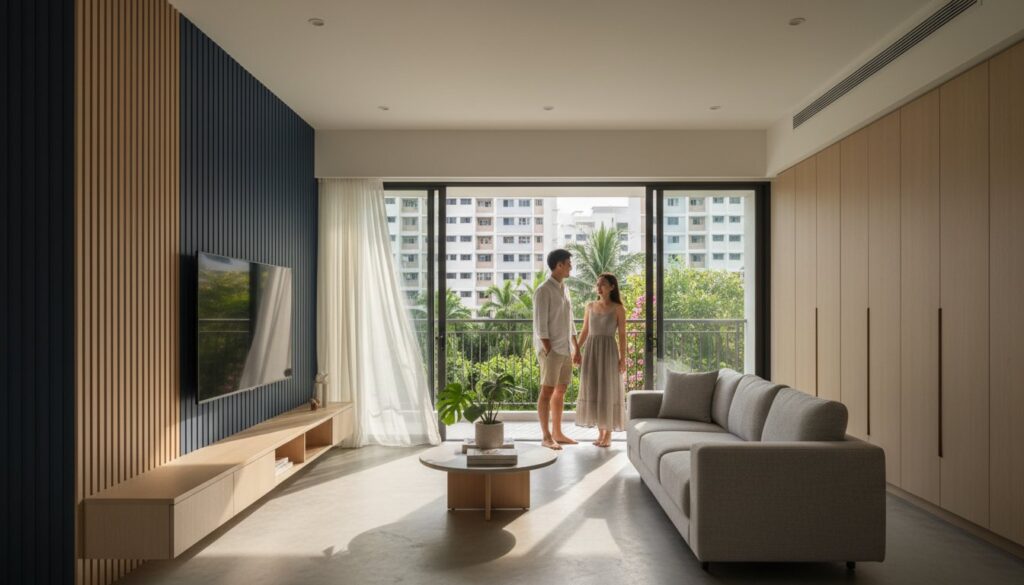
You could be paying upwards of S$15,000 in hidden markups just for the luxury of having a middleman manage your 3D drawings. Most homeowners believe that hiring an interior design firm is the only way to ensure a quality hdb renovation in singapore, but that’s often a costly misconception. You’ve likely felt the frustration of looking at a quote where coordination fees eat up 25% of your total budget. It’s natural to worry that skipping the ID means sacrificing workmanship or getting tangled in confusing HDB permit paperwork.
This guide changes that by providing the direct contractor’s perspective on the 2026 renovation market. We’ll show you how to secure factory prices for your carpentry and masonry while managing structural requirements with confidence. You’ll gain access to a transparent breakdown of current S$40,000 to S$85,000 project costs and a realistic 10 week timeline. We’ll walk through every technical stage from hacking and tiling to the final handover; this ensures you get a high quality home without the unnecessary middleman markup.
Key Takeaways
-
Understand the technical differences between BTO and resale requirements to optimize your project scope and avoid unnecessary structural expenses.
-
Learn how to eliminate middleman markups by engaging a direct contractor for transparent, factory-direct pricing on carpentry and masonry.
-
Review the 2026 cost benchmarks for all HDB flat sizes in S$ to plan your budget accurately against current GST and material rates.
-
Navigate the essential HDB permits and BCA safety regulations required for a fully compliant and worry-free hdb renovation in singapore.
-
Master the sequential phases of execution, from protection and hacking to final handover, to ensure technical excellence at every stage of the build.
Table of Contents
The 2026 HDB Renovation Landscape: BTO vs. Resale
An hdb renovation in singapore is the technical process of modifying a flat while strictly following Housing & Development Board (HDB) and Building and Construction Authority (BCA) safety codes. It’s not just about aesthetics; it’s about structural compliance. Since over 78% of residents live in public housing in Singapore, these regulations ensure the entire block remains safe for everyone. In 2026, the "Direct Contractor" model has become the preferred choice for homeowners. People are tired of paying 20% to 30% markups to middleman firms. They want factory prices and direct communication with the people actually doing the hacking and tiling.
The 2026 landscape is split clearly between new Build-To-Order (BTO) units and older resale flats. BTO owners benefit from a "clean slate" advantage. You don’t need to spend thousands on demolition. Instead, your budget goes toward high-quality carpentry and premium floor finishes. Resale buyers face a different reality. They deal with aging infrastructure that requires heavy hacking, complete re-wiring, and plumbing overhauls. Choosing the right path depends on your appetite for technical complexity and your total budget in Singapore Dollars (S$).
BTO Renovation Essentials
New BTO owners must respect the 3-year restriction on hacking bathroom floor and wall tiles. This rule protects the waterproofing membrane installed by HDB. If you want a different look, you must use overlaying methods, which typically cost S$4.00 to S$8.00 per square foot for labor and materials. Modern BTO layouts are getting smaller, with 4-room flats averaging 93 square meters in 2026. You need smart carpentry to maximize space. Focus your first-move works on these essentials:
-
Full-height kitchen cabinets using high-pressure laminates for durability.
-
Professional LED lighting plans to eliminate dark corners in compact rooms.
-
Low-VOC painting for a move-in ready environment.
-
Custom wardrobes that utilize vertical space up to the ceiling.
Resale Flat Overhaul Strategies
Resale projects require a more aggressive approach to ensure long-term habitability. Hidden costs often lurk behind old built-ins. Expect to pay between S$800 and S$2,500 just for dismantling and disposing of old furniture and debris. If the flat is older than 20 years, re-wiring and re-plumbing are non-negotiable. Old electrical circuits can’t handle modern appliances, and rusted galvanized iron pipes will eventually leak. Your hdb renovation in singapore must prioritize these structural fixes over decorative features. For resale buyers looking to avoid these unexpected costs, a comprehensive hdb resale renovation package can provide transparent pricing and eliminate the guesswork around essential structural works. We always recommend checking for these specific issues before signing a contract:
-
Spalling Concrete: Look for cracks or peeling paint on the ceiling, especially in bathrooms.
-
Water Leakage: Check for damp patches on walls shared with toilets or kitchens.
-
Floor Levelling: After hacking old tiles, you often need a cement screed to ensure the new floor is perfectly flat, costing about S$5.00 per square foot.
Working directly with a contractor in 2026 means you get a transparent breakdown of these costs. There are no hidden "coordination fees" or "design royalties." You pay for the materials, the labor, and the technical skill required to get the job done right. This pragmatic approach is the only way to stay on budget while ensuring your home remains a safe, functional space for the next two decades.
Interior Designer vs. Direct Contractor: Which is Right for You?
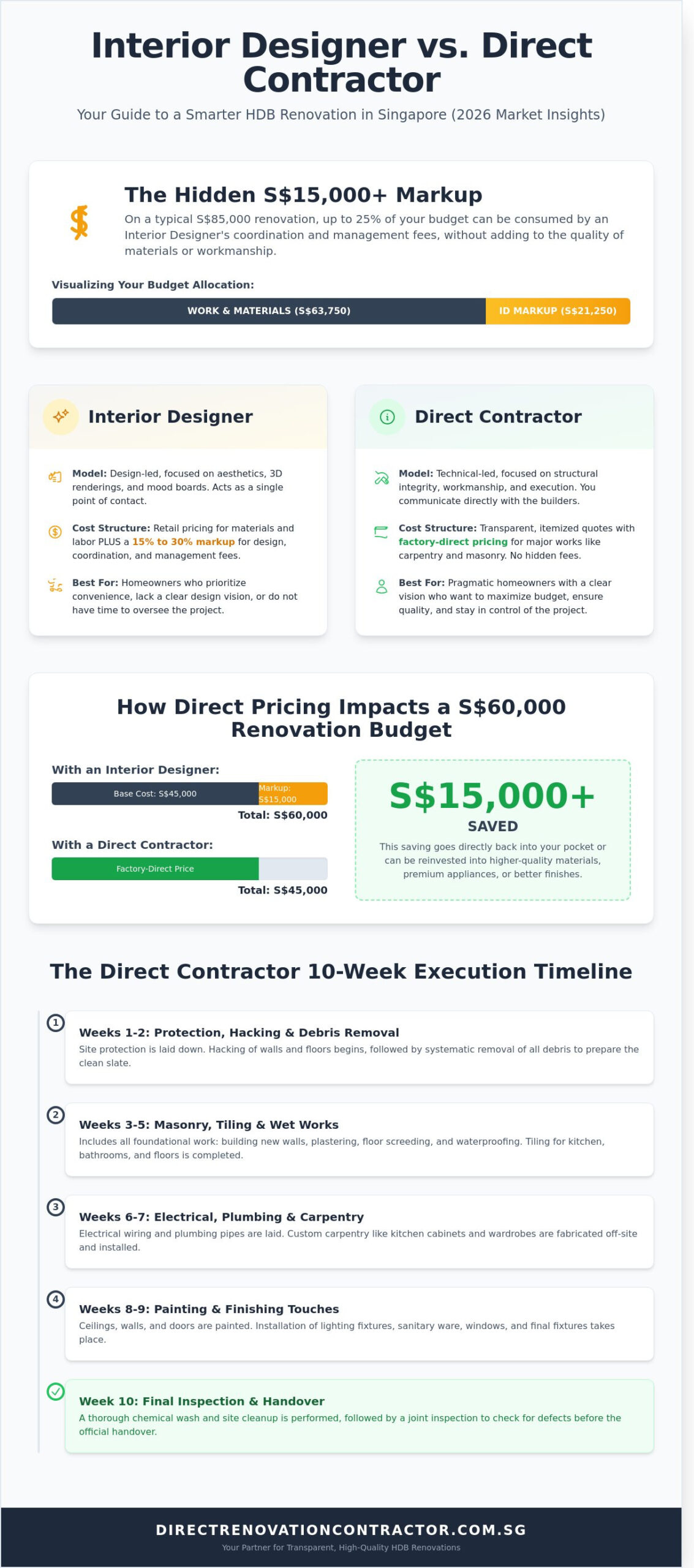
Deciding between an Interior Designer (ID) and a Direct Contractor is the first major hurdle for any hdb renovation in singapore. These two paths offer very different experiences in terms of cost, creative input, and project management. IDs operate on a design-led model. They focus on conceptual visuals, mood boards, and 3D renderings to help you visualize a dream home. This convenience comes at a premium price. Typically, ID firms add a markup of 15% to 30% on top of the actual cost of materials and labor to cover their overheads and management services. This model suits busy homeowners who don’t have a clear design vision or the time to oversee daily site progress.
The Direct Contractor model is technical-led and prioritizes structural integrity and cost efficiency over artistic flair. You pay for the actual work performed without the creative "fluff." Direct contractors often own their own carpentry workshops or maintain long-standing relationships with specific factories. This allows them to offer factory-direct pricing on essential items like kitchen cabinets and wardrobes. This is the logical choice for pragmatic owners who want maximum value for every dollar spent. If you already know where you want your power points and what color your tiles should be, hiring a contractor directly can save you thousands of dollars.
The "Hidden" Markups in ID Quotes
When you review an ID quote, the line items for tiling or hacking often look standard at first glance. However, these prices usually include a hidden coordination fee that isn’t explicitly stated in the contract. Direct contractors offer "unmarked-up" pricing for masonry and carpentry because they manage the trades directly without an intermediary layer. For those who still want a visual guide, the DIY Support Package is a modern solution. It provides professional 3D architectural drawings for a flat fee, often ranging from S$600 to S$1,200. This gives you the visual clarity of an ID without the permanent markup on every square foot of your home.
Managing Your Own Project: Is It Hard?
There is a common myth that you need an ID to prevent a renovation from collapsing into chaos. In reality, a main contractor handles the heavy lifting of coordinating core trades like masonry, plumbing, and electrical works. You don’t need to stand on-site every hour to ensure tiles are laid straight. Your primary responsibility is selecting finishes and ensuring the work aligns with the HDB renovation guidelines to avoid legal issues with unauthorized hacking or structural changes.
The process of an hdb renovation in singapore is much more manageable when you use tools like 3D drawings and curated supplier lists for lights and bathroom fixtures. Most technical contractors provide a clear schedule of works, so you know exactly when the plumber or electrician is arriving. If you’re looking to skip the middleman and work directly with the builders who actually do the work, you can check our transparent project rates to see the potential savings for your floor plan. This approach puts you in the driver’s seat, ensuring that your budget goes toward high-quality materials rather than administrative commissions.
HDB Renovation Cost Guide Singapore 2026
Budgeting for your hdb renovation in singapore in 2026 starts with a reality check on current market figures. Prices haven’t stayed stagnant since the post-pandemic surge. Labor costs rose by 12% over the last two years, and the 9% GST is now a fixed reality in every professional quotation. While material supply chains have stabilized, the cost of raw components like aluminum, glass, and specialized cement has seen a 7% upward adjustment since late 2024. Practical homeowners must account for these shifts before signing any contract.
Direct contractors provide a clear advantage in this environment. By removing the middleman, you’re looking at a 20% to 30% reduction in overall project fees. Homeowners should refer to a comprehensive HDB Renovation Cost Guide 2026 to align their expectations with current bank loan ceilings. On average, a 3-room flat renovation starts at S$35,000, while 5-room flats frequently cross the S$85,000 mark depending on the complexity of the masonry and carpentry involved.
Estimated Budget Breakdowns by Flat Type
For a new BTO 4-room flat, a realistic 2026 budget sits between S$25,000 and S$40,000. This range covers essential lighting, basic carpentry, and painting. It assumes the developer’s flooring is kept. If you’re tackling a resale 4-room unit, prepare to budget S$50,000 to S$80,000. Resale projects require heavy hacking, full electrical rewiring, and new plumbing, which adds S$15,000 to S$25,000 to the base cost alone. Spend your money on high-use areas like kitchen carpentry. Save by opting for vinyl flooring over tiles in bedrooms; it’s faster to install and costs roughly S$3.50 to S$6.50 per square foot.
The Cost of Carpentry: Linear Foot Guide
Carpentry is usually the largest line item in any hdb renovation in singapore. In 2026, kitchen cabinets range from S$130 to S$195 per linear foot (pfr). The price fluctuates based on the internal carcass material and the countertop choice. Laminate remains the budget-friendly standard. For countertops, quartz at S$110 pfr offers the best balance of price and durability. Sintered stone is the premium choice, often exceeding S$170 pfr due to its heat and scratch resistance.
Wardrobe costs also vary by door type. Casement doors are typically S$15 cheaper per linear foot than sliding doors because they require less complex track hardware. Factory-direct carpentry is the smartest way to save in 2026. When your contractor owns the production workshop, you avoid the markups that design firms add when they outsource the fabrication work.
Common 2026 service rates for HDB flats include:
-
Hacking: S$600 to S$950 per wall, depending on thickness and reinforcement.
-
Tiling: S$12 to S$20 per square foot, including labor and cement screed.
-
Painting: S$1,700 to S$2,900 for a 4-room flat using 3 colors and anti-mould sealer.
-
Electrical: S$60 to S$90 per new power point.
Don’t ignore the hidden costs of haulage and debris clearance. These usually add S$800 to S$1,500 to your final bill. Always ask for a transparent breakdown of these preliminaries. A reputable contractor won’t hide these fees in a lump sum. They’ll list them clearly so you know exactly where every dollar of your hard-earned savings is going.
Navigating HDB Rules, Permits, and Compliance
You can’t start an hdb renovation in singapore without knowing the rulebook. HDB isn’t being difficult for the sake of it; they’re protecting the structural integrity of the entire block. Every homeowner must engage a contractor from the Directory of Renovation Contractors (DRC). Hiring an unlisted contractor is a criminal offense that can lead to a fine of up to S$5,000. As a direct contractor, we deal with these regulations daily. We don’t just follow the rules to avoid fines; we follow them to ensure your home remains safe for the next 20 years. The Building and Construction Authority (BCA) also plays a massive role, specifically regarding window safety and structural alterations. By 2026, HDB has streamlined permit applications through the MyHDBPortal, but the technical requirements remain as strict as ever.
Essential Permits You Cannot Ignore
Wall hacking is the most common permit request we handle. You cannot simply knock down any wall to create an open-concept kitchen. Load-bearing walls are off-limits. For non-load-bearing walls, HDB often requires a Professional Engineer (PE) to certify that the hacking won’t affect the building’s stability. We coordinate directly with PEs to get these endorsements, ensuring you don’t face stop-work orders.
Window replacement is another high-stakes area. Only BCA-approved window installers can perform this work. Since 2004, strict legislation has been in place to prevent falling windows. We ensure all rivets and stainless steel screws meet the SS 212 standard. For plumbing, you’re restricted from relocating floor traps or certain discharge pipes. HDB rules prevent these changes to stop leaks from affecting the neighbor in the unit below yours. We provide transparent advice on what’s possible so you don’t waste money on illegal layouts.
Working within HDB Timeframes
Renovation noise is the leading cause of neighbor disputes. HDB mandates standard working hours from 9:00 AM to 6:00 PM on weekdays. No renovation work is allowed on Saturdays, Sundays, or Public Holidays. Noisy works like hacking and drilling are even more restricted; they must stop by 5:00 PM on weekdays. If you ignore these hours, expect a visit from HDB officers and a potential halt to your project.
-
The 3-Month Rule: For new BTO flats, you must complete your renovation within three months of the permit issue date.
-
Resale Timeline: Resale flat owners have a shorter four-month window for the entire project, with noisy works limited to the first month.
-
Digital Tracking: In 2026, HDB uses real-time digital permit tracking. Approval for standard works now takes between 7 to 14 working days, provided all technical drawings are accurate.
Managing neighbor relations is part of our process. We recommend informing your neighbors at least five days before hacking starts. A simple notice on the lift lobby board or a polite knock on the door goes a long way. It’s about maintaining a good living environment while we transform your space. We handle the heavy lifting and the paperwork so you can focus on your move-in date.
Don’t risk your deposit on contractors who cut corners with HDB regulations. Get a transparent quote from a direct renovation contractor who knows the rules inside out.
The Step-by-Step Execution: From Hacking to Handover
Executing a successful hdb renovation in singapore requires a disciplined timeline. Most projects span 8 to 12 weeks, depending on the complexity of the carpentry and masonry. We break the process into five distinct phases to ensure technical accuracy and financial transparency.
-
Phase 1: Protection and Hacking. We start by protecting the lift lobby and internal flooring with heavy-duty plastic or corrugated sheets. Hacking involves removing old tiles, built-in cabinets, and non-structural walls. It’s the loudest phase and requires strict adherence to HDB’s permitted hours.
-
Phase 2: Masonry and Plumbing. This is the "wet work" stage. We build shower curbs, kitchen bases, and lay the floor and wall tiles. Plumbing pipes are rerouted and concealed during this period.
-
Phase 3: Electrical and False Ceiling. Our electricians run new wiring and data points. If you’ve opted for cove lighting or recessed downlights, we install the false ceiling structures now to hide the conduits.
-
Phase 4: Carpentry and Flooring. Once the site is dry and dusty works are minimized, we bring in the custom cabinets. Vinyl or laminate flooring is usually laid just before or after carpentry to prevent scratches.
-
Phase 5: Painting and Final Cleanup. We apply a sealer coat and two coats of premium paint. A professional cleaning crew then performs a chemical wash to remove cement stains and construction dust.
The Importance of Masonry and Tiling
Waterproofing is the most critical technical step in your kitchen and bathrooms. We perform a mandatory 24-hour ponding test to ensure there are zero leaks into the unit below. For materials, homogeneous tiles remain the top choice for durability because the color runs through the entire tile. Large-format porcelain tiles are trending for 2026 as they minimize grout lines, making small HDB toilets feel larger. You must perform a "hollow tile" check by tapping the center and corners of laid tiles. If it sounds hollow, the cement bond is insufficient and the tile will eventually crack.
This level of technical detail is where specialist renovators excel. For inspiration on high-quality kitchen and bathroom projects, you can discover WDC Services and see how a leading Melbourne-based firm approaches their work.
Custom Carpentry: The Heart of the Home
We handle fabrication at our local workshop rather than on-site. This keeps your home cleaner and ensures precision cuts using industrial machinery. Once the carcasses arrive at your unit, our installers align them against the walls, which are rarely perfectly straight in older HDB flats. We use fillers to close gaps for a seamless look. After the cabinets are secured, we install the worktops. The process concludes with a joint defect inspection. We check every hinge, drawer runner, and edge band to ensure the finish meets our professional standards before the official handover.
Start Your 2026 Renovation Journey
Securing a reliable partner for your hdb renovation in singapore starts with a transparent, itemized quote. You should never accept a "lump sum" figure that hides middleman markups. We recommend visiting our carpentry factory to see the raw materials and workmanship before you sign any contract. This gives you peace of mind that you’re paying for quality, not just marketing fluff. Ready to see the difference a direct contractor makes? Get a direct renovation quote from Direct Renovation Contractor Singapore and start your journey with a clear, honest budget today.
Secure Your 2026 Move-In Date with Practical Planning
Successful hdb renovation in singapore requires a firm grasp of HDB compliance and a realistic 2026 budget. You’ve learned how BTO and resale timelines differ; now it’s time to focus on the technical execution. Choosing a direct contractor allows you to bypass the 20% to 30% markups often added by interior design firms. This approach ensures your funds go directly into quality masonry and durable tiling rather than abstract design fees.
This principle of direct sourcing is a global trend for savvy property owners. In other markets, such as the UK, specialised suppliers like Romford Fencing Ltd offer similar benefits by providing materials directly to the public and trade, cutting out costly intermediaries.
For homeowners seeking comprehensive guidance on the entire renovation process, our detailed home renovation planning and execution guide provides additional technical insights and cost-saving strategies that complement the HDB-specific advice in this article.
Direct Renovation Contractor Singapore offers the reliability you need. We’re an HDB Registered Contractor that provides factory-direct carpentry pricing and eliminates hidden ID coordination fees. We don’t hide behind flowery language; we focus on the S$40,000 to S$90,000 practicalities of your build. Every project follows a strict timeline from hacking to handover to ensure you move in on schedule. Your home deserves a builder who values technical skill and financial transparency above all else.
Skip the ID markups; Get a Direct Contractor Quote Today
We’re ready to help you build a home that’s as sturdy as it is functional. Let’s get your renovation started on the right foot.
Frequently Asked Questions
Do I really need an interior designer for my HDB renovation?
You don’t need an interior designer if you have a clear vision and want to save 20% to 30% on middleman markups. Direct contractors handle the technical execution like masonry and carpentry without the design fee. This approach works best for homeowners who prefer functional results over abstract mood boards. You’ll deal directly with the people doing the hacking and tiling, ensuring transparent pricing from the start.
How long does a typical HDB renovation take in 2026?
A standard hdb renovation in singapore typically takes between 8 and 12 weeks to complete in 2026. This timeline accounts for the current 4 week lead time for custom carpentry fabrication and 2 weeks for wet works like tiling. BTO units usually lean toward the 8 week mark, while resale flats requiring extensive hacking and rewiring often push closer to 14 weeks. We provide a 100% transparent schedule before work begins.
Can I stay in my HDB flat while it is being renovated?
You shouldn’t stay in the flat during major works like hacking or floor polishing. Dust levels can exceed 150 micrograms per cubic meter during hacking, which is a health risk. While minor carpentry installation might be manageable, the lack of water or electricity during toilet renovations makes staying nearly impossible. Most homeowners move out for at least 45 days to ensure the project stays on track without safety hazards.
What are the most expensive parts of an HDB renovation?
Carpentry and masonry typically account for 60% of your total renovation budget. In 2026, a full kitchen cabinet set can cost between S$5,000 and S$8,000, while tiling a single bathroom often starts at S$3,500. Hacking walls is another major expense, often costing S$800 to S$1,200 per wall including haulage. Choosing a direct contractor eliminates the 15% project management fee often added to these technical works.
Is vinyl flooring better than tiles for an HDB flat?
Vinyl is 40% cheaper than tiles because it doesn’t require cement screeding or heavy masonry. It’s a dry installation that takes 2 days for a whole flat, compared to 10 days for tiling. However, tiles are more durable for wet areas and last 20 years longer than vinyl. We recommend vinyl for bedrooms to save costs and homogeneous tiles for living rooms to ensure long term structural integrity.
What happens if my contractor finishes the renovation late?
Your contract should include a Liquidated Damages clause specifying a daily penalty fee, usually S$50 to S$100, for every day past the agreed completion date. This ensures the contractor is held accountable for delays. In 2026, standard hdb renovation in singapore contracts include a 14 day grace period for unforeseen material shortages. Always check that your payment milestones are tied to work progress rather than calendar dates to protect your finances.
Are there any renovation works that do not require an HDB permit?
You don’t need a permit for painting, installing window grilles, or fitting wardrobes that don’t involve structural changes. About 70% of cosmetic upgrades fall into this category. However, hacking any wall or replacing floor finishes always requires a formal HDB permit. We handle all permit applications directly with the authorities to ensure your renovation complies with the latest 2026 building codes and safety regulations.
How do I check if a contractor is truly HDB registered?
Check the HDB Directory of Renovation Contractors using the company’s UEN or name on the official e-Service portal. A registered contractor must have attended the HDB renovation training course and maintained a clean record for at least 3 years. We display our registration number on every quote to provide full transparency. Working with an unregistered firm can lead to a fine of up to S$5,000, so always verify credentials before signing. For a comprehensive verification process and detailed checklist to ensure you’re hiring a legitimate contractor, our HDB registered contractor checklist guide provides step-by-step instructions to protect your investment and avoid costly legal issues.