
A single unauthorized hacking mistake can lead to a S$5,000 fine and permanent structural damage to your block. It’s a risk no Singaporean homeowner should take just to save a few dollars on their BTO or resale flat. We understand that you want the cost savings of a direct contractor but feel anxious about HDB stop-work orders or confusing permit requirements. You shouldn’t have to choose between a fair price and a legal, safe renovation.
This guide ensures your project stays on track by providing a definitive checklist for hiring an hdb registered contractor. By following these steps, you’ll gain the confidence to manage your renovation without paying hefty middleman markups to interior design firms. We’ll cover everything from verifying license numbers on the HDB e-Core portal to managing the 2026 permit timeline, ensuring your home passes every inspection without a hitch. You’ll learn exactly how to secure direct factory pricing for your masonry, carpentry, and tiling work while staying 100% compliant with local housing regulations.
Key Takeaways
- Understand why hiring an hdb registered contractor is a non-negotiable legal requirement for all flat renovations to ensure safety and compliance.
- Learn how to use the HDB e-Service to verify a firm’s registration and UEN, protecting your home from unlicensed operators.
- Master the permit application process to ensure all hacking and masonry approvals are in place before any physical work begins.
- Discover how the direct-to-builder model eliminates middleman markups while providing full transparency on renovation costs and timelines.
Understanding the HDB Registered Contractor Scheme in 2026
The Directory of Renovation Contractors (DRC) is a centralized database managed by the government to regulate who can perform works within public housing units. Every homeowner planning a renovation in a flat managed by the Housing and Development Board (HDB) must hire an hdb registered contractor. This requirement isn’t a suggestion; it’s a strict legal mandate designed to protect the safety of all residents.
In 2026, the focus on structural integrity has intensified as many older blocks undergo upgrading. An hdb registered contractor has undergone specific training to understand which walls are load-bearing and which can be safely hacked. If a contractor lacks this registration, they likely haven’t been briefed on the latest 2026 building codes, putting the entire block at risk. For window-related works, the Building and Construction Authority (BCA) also steps in. You must ensure your contractor is BCA-approved for window installation to prevent falling windows, a hazard that carries severe criminal liabilities in Singapore.
The Legal Implications of Hiring Unregistered Labor
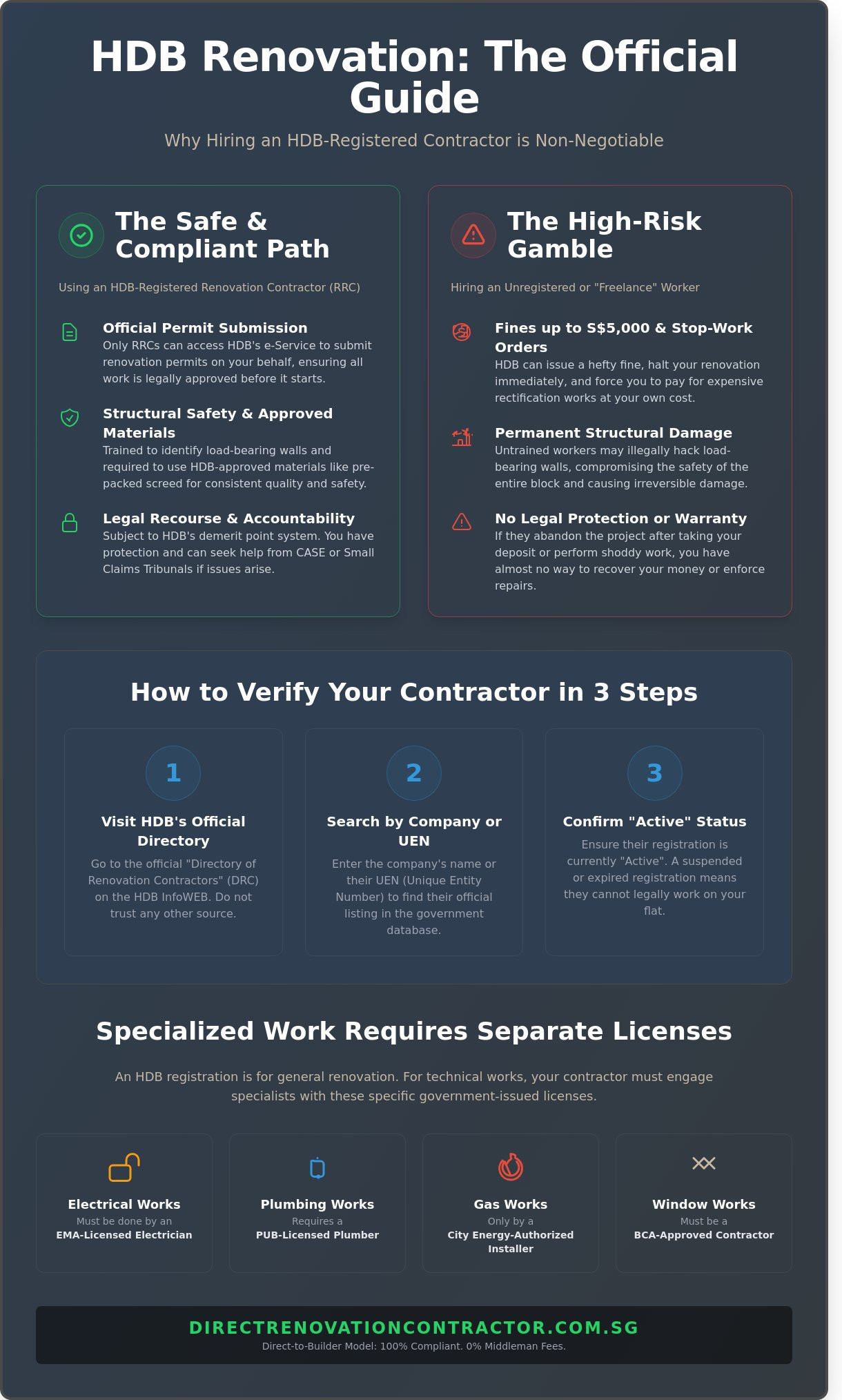
Choosing an unregistered “freelance” worker to save a few hundred dollars often leads to thousands in losses. If you’re caught using unauthorized labor, HDB can slap you with a fine of up to S$5,000. It doesn’t stop at the fine. You’ll be forced to stop all works immediately and pay for the full rectification of any non-compliant structures at your own expense. Unregistered workers also offer no legal protection. If they abandon your project after taking a deposit, you’ll find it nearly impossible to seek recourse through official channels like CASE or the Small Claims Tribunal.
Registration vs. Licensing: Clearing the Confusion
Many homeowners mistakenly believe that a standard ACRA business profile is enough to start hacking. It isn’t. An ACRA registration simply means the company exists as a business entity. It doesn’t grant them the right to renovate HDB flats. The HDB Registered Renovation Contractor Scheme (RRCS) is the specific credential you need to verify.
Beyond general renovation, specialized works require separate, specific licenses:
- Electrical Works: Must be performed by an EMA-licensed electrician.
- Plumbing Works: Requires a PUB-licensed plumber to ensure water pressure and drainage meet national standards.
- Gas Works: Only City Energy-authorized installers should handle gas pipe relocations.
We operate as a direct contractor, meaning we handle these technicalities without the middleman markups. We ensure every specialist on-site holds the correct 2026 certifications so your renovation stays fully compliant and safe.
Why Hiring an HDB Registered Contractor is Non-Negotiable
Hiring an hdb registered contractor isn’t just a recommendation; it’s a legal requirement under the Housing and Development (Renovation Control) Rules. This regulation exists to protect the structural integrity of Singapore’s public housing. If you engage an unregistered worker, you risk a fine of up to S$5,000. Beyond the legal risks, registered firms understand the technical complexities of HDB flats, from load-bearing walls to concealed wiring. They provide a level of accountability that freelance renovators simply can’t match.
Permit Application and Management
Only firms listed on HDB’s official Directory of Renovation Contractors have the credentials to access HDB’s e-Services portal. This access is vital because they must submit renovation permits on your behalf before any work begins. For major projects involving wall hacking or floor replacement, you should plan for a 3-week standard approval window. A qualified hdb registered contractor manages this timeline and coordinates with structural engineers when HDB requires specialized assessments. They ensure that your renovation doesn’t compromise the safety of the entire block.
Quality Assurance and Safety Standards
Registered contractors must use HDB-approved materials to ensure longevity and safety. For example, they are required to use pre-packed screed for flooring to maintain consistent quality and reduce dust pollution. They also handle the logistics of renovation debris. You can’t just leave old tiles at the common lift lobby; contractors must dispose of waste at approved sites according to Town Council rules. Furthermore, all electrical and plumbing works are executed to meet national safety codes, preventing future hazards like short circuits or water seepage into the unit below.
Every registered firm is subject to HDB’s demerit point system. If a contractor fails to follow renovation timings (typically 9:00 AM to 6:00 PM on weekdays) or exceeds noise limits, they receive points. Accumulating 24 demerit points leads to a suspension or total de-registration. This system forces contractors to maintain high workmanship standards. Registered firms also carry professional indemnity insurance, which protects you from financial liability if an accident occurs on-site. If you’re looking for a straightforward partner who handles these technicalities without middleman markups, you can view our direct renovation price list to see how we prioritize transparency. We focus on delivering functional, high-quality results that comply with every HDB regulation.
How to Verify a Contractor’s HDB Registration Status
Verifying your contractor’s credentials is the only way to protect your home from legal and structural risks. Don’t rely on a verbal promise or a business card. You need to confirm they’re currently listed on the HDB Directory of Renovation Contractors (DRC). This step ensures the firm knows the specific structural rules for HDB flats, such as where hacking is prohibited to maintain the building’s integrity.
Using the Official HDB DRC Search
The verification process is straightforward and takes less than five minutes. Use the following steps to ensure you’re hiring a legitimate hdb registered contractor:
- Visit the HDB e-Service portal and navigate to the Directory of Renovation Contractors.
- Type the company name exactly as it appears on your quotation. Even a small variation in the name can indicate a different entity.
- Input the Unique Entity Number (UEN). This 9 or 10-digit code is the most reliable way to identify a business. Check that the UEN on their invoice matches the HDB listing exactly.
- Verify the registered business address. If the office location on their website differs from the HDB record without a valid explanation, treat it as a red flag.
- Confirm the registration expiry date. If their cycle ends within the next 30 days, ask for proof of their renewal application.
Beyond basic registration, look at the demerit point history. HDB assigns points for infringements like poor workmanship or safety violations. A firm with 12 or more demerit points within a 24-month period shows a pattern of negligence. You should also check for CaseTrust accreditation. This provides an extra layer of financial security, as CaseTrust-RC businesses must protect your deposit through a performance bond, ensuring your money is safe even if the firm closes down.
Warning Signs of Unlicensed Contractors
Unlicensed operators often use deceptive tactics to win projects. If a contractor asks you to apply for the HDB renovation permit yourself, stop the process immediately. Only an hdb registered contractor is authorized to submit these technical applications. Doing it yourself makes you legally liable for any structural damage or unauthorized works.
Price is another major indicator. If a quote for masonry and carpentry is 25% to 30% lower than the market average in 2026, the firm is likely cutting corners or using non-HDB-approved materials. These “too good to be true” prices often lead to “hidden costs” that appear halfway through the hacking phase. Finally, insist on a physical office visit. A legitimate direct contractor will have a registered place of business and won’t rely solely on mobile numbers or temporary sites.
The Ultimate 2026 HDB Renovation Checklist
Successful renovations aren’t about luck; they’re about strict adherence to HDB’s 2026 regulations. Engaging an hdb registered contractor ensures your project stays legal and avoids heavy fines that can reach S$5,000 or more. This checklist breaks down exactly what you need to verify before a single tile is removed from your BTO or resale flat.
Renovations in Singapore are highly regulated to protect the structural integrity of the building and the peace of the neighborhood. You can’t afford to skip these steps. A direct contractor approach removes the fluff and focuses on these technical requirements, ensuring your home is built on a solid, legal foundation.
Pre-Contract Documentation
Don’t sign any agreement until you see a physical or digital copy of the HDB registration certificate. Verify this against the HDB e-Service portal to ensure the license is active. You must also check for valid Public Liability Insurance coverage. This policy should cover at least S$500,000 to protect against accidental damage to common property or neighboring units. Every quote should be a direct, unmarked-up document. Ensure it includes a clear line-by-line breakdown of labor and material costs. We eliminate the 15% to 20% “coordination fees” charged by middleman firms by providing factory-direct pricing.
On-Site Compliance Checklist
The HDB Renovation Notice must be displayed outside your flat throughout the entire project duration. This is a mandatory requirement for transparency with your neighbors. Hacking works are the most sensitive phase. HDB mandates that all hacking and demolition must be completed within the first 3 days of the permit’s commencement. Your hdb registered contractor must only use Type 2 or Type 3 noise-generating tools, like electric breakers, to stay within the 85dB(A) noise limit. Noisy works are strictly prohibited on weekends, public holidays, and eve of public holidays.
- Permit Phase: Confirm all hacking and masonry permits are approved in the HDB portal before workers arrive.
- Timing: Ensure noisy works only occur between 9:00 AM and 5:00 PM on weekdays.
- Debris Management: Verify that renovation debris is cleared daily and not left in common corridors.
- Final Inspection: Conduct a joint site walk-through to check for hollow tiles or uneven masonry before the final 5% or 10% payment release.
Before you hand over the final payment, use a tapping rod to check for hollow sounds in your new floor tiles. Ensure all masonry joints are flush and carpentry hinges are aligned. If you find defects, don’t release the funds until the rectification work is done to HDB’s standards. For a transparent, factory-direct quote without hidden fees, book a site measurement with us today.
Direct Renovation: Quality Works Without Middleman Fees
Choosing an hdb registered contractor is the most practical decision a Singaporean homeowner can make to protect their renovation budget. At Direct Renovation Contractor Singapore, we maintain our HDB registration to ensure every structural change, from hacking walls to installing new floor tiles, stays within 2026 safety regulations. By working directly with the builder, you eliminate the layer of sales staff and creative consultants that typically inflate project costs without adding technical value.
We focus on the grit and reality of construction. Our team manages the technical aspects of your home makeover, ensuring that masonry, plumbing, and electrical works are done right the first time. This direct model allows us to offer factory-direct pricing on custom carpentry and high-quality finishes. You aren’t paying for a fancy showroom or a marketing campaign; you’re paying for skilled labor and durable materials that last for decades.
Beyond residential care, maintaining high-performance environments is key; for those managing commercial facilities, RPS Building Services provides an expert guide on industrial cleaning standards.
The Direct Contractor Advantage
The primary reason homeowners switch to the direct model is cost transparency. Most interior design firms add a 20% to 30% markup on top of the actual contractor’s quote to cover their overheads. On a S$60,000 renovation, that’s an extra S$12,000 to S$18,000 spent on coordination fees alone. We remove this middleman tax entirely. You get a direct line to the site supervisor, which means faster problem-solving and fewer miscommunications during the execution phase. If a site measurement needs adjustment, it’s handled on the spot by the people doing the installation.
- Eliminate hidden markups and “consultation fees” found in ID contracts.
- Direct access to our carpentry workshop for precise, factory-priced cabinetry.
- Clear, itemized billing for all HDB renovation packages.
Your Partner for a Compliant 2026 Renovation
HDB regulations have become more stringent to ensure the structural integrity of aging blocks and new BTO developments. As an hdb registered contractor, we take full responsibility for the permit application process. We don’t leave the paperwork to you. Our team prepares the necessary technical drawings and ensures that hacking works don’t compromise your neighbors’ units or the building’s safety. We’ve handled over 500 successful HDB projects, giving us the expertise to navigate the specific quirks of both 40-year-old resale flats and brand-new BTO units.
We understand that a renovation is a major financial commitment. That’s why we prioritize honesty about what can and cannot be done within HDB’s 2026 guidelines. Whether it’s waterproofing requirements for toilets or the specific thickness allowed for floor screeding, we follow the rules to the letter to avoid costly fines or rectification orders. You can find more details on these technical requirements in our HDB Renovation in Singapore: The Ultimate 2026 Owner’s Guide. We’re here to build your home, not just sell you a vision.
Secure Your 2026 Home Renovation with Expert Compliance
Navigating Singapore’s renovation rules doesn’t have to be a headache. By following our 2026 checklist, you’ve learned that hiring a licensed hdb registered contractor is the only way to ensure your hacking and masonry works meet strict HDB technical standards. Choosing a direct contractor eliminates the 20% to 30% markups often charged by interior design firms. We prioritize technical competence and structural integrity, ensuring your BTO or Resale project stays compliant while you save on middleman fees.
At Direct Renovation Contractor, we provide fully compliant services with direct factory-to-home pricing. Our specialized BTO and Resale packages are built on transparency, meaning no hidden costs at the final handover. You get quality carpentry and tiling backed by years of local experience and a straightforward approach to every site measurement. Don’t leave your home’s safety to chance when you can work with a seasoned builder who understands the 2026 landscape.
Get a Direct Quote from an HDB Registered Contractor Today
Your dream home is a major investment; let’s build it right the first time with honest pricing and professional skill.
Frequently Asked Questions
Can I hire a contractor who is not HDB registered?
No, you cannot hire an unregistered contractor for any renovation works in an HDB flat. It’s a legal requirement under the Housing and Development (Renovation Control) Rules for homeowners to engage only those on the official HDB list. If you break this rule, you face a fine of up to S$5,000 and potential legal action. This regulation ensures that the workers understand the structural limitations of HDB buildings.
How do I check if my contractor is HDB registered?
You can verify a firm’s status through the HDB e-Service “Directory of Renovation Contractors” on the official HDB website. Simply enter the company name or their unique entity number (UEN) to view their registration validity. Check for any demerit points or past records of poor workmanship. A reliable hdb registered contractor will always display their registration number clearly on their website and official quotations.
What happens if my contractor carries out unauthorized hacking?
HDB will issue a stop-work order and impose a fine of up to S$5,000 for unauthorized hacking of structural members. You’ll be required to reinstate the flat to its original condition at your own expense within 14 days. These structural violations can compromise the safety of the entire building. Always ensure your contractor has the approved permit in hand before any masonry or hacking work begins on-site.
Does a registered contractor handle all HDB permit applications?
Yes, your hdb registered contractor is responsible for submitting the renovation permit application via the HDB e-Service. They must use their company digital ID to file the request and upload the necessary floor plans. You’ll receive a notification via SMS or the My HDBPage portal once the permit is approved. Don’t start any work until this official approval is granted, as it’s a serious breach of housing regulations.
Is CaseTrust the same as HDB registration?
No, these are two different systems with separate purposes. HDB registration is a mandatory legal requirement that focuses on structural safety and compliance with building codes. CaseTrust is a voluntary accreditation that focuses on consumer protection and fair business practices. While HDB registration is essential for starting work, CaseTrust provides an extra layer of financial security through performance bonds that protect your 100% deposit.
How long does it take for HDB to approve a renovation permit in 2026?
HDB typically approves standard renovation permits within 3 to 5 working days. If your project involves complex structural changes like wall hacking or relocating bathrooms, the approval process can take up to 14 working days. We advise homeowners to submit their applications at least 21 days before the planned start date. This allows enough time for HDB engineers to review the technical drawings and request clarifications if needed.
What should I do if a registered contractor provides poor workmanship?
You should first refer to the dispute resolution clause in your signed contract to see the agreed rectification process. If the contractor refuses to fix the defects, you can file a claim with the Small Claims Tribunals for disputes involving amounts up to S$20,000. For firms with CaseTrust accreditation, you can also approach the Consumers Association of Singapore (CASE) for mediation. Keep all photos, payment receipts, and communication logs as evidence for your claim.
Are all window contractors required to be BCA approved?
Yes, any contractor performing window installation or repair must be a BCA-approved window contractor and registered with HDB. This is a strict safety requirement under the Building Control Act to prevent falling windows, which can be fatal. The installer must have completed the mandatory training course for window safety. After the installation is complete, they must submit a report to HDB within 7 days to certify that the work meets safety standards.