
You are likely paying a S$15,000 coordination premium on your commercial fit-out that never reaches the actual craftsmen building your partitions. Most business owners in Singapore accept hidden markups as an unavoidable part of the process, but that doesn’t make the final invoice any less of a shock. Dealing with the complexity of MCST approvals and FSSB fire safety clearances is already stressful enough without worrying about an inflated office renovation cost singapore. We know you need a workspace that reflects your brand’s professionalism without the unnecessary designer fluff.
This guide provides a transparent, factory-direct breakdown of what you should actually be paying in 2026. We’ll show you how the direct contractor model saves you 20% to 30% on essential works like custom carpentry and electrical M&E. By the end of this article, you’ll have a clear psf budget and a reliable 6-week timeline to ensure your business operations stay on track for a seamless move-in.
Key Takeaways
-
Benchmark your budget against 2026 market rates and understand how the BCA Tender Price Index influences the average office renovation cost singapore.
-
Identify the "middleman markups" in traditional ID quotes and learn how factory-direct pricing can reduce your carpentry and masonry expenses by 20-30%.
-
Gain a clear understanding of essential M&E services and FSSB compliance to avoid unexpected delays or penalties during the fire safety submission process.
-
Follow a practical, step-by-step strategy for site walk-throughs to leverage existing infrastructure and keep your project strictly within budget.
Table of Contents
-
ID vs. Direct Contractor: Understanding the 20-30% Price Difference
-
Strategic Planning: How to Execute a Direct Office Renovation
Benchmarking Office Renovation Costs in Singapore for 2026
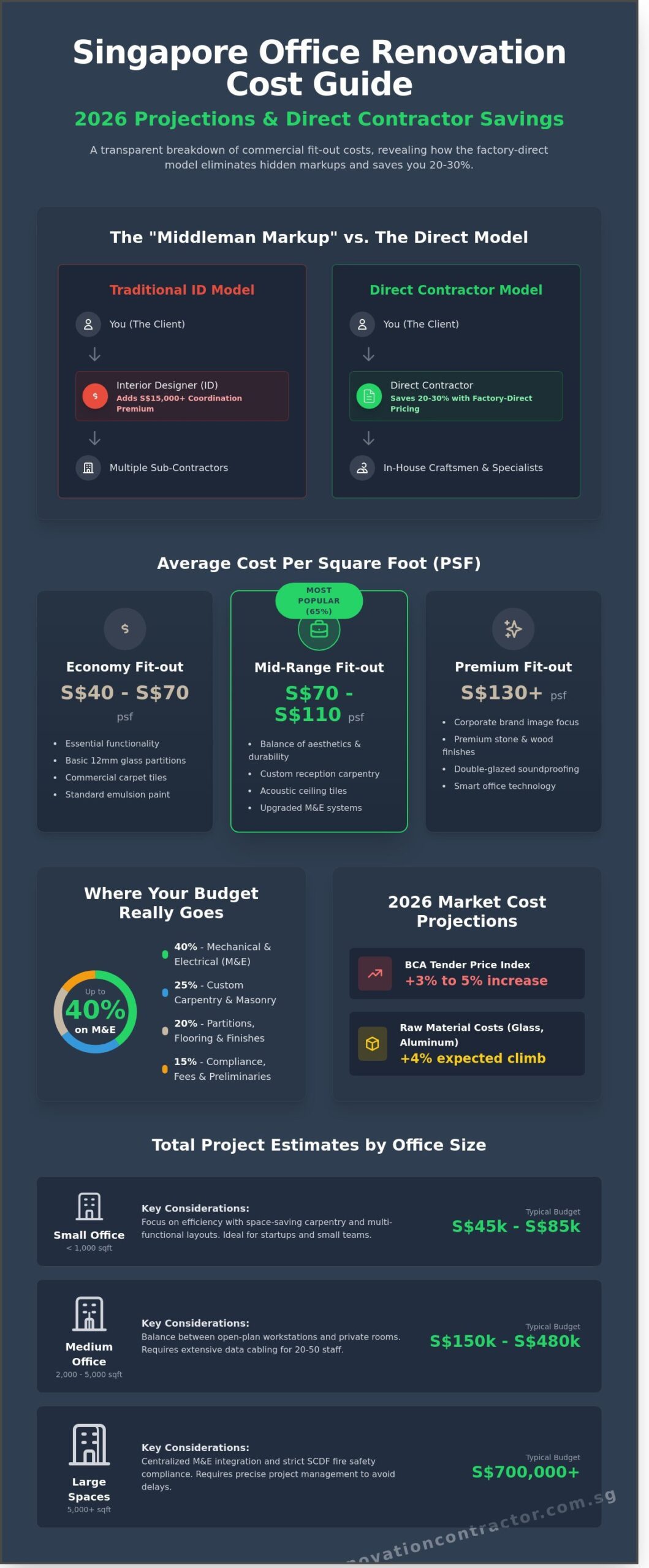
Planning your budget requires a firm grasp of current market benchmarks. In Singapore, we calculate the office renovation cost singapore using the per square foot (psf) metric. This standard allows business owners to compare different commercial units regardless of their layout. By early 2026, you should expect a shift in pricing. The BCA Tender Price Index showed a 4.2% increase in 2024; we project another 3% to 5% rise by 2026 due to labor shortages and carbon tax adjustments. Raw material costs for aluminum and glass are also expected to climb by 4% over the next 18 months.
You’ll pay a higher price for a bare condition unit than a fitted takeover. A bare unit is a blank canvas with no flooring, no ceiling boards, and raw walls. You’re responsible for the entire process of improving a structure, including expensive mechanical and electrical (M&E) works. These technical installations, like fire sprinklers and air-con ducting, often consume 30% of the total budget. Fitted units allow you to reuse existing partitions or light fixtures, which can save you S$20 to S$30 psf immediately. We always tell clients to check the DB box and air-con health before signing a lease; old systems lead to hidden costs later.
Average Cost Per Square Foot (PSF) Breakdown
Working with a direct contractor removes middleman markups. We’ve broken down what you can expect to pay based on the quality of finishes and complexity of the build.
-
Economy Fit-out (S$40 to S$70 psf): This tier focuses on essential functionality. It includes basic 12mm tempered glass partitions, standard commercial-grade carpet tiles, and emulsion paint. It’s a practical choice for startups that need a professional space without high-end carpentry.
-
Mid-Range Fit-out (S$70 to S$110 psf): This is the most common choice for 65% of Singaporean SMEs. It features custom carpentry for the reception area, better acoustic ceiling tiles, and upgraded M&E systems to support more staff. You get a balance of aesthetics and durability.
Total Project Estimates by Office Size
Size dictates the complexity of the project. Larger spaces face stricter fire safety regulations and more intensive logistics. Use these estimates to set your initial office renovation cost singapore expectations.
-
Small Office (under 1,000 sqft): Budgets usually range from S$45,000 to S$85,000. We focus on space-saving carpentry and multi-functional furniture. Efficiency is the priority here.
-
Medium Office (2,000 – 5,000 sqft): Estimates fall between S$150,000 and S$480,000. These projects require a careful balance between open-plan workstations and private meeting rooms. You’ll need more extensive data cabling and power point distribution for 20 to 50 employees.
-
Large Corporate Spaces (5,000+ sqft): Costs often exceed S$700,000. Scale increases complexity. You’ll deal with centralized M&E integration and strict compliance with the latest SCDF fire safety codes. These projects require precise project management to avoid costly delays.
The Line-Item Breakdown: Where Your Budget Really Goes
Calculating a realistic office renovation cost singapore requires looking past the visible aesthetics like paint and furniture. Most of your budget disappears into the infrastructure behind your walls and above your ceiling boards. Recent data regarding Asia Pacific fit out costs indicates that technical infrastructure and mechanical works now account for up to 40% of total project spending in the Singapore market. Business owners often underestimate these "hidden" essentials, leading to budget overruns during the mid-construction phase.
Mechanical & Electrical (M&E) Essentials
Electrical wiring isn’t just about plugging in laptops; it’s about supporting a high-density digital environment. A single power socket or data point typically costs between S$80 and S$150, depending on whether you require surface-mounted trunking or concealed wiring. For a 2,000 sq ft office, these points alone can total S$8,000. Air-conditioning is another major variable. While relocating an existing fan coil unit might cost S$350 per unit, upgrading to a Variable Refrigerant Volume (VRV) system for better energy efficiency can exceed S$25,000 for medium-sized units. Fire protection is a non-negotiable cost regulated by SCDF. Moving or adding a single sprinkler head costs roughly S$350 to S$500. You can’t skip this, as failing to comply with fire safety codes will prevent you from obtaining a Fire Safety Certificate (FSC).
Custom Carpentry and Built-ins
Custom work carries a heavy markup when handled by middleman design firms who outsource the labor. We take a different approach. By working with a Direct Renovation Contractor, you access in-house fabrication. This removes the 20% to 30% commission typically added by interior design agencies. Reception counters serve as your firm’s first impression; a 2.4-meter counter with a quality laminate finish usually ranges from S$2,500 to S$4,500. For pantry areas, expect to pay S$120 to S$180 per linear foot for commercial-grade high-pressure laminates. These materials are chosen for their ability to withstand heavy daily use and moisture, ensuring your investment doesn’t peel or warp after six months of office coffee runs.
Key Pricing Benchmarks for Office Finishes:
-
Partitioning: Standard 9mm drywall partitions cost about S$4.50 to S$6.50 per square foot. Adding rockwool insulation for soundproofing in boardrooms adds an extra S$2.00 per square foot.
-
Ceiling Works: Mineral fiber boards or acoustic tiles are the standard for SMEs because they allow easy access to M&E services. Expect to pay S$4.00 to S$5.50 per square foot.
-
Flooring: Commercial-grade vinyl tiles are the most pragmatic choice at S$3.50 to S$5.50 per square foot. Carpet tiles, which offer better noise dampening for open-plan layouts, range from S$4.00 to S$7.50 per square foot.
-
Masonry: Basic cement screeding for a 1,000 sq ft unit costs roughly S$4,000 to S$6,000 depending on the thickness required to level the floor.
Every dollar spent on high-quality flooring and partitions reduces your long-term maintenance overhead. While it’s tempting to pick the cheapest materials, commercial-grade finishes are designed for the high foot traffic that residential materials simply can’t handle. If you’re currently planning your layout and need an honest assessment of your office renovation cost singapore, it’s best to get a direct quote based on your specific site measurements to avoid any hidden surprises during the hacking phase.
ID vs. Direct Contractor: Understanding the 20-30% Price Difference
Choosing between an Interior Design (ID) firm and a direct contractor is the single biggest factor affecting your office renovation cost singapore. Most ID firms operate as project management agencies. They don’t employ the carpenters, tilers, or electricians themselves. Instead, they outsource the work to sub-contractors and add a 20% to 35% markup to the final bill. This middleman fee covers their showroom rentals, marketing budgets, and sales commissions. By cutting out this layer, you’re looking at immediate savings of at least S$15,000 on a standard S$60,000 project.
Direct factory pricing offers the most significant advantage in carpentry. When you skip the designer’s showroom, you pay for the actual material and labor. For instance, a custom-built reception counter might cost S$130 per linear foot from a direct contractor, whereas an ID firm will quote S$175 for the same internal carcass and laminate. Over a full office fit-out involving 100 linear feet of cabinetry and shelving, that’s a S$4,500 difference for the exact same product quality.
Transparency in labor costs is another reason the direct model wins for budget-conscious owners. You see the actual cost of hacking, masonry, and painting. A direct contractor will quote hacking for a 1,200 square foot office at roughly S$2,500 to S$3,200 depending on the floor finish. An ID firm often rounds these figures up or hides them within "lump sum" packages that make it impossible to see where your money is going.
The Hidden Costs of Design Firms
Design firms often blur the lines between consultation fees and project management fees. You might see a "design fee" of S$3,000, but the real cost is hidden in material markups. A specific vinyl flooring that costs S$4.50 per square foot at the supplier often shows up as S$6.50 on an ID’s invoice. The "Direct" model changes this by providing professional 3D drawings without the S$5,000 design premium. You pay for the drawings as a standalone service, then get the builder’s price for the execution, which keeps your office renovation cost singapore manageable and honest.
Quality Control in the Direct Model
Builders possess a deeper understanding of technical requirements and the Building Control Act than most junior designers. They focus on structural integrity and fire safety compliance rather than just choosing color palettes. Direct contractors are often the ones IDs hire to do the actual work. By removing the messenger, you get direct accountability. If there’s an issue with the electrical load or the plumbing layout, you speak directly to the person holding the tools. This reduces the risk of miscommunication that leads to expensive rectification works later in the project.
For business owners who want more control, the DIY Renovation Support Package is a practical solution. It provides the technical guidance needed to manage a renovation without paying for a full-service ID firm. You get the benefit of factory-direct pricing for all your hacking and tiling needs while maintaining a professional standard of project oversight. This approach is becoming the standard for 75% of small-to-medium enterprises in Singapore looking to maximize their capital expenditure in 2026. It ensures every dollar spent goes into the office walls and floors, not into a designer’s marketing fund.
Navigating Permits, Reinstatements, and Compliance Costs
Renovating a commercial space in Singapore isn’t just about aesthetics; it’s a heavy administrative lift involving multiple government agencies and building managers. You’ll need to account for the "hidden" side of your budget before any hacking begins. Most building managements (MCST) require a renovation deposit ranging from S$2,000 to S$5,000. This isn’t a fee, but a security bond. They’ll hold this money to ensure your contractors don’t damage common property like lift interiors or corridor flooring. If your contractor is careless, you lose that deposit.
You also need to secure Public Liability Insurance. Most Grade A office buildings in the CBD require a minimum coverage of S$1,000,000. This protects your business from massive claims if a renovation mishap causes a fire or water leakage that affects other tenants. As a direct contractor, we handle the technical paperwork, but the insurance premium is a necessary office renovation cost singapore companies must factor into their initial capital expenditure. Expect to pay between S$300 and S$800 for this coverage depending on the project scale.
Singapore Regulatory Requirements
If your renovation involves changing the layout or adding partitions, you’ll likely trigger a submission to the Fire Safety and Shelter Bureau (FSSB). In 2026, fire safety standards remain strict. Any change to the position of sprinkler heads or smoke detectors requires a Qualified Person (QP) or a Professional Engineer (PE) to endorse the plans. These professional fees are significant. A standard QP submission for a 2,000 square foot office typically costs between S$2,500 and S$4,500.
Structural works, such as creating an internal staircase or heavy equipment platforms, require BCA permits. You can’t skip these steps. Unauthorised works lead to heavy fines and orders to reinstate the property to its original state. We provide transparent pricing on these submissions because they are essential for legal occupancy. Always ask for a breakdown of QP fees early to avoid "hidden charges" later in the project.
Office Reinstatement: The Exit Strategy
It’s a mistake to ignore the end of your lease when you’re just starting it. Most Singapore commercial leases include a "reinstatement clause." This means when you move out, you must return the unit in a bare shell condition. You’ll have to pay for hacking partitions, removing floor finishes, and restoring the original ceiling and lighting. In the CBD, reinstatement costs currently average S$15 to S$25 per square foot. For industrial units in areas like Ubi or Jurong, the rate is lower, usually between S$8 and S$12 per square foot.
-
CBD Grade A: S$15 – S$25 psf (Strict rules, limited working hours)
-
Industrial/B1: S$8 – S$12 psf (Easier access, lower disposal fees)
-
Fitted Takeover: S$0 (If the next tenant accepts your current layout)
You can reduce your future liability by choosing "fitted" units where you take over the previous tenant’s partitions and wiring. If the layout works for your team, you save on both the initial fit-out and the eventual reinstatement. This strategy can significantly lower the total office renovation cost singapore businesses face over a five-year lease term. Planning your exit now ensures you don’t face a S$40,000 surprise bill when it’s time to move.
Don’t let compliance fees catch you off guard. Work with a direct renovation contractor to get a clear, no-nonsense breakdown of all permit and regulatory costs from day one.
Strategic Planning: How to Execute a Direct Office Renovation
Executing a successful project requires a systematic approach that prioritizes technical feasibility over aesthetic fluff. You’ll need to start with a thorough site walk-through. This isn’t just a casual stroll; it’s a technical audit of the existing M&E (Mechanical and Electrical) infrastructure. Checking the capacity of the Distribution Board (DB) and the condition of the Fan Coil Units (FCU) early prevents mid-project shocks that spike your office renovation cost singapore. If the existing electrical load can’t support your 2026 server requirements, you’ll face heavy costs for upgrades that should’ve been negotiated before signing the lease.
Budget creep happens when you fail to distinguish between ‘Must-Haves’ and ‘Nice-to-Haves’. Focus your capital on operational essentials like high-speed data points and ergonomic seating. You can save 15% to 20% of your total spend by opting for high-quality laminate finishes instead of imported marble or specialized feature walls. Once your priorities are set, secure 3D drawings. These aren’t just for choosing colors; they’re functional blueprints. Visualizing the workflow helps you spot bottlenecks in narrow corridors or poorly placed power outlets before the masonry work begins.
Hiring a main contractor singapore with a proven commercial track record is the most effective way to protect your bottom line. You’ll avoid the 25% to 35% commission typically charged by interior design firms who outsource the actual labor. Finally, establish a rigid timeline. In Singapore’s commercial market, where CBD rents can hit S$12 per square foot, a two-week delay is a massive financial hit. We recommend an 8 to 10 week schedule for most mid-sized offices to ensure you aren’t double-paying rent during the transition.
Space Planning for Productivity
The 2026 hybrid office model requires a 60/40 split between permanent workstations and flexible hot-desking zones. This layout accommodates the 70% of Singaporean employees who now prefer flexible arrangements. For meeting rooms, acoustic privacy is non-negotiable. Don’t just install glass partitions; ensure they have proper drop-seals and acoustic caulking. Without these, your S$5,000 glass wall won’t stop sound from leaking. Keep the pantry simple. Use durable quartz tops and modular cabinetry to create a social hub that stays within budget.
Working with Direct Renovation Contractor
We manage our own Paya Ubi factory, which gives us total quality control over your office carpentry. Because we fabricate everything in-house, you don’t pay for middleman markups or transportation surcharges from third-party workshops. Our ‘Direct’ pricing model means the quote you see for masonry, electrical work, and partition installation is the actual cost of labor and materials. We’ve eliminated the hidden fees that often surprise business owners. You’ll get a clear, itemized breakdown that reflects the true office renovation cost singapore without the unnecessary overheads of a fancy showroom.
Get a transparent, direct quote for your office renovation today
Take Control of Your 2026 Office Renovation Budget
Managing your office renovation cost singapore for 2026 doesn’t have to involve guesswork or hidden fees. By working directly with Direct Renovation Contractor Singapore, you eliminate the 20% to 30% markups typically added by design firms. We handle everything from hacking and masonry to complex electrical works without middleman overhead. Our in-house carpentry fabrication at our Paya Ubi workshop ensures you receive factory-to-consumer pricing on every custom workstation and cabinet. This hands-on approach keeps your project efficient and your timeline predictable.
You get a transparent, unmarked-up contract that details every S$ spent. This ensures your project stays on budget and meets all BCA and SCDF compliance standards. Before committing to any contractor, it’s essential to thoroughly evaluate their credentials and track record. For a detailed framework on vetting potential partners, refer to our comprehensive guide on choosing the right office renovation company to ensure you make an informed decision that protects your investment. Choosing Direct Renovation Contractor Singapore means you’re investing in quality workmanship rather than expensive showroom commissions. It’s about getting a functional, professional workspace that makes financial sense for your business. Let’s get your project started with a clear, itemized breakdown of costs that prioritizes your bottom line.
Request a Direct Factory Quote for Your Office Fit-out
We look forward to building a workspace that works as hard as you do.
Frequently Asked Questions
How much does a 1,000 sqft office renovation cost in Singapore?
A 1,000 sqft office renovation cost in Singapore typically ranges from S$80,000 to S$150,000 in 2026. This estimate covers standard partition walls, basic electrical wiring, and commercial-grade flooring. Your final bill depends heavily on the complexity of the mechanical and electrical (M&E) works. Choosing a direct contractor instead of a design agency can save you roughly 15% to 20% by cutting out middleman markups.
Do I need an Interior Designer for a small office fit-out?
You don’t need an interior designer if you already have a functional layout in mind. A direct renovation contractor handles the technical drawings, hacking, and carpentry work without charging high consultancy fees. This approach is more pragmatic for small businesses looking to maximize their budget. You’ll save between S$5,000 and S$12,000 that would otherwise go toward design conceptualization and project management fees.
What is the difference between a ‘fitted’ and ‘bare’ office unit?
A bare unit is an empty shell with raw concrete floors and no ceiling, while a fitted unit includes existing partitions, lights, and air-conditioning. Moving into a fitted space can reduce your office renovation cost in Singapore by as much as 35%. However, you’ll still need to budget S$15 to S$25 per sqft for minor modifications and cosmetic upgrades to make the space suit your brand.
How long does a typical office renovation take in Singapore?
A standard office renovation project takes between 6 and 10 weeks from the first site measurement to the final handover. Smaller units under 1,200 sqft often finish within 4 weeks if there are no major structural changes. You must account for the 14 days required for FSSB fire safety clearances before work begins. We provide a fixed schedule so you can plan your move-in date without worrying about business downtime.
Are there any hidden costs in an office renovation quote?
Hidden costs usually appear as professional engineer (PE) fees, fire safety submissions, and insurance premiums that aren’t in the initial estimate. These items can add 10% to your total budget if your contractor isn’t transparent from the start. We provide a line-by-line breakdown of every cost, from debris disposal to floor protection. This ensures you don’t face "provisional sum" charges that suddenly increase your bill at the end of the project.
Do I need BCA or FSSB approval for my office renovation?
You need FSSB approval if your renovation involves altering fire sprinkler heads or adding new rooms that affect smoke detection. BCA permits are mandatory for structural works or installing heavy equipment that exceeds the floor’s loading capacity. Approximately 90% of commercial renovations in Singapore require at least one of these permits. We manage the entire submission process to ensure your office complies with the latest Fire Code 2023 regulations.
What is reinstatement work and how much does it cost?
Reinstatement work is the process of stripping your office back to its original bare condition before returning the keys to the landlord. In 2026, this service costs between S$15 and S$30 per sqft depending on the volume of partitions and built-in furniture. For a 2,000 sqft space, expect to pay roughly S$30,000 to S$60,000 for hacking, electrical termination, and repainting. It’s a mandatory cost in most Singaporean commercial leases that tenants often overlook.
Can I manage the office renovation myself to save costs?
Managing the project yourself is possible but often leads to sequencing errors that increase costs by 20% due to wasted materials and labor delays. Coordinating separate electricians, plumbers, and carpenters requires constant site supervision and knowledge of local building codes. Hiring a reliable main contractor singapore gives you a single point of contact and factory-direct pricing. You get professional results without the stress of managing five different sub-contractors on your own.