

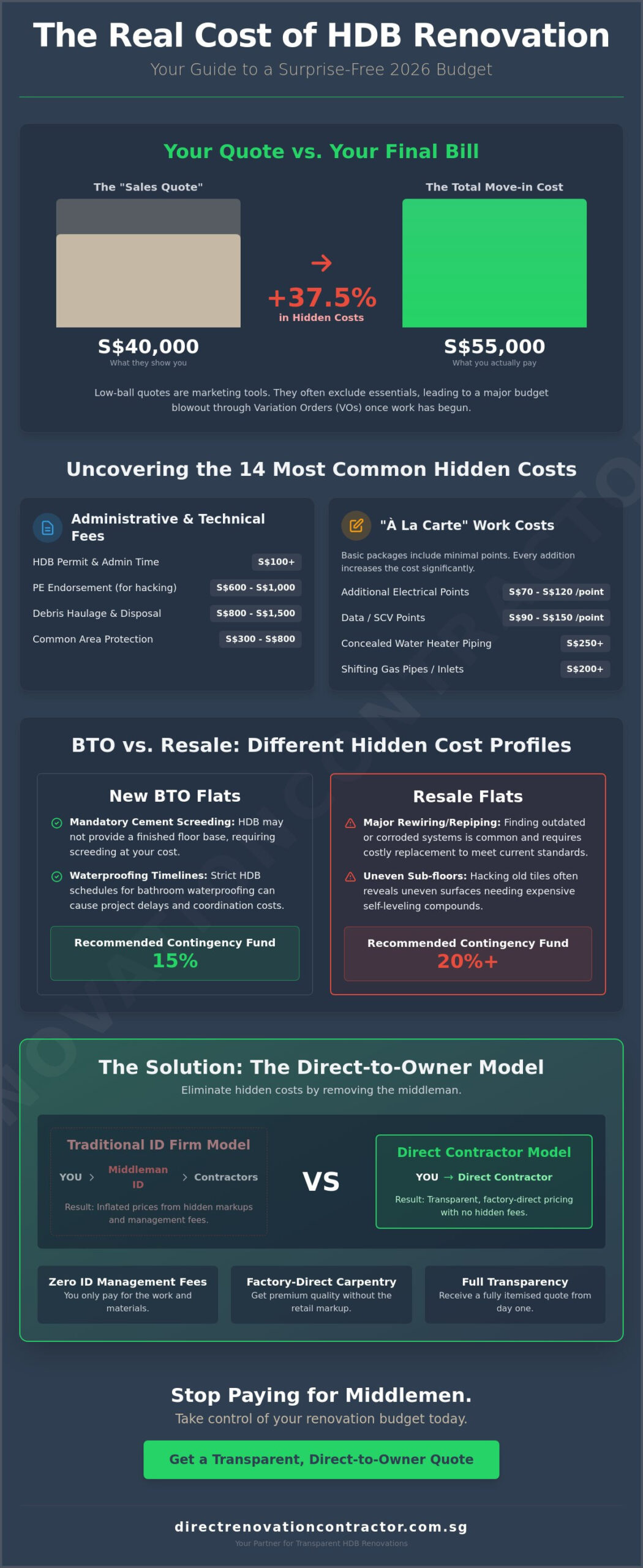
What if that “all-in” S$40,000 renovation quote you just signed is actually a S$55,000 project in disguise? It’s a common reality for many Singaporeans who find their budgets ballooning once the first wall is hacked. You probably already feel that the renovation process is rigged with confusing technical jargon and unexpected Variation Orders (VOs) that appear out of nowhere mid-project. It’s exhausting to manage a budget when you don’t know if you’re paying for actual materials or just a hefty middleman markup from an interior design firm.
This guide will show you how to spot the 14 most common hdb renovation hidden costs before you commit a single cent. We’ll provide the tools you need to eliminate unnecessary administrative fees and secure direct factory prices for your carpentry and masonry. By the time you finish reading, you’ll have a clear roadmap to achieving a transparent 2026 budget with zero surprises. We’re breaking down every line item from haulage fees to electrical sub-circuit charges to give you total control over your home makeover.
Key Takeaways
- Learn how to distinguish between a basic “sales quote” and your actual total move-in cost to avoid budget blowouts in 2026.
- Identify technical fees often omitted from initial estimates, such as HDB permit charges and Professional Engineer (PE) endorsements for wall hacking.
- Uncover the truth behind hdb renovation hidden costs by learning how to spot middleman markups on labor and material supplies.
- Use our 15% contingency fund framework and itemised scope checklist to bulletproof your renovation budget against unforeseen site issues.
- Discover the financial benefits of the direct-to-owner model, utilizing factory-direct carpentry to secure transparent pricing without interior design management fees.
Why HDB Renovation Quotes in 2026 Often Undershoot the Reality
Many Singaporean homeowners receive a renovation quote and assume it represents the final price. It doesn’t. In 2026, the gap between a “Sales Quote” and the “Total Move-in Cost” has widened due to rising labor costs and material volatility. A sales quote is essentially a marketing tool designed to get you to sign a contract. It often ignores the practical realities of making a flat livable. By contrast, the total move-in cost includes every essential item from window grilles to the final chemical wash. When you compare quotes, you’re often looking at incomplete data designed to look attractive on paper rather than a functional budget.
Low-balling is a common tactic used to secure deposits. Some firms intentionally omit essential works to appear cheaper than direct contractors. They know that once the hacking starts, you’ll have no choice but to pay for these “omissions” as variation orders (VOs). By 2026, global supply chain shifts have added a new layer of complexity to these hdb renovation hidden costs. Freight costs for raw materials like quartz and specialized laminates have increased by 12% over the last 24 months. This means a quote signed today without a clear material price buffer is almost guaranteed to increase before the project reaches the carpentry stage.
The “Package” Trap: What is Usually Left Out
Standard BTO packages are built on the assumption that you want the bare minimum. These packages frequently exclude essential items like lighting, bathroom accessories, and window grilles. If a firm offers “free” kitchen appliances, check your carpentry markup. Usually, these gifts are subsidized by higher per-foot-run rates on your cabinets. You must also verify if haulage and debris removal are included in the base price. These fees, regulated by the Housing & Development Board (HDB), can add S$800 to S$1,500 to your bill depending on the volume of masonry work involved.
Resale vs. BTO: Different Hidden Cost Profiles
BTO owners face specific surprises like mandatory cement screeding for certain floor finishes and strict HDB waterproofing timelines that can delay work schedules. Resale buyers deal with more volatile issues. You might find corroded concealed pipes or outdated electrical wiring that doesn’t meet current EMA standards. Hacking old tiles often reveals uneven sub-floors that require expensive self-leveling compounds. Because of these structural uncertainties and the high cost of dismantling existing fixtures, resale renovations require a 20% higher contingency fund compared to new flats. We focus on transparent pricing and direct communication so you don’t face these financial shocks mid-way through your project.
Technical Hidden Costs: From HDB Permits to Professional Engineer Fees
Renovating an HDB flat involves more than just choosing laminates and floor tiles. You must account for administrative and technical fees that often stay hidden until the final invoice. HDB permit fees themselves are relatively low, usually around S$21.40, but the real cost lies in the administrative time your contractor spends managing the approval process. If your design involves hacking walls or structural changes, you’ll need a Professional Engineer (PE) endorsement. This typically costs between S$600 and S$1,000 to ensure the structural integrity of the building remains intact.
Debris haulage and disposal fees are another area where hdb renovation hidden costs catch homeowners off guard. These charges aren’t fixed. They vary based on your flat type and floor level because moving heavy waste from a 40th-story unit requires significantly more labor than a ground-floor flat. You must also budget for the protection of common areas. HDB mandates that lift interiors and corridor floors are covered with corrugated paper or plastic sheets. This protection can cost an additional S$300 to S$800 depending on the length of your corridor and the duration of the works. For a clearer picture of these baseline expenses, check out this comprehensive HDB renovation cost guide to see how these fees fit into your total budget.
Electrical and Plumbing: The “Point-by-Point” Escalation
Basic quotes usually include a minimal number of electrical points, which is a common source of budget blowouts. When you start adding data points, SCV points, and concealed water heater piping, the price escalates quickly. In 2026, smart home hubs and shifting gas pipes are standard requirements for modern living, yet they are rarely included in basic packages. Each additional double power point can add S$80 to S$120 to your bill. We recommend speaking with a direct renovation contractor to get a transparent, point-by-point breakdown before work begins.
Masonry and Waterproofing Compliance
HDB enforces a strict 3-year waterproofing warranty rule for bathrooms to prevent leaks into the unit below. If you hack existing tiles, the contractor must ensure the new waterproofing meets HDB standards, or you risk voiding your warranty. “Hollow tiles” are another frequent issue during hdb renovation hidden costs assessments. If your existing floor has hollow patches, rectification costs fall on you because basic quotes assume a sound subfloor. The HDB cement screed subsidy provides free floor leveling for eligible BTO units, but if your flat doesn’t qualify, expect to pay S$1,500 to S$3,000 for manual screeding before any tiling can happen.
- PE Endorsement: S$600 – S$1,000
- Common Area Protection: S$300 – S$800
- Additional Electrical Points: S$80 – S$120 per point
- Debris Removal: Varies by floor and flat size
The Middleman Markup: How Interior Design Firms Hide Their Margins
Interior design (ID) firms usually list a “Design Fee” of S$3,000 to S$7,000 on their initial quotes. For many homeowners, this seems like a fair price for creative work. However, this fee rarely covers the firm’s total overhead. Most IDs operate as project management intermediaries, meaning they don’t employ their own tilers, electricians, or carpenters. Instead, they outsource these tasks to sub-contractors and apply a markup of 20% to 40% on every invoice. This layering of costs is a primary driver of hdb renovation hidden costs that catch owners off guard mid-project.
Material markups are another common tactic. When an ID quotes S$4.50 per square foot for vinyl flooring that actually costs S$3.00 at the supplier, they’re pocketing the difference as a management margin. This applies to everything from custom carpentry laminates to quartz countertops. Variation Orders (VOs) serve as the final tool for margin recovery. Firms often provide a low initial estimate to secure the contract, then use VOs to charge premium rates for minor changes, such as shifting a power point or adding a cabinet shelf, once the hacking has already begun.
Direct Contractor vs. Interior Designer: A Cost Analysis
Working with a factory-direct team eliminates the middleman layer entirely. For example, factory-direct carpentry rates for kitchen cabinets typically hover around S$100 to S$120 per foot run, whereas ID firms often quote S$150 or more for the same materials. Direct contractors provide transparent labor breakdowns for masonry and hacking instead of “bundled” fees that hide the actual cost of work. You can find a detailed breakdown of these pricing models in our Direct Renovation Contractor Singapore: The 2026 Comparison Guide.
The “Referral Fee” Economy
The ID industry in Singapore relies heavily on a referral fee system. When an ID insists you visit a specific lighting gallery or appliance showroom, they’re often entitled to a 10% to 15% commission on your purchase. These commissions are baked into the retail price you pay. Homeowners can avoid these hdb renovation hidden costs by sourcing their own fixtures directly from wholesalers. Managing your own procurement requires more effort, but it ensures your budget goes toward the quality of the product rather than an undisclosed kickback. Having a curated list of direct sub-contractors allows you to bypass these commercial traps and maintain full control over your renovation spending.
Budgeting Framework: Bulletproofing Your HDB Renovation for 2026
Building a renovation budget requires more than just looking at the final number on a quote. To avoid the stress of hdb renovation hidden costs, you must set aside a 15% contingency fund. This isn’t optional. In 2026, material price fluctuations and aging electrical systems in resale flats often lead to unexpected variations. If your contractor finds corroded pipes or non-compliant wiring behind a wall, that 15% buffer keeps the project moving without a financial crisis.
Before you approach any contractor, prepare a detailed “Itemised Scope of Work.” This document should list every single power point, every square foot of tiling, and every linear foot of carpentry. Vague quotes lead to disputes. For 2026, a realistic rule of thumb for a standard HDB renovation ranges from S$60 to S$150 per square foot. The lower end covers basic BTO refreshes, while the higher end accounts for extensive hacking and masonry in older resale units.
Sourcing Materials Like a Pro
You can save thousands by sourcing materials directly instead of letting an interior designer add a markup. Purchase your vinyl flooring, tiles, and bathroom fixtures from direct suppliers or factory outlets. Use your 3D drawings to calculate exact quantities. These technical drawings provide precise measurements that prevent you from over-ordering tiles or floor planks, which reduces material wastage. For more details on organizing your project, check out this Practical Guide to Planning and Execution in 2026.
Managing the Timeline to Avoid Holding Costs
Delays are a major source of hdb renovation hidden costs. Every week your project runs over is another week of paying rent for temporary housing or storage fees for your furniture. If you’re managing direct contractors yourself, you must coordinate the schedule tightly so that the electrician isn’t trying to work while the tiler is laying the floor. HDB typically grants a three month renovation window for BTO flats, and finishing within this timeframe is crucial to avoid permit expiration issues.
Protect your cash flow by negotiating transparent payment milestones. Don’t pay more than 10% as an initial deposit. Tie subsequent payments to completed work stages like the completion of hacking, masonry, and carpentry installation. This keeps the contractor accountable and ensures you only pay for work that’s actually finished on-site. It’s the most effective way to maintain leverage throughout the project duration.
Eliminating Hidden Costs with Direct Renovation Contractor Singapore
Factory-Direct Carpentry and Masonry
We operate our own custom carpentry fabrication facility in Paya Ubi. This allows us to maintain strict quality control and offer factory prices. By cutting out the middleman, we pass savings of 20% to 30% directly to you. For a detailed look at our fabrication process, read our Carpenter Singapore: The 2026 Guide to Custom Carpentry and Direct Savings. Our masonry and tiling works follow the same honest pricing. We bill these services at unmarked-up labor rates. You pay the actual cost of the skilled labor required to lay your floors and walls, ensuring your hdb renovation hidden costs stay at zero.
- Direct Labor: No 15% to 20% markups on sub-contractor fees.
- Technical Support: Our DIY Support Package includes professional 3D drawings and a curated sub-contractor list for homeowners who want to manage their own projects.
- Compliance: We handle all HDB permits and structural compliance. We don’t charge a “premium” project management fee for these mandatory administrative tasks.
- Material Honesty: You get the actual prices for tiles, laminates, and hardware.
Start Your Transparent Journey Today
The best way to avoid financial surprises is to start with a detailed, itemised quote. We include all technical and compliance fees in our initial proposals. You won’t see vague “lump sum” figures that lead to disputes later. Hiring an HDB-registered direct contractor means your renovation follows all 2026 housing regulations while keeping your costs predictable. Our no-nonsense approach prioritizes functional results and structural integrity over flashy sales pitches. It’s time to renovate your home with the confidence that comes from technical competence and fair pricing. Get a transparent, direct renovation quote for your HDB flat today.
Take Control of Your 2026 HDB Renovation Budget
Navigating the renovation landscape in 2026 requires more than just a mood board. You’ve seen how technical fees for HDB permits and Professional Engineer endorsements can add unexpected thousands to a standard quote. You also understand that many interior design firms apply 20% to 30% markups to manage their sales overheads. Avoiding hdb renovation hidden costs starts with choosing a partner who values technical honesty over high-concept sales pitches. By working directly with the people doing the hacking, masonry, and tiling, you protect your savings from unnecessary inflation.
Direct Renovation Contractor eliminates the guesswork from your project. As an HDB Registered Contractor, we provide factory-direct carpentry prices and a firm guarantee of no middleman markups. We focus on the structural integrity and functional results of your home. You’ll receive a clear breakdown of every cost before the first tile is laid, ensuring your budget remains bulletproof throughout the construction process.
Get Your Transparent Direct Renovation Quote Today
Your renovation doesn’t have to be a source of financial stress. With a pragmatic approach and the right technical expertise, you’ll build a home that’s both high-quality and cost-effective.
Frequently Asked Questions
What is the most common hidden cost in HDB BTO renovations?
Electrical wiring and power point additions are the most frequent hdb renovation hidden costs. BTO flats come with a standard number of points, but the average 4-room flat requires 10 to 15 additional sockets to meet modern lifestyle needs. Each point costs between S$80 and S$150, which can add S$2,000 to your final bill if it’s not quoted upfront.
Do I really need a Professional Engineer (PE) for my HDB renovation?
You only need a PE if your renovation involves structural changes like removing load-bearing walls or installing heavy features that exceed the HDB weight limit of 150kg per square meter. Most standard BTO renovations don’t require one. If you hack a non-structural wall, your contractor handles the HDB permit, but structural alterations require a PE’s endorsement which typically costs S$600 to S$1,000.
How much should I set aside for a renovation contingency fund in 2026?
You should set aside exactly 10% to 15% of your total contract value as a cash reserve. For a S$60,000 renovation, this means having S$6,000 to S$9,000 ready for unforeseen site issues. Data from 2024 shows that 70% of homeowners encounter unexpected site conditions, such as uneven screeding or concealed piping issues, during the initial hacking phase.
Why are Variation Orders (VOs) so common in Singapore renovations?
Variation Orders occur when you change the scope of work or material selection after the contract is signed. These often stem from last-minute design changes or discovery of site constraints once hacking begins. In 2025, industry reports indicated that 85% of VOs are caused by homeowners adding carpentry details or upgrading tile selections mid-project, which disrupts the original labor schedule.
Can I save money by buying my own renovation materials?
You can save on specific items like light fixtures and bathroom accessories, but buying raw materials like cement or tiles often costs more due to retail markups. Direct contractors get wholesale factory pricing that’s 20% lower than what a walk-in customer pays. You also risk delivery delays; if your self-purchased tiles arrive late, you’ll face labor idle charges of S$200 to S$400 per day.
What HDB permits are required for a standard flat renovation?
You need a HDB Renovation Permit for any work involving hacking of walls, floor replacement, or plumbing relocation. Your contractor must be HDB-licensed to apply for this through the HDB e-Service. For window replacements or air-conditioning installation, you must use a BCA-trained installer. Filing these permits ensures your renovation complies with the Housing and Development (Renovation Control) Rules to avoid hdb renovation hidden costs like heavy fines.
Is it cheaper to hire a direct contractor or an interior designer?
Hiring a direct contractor is typically 20% to 30% cheaper because you eliminate the 15% project management fee and design markups charged by IDs. You’re paying for the actual labor and materials without the middleman overhead. This approach works best for homeowners who already have a clear floor plan and don’t require 3D visualizations or extensive design hand-holding.
What happens if my renovation exceeds the HDB-approved timeline?
HDB permits for BTO flats are valid for 3 months, while resale flats must be completed within 1 month. If your contractor misses this window, they must apply for an extension through the HDB portal before the expiry date. Failing to finish on time without an extension can lead to a fine of up to S$5,000 under HDB regulations, and you’ll likely face additional storage fees for your furniture.