

What if the biggest threat to your S$50,000 renovation isn’t the design, but a hairline crack you didn’t notice during key collection? You’ve waited years for your keys. The last thing you want is a three-week delay or a dispute with HDB because of a hollow tile or a leaky pipe. It’s common to feel stressed about the reporting process. You don’t want to miss a hidden structural issue that might cause problems once your carpentry is already installed.
Our bto renovation defects checking guide provides a professional contractor’s perspective on how to inspect your new flat properly. We believe in transparency and technical competence, so we’ve stripped away the jargon to help you secure a flawless foundation for your home. You’ll learn how to manage the Defects Liability Period (DLP) effectively and avoid middleman markups by handling the initial check yourself.
This manual includes a practical DIY checklist and a clear breakdown of the HDB rectification timeline to ensure a smooth transition from key collection to your actual renovation start date.
Key Takeaways
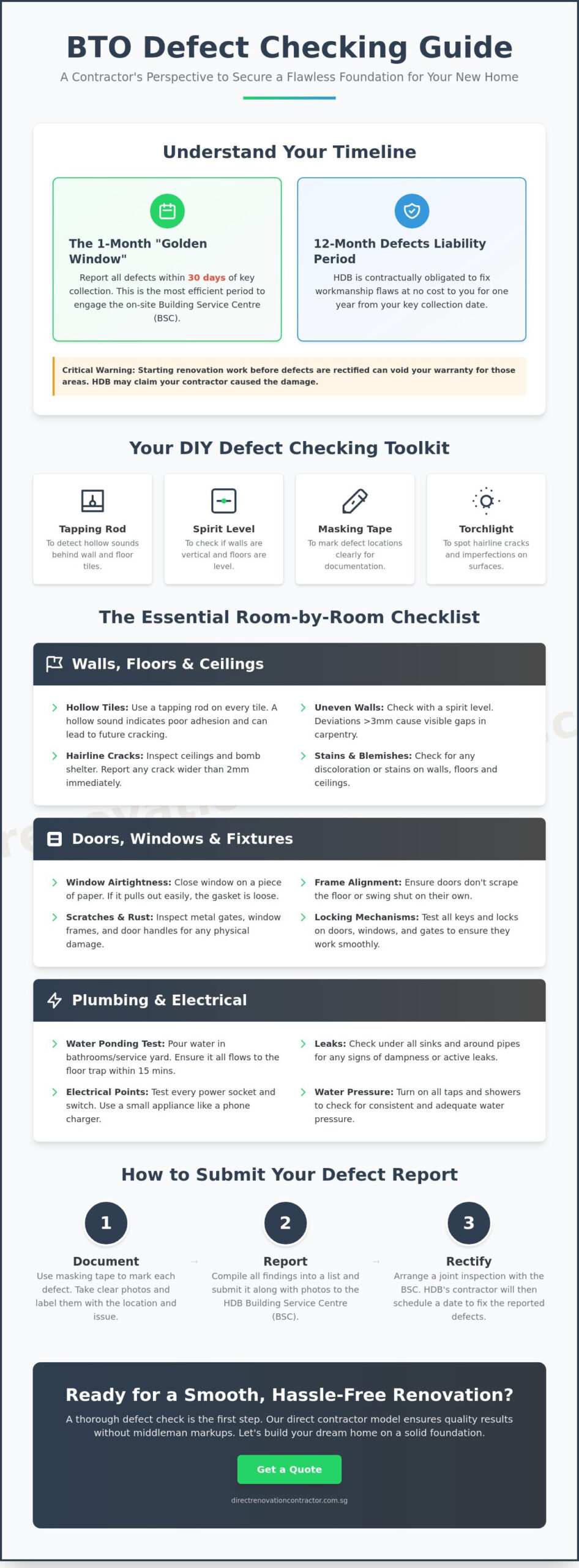
- Learn how to maximize the critical 1-month inspection window and understand your 12-month Defects Liability Period (DLP) to protect your investment.
- Follow our systematic room-by-room bto renovation defects checking guide using essential tools like tapping rods and spirit levels to catch hidden structural flaws.
- Distinguish between minor aesthetic blemishes and “renovation-killing” defects that can lead to expensive additional screeding or masonry costs.
- Master the professional protocol for documenting and submitting your report to the HDB Building Service Centre (BSC) to ensure all issues are rectified before renovation begins.
- Understand how a thorough defect inspection prepares your flat for a direct contractor handover, ensuring quality results without middleman markups.
What is BTO Defect Checking and Why is it Critical?
BTO defect checking is the systematic process of identifying construction flaws in your new HDB flat. This happens during the initial month after you collect your keys. As a central part of Singapore’s public housing system, this step ensures that the government delivers a home meeting specific workmanship standards. Using a comprehensive bto renovation defects checking guide helps you audit the unit for issues like chipped tiles, scratched window panes, or uneven wall plastering.
The Defects Liability Period (DLP) typically lasts 12 months from the date you collect your keys. The DLP is a contractual obligation for HDB to fix workmanship flaws at no cost to the resident. If you find a hollow tile or a leaky pipe within this timeframe, HDB is responsible for sending a team to repair it.
Performing a thorough check before your renovation starts is non-negotiable. If you skip this and jump straight into hacking or masonry, you lose your leverage. HDB can claim that any damage found later was caused by your renovation contractor. This creates a liability dispute that usually ends with the homeowner paying for repairs. Identifying these issues early means HDB bears the financial burden of rectification, not you. This protects your bank account from unnecessary “hidden costs” before the real work even begins.
The 1-Month “Golden Window”
HDB encourages homeowners to report defects within 30 days of key collection. This 30-day window is the most efficient time to engage the Building Service Centre (BSC) located on-site. Reporting early ensures repairs happen before your contractor moves in. Don’t wait. Starting renovation works can void your warranty for specific areas like flooring or plumbing. Once you modify a surface, HDB is no longer responsible for its original condition.
DIY vs. Professional Defect Inspection
A DIY check saves you the S$300 to S$600 fee of a professional inspector. It’s manageable if you’re meticulous and follow the steps in this bto renovation defects checking guide. However, professionals use tools like moisture meters to detect hidden water seepage or tapping rods for hollow tiles. If you suspect major structural issues, hire a consultant. A direct contractor can also assist during an initial site walk-through. We identify technical problems that might interfere with planned masonry or carpentry work, ensuring a smoother handover later.
The Essential BTO Defect Checklist: Room-by-Room
A systematic approach prevents you from missing small issues that turn into expensive repairs later. Start at the main entrance and move clockwise through every room. This method ensures no corner is overlooked. Your bto renovation defects checking guide toolkit must include a tapping rod, a spirit level, masking tape, and a high-intensity torchlight. These basic tools reveal what the naked eye misses during a quick walkthrough. Focus on high-traffic areas first, as these endure the most wear and tear.
Walls, Floors, and Ceilings
Hollow tiles are a major concern in new HDB units. Use your tapping rod to hit every floor and wall tile. A hollow sound indicates insufficient cement screed or adhesive underneath. This often leads to “popping” or cracked tiles within 12 to 24 months. For walls, use a spirit level to check for verticality. A deviation of more than 3mm can cause visible gaps in your built-in carpentry, making cabinets look misaligned. Look for hairline cracks in the bomb shelter and ceiling. While small cracks are usually shrinkage related, any crack wider than 2mm requires an immediate technical assessment by HDB.
Doors, Windows, and Fixtures
Test every window for airtightness and structural integrity. Close the window on a piece of paper; if you can pull the paper out easily, the rubber gasket is loose. This leads to water seepage during heavy monsoon rain. Check if doors swing shut on their own or scrape the floor tiles. Misaligned frames often indicate poor installation or settling issues. Inspect the metal gate and main door for rust spots, scratches, or faulty locking mechanisms. It’s better to fix these issues before you start your actual renovation works to avoid disputes over who caused the damage.
Plumbing and Electrical Points
Renovation-Killing Defects: What Your Contractor Needs You to Find
Don’t waste time obsessing over a tiny scratch on a window frame while ignoring a sloping floor. You must distinguish between aesthetic blemishes and functional defects that actively hinder renovation progress. Aesthetic issues are easily touched up; functional defects are renovation killers that force you to choose between expensive rectifications or a compromised finish. This bto renovation defects checking guide prioritizes the structural issues that impact your contractor’s ability to work efficiently. For instance, any electrical wiring faults or tripped breakers must be rectified by HDB before you start partition or false ceiling works. Fixing a dead socket after the ceiling is up requires hacking and repainting, which adds unnecessary costs to your project.
Masonry and Flooring Issues
Carpentry and Wall Alignment
Wall alignment is the silent enemy of high-quality finishes. Perform the “Squareness” test by placing a set square in the corners of your kitchen and bedrooms. 90-degree corners are vital for custom carpentry installation. When walls are crooked, your wardrobes and kitchen cabinets will have unsightly, tapering gaps against the wall. While we can use filler strips to hide these gaps, it’s a workaround rather than a fix. A direct contractor can only work with the “canvas” HDB provides. If the canvas is warped, the final product will never look perfectly flush. Identifying these misalignments early allows HDB to plaster and straighten the walls before your carpentry measurements are finalized. This prevents your feature walls from looking tilted and saves you from paying extra for corrective masonry work.
- Check corners with a set square to ensure they’re exactly 90 degrees.
- Identify “waves” in the plaster by running a torchlight parallel to the wall surface.
- Verify that door frames are plumb to avoid doors that swing open or shut on their own.
How to Submit Your Defect Report to HDB Building Service Centre (BSC)
Once you’ve completed your initial sweep using this bto renovation defects checking guide, you must follow a formal submission process to ensure HDB takes responsibility for rectifications. The process is straightforward but requires meticulous documentation to avoid disputes later. Don’t rush this stage; any missed items might end up as your own cost once your renovation starts.
- Step 1: Mark every defect clearly. Use colored masking tape to identify issues. Stick a small label next to each piece of tape describing the specific problem, such as “hollow tile” or “scratched window frame.” This makes it impossible for the repair crew to claim they didn’t see it.
- Step 2: Capture clear photos. Take two photos for every marked issue. The first should be a wide-angle shot to show the location within the room. The second must be a close-up shot of the defect itself.
- Step 3: Fill out the HDB defect list form. This form is provided in your key collection kit. Be specific with your descriptions. Instead of writing “floor bad,” write “3 uneven floor tiles in Master Bedroom near the entrance.”
- Step 4: Submit the form. You can submit the report via the HDB portal online or directly at the on-site BSC office. Submitting in person is often better as it allows for immediate clarification of your points with the staff.
- Step 5: Attend the joint inspection. A BSC supervisor will schedule a meeting at your unit to verify the reported works. This is the most critical part of the process.
Communication with the BSC
Dealing with site supervisors requires a firm but professional approach. They manage hundreds of units simultaneously, so clear communication helps your case move faster. Always ask for a specific tracking number for your submission. You should expect a timeline of 7 to 14 working days for standard rectifications. If a repair looks like a shortcut or a “patch job,” don’t accept it. Demand a proper fix that meets HDB’s building standards. Keep a log of every conversation and visit to maintain a clear paper trail.
The Joint Inspection Walk-through
You must be present during the joint inspection to defend your findings. Don’t let the supervisor talk you out of a valid defect by claiming it’s “within tolerance” if it clearly affects the unit’s integrity. Only sign the completion form and “close the case” when you’re 100% satisfied with the repairs. If you encounter complex masonry or plumbing issues, it’s wise to involve your home renovation partner for a second opinion. We can help you determine if a defect will interfere with your upcoming carpentry or hacking works.
Transitioning from Defects to a Direct Contractor Renovation
Once the Building Service Centre (BSC) completes the final patch of cement or replaces that last hollow tile, your BTO enters the most important phase. This transition point is the final step in your bto renovation defects checking guide. You must ensure the flat is completely ready for heavy works like hacking or masonry before any contractor begins. A successful handover means every HDB rectification is signed off and the unit is cleared of all BSC debris.
Choosing a direct renovation contractor singapore at this stage is a strategic financial move. By working directly with the builders, you eliminate the 20% to 30% markups typically added by interior design firms for project management. Since HDB has already fixed the structural basics, you can focus your budget on high-quality materials and technical execution rather than middleman commissions. Our team steps in once the “clean slate” is established, ensuring your vision is built on a solid, defect-free foundation.
Coordination is key during this week of transition. You should schedule a joint site walk-through with your contractor the moment BSC returns the keys. This allows us to verify that the rectified areas, such as newly laid tiles or smoothed walls, are protected. We take extra care to ensure our hacking crews don’t damage the very areas HDB just fixed. Clear communication regarding the start date prevents project stagnation and keeps your move-in timeline on track.
Planning Your Renovation Timeline
Expect BSC repairs to take anywhere from 7 to 14 days depending on the severity of the issues. Use this buffer period wisely to finalize your 3D drawings and select your laminates, tiles, and fixtures. A successful hdb renovation in singapore requires all decisions to be locked in before the first hammer swings. Starting your renovation while defects are still being processed is a mistake; it creates confusion over liability if new damage occurs during the works.
Final Checklist Before Renovation Starts
Before the first day of work, you must settle the practical utilities. Workers cannot perform masonry or electrical tasks without active water and electricity points. Ensure your SP Services account is activated at least three days before the start date. You also need to verify that all necessary HDB permits for hacking or plumbing alterations are approved and printed for display at your door.
- Utility Check: Confirm water pressure is consistent and all electrical sockets are live.
- Permit Verification: Ensure hacking permits are valid for the specific dates scheduled.
- Site Protection: Check that floor protection is laid if you are keeping the original HDB flooring.
Ready to turn your defect-free BTO into a home? Get a transparent, factory-direct quote for your renovation today and see how much you can save by cutting out the middleman.
Secure Your Home Foundation Before Renovation Starts
Completing your joint inspection with the Building Service Centre is the first step toward a functional home. This bto renovation defects checking guide highlights that identifying hollow tiles or uneven wall plastering within the HDB 1-year Defects Liability Period prevents future structural headaches. You’ve seen the room-by-room checklist and know exactly how to document issues for the BSC. Once your unit is cleared, the focus shifts to quality workmanship and cost efficiency. It’s about protecting your investment before the first hammer swings.
Don’t let middleman markups drain your budget. As HDB-registered professional contractors, we provide direct factory pricing for all carpentry and masonry works. You deal directly with the builders, ensuring every S$1 spent goes toward actual materials and labor rather than designer commissions. We focus on technical competence and transparent pricing to deliver a home that lasts. Our team handles the heavy lifting while you enjoy the savings of a direct-to-factory model.
Skip the middleman and get a direct BTO renovation quote today. Your new home deserves a solid start with builders who value your investment as much as you do.
Frequently Asked Questions
How long does HDB take to fix BTO defects in 2026?
HDB typically takes 14 to 30 days to complete repairs through the Building Service Centre (BSC). Most minor cosmetic issues are resolved within 2 weeks, but complex plumbing or masonry work can extend the timeline. You should submit your list through the HDB portal immediately after key collection. This ensures the contractors address every item within the 1-year Defects Liability Period.
Can I start my renovation before the BTO defects are fixed?
You shouldn’t start any works until the BSC officially closes your rectification claims. If your contractor begins hacking or painting, HDB may claim that your renovation caused the damage. This often voids the warranty for those specific areas. Wait for the final joint inspection to confirm all points in your bto renovation defects checking guide are settled before moving in materials.
What if I find a defect after my renovation has already started?
You can still report defects, but HDB only accepts responsibility if the damage is clearly unrelated to your renovation. If you find a structural leak in a wall your contractor hasn’t touched, the BSC will usually step in. However, if you find a scratched tile in a room where carpentry is being installed, HDB will likely reject the claim. It’s harder to prove liability once workers are on-site.
Is it worth paying S$400 for a professional BTO defect inspection?
It’s a practical investment that identifies 15 to 20 hidden issues the average homeowner misses. Professionals use tools like moisture meters and spirit levels to find hollow tiles or uneven wall gradients. Spotting these technical flaws early prevents future costs. Since we operate as a direct contractor, we see how these early catches prevent disputes over workmanship later during the masonry or carpentry phases.
Does HDB fix hairline cracks on the walls or ceiling?
HDB generally considers hairline cracks thinner than 0.3mm as cosmetic issues caused by the building’s natural curing process. They won’t usually perform specialized repairs for these minor lines. If a crack is wider than 0.3mm or shows signs of water seepage, the BSC will patch and repaint the area. We recommend monitoring these for 3 months to see if they expand before reporting them.
What are the most common BTO defects found in 2026 projects?
Recent data shows that 75% of units have hollow floor tiles or inconsistent grouting in the bathrooms. Other frequent issues include misaligned window handles and scratches on the powder-coated frames. About 10% of homeowners also report uneven plastering on the ceiling. Following a systematic bto renovation defects checking guide helps you catch these common technical oversights before you sign off on the keys.
What happens if HDB refuses to fix a defect I reported?
You should request a joint meeting with the BSC supervisor to review the BCA CONQUAS standards. These standards define the acceptable quality limits for Singaporean public housing. If the defect exceeds these limits, HDB is obligated to rectify it. If they still refuse, you’ll have to decide if the repair cost is worth a delay. We often provide transparent pricing for clients who choose to fix minor issues privately.
Do I need to check for defects if I am planning to hack all the tiles anyway?
You must still check for non-tiling defects like electrical faults, wall dampness, and window functionality. Even if you’re replacing the floor, you don’t want to inherit a leaking internal pipe or a faulty DB box. Focus your inspection on the structural elements and utility points that you’re keeping. This protects you from paying for repairs that should have been HDB’s responsibility from the start.