

The final walkthrough of your home isn’t a victory lap. It’s a technical audit where the stakes are your final 5% payment and years of potential maintenance headaches. Many homeowners feel a mix of excitement and deep anxiety during this stage, fearing they’ll discover “hollow tiles” or hidden plumbing leaks only after the contractor has left the site. Without a structured renovation handover checklist singapore homeowners often struggle to distinguish between acceptable workmanship and genuine defects that require rectification.
We know you want a home that’s as functional as it is beautiful. You’ve invested significantly in your property, and you deserve a result that meets local industry standards for quality and durability. This guide provides a professional-grade technical audit checklist to ensure your renovation is defect-free and truly ready for move-in day. We’ll walk you through the critical inspection points for carpentry, masonry, and electrical installations, giving you the technical validation you need to release that final payment with complete peace of mind.
Key Takeaways
- Schedule your final walkthrough with at least three hours of daylight to ensure you can clearly inspect structural finishes and surface alignment.
- Use a professional renovation handover checklist singapore to perform a technical audit of your masonry and carpentry, focusing on tile integrity and laminate joint quality.
- Verify the functionality of every electrical point and plumbing fixture to ensure your home’s essential systems are safe and fully operational before move-in.
- Secure your project documentation, including equipment warranties and HDB permit closure forms, to protect your investment and avoid future regulatory issues.
Essential Preparation for Your Renovation Handover in Singapore
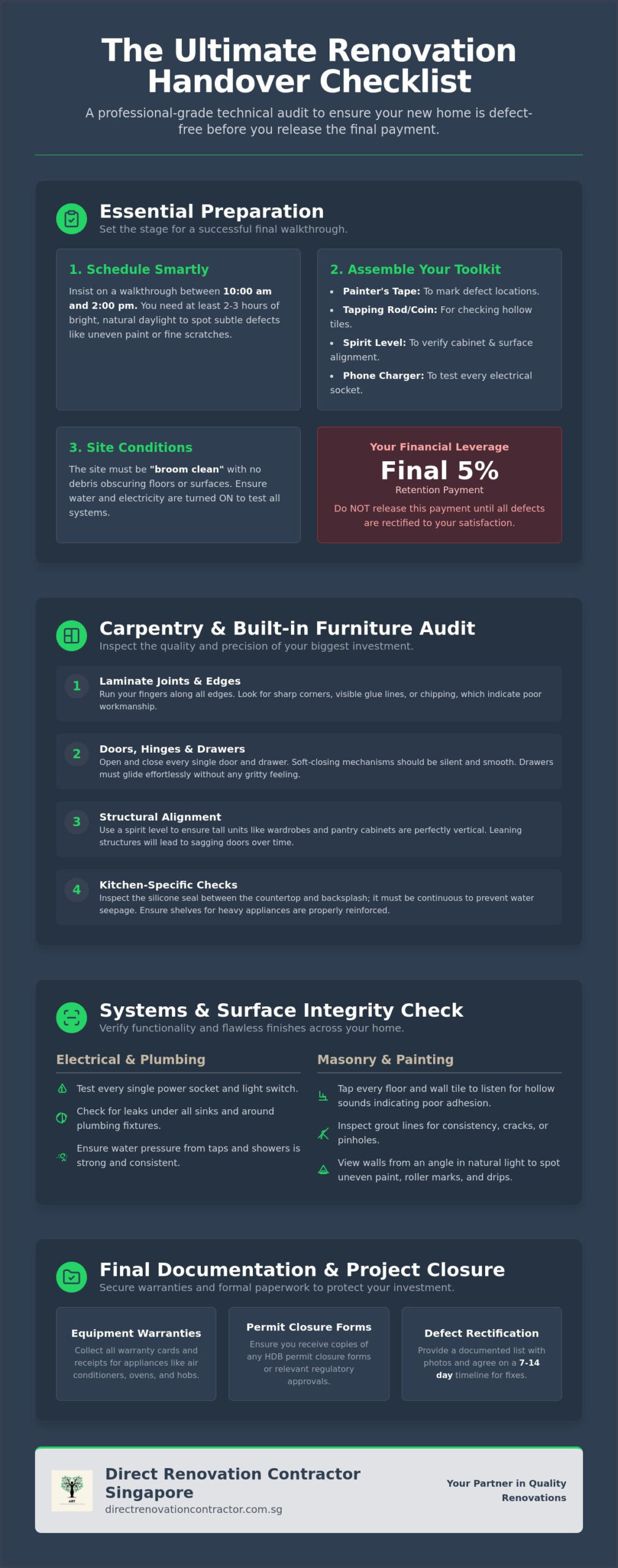
The final walkthrough is the most critical meeting you’ll have with your renovation contractor. It marks the transition from a dusty construction site back into a functional living space. This isn’t just a casual tour; it’s a formal assessment of whether the work delivered matches the technical specifications you paid for. To do this properly, you need a comprehensive renovation handover checklist singapore homeowners can rely on to catch issues before they become permanent fixtures of the home.
Timing is everything. Never schedule a handover for the evening or late afternoon. Artificial lighting can hide uneven paint finishes, grout pinholes, and scratches on glass or laminate surfaces. You should insist on a slot between 10:00 am and 2:00 pm. This ensures you have at least 2 to 3 hours of bright, natural daylight for a proper inspection. Preparation requires more than just your eyes. You need a dedicated defect-marking toolkit. This should include blue painters tape for marking visible flaws, a tapping rod or a large coin for checking hollow tiles, a spirit level to verify cabinet alignment, and a phone charger to test every electrical socket. Approaching this like a professional home inspection process ensures no detail is overlooked.
The Direct Contractor Handover Dynamic
When you work with a direct contractor, you’re the project lead. This means you must communicate your defect list clearly and directly to the site supervisor. Transparency during the home renovation process is vital for fast rectifications. Instead of vague complaints, provide a documented list with photos. We recommend setting a firm timeline for these rectifications, typically 7 to 14 days, before you release the final 5% retention payment. This financial leverage is your best guarantee of quality workmanship.
Site Conditions for Handover
Don’t start your inspection if the unit is covered in sawdust and debris. The site must be “broom clean” so that floor tiles and carpentry joints are fully visible. Ensure all utilities, specifically water and electricity, are turned on. You can’t test for leaks or faulty wiring in a dark house with dry pipes. Finally, bring your original 3D drawings and the signed quotation. These are your benchmarks. If the quotation specified soft-close hinges and you find standard ones, you have the proof needed to demand a change. This disciplined approach is the core of a successful renovation handover checklist singapore.
Carpentry and Built-in Furniture: The Technical Audit
Carpentry often consumes the largest portion of your budget. It’s where workmanship quality is most visible. A robust renovation handover checklist singapore must prioritize technical details over mere aesthetics. You aren’t just looking for a “nice” cabinet; you’re looking for structural precision that will last a decade. Start by inspecting the laminate joints. Run your finger along the edges of doors and panels. You’re looking for “chipping” or visible glue lines. Chipping usually indicates the use of blunt saw blades or poor handling during the fabrication process. Glue lines should be almost invisible; thick, yellowish lines are a sign of sloppy finishing.
Next, operate every single moving part. Soft-closing hinges shouldn’t just “close”; they should do so silently and smoothly without catching at the end. Drawer runners must glide without resistance. If a drawer feels heavy or “gritty” even when empty, it will likely fail once you load it with heavy kitchenware or clothes. Open every cabinet to inspect the internal carcass. The interior should be finished with PVC or laminate as per your contract. It should be completely free of sawdust, wood chips, and stray screws. Use your spirit level to verify that wardrobes and tall units are perfectly vertical. If they lean, the doors will eventually sag or fail to close properly. This level of scrutiny aligns with general renovation dos and don’ts for maintaining the long-term integrity of your home’s built-in structures.
Kitchen Cabinet Specifics
The kitchen is a high-moisture environment that demands extra attention. Check the silicone seal between the countertop and the backsplash. It must be continuous and smooth to prevent water seepage into the wooden carcass. Verify the bracing for heavy appliances like built-in ovens or microwaves. These shelves must be reinforced to handle significant weight without bowing. Test pull-out larders and corner units by extending them fully; they should remain stable without tilting or wobbling. For homeowners seeking reliable kitchen cabinet carpentry, these functional details are the true markers of quality.
Wardrobe and Feature Wall Inspection
Look at the top of your carpentry. The gap between the cabinet and the ceiling should be sealed with a consistent “filler” piece or a neat silicone bead. For wood-look laminates, check that the grain alignment across adjacent doors is consistent. Don’t overlook the integrated LED strips. They should be flush-mounted in their channels. Ensure all wires are properly concealed within the carpentry and not just taped to the back of the unit. A professional renovation handover checklist singapore ensures these hidden details are as polished as the visible ones.
Electrical, Plumbing, and Functional Systems Test
A visually perfect home is useless if the sockets don’t work or the pipes leak behind the walls. While carpentry is about aesthetics and alignment, your systems test is about safety and long-term functionality. This phase of your renovation handover checklist singapore requires a hands-on approach. You’re no longer just looking at surfaces; you’re verifying the invisible infrastructure that powers your daily life. We recommend starting with the “Every Socket” test. Don’t simply flip switches to see if the lights turn on. Take a phone charger or a dedicated socket tester and plug it into every single outlet in the house. This confirms that each point is live and properly wired to the circuit.
Your Distribution Board (DB) is the brain of your home’s electrical system. Open the DB box and ensure every circuit is clearly labeled in English. You should know exactly which breaker controls the kitchen, the water heater, and the air conditioning units. Perform a manual test of the Residual Current Device (RCD) by pressing the “Test” button. It should trip immediately, cutting power to the designated circuits. If it sticks or fails to trip, it’s a major safety defect that needs immediate rectification by your electrician before you move in.
Plumbing requires a stress test. Don’t just turn on one tap at a time. Run all bathroom taps, the kitchen mixer, and both showers simultaneously. You’re checking for significant pressure drops that could indicate a bottleneck in the piping or a faulty regulator. While the water is running, perform a drainage audit. Pour a large bucket of water directly into every floor trap in the kitchen and bathrooms. The water should disappear instantly. If it pools or drains slowly, there’s likely construction debris like cement or grout stuck in the pipes. Catching this now is vital; clearing a choked pipe after you’ve moved in is a messy and expensive ordeal.
Electrical Wiring and Installations
Verify the final placement of all switches and sockets against your original electrical plan. It’s common for points to be shifted slightly during installation to accommodate carpentry, but they must remain functional and accessible. Ensure light fixtures are mounted flush against the ceiling or wall without visible gaps or loose mounting screws. Pay close attention to dimmers. Turn them to 50% brightness and listen for any “buzzing” or humming sounds. This often indicates a mismatch between the dimmer switch and the LED driver, which can lead to premature bulb failure.
Sanitary and Plumbing Works
Inspect the base of every toilet bowl after several consecutive flushes. Look for any moisture seeping out from the floor joint, which indicates a failed wax ring or improper sealing. Check your water heater, whether it’s a storage tank or an instant unit, for proper grounding. The water temperature should be consistent and reach the desired heat within the expected timeframe. Finally, look under the kitchen sink. The bottle trap and all joint connections must be bone dry. Even a tiny “weeping” leak will eventually rot your kitchen cabinet carcass. Including these technical checks in your renovation handover checklist singapore ensures your home is as safe as it is stylish.
Masonry, Flooring, and Painting: Surface Integrity
Surfaces define the visual quality of your home, but they’re also where rushed workmanship is most common. A robust renovation handover checklist singapore must include a rigorous audit of these finishes before you sign off. Start with the “Hollow Tile” scan. Use a tapping rod or a large coin to tap the center and all four corners of every floor and wall tile. A high-pitched, hollow ring indicates an air gap in the mortar bedding. In Singapore’s humid climate, these air pockets can lead to tiles cracking or lifting during temperature fluctuations. You should also inspect the grout lines. They must be uniform in color and completely free of pinholes. These tiny bubbles might seem minor, but they’re entry points for moisture that can cause mold growth or efflorescence over time.
If you’ve opted for vinyl flooring installation, walk the entire perimeter and center of every room. You’re feeling for “spongy” spots where the planks dip under your weight. This usually means the subfloor wasn’t properly leveled with self-leveling screed before installation. Listen for clicking or creaking sounds, which suggest the locking mechanisms are under stress. For painting, don’t just look at the walls from the center of the room. Hold a torchlight at a low angle against the wall surface. This “grazing light” reveals “holidays” (missed spots), unsightly drips, and heavy brush marks that are invisible under direct overhead lighting. Check the corners of door frames and the areas behind pipes, as these are frequently neglected during the final coat.
Tiling and Masonry Standards
Technical precision in masonry is about more than just straight lines. You must check for “lippage,” which is the vertical displacement between the edges of two adjacent tiles. In a standard HDB or condo renovation, lippage shouldn’t exceed 1mm; anything more is a tripping hazard and a sign of poor leveling. You also need to verify the “fall” in your bathroom and kitchen floors. Pour a bucket of water near the entrance; it should flow steadily toward the floor trap without pooling in the corners. If you’ve had walls hacked, inspect the plastering at the edges. The transition between the old and new structures must be seamless and reinforced with mesh to prevent hairline cracks. For guaranteed structural integrity, always engage professionals for your tiling and masonry works.
Window and Grille Functional Check
All window installations in Singapore must be performed by a BCA-approved window contractor to meet safety regulations. During your handover, test the sliding mechanism of every window. It should move with minimal friction and lock securely without needing excessive force. Check the stainless steel rivets and sliding tracks for any signs of debris or damage. Inspect the glass panels for scratches or “spatter” from welding or grinding works nearby. Finally, ensure that window grilles are anchored firmly into the concrete or subframe. There should be no movement or rattling when you pull on the bars, as this indicates a failure in the mounting hardware or a breach of HDB safety standards.
Final Documentation and Closing Your Renovation Project
The physical inspection is over, but the administrative handover is just as vital. You need to collect a complete “Project Handover Folder.” This should contain all original warranties for hardware like soft-close hinges, manuals for installed appliances, and every set of keys for your new locks. A professional renovation handover checklist singapore isn’t complete until you’ve verified the HDB permit status. Your hdb renovation contractor must officially submit the completion form to HDB. Without this, the permit remains open, which can lead to complications if you decide to sell the property or if HDB conducts a random site audit in the future.
Final account reconciliation is the next step. Review your original quotation alongside any Variation Orders (VOs) issued during the project. Direct contractors pride themselves on financial transparency; there should be no undisclosed fees or surprise commissions. If a specific material was substituted or a task was omitted, the final bill must reflect those changes accurately. Once the balance is settled, you enter the Defects Liability Period (DLP). In Singapore, this is typically a 12-month window from the date of completion where the contractor is responsible for rectifying any latent defects that appear after you’ve moved in, such as hardware failures or plumbing issues.
Singapore-Specific Compliance
Compliance is a legal requirement, not a suggestion. If you’ve renovated a commercial office, ensure you receive the updated Single Line Diagram (SLD) signed by a Licensed Electrical Worker (LEW). For residential units where structural hacking occurred, you must keep a copy of the Professional Engineer (PE) endorsement. This document proves that the work was done according to HDB safety standards. Finally, do a physical count of all keys. This includes the main door, the metal gate, all bedroom doors, and even the letterbox if the lock was replaced. Test every key before the site supervisor leaves the unit.
The Direct Contractor Advantage
Working with a direct contractor gives you a distinct advantage during the closing phase. Because you’re communicating directly with the source, defect rectifications happen much faster without the “middleman” delay common in design-heavy firms. This is the moment to appreciate the high-quality carpentry in Singapore that was custom-built for your space. With a completed renovation handover checklist singapore and all documentation in hand, you can finalize your move-in date with absolute confidence. You aren’t just moving into a new house; you’re taking possession of a technically sound, legally compliant home that was built to last.
Secure Your Investment and Move In with Confidence
Completing your home transformation is a major milestone. By using a technical renovation handover checklist singapore homeowners can avoid the stress of hidden defects and ensure every dollar spent translates into quality workmanship. Focus on the high-impact areas we’ve discussed: structural masonry, functional electrical systems, and precise carpentry joints. This disciplined approach protects your financial interest and ensures your home’s long-term durability.
We believe in total transparency and technical excellence. As an HDB Registered Contractor with over 20 years of trade experience, we manage everything from in-house carpentry fabrication at our Paya Ubi workshop to full-scale masonry works. Our direct-to-homeowner model removes intermediary markups; this gives you straightforward pricing and reliable results without the fluff. Get a transparent, direct contractor quote for your HDB or Condo today and start your project with a partner who values structural integrity as much as you do. Your defect-free home is within reach.
Frequently Asked Questions
How long does a typical renovation handover take in Singapore?
A thorough handover for a standard 3 or 4-room flat usually takes between 2 to 3 hours. You’ll need this time to systematically move through every room while there’s sufficient daylight to spot surface imperfections. Rushing the process often leads to missing subtle issues like grout pinholes or cabinet misalignments. Ensure your site supervisor is present to acknowledge every item you add to your renovation handover checklist singapore.
What should I do if I find a defect after I’ve already moved in?
You should document the issue immediately with clear photos and videos once a defect is spotted post-move-in. Send a formal notification to your contractor via email or messaging to start the rectification process. Most reputable contractors provide a 12-month Defects Liability Period (DLP) to handle latent issues that only appear through daily use, such as plumbing leaks or hardware failures.
Is it normal to have “hollow tiles” in a new HDB renovation?
It’s not acceptable to have hollow tiles in a professionally finished renovation. A “hollow” sound when tapping indicates that the cement mortar wasn’t spread evenly, leaving air pockets behind the tile. These pockets weaken the bond and can cause tiles to crack or lift when the building shifts or temperatures change. You should insist on a replacement before the final handover is signed.
Can I withhold the final payment if the contractor hasn’t fixed the defects?
You can generally withhold the final retention sum, which is usually 5% of the contract value, until all major defects are rectified. This retention serves as a financial guarantee that the contractor will return to complete the punch list. Always refer to your signed payment schedule to ensure you’re following the agreed-upon terms while protecting your right to a defect-free home.
Do I need to hire a professional defect inspector for my handover?
Hiring a professional isn’t a legal requirement, but it’s a practical choice if you aren’t comfortable performing a technical audit. Many homeowners find that a professional inspector’s report carries more weight during negotiations with contractors. However, if you’re budget-conscious, you can achieve similar results by using a detailed renovation handover checklist singapore and taking your time during the walkthrough.
What is the standard warranty period for renovation works in Singapore?
The industry standard for renovation works in Singapore is a 12-month Defects Liability Period. This covers general workmanship issues like carpentry alignment, painting, and tiling. Some specific items, such as waterproofing for bathrooms or premium drawer runners, may carry longer manufacturer warranties. Always ensure these terms are explicitly stated in your contract and that you’ve received the relevant warranty cards.
What happens if my contractor refuses to fix a defect I pointed out?
You should first refer to the dispute resolution clause in your renovation contract if a contractor refuses to rectify a legitimate defect. If direct communication fails, you can seek assistance from the Consumers Association of Singapore (CASE) or file a claim with the Small Claims Tribunal. Keeping a documented trail of all communications and defect lists is vital for a successful claim.
How do I check if my electrical wiring is safe during handover?
You can perform a basic safety check by testing every socket with a phone charger or a dedicated plug tester to ensure they’re live. Open the Distribution Board (DB) and press the “Test” button on the Residual Current Device (RCD) to verify it trips properly. For major works or commercial units, you should also verify that a Licensed Electrical Worker (LEW) has certified the installation.