

You walk into your new HDB flat only to find the kitchen tiles are uneven and the carpentry is still three weeks behind schedule. It’s a frustrating reality for many homeowners who feel stuck between a silent project manager and a half-finished living room. If you’re currently facing workmanship issues or timeline delays, you don’t have to feel powerless. Resolving disputes with renovation contractor teams requires a shift from emotional arguments to a document-driven approach that prioritizes technical facts over empty promises.
We understand the anxiety of seeing your hard-earned down payment at risk while your home remains a construction zone. It’s exhausting when the vision you paid for doesn’t match the reality on-site. This guide provides the exact steps to navigate these disagreements using Singapore’s regulatory frameworks and direct communication strategies. We will preview how to handle mediation through CASE, leverage the S$20,000 Small Claims Tribunals limit, and use the 2025 BCA registration requirements to hold your contractor accountable. You’ll gain a clear path to getting the work finished to standard, securing fair compensation for delays, or terminating the contract fairly if necessary.
Key Takeaways
- Differentiate between minor aesthetic preferences and actionable workmanship defects to ensure your complaints carry legal weight during negotiations.
- Master the 2026 legal framework for filing claims with the Small Claims Tribunals and utilizing CASE mediation for disputes up to S$20,000.
- Learn how a detailed “Scope of Work” and fixed payment milestones act as your primary shield when resolving disputes with renovation contractor teams.
- Follow a structured 5-step roadmap to document site issues with timestamps and issue formal “Notice to Rectify” letters that hold workers accountable.
- Discover how a direct contractor model reduces the risk of disagreements by removing intermediaries and ensuring clear, technical communication with the actual tradespeople.
Common Causes of Renovation Disputes in Singapore
Most homeowners find themselves resolving disputes with renovation contractor teams because of a mismatch between digital expectations and site reality. It’s rarely a single catastrophic event that breaks the relationship. Instead, it’s a series of unrecorded changes and technical oversights. A 3D render might show a seamless kitchen island, but the actual installation might have visible joints or misaligned drawers. When the final product doesn’t match the showroom samples you were promised, the project quickly stalls.
Timeline delays represent the second most common friction point. For HDB BTO owners, the three-month renovation permit window is strict. If a contractor misses this deadline, the homeowner faces mounting rental costs or storage fees for furniture that has nowhere to go. These delays often stem from poor scheduling of sub-contractors or a lack of direct manpower. Additionally, unauthorized Variation Orders (VOs) often creep into the final bill. If a contractor fixes an “unforeseen” plumbing issue without a signed price agreement, the resulting financial disagreement can lead to a complete work stoppage.
Compliance with local regulations is another area where disputes flare up. Failing to adhere to HDB hacking permits or ignoring condo MCST renovation hours can result in heavy fines or immediate stop-work orders. If these issues aren’t addressed early through clear communication, homeowners may eventually need to explore Alternative dispute resolution methods to find a middle ground before escalating to the Small Claims Tribunals.
The Workmanship Standard: What is “Acceptable”?
In Singapore, the Building and Construction Authority (BCA) provides the Quality Mark standards as a benchmark for residential workmanship. You should distinguish between aesthetic preferences and structural flaws. A minor paint smudge is an easy fix, but “latent defects” in electrical wiring or plumbing and sanitary works are serious safety concerns. Structural flaws, such as hollow floor tiles or leaking pipes behind kitchen cabinets, require immediate rectification and take priority over minor cosmetic issues.
The “Middleman Gap” in Interior Design Firms
Many disputes arise because of the “middleman gap” found in design-heavy firms. When an Interior Designer manages the project, they often act as a messenger between the client and the actual workers. Miscommunication is common; the ID might promise a specific carpentry detail that the actual carpenter cannot execute due to site constraints. This lack of direct technical oversight often leads to onsite errors that aren’t discovered until it’s too late. By choosing a model with direct oversight of tiling and masonry or carpentry works, you eliminate these layers of miscommunication and ensure the person you speak with is the one actually performing the installation.
Your Legal Rights and Recourse Options in 2026
Knowing your rights is the first step toward resolving disputes with renovation contractor firms that fail to deliver. In Singapore, the legal framework protects consumers from unfair practices, but you must act within specific timelines. Claims must be filed within two years from the date the issue arose. For many homeowners, the “Lemon Law” provides additional protection for materials used in your home. If the vinyl flooring or kitchen cabinet laminates provided are inherently defective, the law requires the contractor to repair or replace them within a reasonable timeframe. However, for broader service issues like timeline delays, you’ll likely need to escalate the matter through formal channels like CASE or the State Courts.
Involving a building and construction claims lawyer is rarely the most efficient path for residential projects. Legal fees can quickly surpass the value of the dispute itself. Instead, most savvy homeowners prioritize mediation or tribunal hearings. If you’re looking for a partner who values transparency from day one to avoid these legal hurdles, consider engaging a direct renovation contractor who manages the project without the miscommunication of intermediaries.
Lodging a Complaint with CASE
The Consumers Association of Singapore (CASE) acts as a neutral third party. Their mediation success rate is approximately 70%, making it a highly effective first stop. To begin, you can pay a mediation fee, which starts at $85.60 for non-members with claims below $10,000. Unlike a court hearing, mediation is a voluntary process where both parties discuss a compromise. It’s less confrontational and often results in a faster resolution than litigation. CASE also encourages the use of CaseTrust-accredited contractors, who are required to offer prepayment protection for your down payments.
The Small Claims Tribunal (SCT) Process
If mediation fails, the Small Claims Tribunals (SCT) provide a faster, more affordable legal route. The claim limit is currently S$20,000, though this can be increased to S$30,000 if both parties sign a Memorandum of Consent. Filing fees for individuals are kept low; it costs just $10 for claims up to $5,000 and $20 for claims up to $10,000. You don’t need a lawyer at the SCT. In fact, lawyers aren’t allowed to represent parties during the proceedings. You must bring all necessary documentation, including your signed contract, payment receipts, and timestamped photos of the defects. If the tribunal issues an Order and the contractor refuses to pay, you can apply for a Writ of Seizure and Sale to enforce the judgment.
The Renovation Contract: Your Primary Shield
A signed contract is your only objective defense when resolving disputes with renovation contractor teams. Verbal agreements don’t hold weight in a tribunal. Your contract should act as a technical manual for the project, detailing every material, dimension, and deadline. Without a robust “Scope of Work” clause, you leave the door open for unauthorized Variation Orders (VOs) that can inflate your final bill by thousands. This clause must specify exactly what is included; if it’s not in the document, don’t expect it to appear on-site without an additional cost. A well-drafted contract also includes a “Liquidated Damages” clause. This allows you to claim a pre-agreed daily or weekly sum if the contractor misses the completion date, providing them a financial incentive to stay on track.
Variation Orders and Documentation
Misunderstandings often occur during the execution phase when changes are made on the fly. Every adjustment to the original plan must be backed by a signed Variation Order that details the revised cost and impact on the timeline. Maintain a rigorous paper trail. Email logs and WhatsApp messages are admissible in the Small Claims Tribunals, so keep all project-related communication in writing. Effective home renovation planning involves anticipating these changes early to avoid scope creep that inevitably leads to budget disputes.
Payment Milestones and Retention Sums
Your payment schedule is your strongest leverage. You should never pay more than a 20% initial deposit. High upfront payments reduce the contractor’s urgency to finish the work. Link all subsequent payments to verified HDB or BCA inspection stages rather than arbitrary dates. We recommend a 10% retention sum strategy. This means you hold back the final 10% of the contract value until all defects are rectified to your satisfaction. This ensures the contractor remains motivated to return for those final touch-ups in your kitchen or wardrobe carpentry before receiving their final payout.
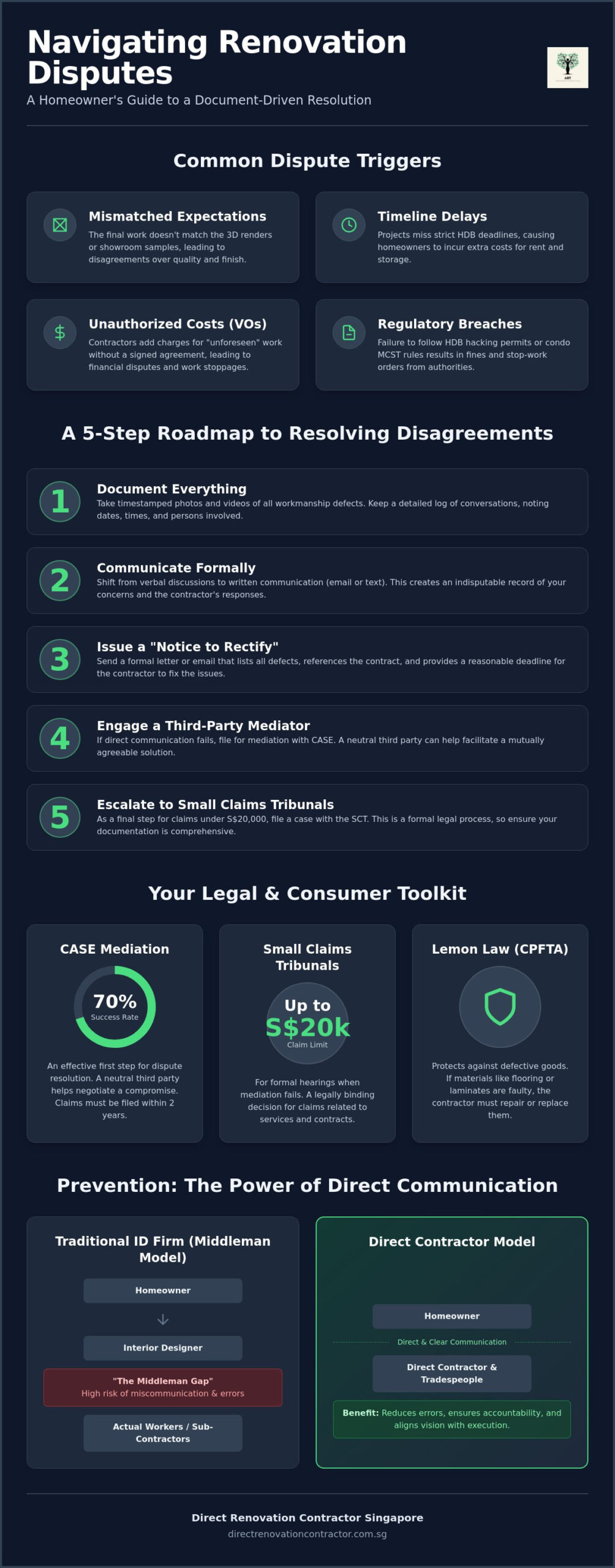
A 5-Step Roadmap to Resolving Contractor Disagreements
When the relationship with your contractor sours, emotions often take over. However, resolving disputes with renovation contractor teams requires a systematic, escalating approach that builds a solid evidence trail. Jumping straight to legal action is expensive and often unnecessary. Most disagreements can be settled on-site if you follow a structured roadmap that prioritizes technical facts over personal frustrations.
- Step 1: Conduct a joint site inspection. Walk through the property with the contractor or project manager. Document every defect with high-resolution, timestamped photos to establish a baseline of the current condition.
- Step 2: Issue a formal “Notice to Rectify.” Send a professional email outlining the specific issues and providing a reasonable deadline, typically 7 to 14 days, for the contractor to fix the problems.
- Step 3: Hold a “Without Prejudice” meeting. This is a discussion where both parties can speak freely to find a compromise, such as cost offsets for minor defects or adjustments to the remaining scope of work, without the conversation being used against them in court later.
- Step 4: Engage a third-party surveyor. If you cannot agree on workmanship quality, hire an independent professional to provide an unbiased assessment. This report carries significant weight in mediation.
- Step 5: Initiate formal mediation. If the contractor remains uncooperative, file for mediation through CASE or the Singapore Mediation Centre to reach a legally binding settlement.
Conducting a Professional Defect Inspection
You don’t need to be an engineer to perform a thorough check, but you do need the right tools. Bring a spirit level to check for slanted kitchen counters, a measuring tape to verify cabinet dimensions, and a high-resolution camera. Use blue painter’s tape to mark specific defect spots; it’s visible in photos and won’t damage new paint or laminates. Categorize your findings into three tiers: Structural (hollow tiles, wall cracks), Functional (leaking taps, misaligned hinges), and Aesthetic (paint drips, scratches). This categorization helps the contractor prioritize their repair schedule.
The Formal Notice to Rectify
A “Notice to Rectify” is more than just a complaint; it’s a legal marker. Your email should be concise and declarative. Reference specific clauses from your hdb renovation in singapore contract to show you know your rights. Use the phrase “Time is of the Essence” for critical path works, such as electrical wiring or plumbing and sanitary works, to indicate that any further delay will cause significant hardship. This documentation is vital if you later need to justify terminating the contract or claiming liquidated damages.
If you’re tired of managing layers of sub-contractors and want a more straightforward experience, working with a direct renovation contractor ensures you deal with the experts actually doing the work, significantly reducing the risk of these disputes.
How a Direct Contractor Model Minimizes Dispute Risks
Choosing the right business model is often more effective than resolving disputes with renovation contractor teams after the damage is done. Most disagreements in Singapore renovations stem from the “Middleman Model” where Interior Design firms outsource labor to third-party sub-contractors. This creates a chain of communication where technical requirements get lost in translation. By working with a direct contractor, you eliminate the “ID Markup,” which is the 20% to 30% commission often added to material and labor costs. This ensures more of your budget is spent on high-quality materials and skilled labor rather than intermediary fees. When you have a direct line to the carpenter singapore teams for your bespoke cabinetry, there’s no ambiguity about dimensions or finishes. This structural clarity is the most practical way of resolving disputes with renovation contractor firms before they even begin.
Technical accountability is the hallmark of the direct model. The person you discuss the quote with is the same person managing the on-site execution. There’s no “creative director” to hide behind when a tiling alignment is off or a plumbing joint leaks. You get straight answers based on technical feasibility rather than aesthetic promises that can’t be built. This transparency reduces financial friction and hidden costs, as the pricing is unmarked-up and reflects the actual trade rates for manual labor and material installation.
Transparency in Material Sourcing
Direct access to material suppliers is the best defense against “bait and switch” tactics. In a middleman model, you might be shown a high-end laminate sample in a showroom, but a cheaper, generic alternative might arrive at your flat. A direct contractor allows you to verify laminate brands and hardware, such as Blum hinges or specific quartz brands, directly at the source. We recommend reviewing direct renovation contractor singapore portfolios that showcase actual completed worksites. Seeing the physical quality of the tiling and masonry in a real home is far more reliable than looking at a glossy 3D render that doesn’t account for site constraints.
The Direct Accountability Advantage
Onsite issues are resolved faster when there’s no ID to act as a messenger. If a worker discovers a hidden pipe during the hacking phase, a direct contractor can provide an immediate technical solution. You don’t have to wait days for an ID’s approval, which keeps the project on schedule and avoids the timeline disputes discussed earlier in this guide. This model also provides a clearer understanding of “buildability.” You’ll know if a specific wardrobe design is structurally sound before the wood is cut. Finally, a labor-based business model is inherently more stable. Because the contractor owns the tools and employs the workers, they’re less likely to abandon a project compared to firms that rely entirely on external credit and sub-contractor availability.
Securing Your Home Investment with Technical Clarity
Managing a renovation doesn’t have to be a gamble. You now have a clear understanding of how to use your contract as a shield and exactly which legal avenues to take if workmanship fails to meet local standards. Resolving disputes with renovation contractor teams is a process of documentation and steady escalation; it’s about shifting the focus from emotional frustration to technical evidence. By prioritizing direct communication and setting clear payment milestones, you protect your finances and your sanity.
We believe the best way to avoid these headaches is to eliminate the middleman entirely. Our team provides direct-to-owner pricing with no ID markups. We are specialists in HDB BTO and Resale renovation packages, offering hands-on project management from our base in Paya Ubi Industrial Park. We focus on quality labor and material transparency so you can move into your new home with confidence.
Get a Transparent, Direct Quote for Your Renovation Today
Your ideal home is within reach when you work with a partner who values straightforward communication as much as you do.
Frequently Asked Questions
What should I do if my renovation contractor goes missing in Singapore?
File a police report immediately and lodge a complaint with CASE if your contractor has abandoned the site after taking payment. You should also check the ACRA register to see if the company has been struck off or is in liquidation. Document the current state of your home with timestamped photos before engaging anyone else. This evidence is vital for resolving disputes with renovation contractor firms that disappear mid-project.
Can I stop payment if I am unhappy with the workmanship quality?
You shouldn’t abruptly stop payment as this can put you in breach of contract. Instead, you should issue a formal “Notice to Rectify” that details the specific defects and sets a deadline for repairs. State clearly that the next milestone payment will be released only after the work meets the technical standards defined in your contract. This approach protects you legally while maintaining financial leverage.
How much does it cost to file a claim with the Small Claims Tribunal?
Filing fees for individuals are kept very low to ensure justice is accessible. It costs $10 for claims up to $5,000 and $20 for claims between $5,001 and $10,000. For claims above $10,000 up to the $30,000 limit, the fee is 1% of the total claim amount. These fees are non-refundable and must be paid at the time of filing through the CJTS portal.
Is a WhatsApp message considered a legally binding contract change in SG?
Yes, WhatsApp messages are admissible as evidence in Singaporean courts and tribunals to prove that an agreement was reached. If you and your contractor agree on a price change or a new material in a chat log, it’s considered legally binding. However, it’s always safer to follow up with a formal signed Variation Order to ensure there’s no ambiguity regarding the technical specifications.
Can I hire a new contractor to finish the work before the old one is terminated?
No, you must legally terminate your existing contract before hiring a new firm to finish the work. Hiring a second contractor while the first contract is still active can lead to a lawsuit against you for breach of contract. You must follow the termination clauses in your agreement, which usually require a formal notice period to allow the original contractor to pack their tools and vacate.
What is the “Retention Sum” and how does it protect homeowners?
A retention sum is a portion of the contract value, typically 10%, that you hold back after the project is physically completed. This sum is only released after the “Defects Liability Period” ends and all minor issues are fixed. It acts as a financial guarantee that the contractor will return to rectify hollow tiles, cabinet misalignments, or paint touch-ups without charging you extra fees.
Do I need a lawyer to resolve a dispute over a $10,000 kitchen renovation?
No, you don’t need a lawyer for disputes involving $10,000. Lawyers are actually not allowed to represent parties during Small Claims Tribunals proceedings. This makes the SCT a much more affordable and straightforward route for resolving disputes with renovation contractor teams. Most residential cases are settled through mediation or a tribunal hearing where you present your own evidence, such as contracts and defect photos.
How do I check if my contractor is HDB-registered or blacklisted?
Visit the HDB e-Service “Directory of Renovation Contractors” to verify if a firm is authorized to carry out works in HDB flats. To check for a history of bad business practices, visit the CASE website and look for companies with active consumer alerts or those that have been blacklisted. Verifying these details before signing any HDB BTO or Resale renovation packages is the best way to prevent future disputes.