

In the Singapore renovation scene, the word “hacker” should only refer to the specialist tearing down your old walls, but too often, it’s the homeowner who ends up getting “hacked” by hidden markups and unlicensed work. It is a stressful reality where a simple demolition job can spiral into structural damage or legal trouble with HDB. If you’re currently asking yourself How To Find A Renovation Hacker That Will Not Hack Me?, you aren’t alone. Most people fear that a lack of technical knowledge will lead to inflated haulage costs or, worse, a contractor who disappears once the permit is approved.
We understand that you want a straightforward process without the interior designer’s middleman commission. This article provides a clear roadmap to hiring a professional demolition contractor who prioritizes structural integrity and financial honesty. You’ll learn the specific steps to verify HDB registration, the mandatory rules for neighbor notification, and how to spot hidden debris removal fees before you sign anything. We’re stripping away the jargon to give you a practical checklist that ensures your renovation starts on a solid, scam-free foundation.
Key Takeaways
- Verify that your contractor is HDB-registered and BCA-approved to ensure all structural hacking complies with 2026 safety regulations and permit requirements.
- Identify and eliminate hidden markups by requesting a transparent breakdown of haulage and debris removal fees, which are common areas for undisclosed commissions.
- Use our technical vetting checklist to answer the question: How To Find A Renovation Hacker That Will Not Hack Me? and avoid unlicensed, fly-by-night operators.
- Engage a direct renovation contractor to remove intermediary markups and ensure hands-on technical oversight of all demolition and masonry works.
- Comply with HDB notification rules by providing written notice to neighbors within a two-unit radius at least five days before any noisy hacking begins.
What is Renovation Hacking and Why Do People Fear It?
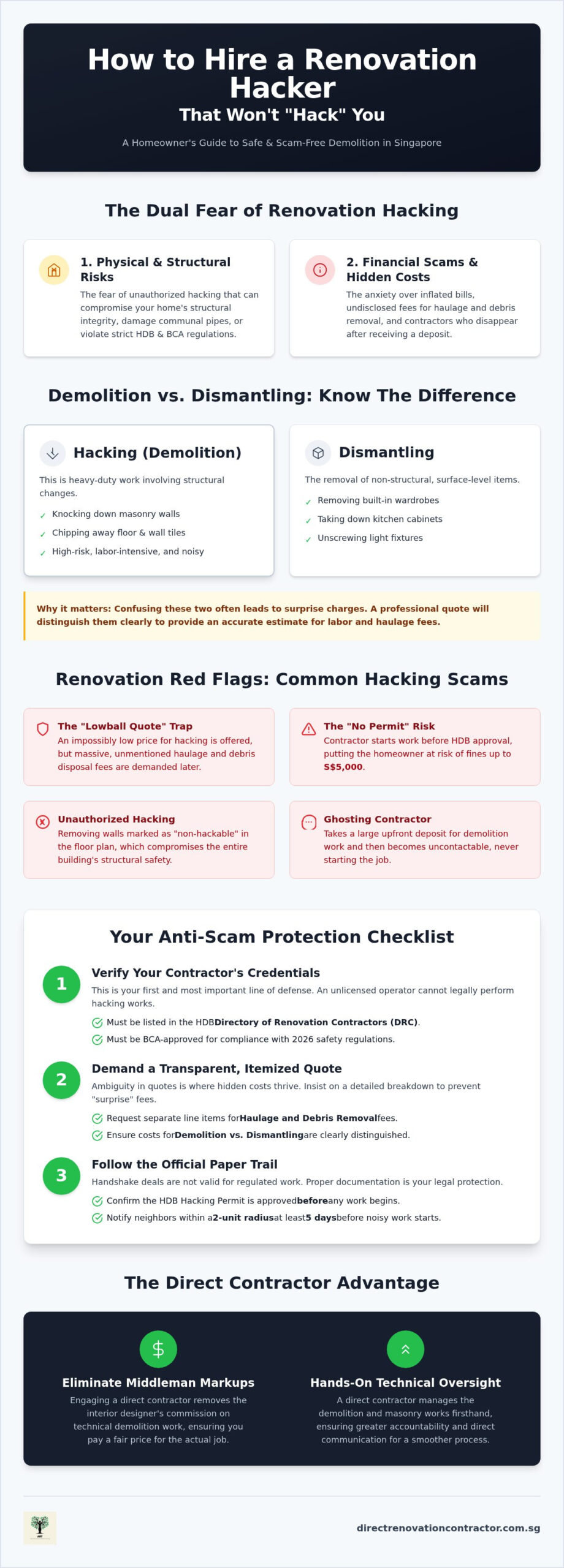
In the Singapore renovation context, “hacking” is a technical term for the controlled demolition of existing structures within a property. It’s the phase where sledgehammers meet masonry walls, floor tiles are chipped away, and the old layout is cleared for the new. For many homeowners, this stage triggers intense anxiety. You aren’t just worried about the noise; you’re worried about the structural integrity of your home and the transparency of your bill. This is why the search query How To Find A Renovation Hacker That Will Not Hack Me? is so common. It reflects a dual fear: the fear of physical damage to the building and the fear of a financial scam.
As of 2026, the industry standards for safe demolition are rigorous. HDB and BCA have tightened regulations to prevent unauthorized removal of structural components. General contractors who manage these projects must ensure that hacking teams follow specific sequences to avoid destabilizing the unit or damaging communal pipes. Because this phase is high-risk and labor-intensive, it often serves as the primary battlefield for hidden costs and technical errors. Technical transparency during this stage isn’t just a preference; it’s your only real protection against a renovation disaster.
The Two Faces of Hacking: Demolition vs. Dismantling
Confusion between dismantling and demolition often leads to disputes over the final invoice. Dismantling is the relatively clean removal of surface-level items like built-in wardrobes, kitchen cabinets, and light fixtures. These are typically screwed or glued into place and don’t involve structural impact. Demolition, on the other hand, involves heavy-duty knocking down of masonry walls and hacking of floor or wall tiles. If your quote lists “dismantling” for a brick wall, you’re looking at a major price revision later. Professional contractors distinguish these clearly to provide accurate labor and haulage estimates from the start. This clarity prevents the “hidden markup” trap that catches many first-time renovators.
Common “Hacking” Scams to Watch Out For
Understanding How To Find A Renovation Hacker That Will Not Hack Me? starts with recognizing the red flags of a renovation scam. One prevalent tactic is the “Lowball Quote” trap. A contractor offers an impossibly low price for hacking but doesn’t mention haulage and debris removal. Once the walls are down, they demand massive disposal fees before they’ll clear the site. Other risks include:
- The “No Permit” Risk: Starting work before HDB or management approval is granted. This can result in fines of up to $5,000 for the homeowner.
- Ghosting: Taking a large upfront deposit for hacking works and then disappearing without ever deploying a team to the site.
- Unauthorized Hacking: Removing walls that were marked as “non-hackable” in the floor plan, which compromises the building’s structural safety.
The Paper Trail: Using Regulations to Protect Your Renovation
The most effective way to answer How To Find A Renovation Hacker That Will Not Hack Me? is to follow the official paper trail. In Singapore, hacking isn’t a handshake deal; it’s a strictly regulated activity. As of the July 21, 2026 update to Singapore Statutes, it’s a legal offense for flat owners to engage a contractor who isn’t listed in the HDB Directory of Renovation Contractors (DRC). This directory is your first line of defense. A legitimate professional won’t hesitate to provide their registration number for you to verify on the HDB portal. If they aren’t on that list, they shouldn’t be in your home with a sledgehammer.
Beyond the contractor’s license, you must ensure the specific hacking permit is in place before any work starts. According to regulations updated in April 2026, homeowners must provide written notice to neighbors within a two-unit radius at least five days before noisy works begin. This process ensures that everyone is aware of the vibration schedules. If a contractor pressures you to start work “quietly” without a permit, they’re putting you at risk of a $5,000 fine. Learning to recognize the signs of a home improvement scam often starts with identifying those who try to bypass these mandatory legal steps.
HDB Hacking Permits and P.E. Endorsements
Removing a wall involves more than just physical labor; it requires structural validation. While some walls are non-load bearing, others are critical to the building’s integrity. When you’re researching How To Find A Renovation Hacker That Will Not Hack Me?, check if they understand when a Professional Engineer (P.E.) endorsement is mandatory. This endorsement is required whenever there’s a risk of affecting the building’s stability. Always cross-reference the approved HDB hacking permit with your floor plan to ensure the work scope matches exactly. Our team at Direct Renovation Contractor Singapore manages these technical submissions directly, ensuring every hammer swing is backed by the right paperwork.
Condo Renovation Rules and MCST Coordination
Private estates operate under their own Management Corporation Strata Title (MCST) bylaws. Unlike HDB flats, condos often require a security deposit before hacking can commence to cover potential damage to common areas. Hacking work hours are strictly limited to 9am to 5pm on weekdays only. It’s vital to remember that every condo has unique hacking restrictions, ranging from specific debris disposal routes to limitations on the weight of machinery allowed in the lifts. Coordination with the management office is not optional. It’s a prerequisite for a smooth, scam-free project that avoids unnecessary fines or work stoppages.
The Cost of Hacking: Avoiding Hidden Markups and Haulage Traps
Financial transparency in renovation starts with understanding how demolition costs are actually calculated. Most legitimate contractors price hacking works based on the specific volume of material being removed. This includes the number of masonry walls, the total square footage of floor tiles, or the quantity of built-in cabinets to be dismantled. If a quote arrives as a single “lump sum” without these details, it’s a major red flag. When you ask yourself How To Find A Renovation Hacker That Will Not Hack Me?, the answer lies in the granularity of the quotation. A clear breakdown prevents the contractor from arbitrarily increasing the price once the work has already started.
Be wary of “free hacking” offers often bundled into HDB renovation packages. In the construction industry, labor and disposal are significant expenses that cannot simply be waived. These costs are almost always hidden in other line items, such as inflated masonry rates or overpriced material installation fees. According to 2026 industry data, renovating a resale flat can cost 15 percent to 30 percent more than a BTO flat primarily due to these extensive hacking and re-piping requirements. A direct contractor will show you the real cost of labor rather than hiding it behind marketing gimmicks.
Understanding Haulage and Debris Removal
Haulage and debris removal are two distinct services that are frequently manipulated to include hidden markups. Haulage refers to the manual labor required to bring new materials like sand, cement, and tiles up to your unit. Debris removal is the process of clearing the rubble created by hacking and transporting it to approved disposal sites. These should always be listed as separate line items. Lumping them together makes it easier for a middleman to hide a commission. Demanding a separate quote for haulage ensures you’re paying for the actual labor involved in the logistics of your specific project.
The “Middleman” Tax: Why IDs Charge More for Demolition
Interior design firms rarely employ their own hacking teams. Instead, they coordinate with sub-contractors and add a management fee, which often adds 20 percent to 30 percent to the final bill. This “middleman tax” covers their coordination time but offers no technical benefit to the structural work itself. By engaging a direct renovation contractor singapore, you bypass these commissions. A direct model gives you a straight line to the technical team performing the work, ensuring that your budget goes toward quality labor and proper disposal rather than administrative markups. This direct oversight is the most reliable way to answer How To Find A Renovation Hacker That Will Not Hack Me? while keeping your budget intact.
Vetting Your Contractor: The 2026 “Anti-Scam” Checklist
Technical verification is your most powerful tool when deciding How To Find A Renovation Hacker That Will Not Hack Me? In the Singapore market, professional demolition isn’t just about strength; it’s about compliance and reliability. Your first step is to verify the contractor’s HDB and BCA registration. It’s a legal requirement for any structural work in a flat to be performed by a firm listed in the HDB Directory of Renovation Contractors (DRC). If a person claims they “don’t need a license for small jobs,” they’re likely an unlicensed operator who will leave you liable for any structural damage or regulatory fines.
Check for a physical office location before signing any contract. Fly-by-night contractors often operate solely through mobile numbers or temporary social media profiles, making them impossible to track if they disappear with your deposit. A established base, such as our technical headquarters in Paya Ubi Industrial Park, signals a commitment to the industry and provides a clear point of contact for project management. Additionally, stick to a strict payment milestone schedule. Never pay more than 10 percent to 20 percent as an initial deposit for hacking works. A professional team with a healthy cash flow doesn’t need 50 percent upfront just to start the hammers.
Finally, insist on a site walk-through. A competent hacker doesn’t just look at walls; they look for concealed electrical conduits and water pipes. They should identify potential risks before the first tile is chipped. If you’re looking for a team that prioritizes this technical oversight, you can contact our direct renovation specialists to discuss your demolition requirements without the pressure of a middleman sales pitch.
Red Flags in Hacking Quotes
When reviewing a quotation, look for vague descriptions like “Hacking works for whole house” without a specific list of items. This lack of detail is a common way for scammers to add “unexpected” costs later. Another major warning sign is a contractor who refuses to apply for the HDB permit in the owner’s name. This is often an attempt to hide their lack of registration. Unusually low prices that exclude debris disposal are another classic trap; they’ll hold your site hostage with piles of rubble until you pay an inflated “haulage” fee. Asking How To Find A Renovation Hacker That Will Not Hack Me? means looking for transparency in every line item.
Questions to Ask Before Signing
- “Who is your HDB registered contractor for this project?” Verify the name against their business card and the official directory.
- “What happens if we find concealed pipes during the hacking process?” A professional should have a clear protocol for stopping work and coordinating with a licensed plumber.
- “Is the haulage fee fixed regardless of the number of trips required?” Ensure the price covers the complete removal of all debris created by the agreed hacking scope.
Why a Direct Contractor is Your Safest Bet for Demolition
Choosing a direct contractor is the most pragmatic answer to How To Find A Renovation Hacker That Will Not Hack Me? because it aligns your financial interests with the technical execution. When you work with Direct Renovation Contractor Singapore, you aren’t paying for an interior designer’s artistic vision or their management markup. Instead, you’re paying for the technical competence of a team that specializes in structural works and HDB permits. This direct model ensures that the person you speak with is the one actually supervising the demolition crew on-site. It removes the communication gaps that lead to costly errors.
Successful home renovation projects in 2026 rely heavily on pre-demolition planning. We use 3D drawings to visualize the hacking process before a single sledgehammer is swung. This prevents the “wrong wall” errors that can lead to structural instability or HDB fines. By mapping out exactly which masonry walls and tiles are being removed, we provide a level of precision that traditional middleman firms often skip in their rush to start the project. This technical foresight is what protects your property’s value and your peace of mind.
Eliminating the “Hacker” Risk with Transparency
Transparency is our badge of honor. By removing intermediaries, we offer direct communication with the project manager who handles the hacking crew. You get a clear view of where every dollar goes, from labor costs to the actual disposal fees at the plant. It’s essential to have a fixed-price contract for all labor and haulage works to prevent the “ballooning budget” scam discussed earlier. We reject undisclosed fees and intermediary commissions; what you see in the technical quote is exactly what you pay. This straightforward financial model is the best defense against renovation fraud.
From Hacking to Custom Carpentry
The demolition phase isn’t an isolated event; it’s the preparation for what comes next. A carpenter singapore needs a perfectly leveled floor and straight walls to install high-quality cabinetry. Our hacking team works in tandem with our masonry and carpentry units to ensure that once the old structures are gone, the site is technically ready for installation. We handle the floor leveling and screeding immediately after hacking, ensuring your new wardrobes and kitchen cabinets fit perfectly without gaps. This seamless transition prevents the delays common when multiple sub-contractors are poorly coordinated.
Ready for a scam-free renovation? Get a direct quote for your hacking works today and work with a team that values technical skill over flashy presentations.
Secure Your Renovation with Technical Transparency
Starting your home makeover doesn’t have to be a gamble. By verifying HDB registration and demanding a line-item breakdown of haulage and debris removal, you eliminate the most common avenues for renovation fraud. You now have a clear technical framework to answer How To Find A Renovation Hacker That Will Not Hack Me? and protect your property from structural risks. The safest path involves removing the middleman and dealing directly with the experts who manage the tools and the permits.
Our direct-to-homeowner model ensures you get HDB Registered Contractor expertise with fixed-price contracts and zero undisclosed commissions. We prioritize technical integrity over flashy sales talk, providing you with the reliable results you deserve. Skip the markups and hire a Direct Renovation Contractor today to ensure your demolition works are handled with honesty and precision. Your dream home starts with a solid, well-managed foundation.
Frequently Asked Questions
Do I need an HDB permit to hack a non-load bearing wall?
Yes, you definitely need a permit. HDB regulations updated in 2026 state that a renovation permit is mandatory for any works affecting structural integrity, including the demolition of non-load bearing walls. This ensures the block’s stability isn’t compromised by improper hacking methods. A registered contractor must submit the application on your behalf. Starting without an approved permit can lead to fines of up to $5,000 and orders to reinstate the wall.
How much does hacking usually cost for a 4-room BTO flat?
Hacking costs are never fixed; they depend on the specific volume of material being removed, such as the length of masonry walls or the square footage of floor tiles. Rather than looking for a general package price, request a detailed breakdown per wall or per item. This granular approach is the most effective way to answer How To Find A Renovation Hacker That Will Not Hack Me? because it prevents arbitrary markups.
Can I stay in my house while the hacking works are being done?
It’s highly unadvisable to stay in the unit during the hacking phase. Noisy activities are restricted to 9am to 5pm on weekdays, and the vibration and dust levels are significant. The process creates airborne debris that can affect respiratory health and makes the living space functionally unusable. For safety and comfort, most homeowners arrange alternative accommodation for the duration of the demolition and heavy masonry works.
What is the “1-month rule” for hacking in new BTO estates?
In new BTO estates, HDB typically mandates that all noisy renovation works, including hacking and drilling, must be completed within one month from the date the permit is issued. This rule aims to minimize the period of disturbance for neighbors. Remember that noisy work is only allowed on weekdays from 9am to 5pm. You should also note the three-year restriction on removing waterproofing membranes in BTO bathrooms.
How do I know if a wall is structural or non-structural?
You must refer to your official HDB floor plan to identify wall types accurately. Structural walls are indicated by thick, bold black lines or hatched patterns, while non-structural walls appear as thinner, single lines. Never rely on a visual inspection or a “hollow sound” when tapping the wall. A professional contractor will always cross-reference your plan with HDB’s technical guidelines before applying for any hacking permit or structural assessment.
What happens if my contractor hacks a water pipe by mistake?
If a pipe is damaged, the contractor must immediately shut off the main water valve and engage a licensed plumber for repairs. This risk is why hiring a technical expert is critical for anyone wondering How To Find A Renovation Hacker That Will Not Hack Me? Professional contractors maintain public liability insurance to cover such accidents. Always verify that your contractor has a clear emergency protocol for handling concealed pipes or wires during demolition.
Is haulage included in the hacking price or is it a separate fee?
Haulage and debris removal should always be listed as separate line items in your quotation. Haulage refers to the labor of bringing new materials like sand and cement up to your unit, while debris removal covers the disposal of hacked rubble. Lumping these into a single fee often masks hidden markups or commissions. Insist on a transparent breakdown to ensure you’re paying for the actual labor and disposal trips required.
How can I verify if a renovation contractor is blacklisted in Singapore?
You can verify a contractor’s standing by checking the HDB Directory of Renovation Contractors (DRC). This portal identifies registered firms and lists those with demerit points or suspended licenses. Additionally, check the Consumers Association of Singapore (CASE) website for alert lists and the ACRA portal to ensure the business is active. Avoid engaging contractors who only provide a mobile number without a registered business address or a verifiable technical office.