
Hiring an unlicensed person to touch your HDB’s water pipes isn’t just a DIY shortcut; it’s a legal offense that can lead to significant fines in 2026. When you’re searching for All You Need To Know When Looking For A Plumber, the priority is usually avoiding hidden markups and ensuring technical compliance. Most homeowners feel a genuine sense of anxiety when faced with a plumbing emergency or a full bathroom renovation. You likely worry about whether the person you hired actually holds a valid PUB license or if you’re being overcharged by an intermediary.
This guide provides a clear roadmap to help you navigate these technical hurdles with confidence. You’ll learn how to verify credentials instantly and understand the specific scope of work required for kitchen and toilet upgrades. We’ll show you how working with a direct contractor eliminates the middleman, ensuring your home remains compliant with PUB and HDB standards while keeping your budget transparent. From leak repairs to full-scale re-piping, we’ll explain how to secure reliable, honest plumbing services without the unnecessary design-firm fluff.
Key Takeaways
- Identify why only PUB Licensed Plumbers are legally permitted to perform regulated water and sanitary works in 2026.
- Distinguish between basic maintenance repairs and the high-stakes technical requirements of full kitchen or bathroom renovations.
- Learn All You Need To Know When Looking For A Plumber to verify credentials and avoid the legal and safety risks of unlicensed contractors.
- Discover how to evaluate quotes for financial transparency, ensuring you only pay for actual materials and skilled labor without hidden fees.
- Understand how the direct contractor model eliminates intermediary markups and simplifies the technical coordination of your plumbing and sanitary works.
Understanding Plumbing Standards in Singapore (PUB Licensing)
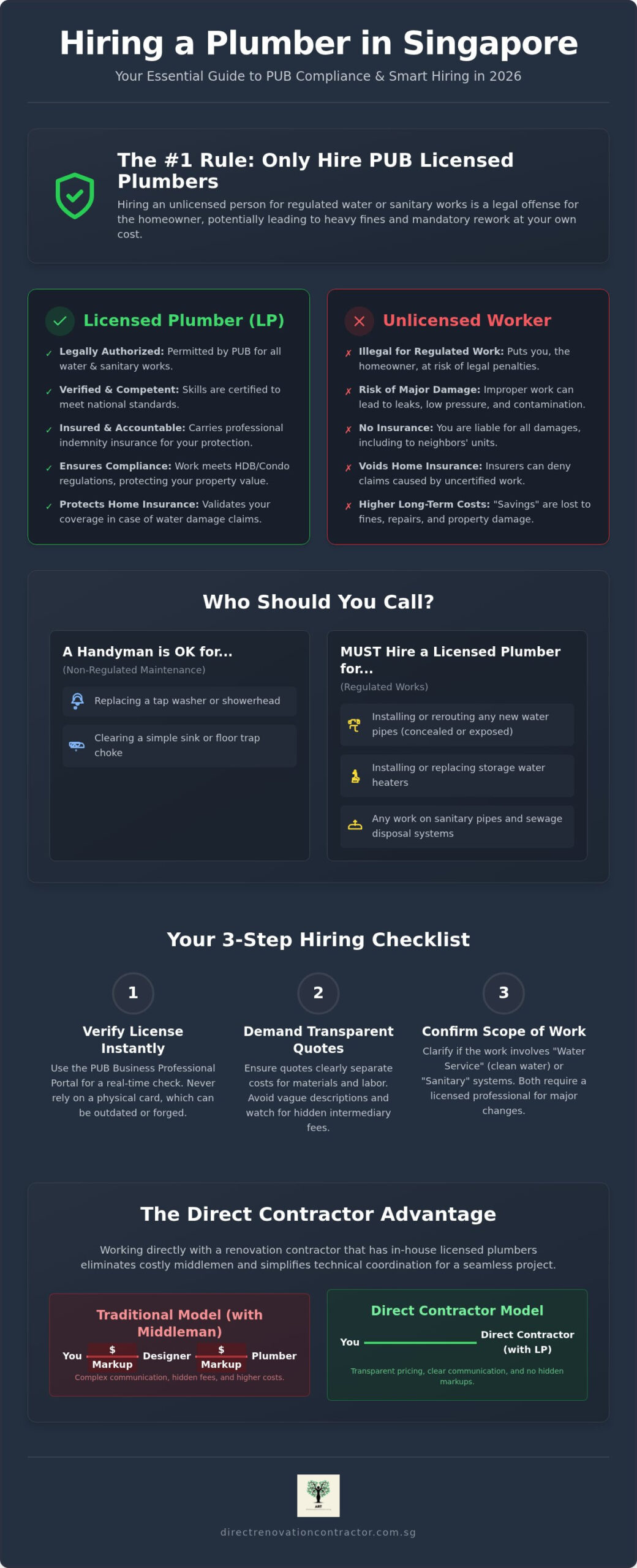
Finding a qualified professional starts with understanding the legal framework that governs Singapore’s water infrastructure. All You Need To Know When Looking For A Plumber begins with the Public Utilities Board (PUB) licensing requirements. Since April 1, 2018, it’s been mandatory for anyone performing regulated water service or sanitary works to hold a valid PUB license. This isn’t just a recommendation; it’s a legal safeguard designed to protect the integrity of Plumbing systems across the island. A Licensed Plumber (LP) is an individual who has met strict technical competencies and is authorized to certify that their work complies with national safety standards.
In 2026, credential verification has shifted entirely to digital platforms. You should no longer rely solely on a physical license card, which can be forged or out of date. Instead, homeowners must use the PUB Business Professional Portal to perform a real-time check of a plumber’s license number. This digital step ensures the license is active and hasn’t been suspended for previous safety violations. Understanding the distinction between “Water Service” and “Sanitary” works is equally vital. Water service refers to the pipes carrying clean, potable water into your home. Sanitary works involve the disposal of used water and sewage. Both categories require a licensed professional for any significant modifications or installations.
The Role of the Public Utilities Board (PUB)
The PUB acts as the central regulator for all water-related activities in Singapore. Through their online portal, they maintain a transparent database of every LP authorized to work in HDB and Condo units. Government regulation in this sector is intense because poor workmanship can lead to cross-contamination of the public water supply. If you engage an unlicensed worker for regulated tasks, you face more than just a leaky pipe. Non-compliant work in HDB flats can result in heavy fines and a legal requirement to tear out the uncertified installations at your own expense. For Condo owners, it often leads to disputes with the Management Corporation Strata Title (MCST) and potential liability for water damage to neighboring units.
Handyman vs. Licensed Plumber: When to Hire Whom?
You don’t always need a fully licensed expert for every small task in your home. Minor maintenance jobs are generally exempt from the LP requirement. For example, replacing a tap washer, clearing a simple sink choke, or swapping out a showerhead are tasks a general handyman can handle. These are considered non-regulated works that don’t impact the core integrity of the building’s water system.
However, major works legally require a PUB Licensed Plumber. This includes installing new water pipes, rerouting concealed copper piping, or installing storage water heaters. Hiring a handyman for these tasks is a significant risk. Beyond the technical danger, most home insurance policies in Singapore will void your coverage if they discover that a major leak or flood was caused by unlicensed plumbing work. When you’re gathering All You Need To Know When Looking For A Plumber, remember that the “cheaper” handyman option for major renovations often becomes the most expensive mistake you can make.
Licensed vs. Unlicensed Plumbers: Risks and Regulations
Choosing an unlicensed contractor often seems like a cost-saving measure at first glance. These individuals typically offer lower rates because they don’t invest in mandatory training, professional indemnity insurance, or high-grade equipment. However, All You Need To Know When Looking For A Plumber includes recognizing that these upfront savings frequently lead to massive long-term expenses. When you bypass a Licensed Plumber (LP), you’re essentially gambling with your home’s structural integrity and your legal standing with the authorities.
In 2026, the distinction between a licensed professional and a “freelance” handyman is sharper than ever. Unlicensed work often results in poor water pressure management or improperly sealed joints that cause slow, structural leaks. These leaks might not appear for months, but by the time they do, the damage to your flooring and cabinetry is often irreversible. Verifying a license is straightforward; use the PUB website or the 2026 mobile app to scan a plumber’s digital ID before they begin any work on your property.
Financial and Legal Risks
Hiring an unlicensed worker for regulated tasks is a punishable offense for the homeowner. PUB can issue heavy fines if they discover illegal plumbing installations during a routine inspection or following a neighbor’s complaint. For those living in HDB flats or Condos, the risks are even more specific. Both HDB and MCST management require an LP’s endorsement for most renovation permits. Without this official signature, your renovation cannot legally proceed. If you’ve already completed the work using an unlicensed contractor, you’ll likely face “rectification works.” This means hiring an LP to hack away the new tiles, inspect the pipes, and redo the entire installation to meet code, effectively doubling your costs.
Health and Quality Considerations
Safety goes beyond just stopping leaks. A major technical risk of unlicensed plumbing is backflow, where contaminated waste water is sucked back into your clean water supply. Licensed professionals understand the complex physics of pressure valves and air gaps required to prevent this health hazard. Quality also extends to materials. Cheap plumbers often use substandard, non-approved pipes that corrode quickly. Working with a professional team ensures you receive a service agreement that guarantees accountability. For homeowners planning a major overhaul, our HDB and Condo renovation packages include fully licensed plumbing works to ensure your home remains safe and compliant.
Every professional LP provides a clear warranty on their workmanship. This accountability is what you pay for. If a pipe bursts due to a faulty joint a month later, a licensed company is legally and professionally bound to fix it. An unlicensed freelancer has no such obligation and can simply disappear, leaving you with the repair bill and a damaged home.
Maintenance Repairs vs. Full Renovation Plumbing Works
Distinguishing between a quick fix and a structural overhaul is a fundamental part of All You Need To Know When Looking For A Plumber. Maintenance plumbing is typically reactive. It involves addressing immediate failures like clearing floor trap chokes, fixing a burst pipe, or replacing a leaking faucet. These tasks are usually standalone and don’t require coordination with other trades. In contrast, renovation plumbing is a proactive, technical undertaking that integrates with your home’s architecture. It includes full re-piping, waterproofing, and the strategic repositioning of sanitary fixtures to match a new floor plan.
When you embark on a major project, plumbing becomes a core component of the construction sequence. It isn’t just about connecting pipes; it’s about ensuring the new layout is functional and compliant with HDB and Condo regulations. Managing these complex scopes requires a professional who understands how plumbing interacts with masonry and carpentry. This is where the direct contractor model provides a distinct advantage over hiring separate, uncoordinated handymen for small parts of a larger job.
Kitchen and Bathroom Plumbing Essentials
Integrating your pipework with kitchen renovation plans is critical for long-term functionality. If the new cabinetry layout moves the sink location, the drainage slope must be precisely calculated to prevent future backflow or slow drainage. For a toilet renovation, waterproofing is the absolute priority. In many older HDB resale units, original piping is concealed within the floor or walls. Hacking these out without damaging the structural slab requires technical expertise. We focus on ensuring that every new pipe is pressure-tested and every waterproof membrane is intact before a single tile is laid.
Managing the Plumbing Process in a Renovation
A successful renovation follows a logical sequence: hacking, followed by piping, and then tiling. If your plumber and tiler don’t communicate, you risk having tiles laid over a slow leak that won’t be visible until after the project is finished. We eliminate this risk by managing the coordination between these trades directly. All You Need To Know When Looking For A Plumber during a renovation is that the “coordination fee” charged by interior designers is often an unnecessary markup. Working with a direct contractor ensures that the person responsible for the pipes is in constant contact with the person laying the tiles. This streamlined approach prevents technical errors and ensures that the financial model remains transparent, with no hidden commissions for intermediary management.
How to Evaluate a Plumber: A 2026 Hiring Checklist
Selecting the right professional requires a systematic approach to filter out low-quality contractors. All You Need To Know When Looking For A Plumber in 2026 involves more than just comparing prices; it’s about verifying technical competence and financial honesty. Start by searching the PUB Licensed Plumber database using their digital ID. This confirms they’re legally authorized to work in Singapore. Next, insist on a detailed, unmarked-up quote. Avoid “lump sum” estimates that hide material costs or intermediary commissions. A transparent contractor will list every pipe fitting and labor hour clearly.
Your evaluation must also cover protection and proof of work. Verify that the plumber carries insurance for third-party property damage. This is critical in high-density HDB and Condo environments where a mistake can cause flooding in the unit below yours. Ask to see a digital portfolio of their recent residential projects in Singapore. This provides evidence of their experience with local HDB piping configurations. Finally, get a written confirmation of the warranty period. A reliable professional should guarantee both the labor and the materials used for a specific duration.
Critical Questions to Ask Before Signing
Before you commit, ask direct questions to gauge their operational transparency. Confirm if the person on-site is the actual PUB Licensed Plumber or just a technician working under someone else’s license. Ask if the quote covers site protection and debris clearing; these hidden costs often surprise homeowners later. You should also verify if they’ll manage the necessary PUB submissions for your renovation. If you’re planning a larger project, our HDB and Condo renovation packages include all technical coordination and submissions as standard, removing the guesswork from the process.
Red Flags to Watch Out For
Protect your investment by recognizing common warning signs. Be wary of plumbers who demand full payment upfront. A standard, professional arrangement usually involves a deposit followed by progress payments. Another red flag is a refusal to provide a written contract or an itemized invoice. Vague answers about HDB or MCST compliance are also a major concern. If a contractor can’t explain the specific regulatory requirements for your unit, they’re likely unlicensed and pose a significant risk to your property and your wallet.
The Direct Contractor Advantage for Plumbing and Sanitary Works
Choosing the right business model for your home renovation is just as important as selecting the right fixtures. All You Need To Know When Looking For A Plumber in a renovation context boils down to who manages the technical coordination and who takes the profit. Direct Renovation Contractor Singapore operates on a straightforward, direct-to-homeowner model. By removing the interior designer (ID) from the plumbing equation, we eliminate the standard 20% to 30% markups often applied to sub-contracted labor. You shouldn’t have to pay an intermediary a premium just to find a licensed professional that we already have on our internal team.
Our expert team, based in Paya Ubi Industrial Park, possesses deep local knowledge of HDB and Condo plumbing regulations. This expertise ensures that your plumbing works are seamlessly integrated with other critical trades. For example, our plumbers coordinate directly with our carpentry team to ensure sink supports and cabinet cut-outs are precise. This prevents the common “site friction” where a plumber arrives only to find the cabinet prevents a proper pipe connection. This level of internal synchronization is a hallmark of the direct contractor approach, providing a level of technical integrity that fragmented teams simply can’t match.
Transparent Pricing Without Markups
We believe in financial clarity. Our plumbing and sanitary work fees are based on the actual complexity of the job and the materials required, not on hidden commissions. Because plumbing is a core part of our HDB BTO and Resale renovation packages, the costs are baked into a transparent framework from the start. You get direct access to the tradespeople doing the actual work on your site. This direct line of communication means that if a technical adjustment is needed during the hacking phase, it’s handled immediately without waiting for an ID to relay messages and approve “variation orders” that inflate your final bill.
Quality Assurance and Compliance
Our commitment to quality is rooted in technical compliance. We exclusively use PUB-approved materials and fittings to ensure your home meets all 2026 regulatory standards. This isn’t just about passing inspections; it’s about the long-term durability of your home’s infrastructure. From high-pressure copper piping to specialized waterproofing membranes, we don’t cut corners on the components that sit behind your walls. We handle all technical coordination and required submissions, providing a reassuring, no-nonsense service that prioritizes functional results over flashy presentations. If you’re ready to secure high-quality workmanship without the middleman fees, contact us for a direct quote on your plumbing and renovation needs today.
Secure Your Home’s Infrastructure with Expert Plumbing
Ensuring your home’s water systems are safe and compliant is a critical part of any successful renovation. By now, you have All You Need To Know When Looking For A Plumber to make an informed and pragmatic decision. Digital verification of a PUB license is your first line of defense against legal fines and structural damage. Choosing a direct contractor model further protects your budget by removing undisclosed middleman markups and intermediary commissions. Our Paya Ubi team provides direct access to skilled tradesmen who understand the technical nuances of HDB and Condo regulations. We focus on technical integrity and financial transparency, ensuring every pipe and fitting meets 2026 standards. It’s a straightforward path to technical compliance when you work directly with the experts. Don’t let hidden fees or unlicensed work compromise your property’s value and safety. You can Get a Transparent, Direct Quote for Your Plumbing and Renovation Works Today and work with an HDB registered contractor who values quality. With the right professional partner, your home renovation will be a smooth, predictable, and cost-effective process.
Frequently Asked Questions
Do I need a licensed plumber for a simple tap replacement?
No, you don’t. Minor maintenance tasks like replacing a tap or washer are considered non-regulated works under current PUB standards. A general handyman or a DIY approach is legally acceptable for these small jobs. However, if the replacement involves modifying the actual water service pipes or installing a new water meter, a PUB Licensed Plumber becomes mandatory. Always distinguish between simple fixture swaps and structural piping changes.
How can I check if a plumber is truly PUB licensed in 2026?
You must use the PUB Business Professional Portal or the official 2026 mobile app to verify credentials in real time. Simply looking at a physical card isn’t enough; digital verification ensures the license is active and not suspended. Input the plumber’s license number into the public register before they start work. This step is a core part of All You Need To Know When Looking For A Plumber.
What is the difference between water service works and sanitary works?
Water service works involve the pipes and fittings that carry clean, potable water into your home. Sanitary works refer to the system that carries used water and sewage away to the public sewers. Both systems are strictly regulated by PUB to maintain public health. While they serve different functions, any major modification to either system legally requires a Licensed Plumber to certify that the work meets safety standards.
Does a renovation contractor provide their own licensed plumber?
Most direct renovation contractors include plumbing and sanitary works as part of their standard HDB or Condo packages. We manage our own team of skilled tradesmen to ensure seamless coordination with masonry and carpentry works. This model is more efficient than hiring an external plumber separately. It also eliminates the coordination markups typically charged by interior design firms, as you are working directly with the technical team.
Why is a licensed plumber more expensive than a general handyman?
A Licensed Plumber (LP) invests in mandatory technical training, professional indemnity insurance, and high-grade equipment required for certification. Their rates reflect the legal accountability they take for the work performed. An LP can officially endorse permits and submissions to PUB and HDB, which a handyman cannot do. This endorsement protects you from legal fines and ensures your home insurance remains valid if a major leak occurs later.
What should I do if my unlicensed plumber causes a leak in my HDB?
You should immediately engage a PUB Licensed Plumber to assess the damage and perform rectification works. An unlicensed plumber has no legal standing to certify repairs, and their work might have voided your home insurance. You’ll likely need to report the incident to HDB if structural damage occurred. Rectifying illegal plumbing often involves hacking away new tiles to redo the piping correctly, which significantly increases your final costs.
Are plumbing works covered under a standard home renovation warranty?
Yes, professional contractors provide a warranty period covering both labor and materials for plumbing installations. This protection is a vital component of All You Need To Know When Looking For A Plumber. A standard warranty ensures that if a joint fails or a pipe bursts within the specified timeframe, the contractor is responsible for the repair. Always ensure this warranty is clearly stated in your written contract before the work begins.
Do I need a permit for changing the position of my toilet bowl?
Yes, repositioning a toilet bowl in an HDB flat requires a permit because it involves modifying the sanitary discharge pipes. This task is highly regulated to prevent blockages and maintain the structural integrity of the floor slab. A Licensed Plumber must handle the installation and ensure the new layout complies with HDB technical requirements. Failing to obtain a permit can lead to fines and a legal order to reinstate the layout.