
You are likely paying a 30% “coordination fee” just for the privilege of having an interior designer call a flooring contractor on your behalf. For many Singapore homeowners, the dream of a durable, scratch-resistant home often gets buried under confusing technical terms like SPC versus LVP and the constant anxiety of hidden markups in a renovation quote. You want a floor that stands up to heavy foot traffic and tropical humidity without the fear of planks warping or popping up after just a year of use.
We understand that navigating the local renovation market is stressful when you’re worried about HDB compliance and sub-floor preparation. This guide shows you how to select the best vinyl flooring singapore has to offer while saving up to 30% by skipping the middleman. By working directly with an established contractor, you gain transparency in per-square-foot pricing and technical expertise that designers often lack. We will preview the essential 2026 HDB regulations for floor thickness, explain why our direct contractor model ensures superior quality control, and provide a clear roadmap for a professional installation that lasts over a decade.
Key Takeaways
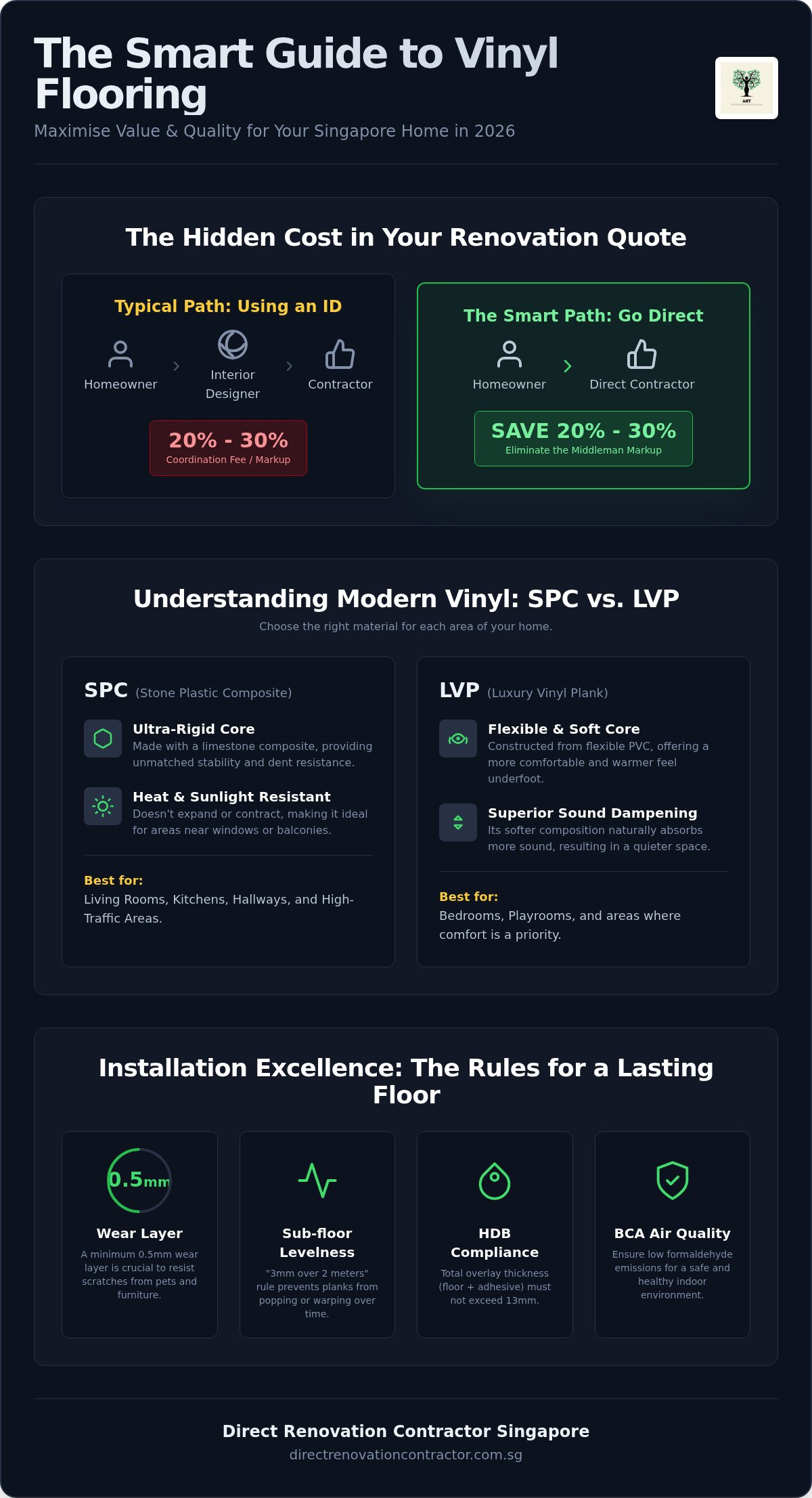
- Eliminate the standard 20% to 30% interior designer markup by sourcing materials and installation directly from a contractor with a physical Paya Ubi workshop.
- Understand the technical differences between SPC and LVP to select the right vinyl flooring singapore for high-traffic living areas versus moisture-prone zones.
- Prevent long-term issues like warping or popping by enforcing strict sub-floor preparation, including moisture testing and the “3mm over 2 meters” levelness rule.
- Ensure your renovation remains fully compliant with 2026 HDB regulations regarding floor thickness and the latest BCA formaldehyde emission limits.
- Utilize a DIY support package that includes technical 3D drawings to manage your flooring replacement with the confidence of a professional.
What is Vinyl Flooring and Why is it the 2026 Standard for Singapore Homes?
Modern vinyl is a high-durability synthetic material engineered to mimic natural wood or stone textures with striking accuracy. To understand the technical composition of these materials, one can look at What is Vinyl Flooring and how its multi-layer structure provides lasting stability. In 2026, vinyl flooring singapore has become the default choice for HDB BTO and resale renovations, largely because it solves the traditional headaches associated with tiling. Unlike ceramic or porcelain tiles, modern vinyl is 100% waterproof and termite-proof, which is essential for our tropical climate where humidity levels often fluctuate.
The most significant practical benefit for local homeowners is the “overlay” advantage. Instead of spending thousands on hacking existing tiles and waiting for HDB permit approvals, we can install vinyl directly over the current floor. This method saves on labor costs and significantly reduces the renovation timeline. It’s an efficient solution for those who want a fresh look without the dust, debris, and noise of a full demolition. Because the material is slip-resistant, it’s also a safer choice for households with elderly residents or young children.
The Evolution of Vinyl: From Linoleum to SPC
The industry has moved far beyond the thin, soft linoleum used in previous decades. Today, Stone Plastic Composite (SPC) is the preferred choice for Singapore homes. SPC features a core made of limestone and stabilizers, creating a rigid plank that doesn’t expand or contract significantly in high humidity. A thick wear layer sits on top of the design film, protecting the floor from scratches caused by pets, heavy furniture, or high foot traffic. This technical shift ensures your floor remains stable and visually consistent even during the hottest months of the year.
Vinyl Flooring in HDB vs. Condo Projects
Selecting the right vinyl flooring singapore for your specific property type requires an understanding of local regulations. For HDB flats, the total thickness of new flooring and adhesive must not exceed 13mm when overlaying existing finishes. We also prioritize the use of high-quality underlays that provide sound dampening to meet HDB’s focus on reducing noise transmission between units. In condo projects, MCST rules often dictate specific decibel ratings for noise insulation and may have stricter limits on floor height changes. We manage these technical requirements directly to ensure your installation remains fully compliant with estate bylaws. For more details on managing your project, refer to our HDB Renovation in Singapore: The Ultimate 2026 Owner’s Guide.
Comparing Vinyl Types: SPC vs. LVP vs. WPC in 2026
Choosing the right vinyl flooring singapore requires looking past the surface color. In 2026, the industry has standardized three primary categories, each serving a distinct purpose in your home. Stone Plastic Composite (SPC) remains the top choice for living rooms and kitchens. Its limestone core provides unmatched rigidity, ensuring the planks won’t expand or buckle even when exposed to direct sunlight from a balcony. This stability is why we recommend SPC for the majority of local residential projects.
Luxury Vinyl Plank (LVP) offers a more flexible structure, providing a softer feel underfoot that many homeowners prefer for bedrooms. These specifications are similar to those found in professional LVT flooring installation Rayleigh services, where precision fitting is key to a long-lasting floor. Wood Plastic Composite (WPC) serves as the thicker, quieter alternative for luxury interiors. While SPC is denser, WPC uses a foaming agent in its core to create air pockets, which naturally insulates against noise and temperature. Regardless of the type you choose, verifying vinyl flooring industry standards is essential to ensure the material meets the latest 2026 BCA formaldehyde emission limits for indoor air quality. We prioritize materials with low-emission certifications to ensure your home remains safe for children and pets.
Technical Specifications to Watch For
We recommend a minimum wear layer of 0.5mm for all residential projects. This transparent top coating determines how well your floor resists scratches from dragging furniture or pet claws. While 4mm is the standard core thickness, upgrading to 5mm or 6mm provides better joint stability and a more solid feel. Look for planks with pre-attached IXPE foam underlayment. This integrated layer simplifies installation and provides the necessary sound dampening required by most MCST and HDB regulations. If you’re planning a full home makeover, you can view our HDB renovation packages to see how these materials fit into a complete project scope.
Aesthetics and Trends for 2026
The “Japandi” and “Modern Organic” styles continue to dominate the Singapore market. These designs favor light oaks and muted tones that create a sense of space in smaller apartments. Embossed-in-Register (EIR) technology has revolutionized the look of vinyl by aligning the physical texture of the plank with the printed wood grain. This means if you see a knot in the wood pattern, you’ll actually feel it when you run your hand over the surface. Large format planks are currently popular for making living areas appear wider, while herringbone patterns remain a timeless choice for those seeking a more traditional, high-end aesthetic. We help you choose a layout that minimizes wastage based on your specific floor plan.
The Cost of Vinyl Flooring: Direct Contractor vs. ID Markups
When you receive a quote for vinyl flooring singapore, the number you see is rarely the final amount you’ll pay. The industry standard is to quote based on a “Per Square Foot” (PSF) model, but this often hides the true cost of the project. Interior designers typically act as intermediaries. They don’t install the floor themselves; they hire a contractor and add a “coordination fee” or “management fee” that often ranges from 20% to 30% of the total cost. You are essentially paying a premium for a middleman to make a phone call.
The direct contractor advantage is simple: you pay for the actual labor and raw material at the source. We maintain a physical workshop in Paya Ubi Industrial Park, which allows us to bypass these intermediary commissions and pass the savings directly to you. Beyond the material itself, you must account for essential finishing works. Items like PVC skirting, floor trimming, and door-shortening services are often listed as “additional” in the fine print. If your new vinyl is thicker than your previous floor, your bedroom doors may scrape against the surface, requiring professional trimming that an ID might not include in an initial estimate.
Identifying Hidden Fees in Your Quote
One common trap in generic quotes is the exclusion of sub-floor preparation. If your concrete base isn’t perfectly level, you might need self-leveling cement. Some quotes ignore this necessity until the day of installation, leading to sudden “variation orders” that bloat your budget. Additionally, designers often recommend specific “premium” brands not because of their technical merits, but because those suppliers provide higher commission structures to the designer. For a clearer picture of how to evaluate these different business models, check our Direct Renovation Contractor Singapore: The 2026 Comparison Guide.
Standardizing Your Flooring Scope
To avoid overpaying, we recommend creating a “Unit Rate” spreadsheet. This allows you to compare quotes apples-to-apples based on the actual square footage and specific technical inclusions like the wear layer and underlayment. A direct contractor offers better accountability because we use in-house installation teams rather than rotating sub-contractors. This hands-on approach is why we can offer reliable workmanship warranties that actually mean something. We always encourage homeowners to visit our Paya Ubi workshop to verify our operations and see the physical stock before signing any contract. Seeing the scale of a contractor’s workshop is the best way to confirm you’re dealing with the source rather than a sales agent.
Installation Excellence: Sub-Floor Prep and HDB Compliance
Sub-floor preparation is the most critical phase of installing vinyl flooring singapore, yet it’s often the most overlooked. A floor is only as stable as the surface beneath it. Our technical process begins with moisture testing the concrete base. Singapore’s high humidity can trap moisture within the slab, leading to mold growth or adhesive failure if not addressed. We then verify floor levelness using the “3mm over 2 meters” rule. If a floor deviates by more than 3mm over a 2-meter span, the click-system joints will eventually experience structural stress, leading to gaps or breakage.
When we identify uneven surfaces, we apply a self-leveling compound or cement screed to create a perfectly flat foundation. During the actual layout, we manage expansion gaps with precision. These small perimeters allow the planks to expand and contract naturally as temperatures fluctuate throughout the day. We conclude the installation by fitting PVC skirting and applying silicone sealing. This ensures a flush finish that prevents water from seeping under the planks during routine cleaning.
Navigating HDB and MCST Regulations
Compliance with local authorities is mandatory for every project. HDB regulations state that for flats with existing flooring, any new layer of vinyl flooring singapore must not exceed a total thickness of 13mm, including the adhesive. If your project involves hacking existing tiles, noisy works are strictly limited to weekdays between 9:00 am and 5:00 pm and must be completed within three consecutive working days. For BTO homeowners in 2026, you should verify the current status of the HDB cement screed subsidy before commencement, as this can affect your preparation costs. For condo owners, we coordinate with your MCST to handle renovation deposits and ensure lift lobbies are protected during material transport.
Preventing Common Installation Failures
The annoying “popping” sound many homeowners experience is usually caused by air pockets or debris left on the sub-floor. We use high-density underlayment to bridge minor imperfections, but a level base remains the primary defense against noise. Warping is another common failure, often caused by prolonged exposure to intense afternoon sunlight through large windows. We recommend UV-resistant planks and ensure expansion gaps are sufficient to handle the heat. Every project we manage includes a site supervisor who monitors these technical details to ensure the structural integrity of your floor. If you want to ensure your installation meets these professional standards, you can book a site assessment with our flooring team.
Direct Renovation Contractor Singapore: Your Partner for Vinyl Savings
Choosing a partner for your vinyl flooring singapore project shouldn’t involve paying for a lifestyle you didn’t ask for. We operate on a direct-to-consumer model that removes the layers of middleman markups typically found in design-heavy firms. By engaging us directly, you’re hiring the people who actually handle the materials and perform the labor. This transparency ensures that every dollar you spend goes into the quality of the planks and the skill of the installation rather than an undisclosed commission.
We maintain full control over the project timeline and workmanship because we use in-house flooring and carpentry teams. This eliminates the unpredictability of sub-contracting, which is the primary cause of renovation delays and quality disputes in Singapore. Our approach is grounded in technical competence; we prioritize the structural integrity of your floor over flashy presentations. We don’t sell a dream; we deliver a functional, durable floor that meets every regulatory standard.
Why Our Paya Ubi Workshop Matters
We are real contractors, not just a design gallery or a sales office. Our workshop in Paya Ubi Industrial Park serves as the operational hub where we manage material quality and oversee installation schedules. When you work with a contractor who has a physical production space, you gain a level of accountability that virtual offices simply can’t provide. You can see the stock and understand the logistics of your project firsthand. If you’re planning built-in furniture alongside your floors, our Carpenter Singapore: The 2026 Guide to Custom Carpentry and Direct Savings explains how we apply the same direct model to cabinetry for even greater savings.
Managing Your Own Renovation with Our Help
We recognize that many savvy homeowners want to manage their own flooring replacement to maximize their budget. To support this, we provide a DIY Support Package that includes technical 3D drawings. These drawings are essential for visualizing how the vinyl flooring singapore will interface with your existing walls, cabinets, and doorways. Having a technical plan prevents costly mistakes before the first plank is laid. We also provide access to our curated list of trusted sub-contractors for other specialized works like electrical or plumbing. This model is the smartest choice for the budget-conscious, quality-driven Singaporean who values technical precision and financial clarity over high-concept artistic visions.
Take Control of Your Flooring Project Today
Choosing the right vinyl flooring singapore doesn’t have to be a source of anxiety or hidden costs. By focusing on technical specifications like SPC rigidity and enforcing strict sub-floor levelness, you ensure a home environment that remains durable for over a decade. You’ve learned that skipping the interior designer’s coordination fee can save you up to 30% without sacrificing the quality of your finish. It’s about prioritizing technical competence and financial transparency over flashy showroom presentations.
As an HDB Registered Contractor with our own in-house installation team and a physical workshop in Paya Ubi, we provide the accountability you need for a successful renovation. We offer transparent, unmarked-up pricing and the technical support required to manage your project with confidence. Whether you’re moving into a new BTO or refreshing a resale unit, our direct-to-consumer model puts you in the driver’s seat of your home’s transformation. Get a Direct Vinyl Flooring Quote and Skip the ID Markups Today. You’re now ready to build a beautiful, resilient space on your own terms.
Frequently Asked Questions
Is vinyl flooring better than tiles for HDB flats in Singapore?
Vinyl is often a superior choice for HDB renovations because it allows for a faster, cleaner installation through overlaying. It provides a warmer, more resilient feel underfoot compared to the cold, hard surface of ceramic tiles. While tiles offer extreme durability against heavy impact, vinyl is 100% waterproof and slip-resistant. For 2026 homeowners, it offers the best balance of cost-efficiency and modern aesthetics without the need for noisy hacking works.
How much does vinyl flooring installation cost per square foot in 2026?
Market rates for supply and installation in Singapore generally range from S$3 to S$13 per square foot. Basic vinyl sheets sit at the lower end, while premium Stone Plastic Composite (SPC) planks with integrated underlayment occupy the higher end of that range. It’s important to look for quotes that include all necessary trimmings and sub-floor preparation. You should always verify if the price includes the PVC skirting and door-shortening services to avoid hidden costs later.
Can I overlay vinyl flooring on my existing HDB tiles?
You can definitely overlay vinyl on existing tiles, provided they are structurally sound and not popping. This method is the standard for most vinyl flooring singapore projects as it saves on hacking fees and HDB permit lead times. HDB regulations require that the total thickness of the new flooring layer doesn’t exceed 13mm. We always perform a levelness check during our site assessment to confirm if your existing tiles are suitable for a direct overlay.
How do I check if a vinyl flooring company is HDB registered?
You should verify a company’s credentials through the HDB e-Service portal under the Directory of Renovation Contractors (DRC). Searching by the company name or UEN will show if they are authorized to perform works in HDB flats. Engaging an HDB-registered contractor is a legal requirement. It ensures that the team understands structural safety rules and follows the permitted working hours for noisy activities, which are strictly regulated to maintain estate harmony.
What is the difference between an ID and a direct contractor for flooring?
An interior designer acts as a project manager who hires external sub-contractors and adds a 20% to 30% markup for their coordination services. A direct contractor performs the installation with their own in-house teams. By working directly with us, you eliminate those middleman commissions and communicate directly with the technical experts. This direct relationship leads to better quality control and more transparent pricing since there are no hidden referral fees involved in the quote.
How long does it take to install vinyl flooring for a 4-room HDB?
A typical 4-room HDB installation takes between 2 to 3 working days to complete. This timeline includes the preparation of the sub-floor, the actual laying of the planks, and the installation of skirting. If your floor requires extensive self-leveling compound to fix unevenness, you should account for an additional day for the cement to dry completely. We provide a finalized schedule after the site assessment so you can plan your move-in date with total confidence.
Does vinyl flooring emit harmful formaldehyde in Singapore homes?
Quality vinyl flooring singapore must meet strict 2026 BCA formaldehyde emission limits for indoor air quality. We prioritize materials that carry low-emission certifications to ensure a safe environment for your family. It’s essential to ask your contractor for technical datasheets or eco-labels rather than relying on verbal assurances. Our SPC planks are engineered to be phthalate-free and low-VOC, making them a safe choice for households with young children, elderly residents, or pets.
What are the common red flags when hiring a flooring contractor?
One major red flag is a quote that’s significantly lower than the market average, which often indicates the use of low-grade materials or the exclusion of essential sub-floor prep. You should also be cautious of contractors who don’t have a physical workshop or office, as this makes them harder to hold accountable. Always check for a clear, itemized contract. A professional contractor will never pressure you for full upfront payment before the materials have even arrived at your site.