
Why pay a 30% markup just for someone to relay instructions to a tiler? For many Singaporean homeowners, the search for an affordable hdb toilet renovation package often leads to frustration because of hidden management fees and vague quotes from design firms. You’ve probably felt the anxiety of wondering if those stylish 3D renders actually guarantee structural integrity, or if you’ll be dealing with ceiling leaks two years later. It’s a valid concern; a bathroom isn’t just about looks, it’s about technical masonry and plumbing performance.
We believe you deserve a modern, functional space without the unnecessary fluff or inflated middleman costs. This guide shows you exactly how to achieve a high-quality HDB bathroom makeover using transparent, direct contractor pricing. You’ll learn how to manage the process yourself while ensuring full compliance with 2026 HDB regulations, including waterproofing standards and hacking permit requirements. We’re breaking down the technical realities of tiling, plumbing, and sanitary installation to help you build a leak-free home on a pragmatic budget.
Key Takeaways
- Learn how a direct hdb toilet renovation package saves you money by removing interior designer markups and undisclosed management fees.
- Understand critical 2026 HDB regulations, including the three-year restriction on hacking BTO floor tiles and mandatory waterproofing membrane standards.
- Identify the technical differences between standard masonry and premium tiling to ensure your bathroom remains leak-free and durable.
- Discover how to select high-performance materials, such as R10 slip-resistant tiles, that prioritize safety and long-term maintenance.
- Gain a clear overview of the streamlined renovation process, from site assessment to final plumbing installation, handled directly by trade experts.
What is Included in a 2026 HDB Toilet Renovation Package?
A standard hdb toilet renovation package is a technical bundle designed to remove the guesswork for homeowners. It isn’t just about picking out new tiles; it’s a complete sequence of works that ensures your bathroom is both functional and compliant with local standards. Instead of you having to coordinate between a tiler, a plumber, and a haulage team, a direct contractor manages these trades as a single, cohesive workflow. This approach ensures that the waterproofing membrane is properly integrated with new drainage pipes, preventing the most common cause of post-renovation disputes: water leakage to the unit below. For homeowners dealing with pre-existing issues, professional 滲水檢測 services can provide the diagnostic clarity needed to ensure a successful renovation.
Standard Work Scope for HDB Bathrooms
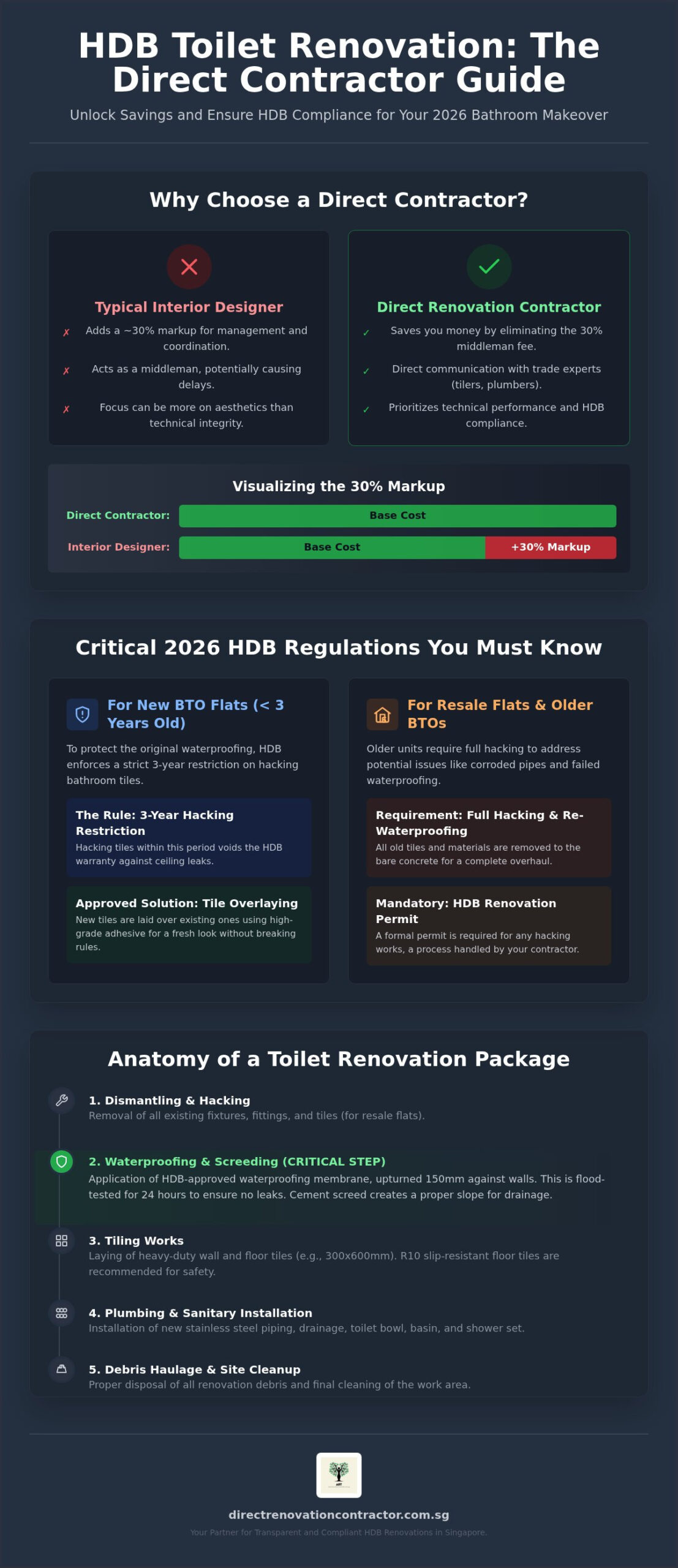
The core of any reliable package is high-quality masonry and technical plumbing. We begin by dismantling all existing toilet accessories, including the WC, washbasin, and old vanity cabinets. For resale units, this involves hacking existing tiles down to the bare concrete slab. Our team then applies a mandatory, HDB-approved waterproofing membrane. This is a critical step that must be tested for 24 hours before any tiles are laid. We use pre-packed waterproofing screed and ensure the membrane is upturned at least 150mm against walls and kerbs to meet 2026 standards. The work scope typically includes:
- Cement screeding to create the correct floor gradient for efficient drainage.
- Supply and laying of heavy-duty floor and wall tiles (typically 300x600mm or 600x600mm).
- Installation of new stainless steel cold water piping and drainage configuration.
- Mounting of new sanitary ware, including the toilet bowl, washbasin, and shower sets.
- Installation of new manhole covers and polished stainless steel floor traps.
- Haulage and debris removal to ensure the site remains compliant with estate rules.
BTO vs. Resale Toilet Renovation Needs
The Housing and Development Board (HDB) enforces specific rules that change depending on your flat type. If you own a new BTO flat, you must observe a three-year restriction on hacking floor and wall finishes to protect the original waterproofing. In these cases, our hdb toilet renovation package focuses on tile overlaying or aesthetic upgrades that don’t disturb the floor slab. This is a faster, cleaner process that still delivers a modern look without breaching your warranty.
Resale flats are more complex and often require full hacking. Older units frequently have corroded cast iron pipes and compromised waterproofing that can lead to ceiling leaks. A full renovation here requires complete stripping of the old materials and the replacement of all internal plumbing lines. Understanding these technical differences is a vital part of planning your HDB renovation in Singapore. While BTO owners prioritize style, resale owners must prioritize structural integrity to avoid future maintenance headaches.
HDB Regulations and Technical Requirements for 2026
Adhering to local building codes isn’t just about avoiding fines; it’s about protecting the structural integrity of your home. When you select an hdb toilet renovation package, the technical specifications must align with current HDB and Building and Construction Authority (BCA) standards. These rules exist to prevent common issues like water seepage and structural weakening, which can affect not just your unit but your neighbors below. Working with a contractor who understands these nuances ensures your renovation is legally compliant and technically sound.
The 3-Year BTO Waterproofing Rule
If you’ve just collected your keys for a new BTO flat, you must follow the three-year restriction on removing wall and floor finishes in bathrooms. HDB provides a three-year warranty on the original waterproofing membrane. Hacking the tiles during this period automatically voids that warranty. For homeowners who want a different look before the three years are up, the approved solution is “overlaying.” This involves laying new tiles directly over the existing ones using high-grade adhesives. It’s a pragmatic way to refresh your space without disturbing the floor slab or the original waterproofing seal. Violating this rule can lead to significant repair costs if leaks occur, as you’ll be held liable for all damages.
HDB Permits and Installation Standards
For resale flats or BTO units past the three-year mark, hacking floor tiles requires a formal renovation permit from HDB. We handle this application process for you, but it’s vital to verify that your chosen firm is an HDB-registered contractor. Unregistered workers may not follow the strict 2026 requirements, such as using pre-packed waterproofing screed or ensuring the total thickness of floor finishes stays below 50mm. Our technical team follows a specific sequence to ensure durability:
- 24-Hour Ponding Test: After applying the new waterproofing membrane, we plug the floor traps and fill the area with water. We only proceed with tiling if the water level remains unchanged after 24 hours.
- 150mm Upturn: We ensure the waterproofing membrane is upturned at least 150mm against all walls and kerbs to prevent lateral water migration.
- PUB Compliance: All plumbing works, including the replacement of toilet bowls or drainage pipes, are executed by a PUB Licensed Plumber to meet current water efficiency and drainage standards.
Navigating these technical requirements is simpler when you work with a team that prioritizes structural performance over flashy sales pitches. If you’re planning a project, you can consult our trade experts to ensure your layout meets all current HDB guidelines before work begins. This straightforward approach prevents costly rectification works down the road and guarantees a bathroom that stays leak-free for years.
Direct Contractor vs. Interior Designer: The Cost Difference
Choosing a direct contractor over an interior designer (ID) is a financial decision that prioritizes technical execution over aesthetic curation. In the local industry, most IDs act as intermediaries. They manage the project but outsource the actual labor to masonry and plumbing firms. When you sign an hdb toilet renovation package with a design firm, you’re often paying a 20% to 30% premium for this management layer. A direct contractor model removes this intermediary, allowing you to deal directly with the tradespeople responsible for the structural integrity of your bathroom.
This “Direct-to-Consumer” approach ensures that every dollar you spend goes into material quality and skilled labor. By working with Direct Renovation Contractor Singapore, you gain access to the same technical expertise used by high-end firms but without the design-heavy markups. We prioritize transparency, providing clear breakdowns of masonry and plumbing costs so you know exactly where your budget is allocated. This clarity helps you avoid the “sticker shock” often associated with final renovation bills.
Identifying Hidden Markups in Toilet Quotes
Many ID quotes include “coordination fees” or “site supervision charges” that don’t actually improve the quality of the tiling or waterproofing. These are often flat percentages added to the total cost. Another area for hidden costs is linear footage pricing for bathroom vanities and carpentry. IDs may inflate these rates to cover their overheads. By sourcing your own sanitary ware, you can typically save 15% to 20% compared to buying through a firm’s “recommended” list. You can discover Akron Malaysia to explore a wide range of water closets and faucets that fit your project. Direct contractors focus on the installation, leaving the material selection and its associated savings in your hands. It’s a more pragmatic way to handle a hdb toilet renovation package if you’re comfortable making your own design choices.
Estimating Material Costs for Tiles and Sanitary Ware
Understanding the technical differences between materials is key to managing your budget. Homogeneous tiles are generally more expensive than ceramic options because they’re denser and more durable, making them ideal for high-moisture areas. For a standard HDB bathroom, we recommend porcelain or homogeneous tiles with a high slip-resistance rating. While we don’t sell ready-made furniture, we provide 3D drawings to help you visualize the layout. This allows you to manage your own project effectively. You can take these technical drawings to direct suppliers to purchase your WC, basin, and tap sets at wholesale rates. This DIY management style, supported by our technical expertise, ensures a modern result that fits a pragmatic budget.
Selecting Durable Materials for Your HDB Bathroom
Selecting materials for a bathroom isn’t just a design exercise; it’s a technical decision that determines how many years your renovation lasts before needing repairs. In the high-humidity environment of a Singaporean bathroom, aesthetics must take a backseat to structural performance. When you evaluate an hdb toilet renovation package, the durability of the tiles, vanities, and sanitary ware should be your primary concern. Choosing the wrong material for a wet area can lead to mold growth, water damage, and slippery surfaces that compromise safety.
Tile Selection: Slip Resistance and Maintenance
Bathroom safety depends heavily on the R-rating of your floor tiles, which measures slip resistance. We recommend a minimum of R10 for dry areas and R11 for shower zones, especially in households with elderly residents or young children. While ceramic tiles are a budget-friendly option, they’re more porous and prone to cracking. Homogeneous tiles are the pragmatic choice for a bathroom floor because the color and material are consistent throughout the entire tile. If a chip occurs, it remains nearly invisible. Porcelain tiles offer a middle ground, providing high density and low water absorption rates.
Many homeowners prefer large-format tiles (600x600mm) because they reduce the number of grout lines, creating a seamless look that’s easier to scrub. However, in small HDB toilets, smaller tiles can be better for creating the necessary floor gradient for drainage. To prevent staining, we suggest using epoxy grout rather than standard cement grout. It’s waterproof and resists the mold that typically turns white grout lines black over time. These choices align with the core principles of home renovation that prioritize function and long-term maintenance over temporary trends.
Sanitary Ware and Accessory Essentials
Your choice of sanitary ware impacts both daily cleaning and future plumbing maintenance. A one-piece WC is generally preferred for its sleek profile and lack of a join between the tank and bowl, which eliminates a common hiding spot for bacteria. For vanities, aluminium is the superior material for the Singapore climate. Unlike solid wood or standard laminates, aluminium is completely rust-proof and won’t swell when exposed to water. If you prefer a vanity top, quartz or solid surfaces are more durable than natural marble, which is porous and stains easily when in contact with toiletries.
- 1-Piece WC: Easier to clean; higher upfront cost but better hygiene.
- Under-mount Basins: Provide a clean countertop look; require a solid surface or quartz top.
- Aluminium Vanities: Maximum water resistance; won’t warp or rot in wet conditions.
- Tempered Glass Partitions: Essential for safety; 10mm thickness is the trade standard for durability.
Making these technical decisions early in the process ensures your hdb toilet renovation package delivers a space that remains functional for a decade or more. If you’re unsure which materials best suit your specific layout, you can contact our technical team for a material durability assessment. We focus on providing straightforward advice that helps you avoid expensive replacement works in the future.
Executing Your Renovation with Direct Renovation Contractor
Engaging a direct contractor means you’re hiring the actual tradespeople who hold the tools and manage the site. We don’t hide behind a desk or relay messages through multiple layers of management. Our team operates out of Paya Ubi Industrial Park, and we’re on-site daily to ensure every hdb toilet renovation package we deliver meets our technical standards. This hands-on approach eliminates the typical anxieties of home improvement because you’re dealing with the experts responsible for the structural integrity of your bathroom.
Our Direct-to-Homeowner Process
We’ve streamlined our workflow into a logical sequence that prioritizes accuracy and financial transparency. It starts with an initial site walkthrough where we perform technical measurements. We don’t rely on floor plans alone; we assess the condition of your existing pipes and the levelness of your floor slabs. This ensures our quotation is final and free from undisclosed “unforeseen” costs. Once the scope is agreed upon, we provide 3D drawings to help you visualize the layout and manage your own material sourcing if you choose.
The physical execution is handled by our in-house masonry and plumbing teams. By maintaining our own crew, we control the schedule and the quality of the workmanship. You won’t have to worry about sub-contractors failing to show up or cutting corners on waterproofing. We handle the heavy lifting, from the initial hacking and debris removal to the final installation of your toilet bowl and shower sets. This direct model is the most pragmatic way to renovate, ensuring your budget goes entirely into the labor and materials that make your home durable.
Quality Assurance for Plumbing and Masonry
Our commitment to quality extends beyond just the tiling work. While we specialize in masonry, our custom vanity installations follow the highest carpenter Singapore standards. We ensure your cabinets are built with water-resistant materials and fitted with millimeter precision to your specific bathroom dimensions. Every vanity is checked for levelness and structural support before the plumbing fixtures are mounted.
- Waterproofing Verification: We perform rigorous ponding tests before any tiles are laid to ensure a 100% leak-free foundation.
- Precision Tiling: Our tilers focus on perfect alignment and consistent grout lines to prevent future mold traps.
- Compliance Handover: A final walkthrough ensures all works meet current PUB and HDB regulatory standards for 2026.
We stand by our work with clear warranty periods for both waterproofing and plumbing. If a pipe joint leaks or a tile sounds hollow after the project is finished, we’re the ones who return to rectify it. There’s no passing of blame between an ID and a sub-contractor. Our straightforward after-sales support is a core part of why savvy homeowners choose a direct hdb toilet renovation package. We prioritize functional results and long-term reliability over high-concept artistic visions.
Building a Durable HDB Bathroom with Technical Confidence
Achieving a modern bathroom doesn’t require a high-concept design fee or inflated management markups. By choosing a direct hdb toilet renovation package, you prioritize technical trade expertise and financial transparency. You now understand how to navigate the 3-year BTO restriction, why R11 tiles are vital for safety, and how to spot hidden costs in generic quotes. This pragmatic approach ensures your budget is spent entirely on high-quality masonry and plumbing that stands the test of time.
As an HDB Registered Contractor with over 15 years of local trade experience, we focus on functional results rather than flashy presentations. Our direct factory pricing for carpentry ensures you receive custom vanities without any intermediary commissions. We handle the technical complexities of waterproofing and HDB permits so you can enjoy a leak-free, compliant home.
Don’t settle for vague quotes and hidden fees. Get a Transparent Direct Quote for Your HDB Toilet Today and partner with a team that values honest workmanship. Your straightforward path to a modern, durable bathroom starts with a clear, technical assessment.
Common Questions About HDB Toilet Renovations
How long does a typical HDB toilet renovation take?
A standard toilet renovation takes approximately one to two weeks for the physical work on-site. This timeframe covers hacking, waterproofing, tiling, and the final installation of sanitary ware. You should also account for an additional two to four weeks for the HDB permit application and material selection phases. Coordinating these steps early ensures our team can start immediately once the permit is approved, which minimizes downtime in your daily routine.
Can I renovate my BTO toilet within the first 3 years?
You can renovate your BTO toilet within the first three years, but you’re restricted from hacking the existing floor or wall finishes. HDB enforces this rule to protect the original waterproofing warranty provided with new flats. The most pragmatic solution for new owners is to overlay new tiles directly over the existing ones using high-grade adhesive. This allows you to update the aesthetic without violating structural regulations or risking future water seepage issues.
Is it cheaper to buy my own toilet accessories or use the contractor’s?
It’s generally more cost-effective to purchase your own toilet accessories and sanitary ware directly from suppliers. By doing this, you avoid the management markups that many firms include in a bundled hdb toilet renovation package. We focus on the technical installation and masonry works, giving you the flexibility to select fixtures that fit your specific budget. This transparent approach ensures you only pay for the skilled labor and the materials actually used.
What happens if there is a water leak after the renovation?
You don’t strictly need to move out if your flat has a second functioning bathroom you can use. However, the renovation process involves significant noise and dust, especially during the hacking and drilling phases. We use plastic screening to contain debris, but the environment can still be disruptive if you’re working from home. If you’re renovating all bathrooms simultaneously, making alternative arrangements for a few days is highly recommended for your personal comfort.
Can I change the location of the WC or floor trap in an HDB flat?
Changing the location of the WC or floor trap is extremely difficult because the discharge pipes are fixed within the structural floor slab. HDB regulations strictly prohibit hacking the structural slab or relocating the main soil pipe. We can sometimes make minor adjustments to the piping above the floor level, but the core drainage points must remain in their original positions. This ensures proper waste flow and prevents recurring chokes in your drainage system.
Does a direct contractor package include the HDB permit application?
Yes, our hdb toilet renovation package includes the management of the HDB renovation permit application. As an HDB-registered contractor, we handle the technical documentation and submission on your behalf to ensure all hacking and masonry works comply with 2026 safety standards. Having the contractor manage this process reduces your administrative burden and ensures the project starts on a legally sound footing. We only begin work once the official approval is granted.
What is the best type of tile for an HDB toilet floor?
Homogeneous tiles are the superior choice for HDB toilet floors due to their high density and low water absorption rates. They’re more durable than ceramic tiles and remain slip-resistant even when wet. You should specifically look for tiles with an R10 or R11 slip-resistance rating to ensure safety for all family members. While ceramic tiles are cheaper, they’re more porous and prone to chipping, making them less ideal for long-term performance in high-moisture areas.