

Why are you paying a 30% markup for someone to simply call a plumber or tiler on your behalf? Many Singapore homeowners realize too late that a high-concept design proposal often hides significant intermediary commissions that don’t contribute to the actual quality of the build. It’s understandable to feel anxious about managing a site yourself, especially when you fear that lower prices might lead to sub-par workmanship or missed HDB permit deadlines.
We agree that your home renovation shouldn’t feel like a financial guessing game. This 2026 comparison of a renovation contractor vs interior designer singapore provides the clarity you need to choose between paying for a lifestyle vision or technical execution. You’ll discover the critical differences in project scope, material sourcing, and total costs in S$. We’ll also preview how a direct-to-consumer model eliminates hidden fees while providing the technical support, such as 3D drawings, that was once exclusive to expensive design firms. By the end of this guide, you’ll know exactly how to secure a high-quality finish and functional carpentry without the unnecessary overhead of a middleman.
Key Takeaways
- Learn the fundamental difference between an ID’s design-first consultancy and a contractor’s execution-focused approach to technical trade works.
- Identify how to save on the typical 20% to 30% markup by understanding the renovation contractor vs interior designer singapore pricing models for material and labor.
- Decide if you’ll handle project management tasks like coordinating electrical wiring and plumbing yourself.
- See why standard HDB BTO units benefit from direct packages while resale properties require more complex hacking and HDB permit management.
- Discover how DIY support packages provide 3D drawings and site plans without the high overhead of a consultancy firm.
Interior Designer vs Renovation Contractor: Core Definitions
Understanding the fundamental difference between a renovation contractor vs interior designer singapore is the first step toward a successful home makeover. It’s the distinction between hiring a creative consultant and hiring the technical team that actually builds the cabinets and lays the tiles. While both play a role in the local property market, their responsibilities, fee structures, and levels of site involvement differ significantly.
The Role of an Interior Designer
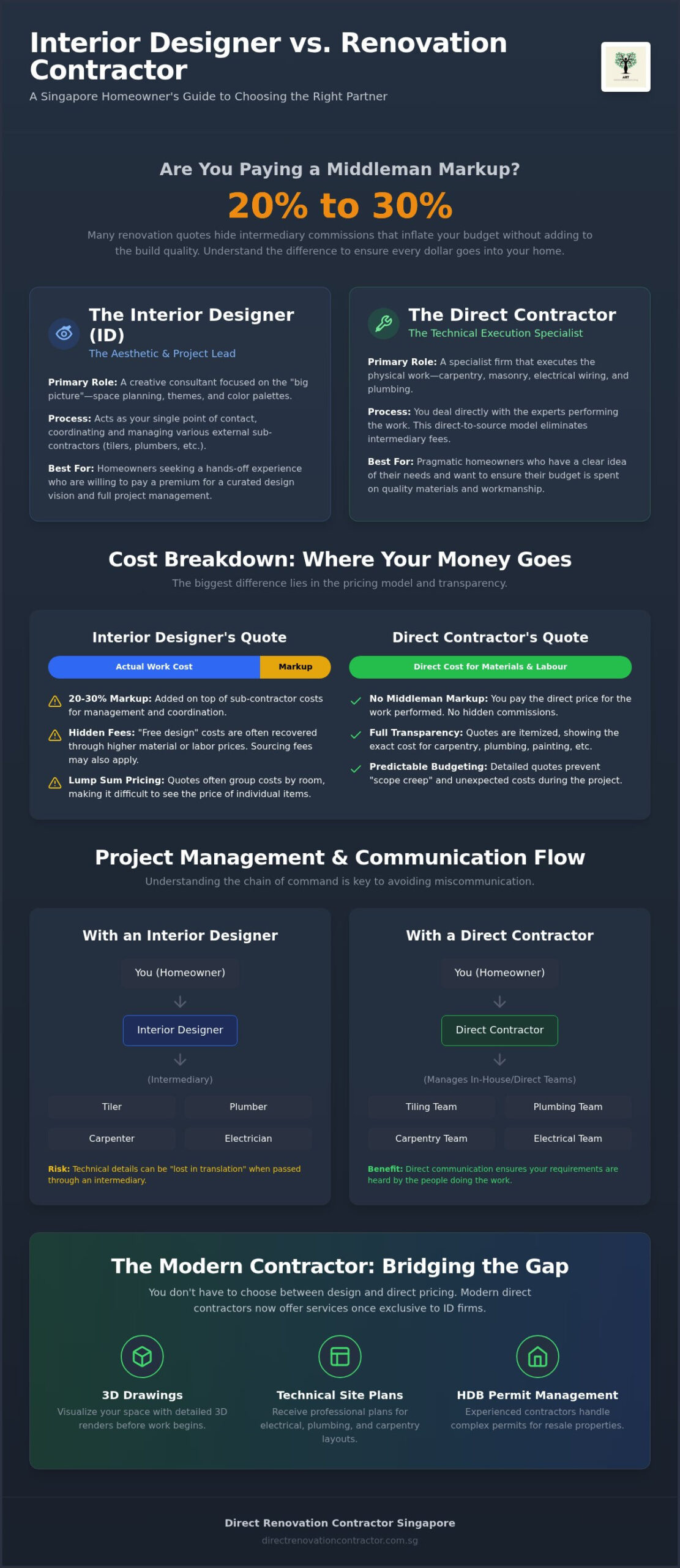
An Interior Designer (ID) acts as a project manager and aesthetic lead. Their primary focus is on the “big picture,” which includes space planning, color palettes, and theme consistency. For many homeowners, the appeal of an ID lies in convenience. They act as your single point of contact, managing various sub-contractors so you don’t have to. You’re essentially paying for their design eye and their time spent coordinating schedules. However, this service comes at a premium. Most IDs don’t employ their own tilers or carpenters. Instead, they outsource these works to external firms and add a management fee or markup to the final quote to cover their overhead.
The Role of a Direct Renovation Contractor
A direct renovation contractor is a specialist firm that executes the physical works. When you hire a contractor, you’re dealing directly with the experts responsible for your kitchen cabinet carpentry, tiling, or electrical wiring. There’s no intermediary. This model prioritizes technical execution, material quality, and structural integrity over artistic conceptualization. Because you’re working directly with the source, you avoid the commissions that often inflate ID quotes. Modern contractors in Singapore have also evolved; many now provide technical drawings and 3D visuals, bridging the gap for homeowners who want a professional look without the high-concept price tag. This direct access ensures that your requirements for masonry or plumbing works are heard by the people actually doing the labor.
The “middleman” factor is the most critical distinction for your 2026 renovation budget. In the ID model, communication follows a chain: you speak to the ID, who then speaks to the contractor. This can sometimes lead to technical details being lost in translation. With a direct contractor, the person assessing your site is the one managing the fabrication. This transparency is a badge of honor for direct firms. It guarantees that every S$ you spend goes into the actual materials and skilled labor rather than a consultant’s commission. For pragmatic homeowners who value functional results, cutting out the intermediary is the most logical way to ensure quality workmanship without hidden costs.
Cost Breakdown: Markups, Management Fees, and Direct Pricing
The price gap between a renovation contractor vs interior designer singapore usually boils down to how the business makes its profit. While an ID might present a “design fee,” the majority of their revenue often comes from a 20% to 30% markup on every sub-contracted trade. This means for every S$1,000 spent on tiling or electrical works, you could be paying an additional S$300 simply for the ID to manage the communication. In contrast, a direct contractor charges based on the actual technical scope of work, such as the linear footage of cabinetry or the square footage of hacking and masonry.
Learning how to read a renovation quote is essential for financial transparency. Many ID firms use “lump sum” pricing for rooms, which obscures the cost of individual materials. A direct contractor provides an itemized breakdown. You’ll see exactly what you’re paying for plumbing, painting, and flooring installation. This level of detail prevents “scope creep” and ensures you aren’t paying hidden commissions on top of material costs. This is why savvy homeowners often find that a contractor’s quote is more predictable over the duration of the project.
Hidden Costs in ID Packages
Beware of the “Free Design” marketing hook. In the Singapore renovation industry, design work requires significant man-hours; if you aren’t paying for it upfront, the cost is likely recovered through higher material markups. IDs also frequently charge sourcing fees for furniture and lighting recommendations. These are often bundled into the project management fee, making it difficult to see the true value of the service. You might also find coordination fees attached to every delivery, even if you bought the items yourself.
Transparency in Direct Contractor Quotes
Direct contractors operate on a volume and technical skill model. When you request a quote for custom carpentry, the price reflects the factory fabrication costs and installation labor. There is no middleman adding a percentage for “aesthetic supervision.” This direct-to-factory approach is particularly beneficial for HDB BTO and resale owners who need extensive kitchen cabinets or wardrobes. By removing the intermediary, you gain access to unmarked-up material costs from suppliers, allowing your budget to go further. If you want to see how these savings apply to your specific layout, you can explore our direct renovation packages designed for transparency.
Project Management: Who Should Lead Your Renovation?
Deciding between a renovation contractor vs interior designer singapore isn’t just about the final bill. It’s about who manages the daily grind on-site. An ID acts as your shield, filtering communication and managing timelines across different trades. If you choose a direct contractor, you step into the role of project lead. This requires a firm grasp of the renovation sequence, from the initial hacking to the final coat of paint. You’ll be the one deciding if the grout color matches the tiles or if the power points are positioned exactly where you need them.
Managing HDB and MCST permits is a technical requirement that cannot be overlooked. In 2026, HDB permit processing times remain a critical factor in project scheduling, often taking several weeks depending on the complexity of the works. A direct contractor handles these technical filings as part of the service, ensuring your project meets all local regulatory standards without the need for an intermediary. Quality control also falls under this technical umbrella. Someone must verify that the waterproofing in the toilet is cured correctly and that the electrical load for your new kitchen appliances is sufficient. While an ID checks these for aesthetic alignment, a contractor checks them for structural integrity and safety. For those interested in how specialized safety infrastructure supports these goals in larger projects, you can learn more about Allround Steigerbouw.
You might find an ID essential if your project involves complex structural changes that require professional space planning. If you’re a busy professional with zero time to visit the site or coordinate material deliveries, the ID’s management fee becomes a practical convenience tax. They also excel at sourcing niche materials or high-concept finishes that require a specific aesthetic eye to pull together. If your goal is a “magazine-ready” look and you have the budget to support the 20% to 30% markup, the consultancy model offers a hands-off experience.
When a Direct Contractor is the Smarter Choice
For a standard HDB renovation where the layout is straightforward, a direct contractor is often the more efficient choice. If you already have a clear vision or have found your inspiration on social media, you don’t need to pay for a consultant’s vision. Instead, you can focus your budget on high-quality technical works like masonry and home renovation basics. Dealing directly with the team performing the labor ensures that structural constraints are identified immediately. This prevents design flaws that look good on paper but fail during execution. It’s a pragmatic approach for homeowners who value technical competence and financial transparency over flashy presentations.
Property-Specific Considerations: BTO, Resale, and Condo
The type of property you own significantly shifts the balance in the renovation contractor vs interior designer singapore debate. A brand-new HDB BTO unit is essentially a blank canvas with standardized dimensions. In these cases, paying for a high-concept design consultancy is often unnecessary. Conversely, an older resale flat or a landed home requires deep technical knowledge to navigate structural quirks. Your choice should align with the specific technical challenges your property presents rather than just aesthetic desires.
BTO and Resale Strategies
For HDB BTO owners, the goal is usually to maximize storage and functional flow within a fixed footprint. Since the layout is predictable, direct contractor packages are ideal. You can use 3D drawings provided by your contractor to visualize your kitchen cabinets and wardrobes without the overhead of an ID’s management fee. Resale flats present a different set of challenges. You’ll often deal with uneven flooring, brittle plumbing, and outdated electrical wiring. These projects require heavy hacking and masonry works. In this scenario, the technical expertise of an HDB Registered Contractor is non-negotiable. They understand the structural limitations of older blocks and ensure all works comply with current HDB renovation guidelines. Choosing a direct team ensures that these technical fixes are prioritized over cosmetic cover-ups.
Condo and Commercial Needs
Condominium renovations are governed by MCST rules, which are often stricter than public housing regulations. You need a main contractor who is familiar with providing the necessary insurance, security deposits, and protection for common areas like lift lobbies. The focus here is on efficient execution within limited working hours to avoid penalties from building management. Commercial spaces, such as offices or retail units, favor the contractor model even more heavily. Whether it’s a new fit-out requiring glass partitions or reinstatement works for a lease end, functional results and speed are the priority. Direct contractors excel here because they control the fabrication and labor directly, ensuring the business is up and running without delay. If you’re planning a project for your specific property type, you can view our specialized renovation packages to see how we handle these technical requirements.
The Middle Ground: Direct Contractors with DIY Support
The choice in the renovation contractor vs interior designer singapore debate is often presented as a binary: you either pay for an expensive consultant or struggle through a project alone. This ignores a modern, pragmatic middle ground. A DIY Renovation Support Package allows you to retain control over your vision while leveraging the technical infrastructure of a professional firm. You get the professional oversight and documentation of an ID firm without the intermediary commissions. This model is built for the savvy homeowner who has a clear idea of their home’s aesthetic but needs the technical muscle to execute it safely and within budget.
The Direct Renovation Contractor Model
By choosing a Direct Renovation Contractor Singapore, you secure savings that would otherwise be lost to management fees. This model doesn’t mean you’re left without visual guidance. We provide the necessary technical documentation, including 3D visuals and floor plans, to ensure your cabinetry and tiling layouts are accurate before work begins. You also gain direct access to our dedicated carpentry workshops. Dealing directly with the fabrication team ensures your wardrobe or kitchen cabinet specs are executed exactly as discussed, avoiding the “lost in translation” errors common in outsourced models.
In addition to fabrication, this hybrid approach provides a curated list of trusted sub-contractors and suppliers. Instead of searching blindly for reliable tilers or electricians, you tap into a network of professionals who have already been vetted for workmanship quality. This eliminates the fear of poor execution from “cheap” contractors while maintaining the direct-to-consumer pricing model. You pay for the technical skill and the materials, not for someone to make phone calls on your behalf. This ensures that every S$ invested contributes directly to the structural integrity and finish of your home.
Next Steps for Your Renovation
Moving forward requires a clear, itemized plan. Start by finalizing your wishlist, focusing on the functional trades like electrical wiring, plumbing, and custom carpentry. Once your budget is set, request an itemized quote that breaks down costs by linear footage or specific work scope. This transparency is your best defense against hidden fees and ensures you aren’t paying for “lump sum” packages that hide markups. Finally, prepare for a site walk-through. This is where technical experts assess your home’s structural integrity and identify any constraints that might affect your design. It’s a straightforward process that prioritizes quality workmanship and financial clarity over lifestyle marketing.
Secure Technical Excellence for Your 2026 Home Renovation
Choosing between a renovation contractor vs interior designer singapore is a decision that defines your budget’s efficiency. You now understand that while IDs offer a hands-off experience, they often include markups that don’t improve the actual build quality. For homeowners who value functional results and structural integrity, the direct contractor model provides a clear path to high-quality workmanship without the intermediary fees.
Working directly with a technical team ensures your custom carpentry is built to exact specs at a local workshop. You’ll maintain full control over your project while benefiting from the professional oversight of an HDB Registered Contractor. This straightforward approach removes the anxiety of hidden costs and puts you in charge of your home’s transformation. Your renovation should be a predictable, transparent process that delivers long-term value.
Ready to skip the commissions? Get a Transparent, Direct Quote for Your Home Renovation Today and experience the benefits of direct factory pricing for carpentry and no middleman markups. Your ideal home is within reach when you prioritize technical execution and financial clarity.
Frequently Asked Questions
Is it cheaper to hire a contractor or an interior designer in Singapore?
Yes, hiring a direct contractor is generally more cost-effective. You avoid the management fees and markups that IDs add to sub-contracted works. By dealing directly with the firm performing the masonry or carpentry, you pay for the actual labor and materials without intermediary commissions. This is a primary driver in the renovation contractor vs interior designer singapore debate for budget-conscious homeowners who want financial transparency.
Can a renovation contractor do 3D design drawings?
Yes, modern direct contractors often provide technical documentation, including 3D visuals and floor plans. While we don’t offer design consultancy, our DIY support packages include these drawings to help you visualize your kitchen cabinets or wardrobe layouts. This bridge allows you to see the final result before fabrication begins, ensuring technical accuracy without the high overhead costs typically associated with full-service design firms.
Do I need an interior designer for a standard HDB BTO flat?
Not necessarily, especially if you have a clear vision and the layout is straightforward. Standard BTO units are predictable in their dimensions and structural constraints. A direct contractor can handle the essential works like tiling, painting, and electrical wiring based on your requirements. If you aren’t making complex structural changes, a contractor package offers a pragmatic way to achieve a high-quality finish while saving on consultancy fees.
What is the typical markup an interior designer charges?
While fee structures vary, many industry professionals report that IDs often add a 20% to 30% markup on sub-contracted trades. This markup covers their time spent on project management, material sourcing, and site coordination. In a direct contractor model, this intermediary cost is eliminated. You receive itemized billing where the price reflects the factory fabrication costs and the technical labor required for installation rather than a percentage-based management fee.
How do I manage my own renovation without an interior designer?
Managing your own project requires a firm understanding of the renovation sequence and local regulations. You’ll act as the main point of contact, coordinating with various trades and ensuring HDB permits are filed. Utilizing a DIY support package can simplify this by providing 3D drawings and a curated list of reliable sub-contractors. This ensures you have the technical documentation needed to guide the electrical, plumbing, and carpentry teams effectively.
What is the difference between a main contractor and a sub-contractor?
A main contractor is the primary firm you hire to oversee the entire scope of work. They are responsible for the overall project delivery and technical compliance. Sub-contractors are specialists, such as electricians or plumbers, hired by the main contractor to perform specific tasks. When you work with a direct renovation contractor, you’re dealing with the main contractor who manages their own in-house teams or trusted partners directly.
Are contractors in Singapore HDB-licensed?
Yes, any contractor performing works in an HDB flat must be registered with the Housing & Development Board. This HDB Registered Contractor status ensures that the firm is familiar with structural safety requirements and renovation guidelines. We maintain this registration to ensure all hacking, masonry, and electrical works meet the latest regulatory standards. Always verify a contractor’s license number before signing any agreement to protect your home’s structural integrity.
Can I hire a contractor for just kitchen carpentry or toilet renovation?
Yes, direct contractors specialize in both full-home packages and specific trade works. You can hire us specifically for kitchen cabinet carpentry, wardrobe fabrication, or targeted tiling and masonry for a toilet makeover. This flexibility is ideal for homeowners who are performing partial renovations or upgrading specific areas. Dealing directly with the workshop ensures that your custom carpentry is fabricated to your exact dimensions and material preferences.