
Why are you paying a 30% markup for a middleman to manage condo remodeling contractors you could have hired yourself? Many Singaporean homeowners realize too late that an interior designer’s coordination fee often adds thousands to the final bill without improving the actual build quality. It’s frustrating to watch your budget disappear into these hidden costs while you still face the headache of managing complex MCST renovation bylaws and sub-contractor delays.
We understand that you want a high-quality home that follows all building regulations without the unnecessary financial padding. This guide teaches you how to cut out the middlemen and choose direct contractors who prioritize technical competence and financial transparency. You’ll learn how to secure the necessary BCA permits for structural work and ensure your bespoke carpentry fits your specific layout perfectly through direct fabrication.
We’ll explain the 2026 regulatory landscape, show how to avoid common communication breakdowns, and demonstrate how direct sourcing leads to significant cost savings. By the end of this guide, you’ll have a clear roadmap for achieving a premium renovation that balances professional workmanship with a straightforward, honest price.
Key Takeaways
- Eliminate hidden markups and intermediary commissions by working directly with trade specialists who provide transparent labor and material costs.
- Navigate complex MCST renovation bylaws and BCA permit requirements for high-rise properties to avoid project delays or legal complications.
- Identify reliable condo remodeling contractors by focusing on their technical expertise in structural hacking and M&E works rather than just aesthetic design.
- Utilize in-house carpentry fabrication to create bespoke storage solutions that maximize the specific floor plans and structural constraints of your unit.
- Follow a structured buying guide to define your essential renovation scope and secure a detailed breakdown of all costs before signing any contract.
Navigating the Condo Remodeling Landscape in Singapore
Remodeling a private apartment is a technical challenge that goes far beyond simple interior design. Unlike HDB flats where rules are standardized across the island, private condominiums operate under individual Management Corporation Strata Title (MCST) boards. Each estate has its own unique set of bylaws that dictate exactly how, when, and what you can renovate. Experienced condo remodeling contractors understand that ignoring these rules doesn’t just lead to fines; it can result in an immediate work stoppage and the forfeiture of your security deposit.
Permits and MCST Bylaws: What You Need to Know
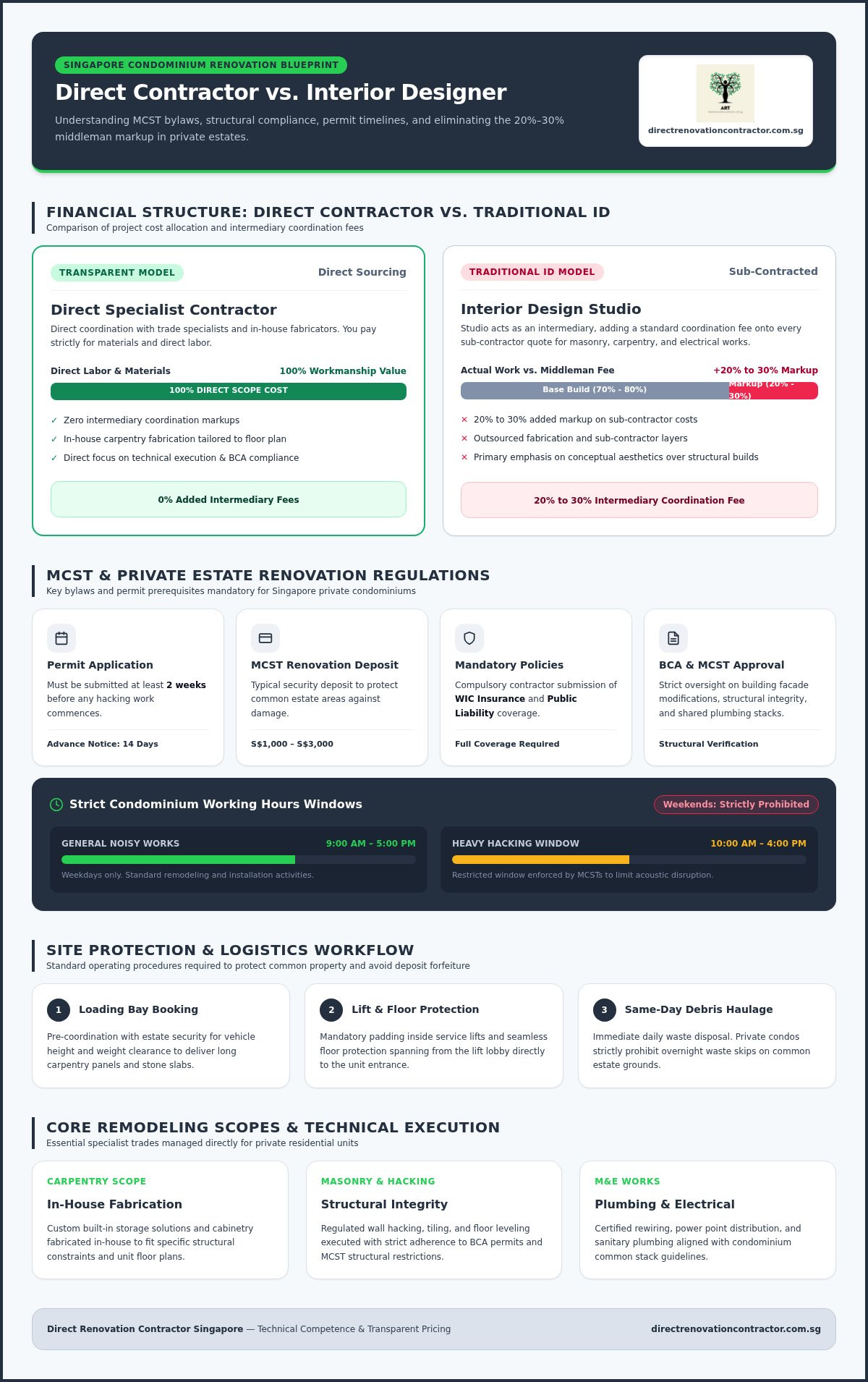
The permit application process usually begins at least two weeks before any hacking starts. You’ll need to submit a renovation application form, a copy of the contractor’s Work Injury Compensation (WIC) insurance, and a Public Liability insurance policy. Most MCSTs also require a renovation deposit, often ranging from S$1,000 to S$3,000, to cover potential damage to common areas during the project. The MCST holds the legal authority to approve or reject any structural modifications that may impact the building’s facade, common plumbing stacks, or overall structural integrity.
Work hours are strictly enforced in private estates. Most condos limit noisy works to weekdays between 9:00 AM and 5:00 PM. Weekend work is almost universally banned to maintain the peace for other residents. If your project involves hacking, the MCST might restrict these activities to even narrower time windows, such as 10:00 AM to 4:00 PM. Reliable condo remodeling contractors will build their schedules around these limitations to avoid project delays.
Site Protection and Logistics Management
Logistics in a private estate are significantly more complex than in public housing. Professional direct general contractors must coordinate with the estate’s security team to book loading bay slots and ensure service lifts are padded before any materials arrive. This coordination is vital because many estates have height and weight restrictions for delivery vehicles that can impact the delivery of long carpentry panels or heavy stone slabs.
Site protection is another non-negotiable requirement. Floor protection must extend from the service lift lobby all the way to your unit’s front door. If a single tile in the common hallway is cracked or stained by a contractor’s trolley, your renovation deposit will be used for the repair. Managing debris removal is equally critical. Since most condos don’t allow waste skips to be parked overnight, your contractor must arrange for same-day haulage. It’s the contractor’s responsibility to maintain common property throughout the project, ensuring that dust and debris don’t migrate into the hallways or shared facilities.
Direct Contractor vs. Interior Designer: Which is Best for Your Condo?
Deciding between an interior designer (ID) and direct condo remodeling contractors often comes down to your budget and how much control you want over the technical details. An ID typically focuses on the aesthetic vision and lifestyle concepts. In contrast, a direct contractor prioritizes the structural integrity and the practical execution of the build. For homeowners who already have a clear idea of their desired layout, the direct model offers a level of cost transparency that is impossible to find in the traditional ID model.
Choosing a direct contractor doesn’t mean you’re sacrificing quality. It means you’re paying for the actual work rather than the overhead of a design studio. This approach is particularly effective for condo refreshes or full remodels where the floor plan is already fixed, and the goal is to modernize the space with high-quality materials and better carpentry.
The ‘Middleman’ Markup Explained
The most significant difference lies in the financial structure. When you hire an ID, you aren’t just paying for design; you’re paying a coordination fee that usually manifests as a 20% to 30% markup on every sub-contractor’s quote. This means you pay more for the same tiles, electrical wiring, and masonry work. By working with a specialist, as detailed in our Direct Renovation Contractor Singapore: The 2026 Comparison Guide, you eliminate these intermediaries. Direct contractors source materials like quartz countertops and vinyl flooring directly from suppliers, ensuring you see the unmarked-up costs of both materials and labor.
The DIY Renovation Model for Savvy Owners
Savvy owners are increasingly adopting a DIY project management approach to save money. You don’t need an ID to tell you that a wall needs hacking; you need an expert who understands the BCA guidelines on building works to ensure the structural safety of your unit. Modern condo remodeling contractors bridge the gap by providing 3D drawings that help you visualize the space without the high-concept design fees.
This model gives you a direct line to the master carpenter and mason. Your feedback isn’t lost in translation through a middleman. You manage your own timeline while the contractor handles the heavy lifting and technical trade coordination. If you’re ready to take charge of your project, viewing our condo renovation packages can help you define your essential scope. This direct access ensures that the material quality you pay for is exactly what gets installed in your home.
Core Remodeling Scopes: Carpentry, Masonry, and M&E
Successful condo renovations rely on the technical quality of the three primary trades: carpentry, masonry, and Mechanical and Electrical (M&E) works. While aesthetic design is subjective, the structural integrity of your built-ins and the waterproofing of your wet areas are fixed technical standards. Experienced condo remodeling contractors prioritize these core scopes to ensure the longevity of your unit, especially in Singapore’s humid climate where poor material choices lead to rapid deterioration.
Custom Carpentry for Modern Condo Layouts
Maximizing storage is the top priority for owners of smaller, modern condo units. Floor-to-ceiling wardrobes and custom kitchen cabinetry utilize vertical space that pre-fabricated furniture simply cannot reach. There’s a significant technical difference between local fabrication and pre-fab imports. Local carpentry, such as the work produced at our Paya Ubi workshop, allows for precise on-site measurements that account for uneven walls or structural pillars. For a detailed breakdown of material costs and construction methods, refer to our Carpenter Singapore: The 2026 Guide to Custom Carpentry and Direct Savings.
Masonry and Flooring Excellence
Masonry is often the most labor-intensive part of any remodel. You must first determine if your MCST allows floor hacking. Many private estates prohibit hacking in wet areas within the first few years of completion to protect the original waterproofing membrane. In these scenarios, overlaying with vinyl flooring or homogeneous tiles is the most pragmatic choice. If hacking is permitted, your contractor must ensure a perfect drainage gradient in bathroom floors to prevent water ponding, which is a common cause of downstream leaks to the unit below.
Navigating the existing electrical wiring and plumbing stacks requires a contractor who understands the specific M&E layout of your building. M&E works in private units are often concealed within structural slabs or false ceilings, making any relocation of power points or pipes a complex task. Given the risks of large renovation package prepayments reported by CASE, we advocate for a progressive payment schedule. This ensures you only pay for M&E and masonry work once specific technical milestones are verified on-site. Using materials that withstand high humidity, such as marine-plywood carcasses for kitchen cabinets, will further protect your investment from the local climate.
A Step-by-Step Buying Guide for Condo Renovation Packages
Selecting from various condo remodeling contractors requires a systematic approach to ensure your budget stays intact. You should begin by defining your essential scope, such as hacking and M&E works, versus “nice-to-have” design elements. This distinction helps you prioritize technical necessities over purely aesthetic upgrades that don’t add structural value. Once your needs are clear, request a detailed breakdown of labor and material costs rather than accepting a single total figure. This transparency allows you to compare quotes accurately and identify exactly where your money is going.
It’s also vital to verify the contractor’s experience with your specific condo’s MCST. A contractor who has worked in your estate before will already be familiar with the specific loading bay restrictions and permit nuances. Review the payment schedule to ensure it follows a progressive model, where you pay only after specific milestones are reached. Finally, finalize your 3D drawings and technical site plans. These documents serve as the blueprint for the entire project, ensuring that every electrical point and cabinet dimension is agreed upon before any work starts on-site.
How to Evaluate a Condo Renovation Quote
Watch out for “lump sum” traps in quotes that hide potential cost overruns. A professional quote should explicitly include haulage, debris clearing, and post-renovation professional cleaning to avoid unexpected fees. Linear footage is the gold standard for carpentry quotes because it provides a transparent, measurable unit of cost that prevents arbitrary price hikes based on perceived design complexity. Without these specific details, you might find yourself facing “hidden” charges once the project is underway. If you want to see an example of a clear, itemized breakdown, you can explore our condo renovation packages.
Planning Your Renovation Timeline
Realistic durations for a full condo remodel in 2026 typically range from 8 to 12 weeks, depending on the complexity of the hacking and carpentry. You must factor in lead times for custom carpentry fabrication and any indent tiles sourced from overseas. Delays often occur during the permit application phase or when condo remodeling contractors don’t manage sub-contractors effectively. For a deeper look at managing these stages, see our Home Renovation in Singapore: A Practical Guide to Planning and Execution in 2026. Planning for these technical milestones early ensures that your move-in date remains predictable and stress-free.
Why Choose Direct Renovation Contractor for Your Condo?
Finding reliable condo remodeling contractors in Singapore often feels like a choice between high-priced design firms and unmanaged sub-contractors. Direct Renovation Contractor Singapore offers a pragmatic middle ground by providing a direct-to-homeowner model that prioritizes technical skill and financial transparency. We eliminate the 20% to 30% markups typically charged by interior designers, ensuring your investment is spent on actual construction quality. Our team manages every phase of the build, from the initial hacking to the final installation of bespoke carpentry fabricated at our Paya Ubi workshop.
We provide comprehensive support for DIY owners who want professional results without the fluff of high-concept design consultancy. This includes 3D architectural drawings that bridge the gap between your vision and our technical execution. Our experience with MCST compliance is a critical asset; we know how to handle the paperwork, deposits, and site protection requirements that keep your project on the right side of estate bylaws. We speak the language of the local construction industry, focusing on structural integrity and practical durability rather than just aesthetic trends.
The Direct Contractor Advantage
The primary benefit of our model is the direct line of communication between you and the tradespeople. This eliminates the “lost in translation” errors that occur when information passes through multiple intermediaries. Our project management style is hands-on and process-oriented, ensuring that masonry, plumbing, and electrical works are coordinated to meet strict technical standards. We specialize in creating bespoke solutions that fit the unique, often challenging floor plans of modern Singaporean condos, maximizing storage and floor space through precision carpentry.
Getting Started with Your Remodel
The first step toward a stress-free renovation is an honest site assessment. We’ll visit your unit to evaluate the existing M&E layout and discuss your specific remodeling goals. After this assessment, we help you customize one of our specialized packages to fit your unit’s requirements, providing a clear, itemized quote with no hidden commissions. We value straightforward communication and technical competence above all else. If you’re ready to renovate with a partner who values your budget as much as you do, View our Condo Renovation Packages from Direct Renovation Contractor Singapore today and secure a quote built on transparency and hard work.
Take Control of Your Condo Remodeling Project
Remodeling your private apartment doesn’t have to be a process defined by hidden fees and coordination headaches. By choosing direct condo remodeling contractors, you’ve learned how to bypass typical middleman markups while ensuring your project stays compliant with strict MCST bylaws. We’ve highlighted why technical trade management, from local carpentry fabrication to precise masonry, is the real key to a durable home.
At Direct Renovation Contractor Singapore, we prioritize functional results over design fluff. Our direct-to-owner pricing model removes unnecessary commissions, while our in-house carpentry workshop in Paya Ubi guarantees that every built-in is tailored for your specific layout. As specialists in MCST compliance, we manage the permits and site logistics so you don’t have to. It’s time to invest in quality workmanship that respects your budget.
Get a Transparent Condo Renovation Quote from Direct Renovation Contractor and start your renovation journey with a partner you can trust. We’re ready to help you build a better home with total financial clarity.
Frequently Asked Questions
Do I need a permit for a condo remodeling project?
Yes, you must obtain a renovation permit from your MCST before any work begins. Any structural hacking or changes to the unit facade also require approval from the Building and Construction Authority (BCA). Your chosen condo remodeling contractors should assist with the technical documentation and insurance certificates required for the application. Failure to secure these permits can lead to immediate work stoppages and heavy fines from your estate management.
How much does a typical condo renovation cost in Singapore?
Renovation costs vary significantly based on the unit size and the technical scope of work. Instead of looking at lump sum estimates, focus on itemized costs for trades like masonry, carpentry, and M&E works. Direct contractors offer transparent pricing by removing interior design markups, allowing you to pay the actual market rate for labor and materials. You should always request a detailed breakdown of linear footage for carpentry to avoid hidden fees.
Can a direct contractor provide 3D drawings for my condo?
Yes, direct contractors like Direct Renovation Contractor Singapore provide 3D architectural drawings as part of their service. These drawings are essential for visualizing the layout and ensuring that bespoke carpentry fits the specific dimensions of your condo. This technical support allows you to manage the aesthetic direction of your project while the contractor handles the structural execution and trade coordination without the need for an expensive design consultant.
What is the difference between an ID and a direct renovation contractor?
The primary difference lies in the financial model and project focus. Interior designers (IDs) act as consultants who charge a coordination fee, often resulting in a 20% to 30% markup on sub-contractor quotes. Condo remodeling contractors operate on a direct-to-owner model, providing unmarked-up prices for their own in-house trades. While IDs prioritize lifestyle concepts, direct contractors focus on technical integrity, material quality, and straightforward financial transparency.
How long does a condo renovation usually take?
A comprehensive condo renovation typically takes between 8 and 12 weeks to complete. This duration accounts for the time needed for MCST permit approval, material indenting, and on-site execution of masonry and carpentry. Complex projects involving extensive hacking or customized M&E works might require additional time. It’s vital to establish a clear project schedule with your contractor to track technical milestones and ensure the project remains on schedule for your move-in date.
Can I stay in my condo while the remodeling is happening?
It is generally not advisable to stay in your condo during major remodeling works. The hacking and masonry phases generate significant dust, noise, and debris that make the environment unsuitable for living. Additionally, essential services like water and electricity are often disconnected during M&E upgrades. If you’re only doing minor carpentry or painting, staying in might be possible, but full-scale renovations require a vacant unit for safety and efficiency.
What happens if the contractor damages common condo property?
If a contractor damages common property, such as service lifts or corridor tiles, the MCST will utilize your renovation deposit to cover the repairs. To prevent this, professional contractors install extensive site protection before any materials arrive. You should ensure your contractor carries valid Public Liability and Work Injury Compensation (WIC) insurance. This coverage protects you from financial liability if accidents occur within the estate or your unit during the project.
How do I handle the renovation deposit with my MCST?
You must pay the renovation deposit directly to your MCST office during the permit application process. This deposit, which often ranges from S$1,000 to S$3,000, acts as a security bond against potential damages or illegal disposal of debris. Once the renovation is complete and the MCST conducts a final site inspection of the common areas, the full amount is refunded to you, provided no estate rules were breached during the works.