

What if “bare condition” doesn’t mean stripping a leased unit back to concrete? The reinstatement to bare condition meaning depends on the lease and the premises’ original state, so the phrase isn’t a universal instruction to remove every fitting. A tenant who assumes otherwise could plan unnecessary work or miss something the landlord expects at handover.
If your agreement uses unclear wording, it’s reasonable to be unsure which partitions, flooring, fixtures or services must be removed or restored. Turn the lease clause into a specific scope before work begins instead of relying on assumptions about what “bare” means.
This guide explains how to interpret the phrase in a Singapore lease, what to check in the reinstatement clause and handover records, and how to document the agreed scope with the landlord. It also explains how tasks such as dismantling partitions, removing tenant-installed finishes and making good affected areas fit into a practical handover plan. Clear details help you organise the work and reduce the risk of last-minute disagreements.
Key Takeaways
- The reinstatement to bare condition meaning depends on the lease and agreed handover scope, not a universal requirement to expose concrete.
- Use the lease clause, approved fit-out plans, written variations and move-in records to identify the condition the premises must meet.
- “Bare condition,” “original condition” and “make good” can describe different scopes. Read each term in the context of your agreement.
- Before work starts, list alterations, agree what to remove, repair or retain, and document the scope with the landlord.
- A clear scope helps coordinate relevant reinstatement work, from partition removal and flooring to painting, electrical and plumbing works.
Reinstatement to bare condition meaning: what does the phrase describe?
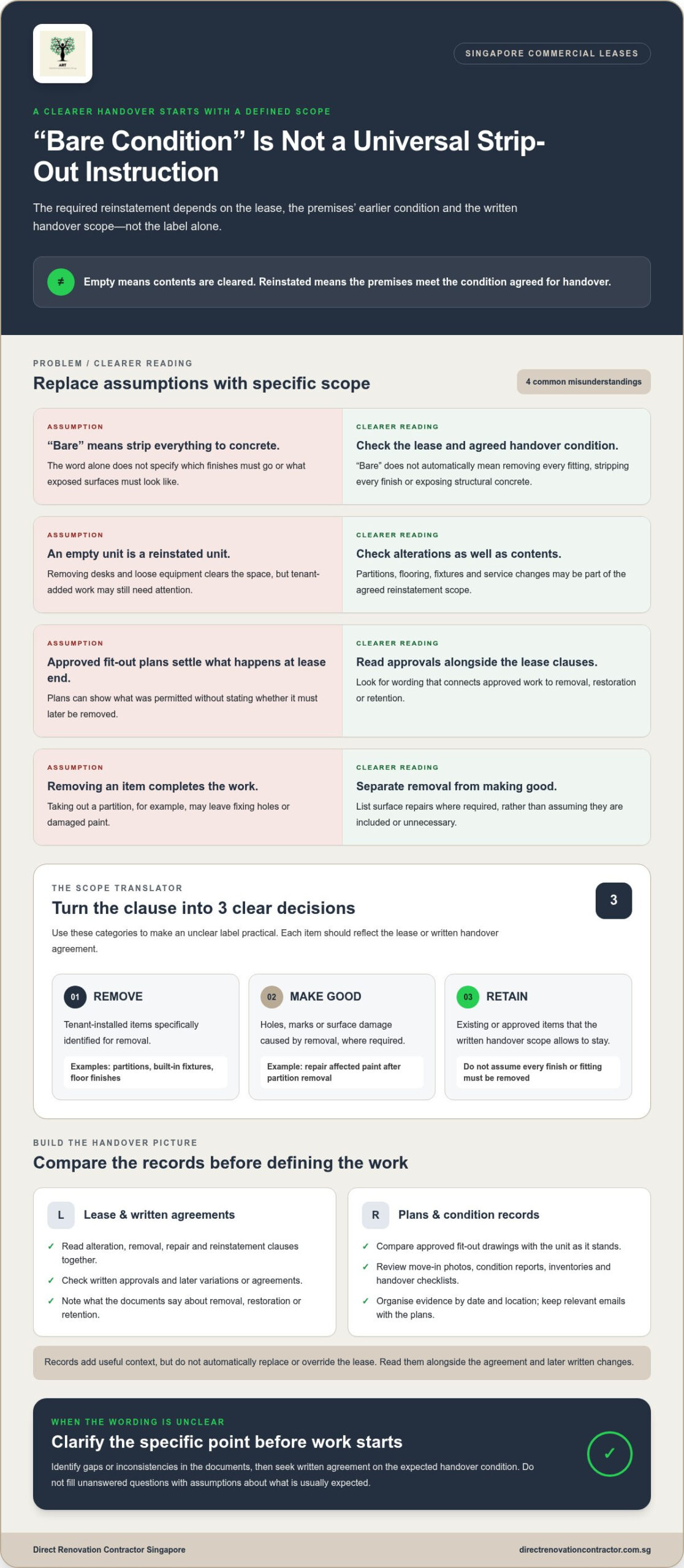
The reinstatement to bare condition meaning is the work needed to return a leased premises to the condition specified in the lease or an agreed handover scope. It may involve removing tenant-installed fit-out items and making good affected surfaces, but “bare” doesn’t automatically mean stripping every finish or exposing structural concrete.
A unit can be empty without being reinstated. Removing desks and loose equipment clears the space, but tenant-added partitions, flooring, fixtures or changes to services may still need attention if the agreed scope requires it. Conversely, some existing finishes or fittings may be allowed to remain. The required result depends on what was there before the tenancy and what the parties have agreed for handover.
The lease and written handover requirements determine the reinstatement scope. Treat the phrase as a label to interpret in context, not a complete work instruction. For planning, translate it into specific actions: remove, repair, restore or retain.
What “bare” may mean in a commercial lease
In a commercial tenancy, “bare” commonly points to removing tenant-added items where required, such as partitions, built-in fixtures or floor finishes. But it doesn’t, by itself, tell you exactly which items to take out or what condition the exposed surfaces must be left in. An empty unit is cleared of contents; a reinstated unit has also been returned to the agreed condition.
For example, removing a partition may leave fixing holes or damaged paint that need making good. Whether the floor beneath tenant-installed carpet must be restored, or the carpet can remain, depends on the handover requirements. Neither outcome follows automatically from the word “bare.”
Why the lease wording matters more than the label
Read the reinstatement, alterations and handover clauses together. The lease may describe what to remove, require restoration to an earlier state, or refer to approved plans and schedules. Written approvals for fit-out works and later agreements can also clarify what was permitted and what must happen at lease end.
Review the complete set of documents, not one phrase in isolation. Compare the lease with fit-out approvals, schedules, inventories and written variations. If the wording seems inconsistent, identify the specific point that needs clarification and seek written agreement on the expected handover condition before work starts. This gives you a practical basis for defining the physical scope without treating a general label as a universal technical standard.
- Remove: tenant-installed items specifically identified for removal.
- Make good: holes, marks or surface damage caused by removal, where required.
- Retain: existing or approved items that the written handover scope allows to stay.
That distinction turns an unclear phrase into a usable checklist. It also helps prevent unnecessary stripping while keeping required repairs visible in the work plan.
What determines bare-condition reinstatement in a Singapore lease?
The required condition is shaped by the documents and agreements for that tenancy, not by an assumed industry-wide rule. A clause that says “reinstate” may leave practical questions unanswered: which tenant-added items must go, whether affected surfaces must be repaired, and whether approved fit-out can remain. The reinstatement to bare condition meaning in your case depends on how the lease uses the phrase and what other written records say about the premises.
Keep contractual requirements separate from assumptions about what landlords usually expect. Common practice or a contractor’s understanding cannot, by itself, establish the agreed handover scope. If documents appear to conflict or leave a material point unclear, identify the issue and seek written clarification before setting the work plan.
Lease clauses, approvals, and agreed changes
Review the clauses covering alterations, tenant improvements, removal, repair and reinstatement together. Then compare approved fit-out drawings and written consent with the unit as it stands. An approval may describe what was permitted during the tenancy, while a separate clause may address what happens at lease end. Later written variations or agreements may also change the expected handover condition.
For example, drawings can help identify which partitions or service changes belong to the tenant’s fit-out. They don’t necessarily say whether those items must be removed at handover. Look for wording that connects approved work to removal, restoration or retention, and note any gaps instead of filling them with assumptions.
Original condition records and handover evidence
Move-in photographs, a condition report, an inventory or a handover checklist can help establish what was already in the premises. Compare those records with approved plans and the current fit-out. This makes it easier to distinguish a pre-existing finish from a tenant-installed one, or existing damage from marks caused by later works.
Keep the evidence organised by date and location. Label photographs, retain the original files where possible, and group emails or approvals with the relevant plans. These records provide useful context, but they don’t automatically replace or override the lease. Read them alongside the agreement and any later written changes.
Before defining the work, compare the lease clauses, approved fit-out plans, written variations, and original-condition records such as inventories, photographs or condition reports. An item-by-item schedule can help: note what the documents say, what is currently installed, and whether the item is proposed for removal, repair or retention. Mark unclear entries for written agreement rather than treating them as settled.
This document review gives a reinstatement contractor a clearer basis for planning physical work, including partition removal, flooring, painting, and electrical or plumbing tasks where required. A defined scope helps align the work with the documented handover expectations. Direct commercial reinstatement work can then be planned around the agreed items, rather than a broad instruction to make the unit “bare.”
Bare condition vs original condition: how do reinstatement scopes differ?
Lease terms such as “bare condition,” “original condition” and “make good” can point to different handover outcomes, but none should be treated as a universal technical definition. The reinstatement to bare condition meaning for a particular unit depends on the wording of its lease and any agreed scope. Use the comparison below to identify the questions each label raises, not as a substitute for the actual clause.
| Lease wording | Possible focus | What to check |
|---|---|---|
| Bare condition | Removal of specified tenant-installed fit-out items, such as partitions, floor finishes, signage or fittings. | Which items must be removed, and what repairs or making good are required afterward? |
| Original condition | Return to a documented earlier state, which may include finishes or fixtures that were already present at the start of the tenancy. | What do move-in records, inventories, photographs or condition reports show? |
| Make good | Repair or restoration of specified areas or damage, sometimes as part of a wider reinstatement scope. | Does the clause identify particular repairs, items or areas, or refer to broader reinstatement work? |
These examples are prompts for interpreting the documents, not automatic instructions to remove every item. A partition, floor finish, sign or tenant-installed fitting may need removal, repair or retention depending on the agreed requirements.
Bare condition and original condition are not automatically identical
“Bare condition” may focus on taking out specified fit-out elements. “Original condition” may instead refer to the state recorded before tenant works began. Those outcomes can overlap, but they aren’t necessarily the same: a finish present at move-in might remain under one agreed scope, while a later tenant-installed finish might be marked for removal. The lease and supporting records determine the intended result.
What “make good” can mean in a handover clause
“Make good” may refer to repairs or restoration identified in the lease, such as repairing affected surfaces after removing a fitting. It can overlap with reinstatement, but the phrase alone doesn’t establish that a complete strip-out is required. Read the full clause and any documented scope to establish which areas need repair, which items must be removed and what may stay.
The main misconception is that bare condition always means stripping a unit back to its concrete shell. That isn’t a safe assumption. A clause might specify removal of partitions and signage but say nothing about removing every floor finish; another may describe broader work. The practical difference lies in the listed tasks, the condition required after removal, and any exceptions recorded in writing.
Before planning work, turn each phrase into item-level questions:
- Are partitions, signage and tenant-installed fittings identified for removal?
- Does the agreement specify what happens to floor finishes and exposed surfaces?
- Are repairs or repainting required after removal, and are any items allowed to remain?
Record the answer against the relevant lease wording or written agreement. This makes the comparison useful for defining a real scope, rather than relying on assumptions about what a short label means.
How to prepare for bare-condition reinstatement and handover
A clear handover plan turns lease wording into defined work. Start by reviewing the relevant documents, then compare them with the unit’s current condition. Before any work begins, record what must be removed, repaired, restored or retained, and document the agreed scope and any changes in writing. This keeps the work plan tied to actual requirements rather than assumptions about what “bare” usually means.
Build a scope checklist from the lease and site records
Walk through the premises and list tenant-installed partitions, flooring, signage, fittings and changes to services. Compare each item with the lease, approved fit-out plans, move-in records and later written agreements. Assign a status to each item, and leave uncertain items marked for clarification instead of treating them as approved for removal or retention.
- Remove: items the agreed scope specifically requires to be taken out.
- Repair or make good: surfaces or fixtures that need attention after removal.
- Reinstate: elements that must be returned to a specified layout or condition.
- Retain: items the written scope allows to stay.
- Clarify: anything where the documents and current site condition don’t clearly match.
Photograph relevant areas before work starts, including existing damage and the condition around items due for removal. Take follow-up photographs after completion from comparable angles. These records help show what changed and support a more orderly handover discussion.
Plan works and keep handover evidence organised
Once the scope is agreed, schedule the work in a practical sequence. Removal usually comes before making good, cleaning and final inspection, but the actual order depends on the specified tasks and site conditions. Align building-management access arrangements, permitted work timing and site requirements with the property’s applicable instructions. Don’t assume the same schedule or access process applies to every premises.
Planning time also depends on what the agreed scope involves and the condition of the unit. A plan that includes partition removal, flooring work, painting or changes to electrical and plumbing elements has different requirements from one limited to a few repairs. Avoid relying on a standard timeline. Confirm the work sequence against the actual scope and site constraints.
- Review the lease, approved plans, handover records and written variations.
- Inventory alterations and mark each item for removal, repair, reinstatement, retention or clarification.
- Agree the detailed scope and record changes in writing before work begins.
- Schedule work around the agreed tasks and applicable site instructions.
- Photograph completed areas, organise records and carry out the final handover inspection.
Keep the lease, approvals, agreed scope, correspondence, work records and before-and-after photographs together. This gives the work team and the parties reviewing the handover a consistent reference. For defined commercial reinstatement work, use an itemised scope to connect each physical task to the agreed handover condition and keep the process clear from planning through completion.
Commercial reinstatement in Singapore: how a direct contractor can help
Once the handover requirements are clear, the next task is translating them into physical work. Commercial reinstatement is not simply a request to empty a unit. It is a defined scope of restoration shaped by the lease, written agreements and the premises’ condition. A direct contractor can plan the work around those requirements, so each task has a clear purpose and relates to the expected handover outcome.
Match the work to the documented reinstatement scope
Different premises need different work. If the agreed scope calls for partition removal, demolition may be followed by making good affected walls or ceilings. If tenant-installed flooring must go, the work may include removing it and addressing the exposed surface as specified. Painting may be required where removal leaves marks or where the handover scope calls for repainting. Electrical or plumbing work may be relevant if tenant fit-out changed those services and the agreement requires restoration.
These trades aren’t automatically required for every unit. The reinstatement to bare condition meaning for a particular project must be read against its documented scope. An itemised plan helps keep removal, repairs and any service alterations tied to actual requirements, rather than adding work based on a general assumption about what “bare” means.
For broader commercial project considerations, the office renovation company guide offers related context on planning office works. Reinstatement has a different end goal from a fit-out, but careful scope definition matters in both.
Keep scope and pricing transparent
Before work starts, the scope should set out the tasks, affected areas and any stated responsibilities. It should distinguish removal from repair, reinstatement and retention. If the agreed requirements change, record the change in writing and update the work plan. This gives the tenant, landlord and site team a shared reference for what is included, helping reduce confusion during the work and handover.
A direct-contractor model puts the contractor in direct coordination with the client and supports transparent, unmarked-up pricing. Clear pricing works best alongside a clear scope: each listed task can be understood in relation to the required outcome, without relying on vague descriptions or hidden additions. For more context on how this approach compares with other contractor arrangements, see the direct renovation contractor comparison guide.
Direct Renovation Contractor Singapore handles commercial reinstatement and practical trade works for lease handover. If you’re planning a commercial unit’s restoration, explore commercial renovation and reinstatement services to learn how the work can be aligned with a defined scope.
Set up a smoother lease handover
Give the handover a clear starting point: turn the agreed scope into a work sequence everyone involved can follow. Identify which decisions need to be settled before site work begins, who will coordinate access, and how completed items will be checked against the agreed requirements. This moves the reinstatement to bare condition meaning from an open-ended phrase to a practical plan for the final stage of your tenancy.
Keep one current version of the scope and update it if the parties agree to changes. This helps prevent outdated instructions from reaching the work team and gives the final inspection a clear reference. The handover is easier to manage when expectations are recorded before the unit is vacated, rather than reconstructed from memory at the last moment.
For help planning work around a commercial lease handover, explore commercial renovation and reinstatement services. A clear plan is a practical next step towards a more orderly handover.
Frequently Asked Questions
Does reinstatement to bare condition mean stripping a unit back to concrete?
No. The phrase doesn’t automatically require removing finishes until concrete is exposed. The reinstatement to bare condition meaning depends on the handover wording, so check whether it specifies removal of floor coverings, ceiling finishes or other layers. Stripping more than required can add work and may affect building elements or services. If a clause simply uses “bare condition” without explaining the required finish, get the expected outcome recorded clearly before demolition begins.
Is bare condition the same as original condition in a commercial lease?
Not necessarily. A lease may use “bare condition” to describe a cleared space, while “original condition” may refer to the state recorded at the start of the tenancy. For instance, an existing ceiling feature might have been present at move-in, while a later tenant-added partition was not. Check how each phrase appears in the agreement and whether the handover schedule treats the two conditions as separate outcomes.
What items may need to be removed during commercial reinstatement?
Depending on the agreed scope, removal may cover tenant-added workstations, built-in fittings, partitions, signage, floor finishes or changes to electrical and plumbing layouts. A wall-mounted sign, for example, may leave holes that need repair after removal. Don’t assume every item installed during the tenancy must go, or that loose furniture is the only item to clear. Match each item to the lease wording and any written handover instructions.
Can a tenant leave fixtures or partitions behind at handover?
Possibly, if the landlord’s written agreement or lease scope allows them to remain. A partition may be useful to the next occupant, but usefulness alone doesn’t establish permission to leave it. Record the specific item, its condition and the agreed arrangement in writing. Include any related work, such as making good around fittings that are removed while the partition stays. This avoids relying on a verbal understanding during final inspection.
How do I find the reinstatement requirements in my lease?
Search the full lease for terms such as “reinstatement,” “alterations,” “tenant’s works,” “removal,” “repair” and “handover.” Then read those clauses together, including any schedules or appendices they refer to. Note cross-references to approvals or fit-out documents. If one clause says alterations need consent and another describes end-of-lease work, consider both when preparing questions for written clarification. Don’t base the scope on a search result or a single phrase alone.
What documents help determine a unit’s original condition?
Useful records include move-in photographs, a signed inventory, a condition report, handover forms and correspondence describing existing defects or fixtures. Approved fit-out plans can help identify later tenant work, while dated photographs may show when an item appeared. Keep files in an organised folder and label images by room or area. These records provide context for discussions, but review them alongside the lease and later written agreements.
When should reinstatement work be planned before lease handover?
Start planning once the handover date and relevant lease requirements are clear, rather than waiting until the unit is empty. The scope may involve several trades, building-management access arrangements or written agreement on disputed items. Those details affect scheduling, so there’s no single timeline that fits every premises. Confirm the sequence and site requirements early, then leave time to inspect the completed work and address any agreed outstanding items before handover.