

A Variation Order should clarify a change, not become a blank cheque. If you’re unsure whether proposed work was already included in your renovation quote, understanding VO in renovation contracts can help you compare the change with the signed scope before agreeing to extra cost or time.
It’s reasonable to want clear answers before work changes. A VO records what’s being added, removed or altered, along with its price impact and any effect on the schedule. It doesn’t replace the need to understand what your original contract covers, and it shouldn’t leave you guessing about the revised bill.
This guide explains what a VO should record, how to compare it with your agreed scope, and what to review about costs, timing and relevant approvals. You’ll also learn why recording a change in writing before the affected work proceeds helps both sides stay aligned. A clearly defined original scope makes each proposed change easier to assess.
Key Takeaways
- Understanding VO in renovation contracts starts with distinguishing a proposed change from work already stated in your signed scope.
- Descriptions, quantities, materials, locations and exclusions help you assess whether a change is genuinely additional.
- Review the VO’s pricing basis, comparing added or removed work, material changes and any stated credits before approving it.
- Check how the change may affect the project schedule, then keep the written approval and supporting drawings or specifications with your contract.
- A clearly itemised scope makes changes easier to track. Direct contracting also gives you a straightforward way to discuss work and pricing.
What Does VO Mean in a Singapore Renovation Contract?
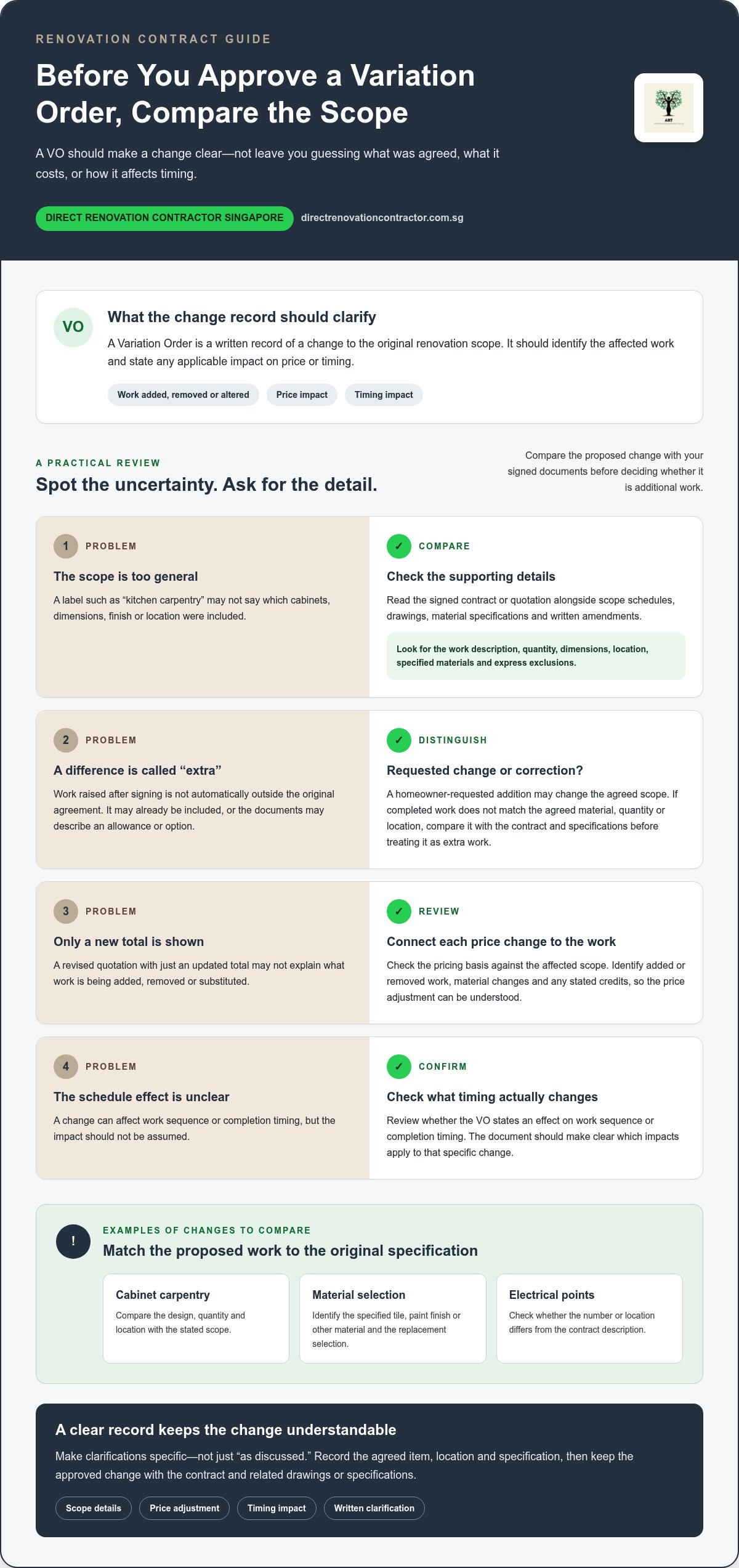
A Variation Order, usually shortened to VO, records a change to the renovation work agreed for a project. A practical definition is: A VO is a written record of a change to the original renovation scope, including the work affected and any stated impact on price or timing. This is different from work already included in the signed quotation or contract. The general project-management term Change order (Variation Order) also describes a change to the original contract, but your signed documents determine how changes are handled for your renovation.
A VO may affect the price, materials, work sequence or completion timing, depending on the change and the project. For example, changing a cabinet finish could affect material selection, while adding electrical points may involve extra work and adjustments to the work sequence. Don’t assume any of these impacts: the document should state what applies to the specific change. Understanding VO in renovation contracts means looking at the agreed scope first, then identifying exactly what the proposed change alters.
What kinds of renovation changes may need a VO?
A VO may be relevant when a homeowner requests work that changes the agreed scope. Common examples include:
- Adding kitchen cabinet carpentry beyond the stated design, quantity or location.
- Changing a specified tile, paint finish or other material to a different selection.
- Revising the number or location of electrical points from what the contract describes.
These examples don’t automatically require a VO in every project. Check the signed scope: an item may already be included, or the documents may describe an allowance or option. The key question is whether the requested work changes what was agreed, not simply whether it came up after signing.
Also distinguish a requested change from a correction. If completed work doesn’t match the agreed material, quantity or location, the issue is whether the original scope was followed, rather than whether the homeowner requested an addition. Compare the work with the contract and relevant specifications before treating the issue as extra work.
Is a VO the same as a revised quotation?
Not necessarily. A revised quotation may set out updated pricing, but a VO records the change to the agreed work. A quotation that shows only a new total may leave you unclear about what is being added, removed or substituted. A useful change record connects the revised price to a clear description of the affected scope.
Document names and processes can differ between contracts. One contractor may issue a form titled “Variation Order”; another may record the change in an addendum or revised document. Focus on the content and approval process stated in your signed documents, rather than relying on the title alone.
Before accepting a change, match its description to the original scope and make sure the record identifies the work being changed. Check whether it states any price adjustment, material substitution or timing impact. Keep the approved record with the contract and related specifications so the agreed version is easy to refer to during the renovation.
How the Original Scope Determines Whether a VO Is Needed
Before deciding whether proposed work is additional, establish what the original agreement covers. Start with the signed contract or quotation, then check any attached scope schedule, drawings, material specifications and written amendments. Read these documents together: a short quotation may rely on a separate schedule for the actual dimensions, finishes or quantities.
Understanding VO in renovation contracts depends on comparing like with like. Look for the work description, where it will be done, how much is included, which materials are specified and what the documents expressly exclude. A general label such as “kitchen carpentry” may not settle whether a particular cabinet, internal fitting or finish is included. The supporting details matter.
For example, a scope might say “install kitchen cabinets” without stating the length, layout or finish. You may understand this to cover cabinets along two walls, while the contractor may have priced a shorter run. That difference can lead to disagreement over whether the extra cabinets are a change or part of the original work. Clear dimensions and drawings reduce room for conflicting interpretations.
Which contract details should homeowners compare?
Place the proposed change beside the original description and supporting documents. Check what is changing, not just the new total. Compare the listed material or finish, quantity, dimensions, location and any relevant exclusions. For a tile change, for instance, the original specification and replacement should both be identified so the difference is clear.
- Check drawings and dimensions against the proposed layout or installation.
- Compare quantities, locations and material descriptions with the signed scope.
- Review exclusions and allowances that may affect what the original price covers.
- Flag differences between the documents and earlier discussions, then seek written clarification.
Make clarification specific. Instead of relying on “as discussed,” record the agreed item, location and specification in writing. This gives both sides a clear reference when deciding whether the work changes the original scope.
How can HDB or property requirements affect a scope change?
Contract scope and regulatory approval are separate questions. Requirements can depend on the proposed work and property type, so HDB homeowners should refer to current HDB renovation guidance for the work in question. Condo projects may also be subject to building-management requirements. A signed VO records a contractual change; it does not, by itself, establish that any required approval has been obtained.
For background on how renovation disagreements can be handled in Singapore, the Ministry of Law Singapore on Renovation Disputes discusses dispute-resolution avenues. Keeping the original scope, written clarifications and updated drawings together can help make the agreed work easier to follow if questions arise. With direct contracting, scope and pricing discussions are between the homeowner and renovation team. Learn more about how direct renovation contracting works.
How to Assess a VO’s Price and Timeline Impact
A proposed change is easier to assess when the VO shows what will change and how that change affects the contract. Don’t rely on a new total alone. Compare the original work with the revised work, then check the stated pricing basis and any schedule adjustment. This helps you see whether the amount relates to added work, a material change, removed work or a combination.
For example, if a cabinet layout is revised, check whether the VO accounts for new carpentry, removed components and any credit for work no longer required. The document should make the calculation understandable from its stated details. There’s no single market rate that serves as a guaranteed benchmark; the relevant question is whether the proposed amount is explained for this project and scope.
What should a clear VO say about price?
Look for a specific description of the affected work and a clear amount or calculation basis. Check whether material substitutions, labour, removal of existing work and credits are addressed. If an item is removed, see whether the VO states how that affects the contract sum. If the calculation or treatment of a credit is unclear, ask for a written explanation before approving the change.
Can a VO change the renovation schedule?
It can, depending on the extra work and how trades must be sequenced. A revised cabinet detail, for instance, may affect when installation can proceed or whether another task needs to happen first. Check whether the VO identifies a changed milestone or completion date. Distinguish that stated adjustment from an assurance that work will finish by a particular date.
A side-by-side comparison can make gaps visible. The example below is a guide to the details to record, not a price estimate or a prediction of project duration.
| Original scope | Proposed change | Price impact | Timing impact | Clarification needed |
|---|---|---|---|---|
| Cabinet layout shown in the signed schedule | Revise the layout and add a cabinet section | State added work, removed items and any credits | State any sequence or milestone adjustment | Confirm revised dimensions, finish and work description |
Read each column across. The price should correspond to the scope change, and the timing note should describe the effect on the work programme, not just say “delay” without context. If a change replaces one material with another, check that the original item and replacement are both identifiable. If no credit applies for removed work, the VO should make the pricing treatment clear rather than leave you to infer it.
As part of understanding VO in renovation contracts, check whether the updated document changes only the stated item or also affects connected work. Keep the approved VO with the contract and use it as the reference for the revised scope, price and schedule.
A Practical Checklist for Reviewing and Approving a VO
Use a consistent review sequence before agreeing to a proposed change. The aim is to understand what’s changing, what it means for the contract sum and schedule, and what record will show the agreed details. A conversation can help clarify the work, but follow it with a written record so there’s less room for different recollections later.
- Identify the change. State the work being added, removed or altered, including its location and relevant material or specification.
- Compare the scope. Check the proposal against the signed contract, quotation, drawings and schedules to distinguish new work from existing obligations.
- Review the price. Look for the stated amount or calculation basis, including how removed work, substitutions or credits are treated.
- Assess the timing. Check whether the change affects work sequence, milestones or the stated completion date.
- Record approval. Keep the agreed change and supporting documents together, following the approval process described in your contract.
In short: identify the change, compare it with the signed scope, review cost and timing, then keep the agreed record with your contract. This is a practical document-review checklist, not legal advice or a statement about the legal effect of any particular VO. For a legal interpretation, use current Singapore consumer or legal guidance relevant to your circumstances.
What documents and details should you keep together?
Keep the signed contract and original quotation with the relevant drawings, specifications and every agreed VO. Each change record should identify its date, the work affected, the stated price impact, any schedule impact and how approval was recorded. Use clear file names or version dates so the team can distinguish the current drawing or specification from an earlier draft.
After a phone call or site discussion, send a short written summary of what was discussed and ask for any corrections to be recorded. Save the response with the same project documents. This creates a useful reference for later discussions without assuming that a verbal exchange has a particular legal status.
What if the proposed VO is unclear or disputed?
Pinpoint the uncertainty. Refer to the exact line in the VO, amount, drawing detail or schedule note, then describe what needs clarification. For example, ask for the affected cabinet dimensions or the item a credit applies to, rather than asking generally whether the price is correct. Keep the question and response in writing, and make sure the revised record reflects any agreed correction.
If the disagreement concerns contract interpretation or your rights, consult current Singapore guidance. The Ministry of Law’s information on renovation disputes provides relevant local context; seek qualified legal advice for advice on your specific situation.
For renovation work with clearly defined scope and direct discussion of changes, explore direct renovation contracting.
Choosing a Clear Contracting Approach for Renovation Changes
A well-itemised contract gives both sides a shared reference point. It sets out what work is included, where it will be done and, where relevant, the materials, quantities or drawings that define it. When a new request comes up, you can compare it with those details instead of relying on memory or broad descriptions. That makes it easier to identify what is changing and discuss the cost or schedule implications clearly.
With direct contracting, homeowners discuss renovation work with the contractor handling it, without an interior-designer middleman. This keeps questions about scope close to the people involved in carrying out the work. It doesn’t prevent every misunderstanding or mean that additional charges can never arise. The value is having a direct conversation about the specified work and recording any agreed change clearly.
How does direct contracting support clearer scope discussions?
Defined work scopes create a useful baseline. A fixed-price contract for a defined scope records the agreed work and price for that scope. If you later request a different finish or an added item, both sides can compare the request with the original description and discuss what it changes. The clearer the starting point, the easier it is to separate included work from a requested variation without assuming the answer.
How can homeowners prepare for a renovation contract discussion?
Before discussing a project, organise your priorities and supporting information. This helps turn broad ideas into work descriptions that can be reviewed and priced as a defined scope.
- List the rooms and work you consider essential, and separate them from optional items.
- Note preferred materials or finishes, including any alternatives you would consider.
- Gather available drawings, measurements, reference images and relevant property constraints.
- Mark questions that need a clear answer, such as what is included, excluded or dependent on a later choice.
Direct Renovation Contractor Singapore’s DIY renovation support includes 3D drawings and a curated list of direct contractors and material suppliers. Drawings can help communicate layout intentions, while the list can support planning how work and materials will be arranged. Keep the scope descriptions aligned with the drawings so both describe the same proposed work.
Bring the organised scope and documents into the discussion, then make sure the resulting contract describes the agreed work in specific terms. If a change arises later, understanding VO in renovation contracts starts with this baseline: compare the request with what was documented, identify the difference, and record the agreed cost and timing impacts before the affected work proceeds.
Start Your Renovation with a Clear Brief
Your next useful step is to prepare a brief that reflects how you plan to live or work in the space. Separate essential work from optional upgrades, and note any decisions that are still open. This gives the project discussion a practical starting point and helps keep later choices connected to your priorities.
For understanding VO in renovation contracts, a clear initial brief matters because change discussions are easier to follow when the agreed starting point is specific. Direct Renovation Contractor Singapore works with homeowners and businesses without an interior-designer middleman, using defined-scope contracts for residential and commercial renovation work.
Bring your priorities and project information into a scope discussion, then decide what needs to be settled before work begins. Discuss your renovation scope and next steps with Direct Renovation Contractor Singapore. A clear start can make each decision feel more manageable.
Frequently Asked Questions
What does VO stand for in a renovation contract?
VO stands for Variation Order. It refers to a record of a change to renovation work agreed for the project. For example, if the agreed kitchen cabinet layout is modified, the VO can identify which parts of the work are changing and the related updates to the project documents. Some contracts use a different name, such as “variation” or “change order,” so check the wording in your own agreement.
When should a renovation contractor issue a VO?
A VO is generally relevant when a requested or necessary change alters the work described in the original agreement. This could happen if you ask to add a wardrobe, select a different finish or change the position of electrical points. If the work is already included in the signed scope, it may not be an additional change. Raise scope questions early and keep the agreed details in writing before the affected work proceeds.
Can a contractor charge more without a VO?
Whether an additional charge is payable depends on the signed contract, the agreed scope and the circumstances of the work. A request outside the documented scope may have a price impact, while a charge for work already included raises a different question. Ask for the specific work and pricing basis in writing, then compare them with your contract. If you dispute the charge, keep records and seek advice suited to your situation.
What should be included in a renovation Variation Order?
A useful VO should identify the affected work clearly enough that you can tell what will change and where. It should also state the price adjustment or how it is calculated, any credit for removed work, and any effect on milestones or the stated completion date. Include relevant drawing or specification references and the date and approval record. These details make it easier to match the change to the right project documents later.
Can I reject a Variation Order after renovation work starts?
You can raise an objection or decline to agree to a proposed change, but the consequences depend on your contract and what was already discussed or approved. If work has started, identify the disputed item and put your position in writing promptly. Ask the parties to clarify whether the affected work can pause while the issue is addressed. For advice about your rights or obligations, consult a qualified legal professional in Singapore.
Does an HDB renovation permit cover changes in a VO?
No. A contract variation and any HDB renovation approval are separate matters. A VO records a change to the agreed work between the parties; it does not itself show that HDB has approved work that requires approval. If a proposed change affects work in an HDB flat, check the current HDB renovation requirements for that specific work before proceeding. The applicable requirements depend on the work involved.