
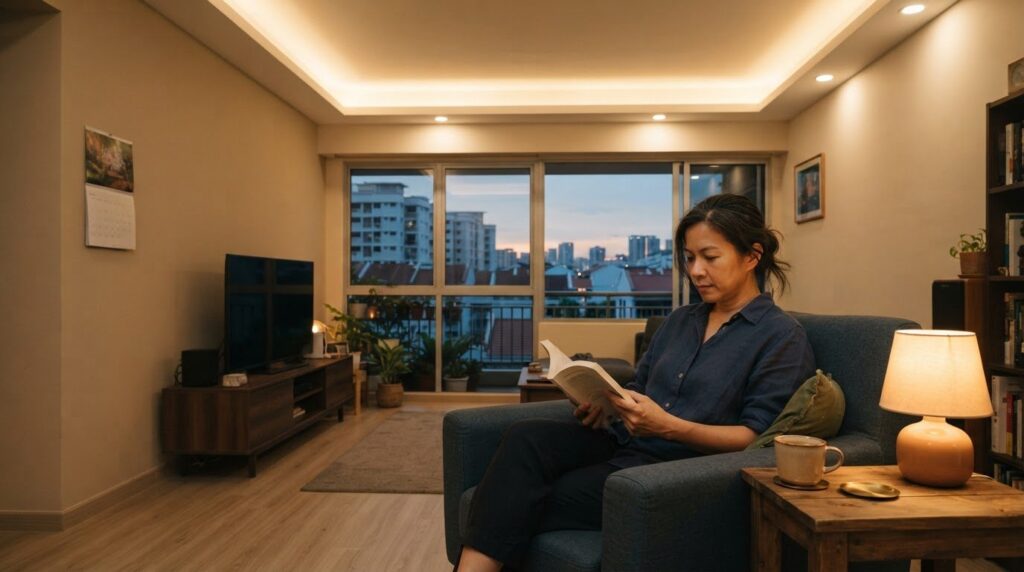
For cove lighting vs downlights for a living room, a practical answer is often to use both: cove lighting creates soft, indirect ambient light, while downlights provide more direct illumination where needed. They serve different purposes, so choosing one does not always mean giving up the other. In a Singapore home, ceiling height and the space required for a false ceiling also matter.
A comfortable living room should feel well lit without dark corners, harsh glare or ceiling work that makes the room feel lower. This guide compares the ambience and light distribution of cove lighting and downlights, explains when combining them works well, and outlines what to consider before planning lighting for an HDB flat, condo or landed home. Use these practical trade-offs to choose a setup suited to how you use the room, whether relaxing, watching TV or lighting specific areas. Placement and ceiling impact matter too.
Key Takeaways
- Use cove lighting for softer, indirect ambience, and plan a more directed light source for reading or other tasks.
- Choose downlight beam angles and placement based on the room’s shape, seating, and features you want to illuminate.
- For a more comfortable living room, consider warm light and control glare around the TV and seating area.
- Plan lighting alongside your renovation works; an HDB BTO Renovation Package can help bring the ceiling and electrical work into the project plan.
Living room ambient lighting with cove lights
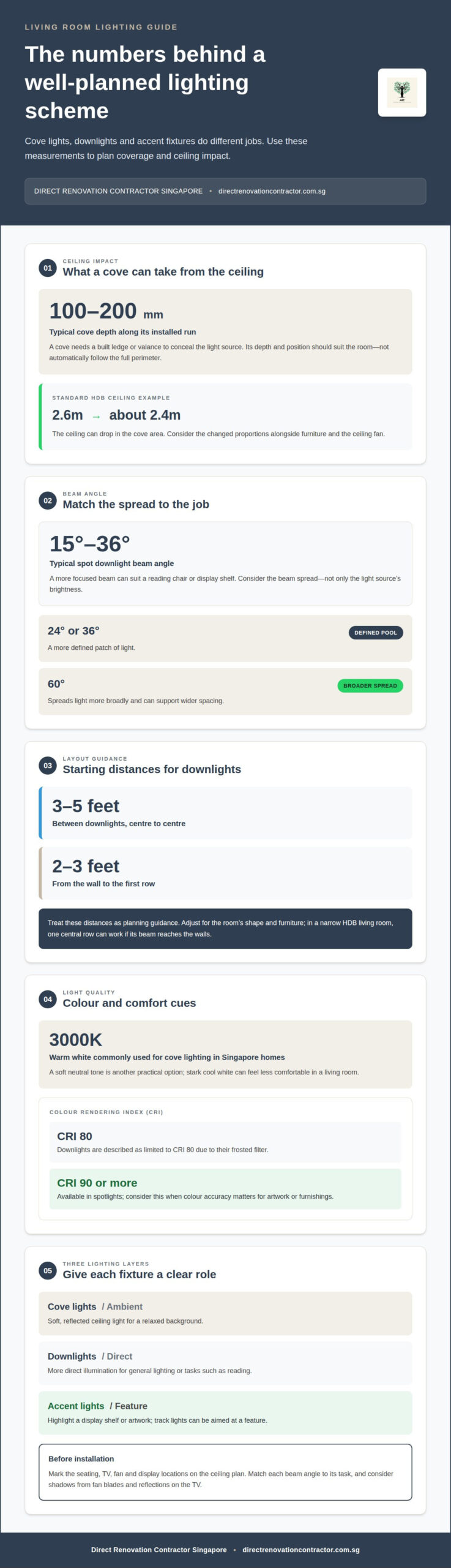
Cove lights bounce illumination off the ceiling, creating soft ambient light rather than a focused task beam. In Singapore, they sit inside a ledge or valance and require a false ceiling. The cove typically adds 100-200mm of ceiling depth along its run.
For a standard HDB ceiling, that construction can reduce height from 2.6m to about 2.4m in the cove area. This affects the room’s proportions, so consider the ceiling plan alongside furniture and the ceiling fan.
Living-Room Ambience and Visual Contrast
Cove lighting reflects light across the ceiling, softening the stark contrast that concentrated downlights can create. It can make a feature wall or seating area feel calmer, but it does not provide the focused illumination needed for reading. In a lower-ceiling living room, consider lighting walls, shelves and artwork as well. A bright ceiling above dark vertical surfaces can make the room feel visually unbalanced.
Ceiling Height and Design Needs
Unlike a surface-mounted fixture, a cove needs a built ledge or valance to conceal its light source. The false ceiling takes up space, so its depth and position should suit the room rather than follow the perimeter automatically. A perimeter cove adds 100-200mm of depth where installed, and an HDB ceiling can drop from 2.6m to about 2.4m in that area. False Ceiling and Partition Works can form part of planning this feature.
Plan three lighting layers around your activities: cove lights for ambient illumination, downlights for more direct light, and accent lighting for a display shelf or artwork. For example, use cove lighting for a relaxed evening, then switch on a focused light beside a reading chair. Position ceiling lights with the fan and TV in mind to reduce distracting shadows and screen reflections.
| Option | Primary role | Visual effect |
|---|---|---|
| Cove lights | Ambient | Soft, reflected ceiling light |
| Downlights | Task or general | More direct illumination |
| Accent lights | Feature emphasis | Highlights shelves or artwork |
Choose cove lighting for a soft ceiling wash, then add directed or accent lights where you need more functional coverage.
Beam width and light distribution
A fixture’s beam angle affects how much floor and wall space it illuminates. A wide beam spreads light across more of the living room, while a narrow beam creates a concentrated pool for a specific area. When comparing cove lighting vs downlights for a living room, consider both the beam spread and the role of each lighting layer.
Spot downlights typically have a beam angle of 15-36 degrees, producing focused light for a reading chair or display shelf. A 24-degree or 36-degree beam gives a more defined pool, while a 60-degree beam spreads light more broadly and can support wider spacing. Check the beam angle, not just the light source’s brightness, when comparing fittings.
For a narrow HDB living room, one central row of downlights can work if the beam is wide enough to reach the walls. A practical starting layout places LED downlights 3 to 5 feet apart, centre to centre, with the first row about 2 to 3 feet from the wall. Treat those distances as planning guidance, then account for the room’s shape and furniture. The cove lighting vs downlights for living room choice also depends on where you need useful light, not just how many fixtures fit the ceiling.
Beam choice affects shadows and contrast. Narrow beams can leave gaps between pools of light, while wider beams can provide more even coverage. For example, aim a focused beam at artwork or a display, then use broader light for the main seating area. Space downlights around a ceiling fan thoughtfully to reduce moving-blade shadows. A pendant provides localised illumination rather than the broad coverage of a ceiling fitting.
Before installation, mark the seating, TV, fan and display locations on the ceiling plan. Then match each light’s beam angle to its job and check that the spread reaches the intended surfaces. For a Singapore HDB renovation involving ceiling changes, ceiling and lighting work can be planned together with Direct Renovation Contractor Singapore.
Cove Lights vs Recessed Lights vs Track Lights: Which Is Perfect For You?
Cove lighting usually creates softer ambient light by reflecting it off the ceiling, while downlights provide more direct illumination. For balanced living-room lighting, combine cove lights with focused fixtures for tasks or features.
Brightness and Colour Temperature
LED cove lights can be dimmed, letting homeowners adjust brightness for a quiet evening or a brighter gathering. In Singapore homes, 3000K warm white is commonly used for cove lighting. A soft neutral tone is another practical choice; stark cool white can feel less comfortable in a living room.
Ambient Lighting from Coves and Downlights
Cove lighting reflects light across the ceiling, making it better suited to ambient illumination than focused tasks. Recessed downlights direct light into the room and can support activities such as reading. Track lights offer another option: aim them at artwork or a display, but do not rely on them to illuminate the whole room.
Colour rendering index, or CRI, describes how accurately a light source shows colours. Downlights are described as limited to CRI 80 because their frosted filter diffuses the light. Spotlights with CRI 90 or more are available. If colour accuracy matters for artwork or furnishings, consider this alongside brightness and beam direction.
Choose each fixture for a specific purpose. Use dimmable cove lighting for a soft background, recessed lights for more direct general illumination, and an angled track spotlight to highlight a feature. For a living room used for TV viewing and reading, for instance, use cove lighting for ambience and switch on a focused reading light separately. This layered approach gives you control without expecting one light source to do every job. Factor ceiling height into the design too: recessed fittings need ceiling space, while track lights remain visible below the ceiling.
Choosing lighting for a Singapore home
For HDB flats, consider ceiling height, existing wiring and how the room is used when choosing fixtures. A dining area beside the living room may need more focused illumination than the TV seating area. The cove lighting vs downlights for a living room decision should account for these different activities.
Recessed downlights sit inside ceiling openings, while a flush-mounted light protrudes from the ceiling. GU10 downlights generally need a false-ceiling void of 100mm or more. Cove lighting also needs a false ceiling, so compare the resulting ceiling profile with the room’s proportions before settling on a design.
Cove lighting costs in Singapore depend on the run length, ceiling construction, materials, and installation complexity; pricing is provided after a quote request. For a standard 4-room HDB living room, a full-perimeter cove typically uses 10-15 metres of LED strip. Include both strip length and ceiling work when planning the renovation scope.
Energy use depends on each light’s wattage and operating time. LED strips run on 12V or 24V DC and need a driver to convert Singapore’s 230V mains supply; the driver should be sized at 120% of the strip’s total wattage. Downlights are often integrated modules, which a qualified technician must replace fully if they fail. These differences matter when weighing the ongoing use and upkeep in your cove lighting vs downlights for living room plan.
Singapore’s electrical and renovation requirements depend on the work involved, such as adding or moving wiring or building a false ceiling. Plan the lighting layout and electrical scope together instead of treating fixture selection as a standalone purchase.
Before renovation, mark the TV, seating, dining table, ceiling fan, and proposed light positions on one plan. This helps coordinate illumination and wiring while limiting unnecessary ceiling changes. To include wiring in your home renovation scope, plan electrical installation alongside the lighting layout.
Direct Renovation Contractor Singapore: HDB BTO Renovation Packages
Direct Renovation Contractor Singapore offers HDB BTO Renovation Packages for homeowners planning a new flat’s renovation and lighting layout. Cove lights and downlights affect ceiling design, so plan their placement before work begins. This helps coordinate the lighting plan with the rest of the renovation scope.
For a resale flat, HDB Resale Renovation Packages can suit a project that updates existing spaces. Condo Renovation Packages and Landed Property Renovation are available for those property types. Start by mapping your preferred lighting layers, ceiling changes and room use, then include them in the wider renovation plan.
Contact Direct Renovation Contractor Singapore to discuss the renovation package that fits your home.
Plan the lighting before renovation begins
Before settling on a ceiling layout, think about how you use the living room throughout a typical day. Mark the TV, seating, reading spot and any display area, then identify where you need gentle background light and where you need direct illumination. This gives your lighting plan a practical starting point and helps align fixture positions with the room layout.
Choosing between cove lighting and downlights for your living room is not just a style decision. Ceiling work, wiring and daily activities all affect what will work well. Set your priorities before renovation begins, so lighting can be planned alongside the rest of the work rather than added as an afterthought.
If you’re ready to plan the renovation around your home and lighting needs, contact Direct Renovation Contractor Singapore to discuss the next step. A clear plan makes it easier to move forward with confidence and create a living room that works for you.
Frequently Asked Questions
Can you combine them?
Yes. Combining cove lights and downlights lets you adjust the room’s lighting for different activities. For example, use cove lighting during a film, then switch on selected downlights when reading or clearing the coffee table. Separate switches or dimming controls can make these changes easier. Plan the controls alongside the lighting layout so each layer has a clear purpose.
Which do I choose?
Choose according to the room’s main use and ceiling constraints. If you mainly want softer light for relaxing, cove lighting may suit your needs. If you need direct illumination for reading or other activities, downlights are more practical. For example, a living room used as a work-from-home space may need directed light at a desk, not just a ceiling wash.
What is the difference between cove lighting and recessed downlights?
Cove lighting conceals its light source in a ceiling ledge or valance, while recessed downlights sit in openings cut into the ceiling. This affects the renovation plan: cove lighting needs a built feature, while recessed fittings need suitable ceiling space. Decide where the light should fall before finalising ceiling work, especially if the layout includes a fan or built-in storage.
How many downlights are needed for a typical living room in Singapore?
A compact HDB living room may use four downlights when another ambient layer supports them. For a standard HDB living room, six to eight downlights is a workable starting range. The final count depends on room shape, furniture, beam spread and other light sources. For instance, a long seating area may need a different layout from a compact square room.
What spacing and placement are recommended for living room downlights?
Start with downlights spaced 3 to 5 feet apart, measured centre to centre, and place the first row about 2 to 3 feet from the wall. Adjust that layout to the room’s dimensions and beam spread. Keep the TV and seating positions in mind, and space fittings around a ceiling fan to reduce distracting moving shadows.
What LED colour temperature and brightness suit a Singapore living room?
Warm white at 3000K is a commonly used colour temperature for cove lighting in Singapore homes. For brightness, consider the room’s activities and whether the fittings can be dimmed. A softer setting can suit evening TV viewing, while brighter illumination helps with reading or tidying. Use the light’s dimming range to adjust the room rather than relying on one fixed level.