
Why are you paying a 30% “coordination fee” just to have a middleman talk to a carpenter on your behalf? Most Singaporeans don’t realize that interior design markups can add S$15,000 to a project without improving the actual build quality. It’s frustrating. You’re trying to decode a 4-room bto renovation budget breakdown filled with technical jargon while 2026 material prices continue to climb. You’re right to worry about hidden costs; 65% of homeowners report unexpected variation orders after the work starts. This isn’t just a minor inconvenience; it’s a financial trap that ruins the excitement of moving into a new home.
This guide provides a granular, factory-direct look at 2026 pricing for everything from masonry to electrical works. We’ll show you how to save up to 30% by skipping the middleman and dealing directly with the source. You’ll get a clear, spreadsheet-style view of itemized costs so you can walk onto your site and speak to contractors with total confidence. We’re stripping away the fluff to focus on the structural integrity and fair pricing your HDB deserves.
Key Takeaways
- Understand why the average 4-room BTO renovation cost in 2026 is projected between S$55,000 and S$75,000 due to shifting labor and material trends.
- Access a granular 4-room bto renovation budget breakdown that highlights the significant price difference between factory-direct rates and standard retail markups.
- Learn how to save 20-30% on your total bill by bypassing interior designer coordination fees and working directly with a renovation contractor.
- Identify strategic ways to reduce your cash outlay by maximizing HDB’s Optional Component Scheme and choosing flexible furniture over permanent built-in carpentry.
- Master the 8-12 week renovation timeline to ensure a smooth transition from site measurement and contract signing to the final handover.
The 2026 State of HDB Renovation: Why 4-Room BTO Costs Are Shifting
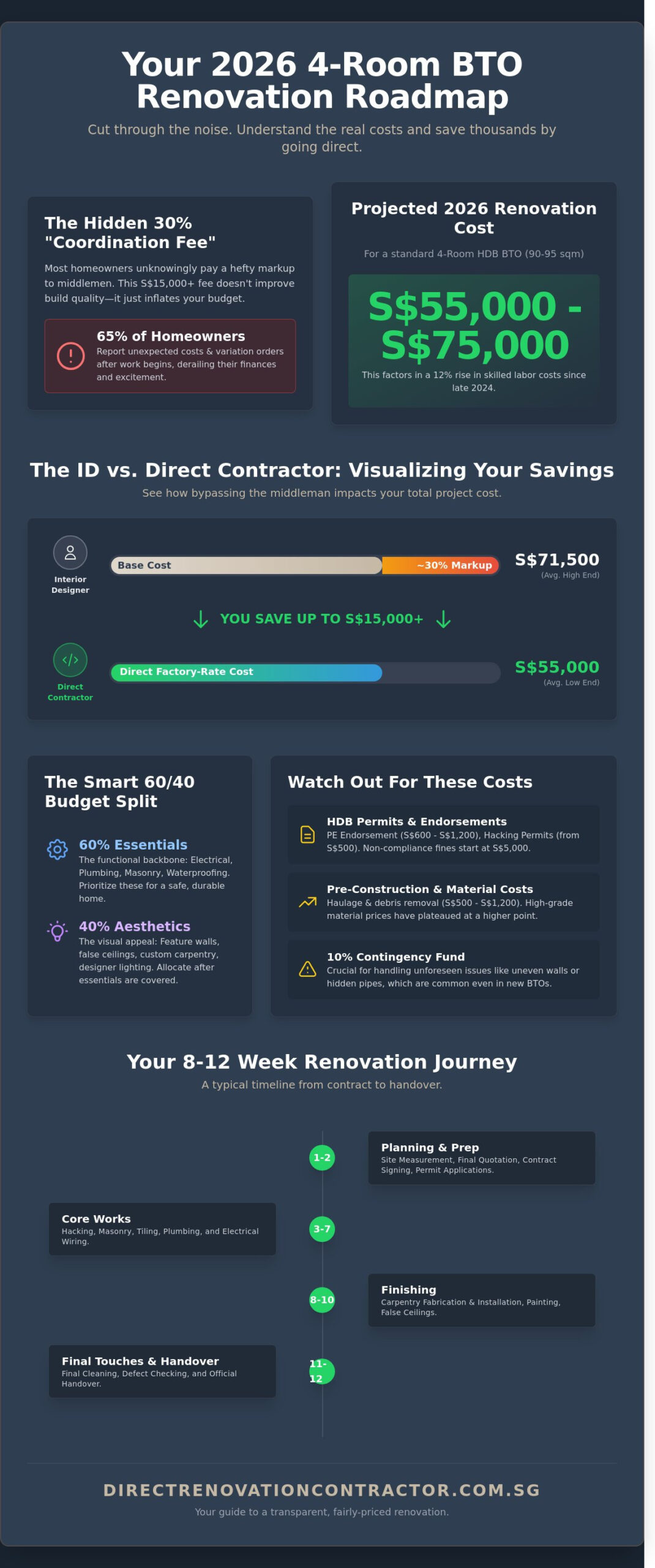
Renovating a new home in 2026 requires a practical approach to financial planning. For most homeowners, a realistic 4-room bto renovation budget breakdown currently falls between S$55,000 and S$75,000. This estimate accounts for the 12% increase in skilled labor costs for masonry and carpentry observed since late 2024. While the 9% GST rate remains a fixed factor, local transport levies and specialized trade shortages continue to influence the final quote you receive from contractors.
The history of public housing in Singapore demonstrates a shift from basic utility to complex, modern living spaces. Today’s 4-room BTO flats, typically spanning 90 to 95 square meters, represent the most popular housing tier. They’re also the most difficult to budget for accurately. You’re balancing three bedrooms, two bathrooms, and a kitchen area that often requires extensive custom cabinetry to remain functional. Because these units are the “middle ground” of HDB sizes, homeowners often underestimate the sheer volume of tiling and electrical points required to cover the floor area effectively.
Supply chain stability has improved significantly compared to the 2021-2023 period. However, the cost of raw materials like premium quartz for countertops and high-grade plywood for carpentry has plateaued at a higher price point. We see more owners opting for direct contractor models to cut out the 15% to 20% markups typically charged by interior design firms. This direct approach ensures your money goes straight into the workmanship and materials rather than sales commissions or 3D rendering fees.
The Essential vs. Aesthetic Budget Split
Smart budgeting requires a 60/40 rule to ensure your home doesn’t just look good, but actually works. Essential works are the structural backbone of your HDB flat. These include your electrical rewiring, plumbing extensions, and cement screeding. You should allocate 60% of your total funds to these functional areas. The remaining 40% covers “nice-to-have” aesthetic elements like fluted feature walls, false ceilings, or designer lighting fixtures. If you overspend on the design side early on, you’ll likely face stress when the final bill for essential tiling or waterproofing arrives.
HDB Regulations and Permit Costs in 2026
Navigating HDB rules is a non-negotiable part of your 4-room bto renovation budget breakdown. As of January 2026, HDB has tightened its oversight on structural modifications to ensure building longevity. You must factor in Professional Engineer (PE) fees if you plan to hack non-load-bearing walls. These fees now range from S$600 to S$1,200 per assessment. Standard hacking permits are mandatory and must be filed by your contractor before any heavy work begins.
- PE Endorsement: S$600 to S$1,200 for structural safety checks.
- Hacking Permits: Administrative fees plus debris removal costs, usually starting at S$500.
- Waterproofing Tests: Mandatory 24-hour flood tests for all wet areas.
Don’t try to cut corners by skipping these official channels. HDB inspectors conduct random site visits across new BTO estates. If they find unauthorized hacking or poor waterproofing practices, you face fines starting at S$5,000. Beyond the fine, you’ll be served a rectification order. This forces you to undo the work at your own expense, which often costs double the original renovation price. We always prioritize compliance to protect your investment and your neighbors’ safety.
Itemized 4-Room BTO Renovation Budget Breakdown
A transparent 4-room bto renovation budget breakdown starts with understanding where your money actually goes. In 2026, the gap between retail interior design prices and direct factory rates has widened to approximately 20% or 30%. When you work with a direct contractor, you eliminate the middleman markup that typically inflates a S$50,000 project by an extra S$10,000. Most homeowners struggle to decode quotes because they overlook “pre-construction” costs like haulage and protection. These fees, usually ranging from S$500 to S$1,200, cover the transport of debris and the floor protection sheets required by HDB. Always set aside a 10% contingency fund. Unexpected site conditions, such as uneven wall surfaces or hidden pipe leaks, are common in new builds.
| Renovation Category | 2026 Retail Price Range | 2026 Factory Price Range |
|---|---|---|
| Masonry & Flooring | S$12,000 – S$18,000 | S$9,500 – S$14,000 |
| Carpentry (Kitchen & Rooms) | S$18,000 – S$30,000 | S$14,000 – S$22,000 |
| Electrical Works | S$4,500 – S$6,500 | S$3,500 – S$5,000 |
| Plumbing & Ceiling | S$3,500 – S$5,500 | S$2,800 – S$4,200 |
Masonry and Flooring: The Foundation of Your Costs
Current 2026 rates for vinyl flooring hover between S$3.50 and S$5.50 per square foot. If you opt for homogeneous tiles, expect to pay S$10 to S$16 per square foot including labor and cement screeding. Wet works are non-negotiable costs. You’ll need to account for kitchen bases and fridge plinths, which typically cost S$150 to S$300 per item. These small masonry additions prevent water damage to your expensive carpentry. Every tiling job must strictly follow the official HDB renovation guidelines to ensure structural integrity and waterproofing standards are met. Waterproofing for bathrooms is particularly critical; don’t cut corners here to save a few hundred dollars.
Carpentry: The Biggest Budget Consumer
Carpentry often consumes 40% of your 4-room bto renovation budget breakdown. For 2026, kitchen cabinets are priced at S$120 to S$160 per foot run (pfr). Wardrobes are slightly higher, ranging from S$220 to S$280 pfr due to the depth and internal hardware required. We use plywood as our local gold standard for internal carcasses because it resists moisture better than cheaper chipboard or MDF. Choosing the right laminate finish impacts the final bill. Standard wood grain laminates are the baseline, but anti-fingerprint or high-gloss finishes can add S$20 to S$40 pfr to your total cost. You can get a direct quote to see how factory-direct carpentry pricing compares to designer rates.
Electrical and Plumbing Essentials
Electrical pricing has stabilized in 2026, with single power points costing S$70 to S$90 and double points at S$90 to S$120. Data sockets for high-speed internet in every room will set you back roughly S$120 per point. Plumbing costs are equally fixed. Installing a storage heater costs about S$150, while kitchen sink and tap installation usually runs S$120 to S$200. Beware of hidden electrical costs. If you’re planning a heavy kitchen setup with multiple ovens and induction hobs, you might need a DB box upgrade, which starts at S$600. Concealed wiring looks cleaner but requires hacking and patching, adding 25% to your total electrical labor bill.
The ID vs. Direct Contractor Debate: Saving the 30% Markup
Most Singaporean homeowners assume hiring an Interior Designer (ID) is the only way to achieve a beautiful home. That’s a misconception that costs thousands. An ID essentially functions as a project management agency. They handle the creative vision but outsource the actual labor to sub-contractors. For this service, they typically add a 20% to 30% markup on every single line item in your 4-room bto renovation budget breakdown. If your renovation costs S$60,000, you might be paying S$18,000 just for coordination and “design concepts.”
Direct contractors like Direct Renovation Contractor Singapore operate on a different model. We provide factory-direct pricing because we own the production facilities and employ the craftsmen directly. Current construction market trends indicate that material and labor costs in Singapore remain volatile. In this environment, paying a middleman markup is a luxury many BTO owners can’t afford. You don’t lose design quality by going direct; you simply take more control over the process and keep the savings in your bank account.
Identifying Hidden Markups in ID Quotes
When you look at an ID’s quotation, the markups aren’t always labeled. They’re buried in the unit rates for carpentry, glass works, and stone surfaces. For example, an ID might quote S$150 per foot run for a kitchen cabinet that a direct factory produces for S$110. They justify this as a “coordination fee,” but it’s often a significant overcharge for simple logistics. These margins apply to every mirror, shower screen, and quartz countertop installed in your home. Direct contractors eliminate the middleman to pass savings to the homeowner, ensuring you pay for the material and labor, not the ID’s office overhead.
Common areas where these markups hide include:
- Carpentry: The largest expense where IDs add 25% or more.
- Glass and Mirror Works: Often outsourced to the same few factories with a heavy markup.
- Stone and Solid Surfaces: Markups on brand-name quartz or sintered stone.
How to Be Your Own Project Manager
Managing a renovation isn’t rocket science. It’s about following a logical sequence. The “DIY Renovation” movement has gained traction because homeowners now have access to the same resources as IDs. You can commission standalone 3D drawings for a few hundred dollars. These drawings serve as your technical blueprint. They tell the tiler exactly where to start the layout and show the carpenter where the internal shelving goes. Without these drawings, miscommunication happens. With them, you’re the boss.
The sequence of works is the most critical part of project management. You can’t install cabinets before the floor is done. A typical 4-room bto renovation budget breakdown relies on this order:
By leveraging a curated list of direct sub-contractors for specialized tasks like air-con trunking or window grilles, you maintain total transparency. You’ll know exactly what each specialist is charging. This hands-on approach requires more time, but the reward is a high-quality renovation that fits a realistic budget without sacrificing the premium finishes you want.
Strategic Cost-Saving Tips for 4-Room BTO Owners
Managing your 4-room bto renovation budget breakdown requires a disciplined approach to essentials. Opting for the HDB Optional Component Scheme (OCS) is your first win. By choosing HDB’s flooring and doors, you roll these costs into your housing loan. This keeps your cash and CPF savings available for other renovation works like electrical wiring or plumbing. It’s a pragmatic move that reduces your immediate out-of-pocket expenses by several thousand dollars.
Custom carpentry is often the biggest budget killer in Singapore homes. A full-height wardrobe in a master bedroom can easily cost S$2,500 to S$3,500. Choosing loose furniture instead saves you 40% on average. It also gives you the flexibility to reconfigure your room if your needs change in five years. You don’t need a built-in TV console when a stylish, high-quality sideboard does the job for half the price.
Stop thinking about expensive stone feature walls that cost S$2,000 or more. Strategic lighting is a far more cost-effective way to add character. A simple painted wall paired with LED cove lighting or track lights creates a premium feel for 15% of the cost of masonry. You’ll save roughly S$3,000 by skipping the TV feature wall and focusing on a clever lighting plan instead.
Don’t fall into the trap of DIY painting to save a few dollars. A professional 4-room BTO painting package usually costs between S$1,200 and S$1,600. If you mess up a DIY job, the cost to strip and redo the paint is often double. Professionals use the right sealers to prevent moisture peeling; this saves you money on maintenance down the road. It’s a small price to pay for a finish that lasts five to seven years.
Material Selection Hacks
The Power of 3D Visualization
Spending S$500 on a professional 3D drawing isn’t an extra expense; it’s insurance. It helps you spot layout errors, such as a cabinet door hitting a ceiling fan, before construction starts. Rectifying a masonry mistake after the cement has dried can cost you over S$5,000 in hacking and material replacement. Use the DIY Renovation Support Package to visualize your space and lock in your dimensions accurately. Seeing the final look helps you resist “on-the-fly” additions that always lead to cost overruns.
Ready to cut out the middleman and secure factory-direct pricing for your home? Get a direct contractor quote today to keep your budget on track.
Executing Your Renovation: From Quote to Handover
Once you’ve finalized your 4-room bto renovation budget breakdown, the project moves from paper to the actual site. A standard renovation for a 4-room unit typically spans 8 to 12 weeks. This timeline isn’t a vague estimate; it’s a coordinated sequence of specialized trades. The first 10 days usually involve hacking and masonry. By week 4, electrical and plumbing rough-ins should be 90% complete. Carpentry, which often consumes 30% of your total spend, takes the longest because it requires off-site fabrication before a 5 to 7-day installation period near the end of the project.
Don’t sign a final contract based solely on HDB floor plans. Actual site measurements are mandatory. Floor plans can vary from reality by 50mm to 100mm, which is enough to make a custom kitchen cabinet or a wardrobe fit poorly. The final “black and white” contract must reflect these onsite dimensions to avoid hidden costs later. If a contractor refuses to visit the site for a final measure before demanding a deposit, it’s a red flag for your budget’s stability.
Financial protection depends on your payment schedule. You should never pay 100% upfront. We recommend a progressive payment structure that keeps you in control. A typical safe ratio is a 10% deposit, 30% after masonry and wet works, 30% after carpentry installation, 25% after painting and electrical fittings, and the final 5% only after the defects list is cleared. This ensures the contractor stays motivated to finish the job to your standards. If you pay everything early, you lose your leverage to demand quality rectifications.
The final defects inspection is the most important day of your renovation. Set aside at least 3 to 4 hours for this walk-through. Bring a roll of blue painter’s tape to mark every scratch, hollow tile, or misaligned hinge. Check every power point with a simple plug-in tester. Don’t let the excitement of moving in cloud your judgment; once you sign the handover form, getting a contractor back for minor touch-ups becomes significantly harder.
Communication with Your Direct Contractor
Clear communication prevents expensive mistakes. We insist on a site walk-through before any carpentry fabrication begins. This is when we mark out exactly where your switches, drawers, and appliances will go. You must also manage Variation Orders (VOs) strictly. VOs occur when you change your mind about materials or layouts mid-way. These can easily add 15% to your initial 4-room bto renovation budget breakdown if you aren’t careful. Always get a written quote for any change before the work starts.
Ready to Renovate Your 4-Room BTO?
Achieving a high-quality home without overspending requires a disciplined approach. You’ve seen the costs for masonry, carpentry, and electrical work. Now, it’s time to put that plan into action with a partner who values transparency. Before you sign any document, ensure you have a detailed itemized quote, a clear timeline, and a fair payment schedule. If you’re looking for a straightforward experience without middleman markups, we’re here to help. Get a transparent, direct contractor quote from us today!
Secure Your 2026 Home Renovation Strategy
Navigating a 4-room bto renovation budget breakdown requires a focus on technical reality rather than design fluff. By 2026, material and labor costs have stabilized at a higher baseline; this makes it essential to cut the standard 30% interior design markup. You’ll save thousands of dollars by working directly with the people actually building your cabinets and laying your tiles. Prioritize high-impact areas like kitchen carpentry and floor masonry to ensure your S$45,000 to S$65,000 investment stands the test of time.
We’re an HDB Registered Contractor operating out of our own facility in Paya Ubi Industrial Park. We provide direct factory pricing because we manage our own local workmanship and production. This approach eliminates hidden fees and ensures your project follows all HDB regulations without unnecessary delays. You don’t need to pay for a middleman’s office rent when you can put that money back into better materials for your home.
View our 4-Room BTO Renovation Packages
Building your first home shouldn’t be a financial guessing game. We’re ready to help you get the keys to a well-built flat that fits your budget perfectly.
Frequently Asked Questions
How much should a 4-room BTO renovation cost in 2026?
A standard 4-room BTO renovation in 2026 will likely range between S$55,000 and S$85,000 depending on the extent of carpentry and masonry work. This estimate accounts for a 3% to 5% annual increase in material costs and labor wages since 2024. If you choose premium finishes or extensive hacking, your 4-room bto renovation budget breakdown may exceed S$95,000. Sticking to essential works like kitchen cabinets and flooring helps keep costs near the lower end.
Is S$30,000 enough for a 4-room BTO renovation?
S$30,000 is generally insufficient for a full 4-room BTO renovation unless you limit work to basic lighting, painting, and minimal carpentry. Most homeowners find that even a bare-bones project costs at least S$45,000 in the current market. With S$30,000, you’ll likely have to skip built-in wardrobes and high-end kitchen countertops. You should prioritize structural essentials and add custom furniture later when more funds become available to avoid overstretching your finances.
What are the biggest hidden costs in HDB renovations?
The biggest hidden costs include electrical point additions, haulage fees, and debris removal charges which can add S$3,000 to S$5,000 to your final bill. Many initial quotes omit the cost of professional engineer (PE) endorsements for hacking walls, which costs roughly S$800 to S$1,500 per application. You should also set aside 10% of your total budget for unforeseen site conditions. These surprises often appear once hacking begins and reveal plumbing or structural issues.
Can I use my CPF to pay for home renovation in Singapore?
You can’t use your CPF Ordinary Account or Special Account savings to pay for home renovation works in Singapore. CPF funds are strictly reserved for the property purchase price, stamp duties, and monthly mortgage installments. To fund your renovation, you must use cash savings or apply for a renovation loan from banks like DBS or OCBC. These loans typically offer capped amounts of S$30,000 or six times your monthly salary.
How do I avoid renovation scams and “fly-by-night” contractors?
Is it cheaper to buy my own materials or let the contractor provide them?
It’s almost always cheaper to let your contractor provide materials like cement, sand, and tiles because they access wholesale trade prices. Contractors typically receive 15% to 20% discounts from suppliers that retail customers can’t get. If you buy your own items, you’ll also face logistical headaches and extra delivery fees. You should only buy vanity items like designer lamps or specific bathroom taps yourself to ensure the aesthetic matches your personal preference.
How long does a typical 4-room BTO renovation take?
A typical 4-room BTO renovation takes between 8 and 12 weeks from the first day of hacking to the final handover. This timeline includes 2 weeks for masonry, 3 weeks for carpentry fabrication, and 1 week for electrical and plumbing installations. Delays often occur during peak periods like the months leading up to Chinese New Year. You should plan for a 2-week buffer to handle minor rectifications or shipping delays for imported materials.
What is the difference between a main contractor and an interior designer?
An interior designer (ID) provides 3D drawings and project management but charges a 20% to 30% markup for these services. A main contractor or direct contractor executes the physical work and manages the sub-contractors without the high design fees. Choosing a direct contractor is more cost-effective if you already have a clear vision of your home’s layout. You’ll work directly with the builders, ensuring better technical communication and significant savings on your overall project.