

What if you could pocket S$18,000 from your renovation budget without sacrificing a single square foot of custom cabinetry? Most homeowners in Singapore accept that they’ll blow their budget by 20% or more because they believe high markups are just part of the process. It’s frustrating to look at a quote and see vague “coordination fees” that don’t add any tangible value to your HDB or BTO flat. You want quality workmanship, but you don’t want to pay a premium for someone else’s fancy showroom overheads.
The truth is that you can learn how to save money on home renovation singapore by eliminating middleman markups and dealing directly with the people actually doing the hacking, masonry, and carpentry. This guide promises to show you how to slash your total bill by up to 30% by focusing on high-impact, direct-to-contractor strategies. We’ll provide a transparent breakdown of material costs, explain the real price difference between quartz and Kompacplus, and give you the technical confidence to manage your project like a seasoned pro.
Key Takeaways
- Navigate the 2026 market landscape by understanding how the 9% GST and current HDB BTO and resale rates impact your total project costs.
- Learn how to save money on home renovation singapore by adopting a direct-to-factory model that eliminates middleman markups on carpentry and masonry.
- Master the “80/20 Rule” to prioritize essential structural fundamentals over purely aesthetic features for a high-impact, cost-effective result.
- Reduce your carpentry bill using technical hacks like the “golden ratio” for kitchen cabinets and strategic material substitutions like laminate over veneer.
- Discover how to act as your own project manager using 3D drawings and a phased renovation approach to maintain a designer look on a tighter budget.
Understanding the Renovation Cost Landscape in Singapore (2026)
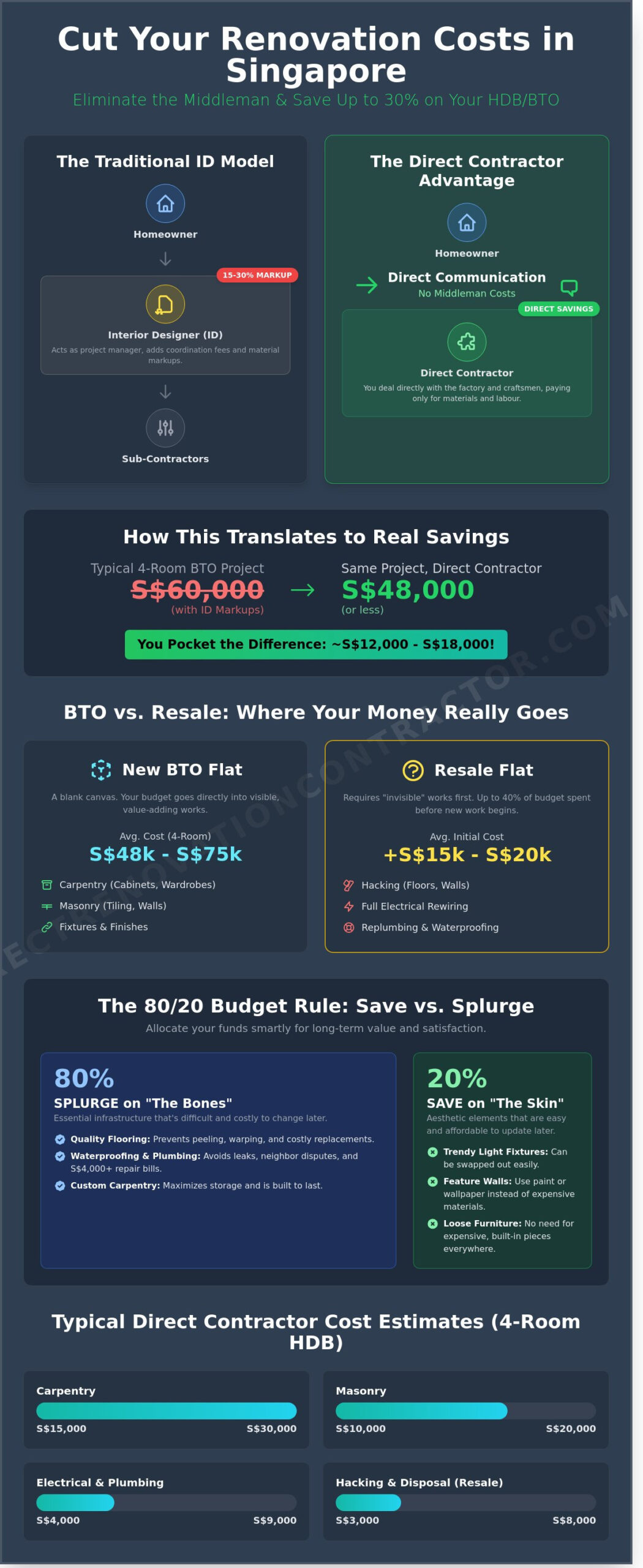
Renovating in 2026 requires a realistic look at your bank balance. With the 9% GST fully implemented and a 12% year-on-year increase in skilled labor costs, the baseline for a standard 4-room HDB BTO now sits between S$48,000 and S$75,000. If you’ve bought a resale flat, those figures climb much higher. Many homeowners struggle to define What is Home Improvement? in a way that balances aesthetics with structural necessity. In the Singapore context, it’s the difference between a simple coat of paint and a full-scale overhaul of aging assets. To avoid overleveraging, the “6-times monthly income” rule remains the gold standard. This means your total renovation budget shouldn’t exceed six months of your combined household income. It keeps your debt manageable while ensuring you don’t compromise on essential safety works like electrical grounding and waterproofing.
BTO vs. Resale: Where the Money Goes
A new BTO is a blank canvas, but a resale flat is a puzzle that needs solving before you can even begin. You’ll spend roughly 40% more on a resale unit because of “invisible” works. These include floor hacking, replumbing, and full electrical rewiring. These aren’t optional upgrades. In 2026, old copper pipes and 20-year-old wiring are genuine safety hazards that HDB regulations often require you to address. For a BTO, your money goes directly into carpentry and masonry. For a resale unit, you’re often paying S$15,000 to S$20,000 just to clear the old materials away before the first new tile is laid. Understanding these technical requirements is the first step in learning how to save money on home renovation singapore. You must identify the “non-negotiables” early. Focus your spending on structural integrity and functional carpentry rather than imported marble feature walls or trendy finishes that date quickly.
The Hidden Costs of the ID Model
Choosing between an Interior Designer (ID) and a Direct Contractor is the biggest financial decision you’ll make. Most ID firms don’t own their own factories or employ their own tilers. They function primarily as project managers and sales consultants. This convenience comes with a 15% to 30% coordination fee that is often hidden deep inside your quote. You might see a small “management fee” line item, but the real cost is usually buried in marked-up material prices. For example, a tile that costs S$5.00 per square foot at the supplier might be billed to you at S$7.50 by an ID firm. The “Middleman Tax” is the premium paid for design management over actual labor. If you have a clear vision and the time to manage schedules, going direct to a contractor is the most effective way to learn how to save money on home renovation singapore. By removing the extra layer of management, you ensure every dollar spent goes directly into the materials and the hands of the craftsmen building your home.
- Hacking and Disposal: S$3,000 – S$8,000 depending on flat age.
- Masonry: S$10,000 – S$20,000 for living and kitchen areas.
- Carpentry: S$15,000 – S$30,000 for custom wardrobes and kitchen cabinets.
- Electrical and Plumbing: S$4,000 – S$9,000 for full rewiring and piping.
The Save vs. Splurge Framework: Prioritising High-Impact Works
Smart budgeting isn’t about choosing the cheapest option for every item. It’s about strategic allocation. When homeowners ask how to save money on home renovation singapore, we point them to the 80/20 rule. This principle suggests that 80% of your budget belongs to the “bones,” the essential infrastructure that’s expensive or impossible to fix later. The remaining 20% goes toward the “skin,” or the aesthetic elements you can easily update as your tastes change. You should always prioritise flooring and plumbing as splurge items. A cheap vinyl floor might peel in 3 years, costing you double in replacement labor. Similarly, poor plumbing leads to leaks that damage your neighbors’ ceilings, resulting in legal headaches and repair bills exceeding S$4,000. Before you commit to a contractor, it’s helpful to Calculate Your Renovation Expenses to see where your capital is actually going. For a detailed breakdown of current market rates, refer to our Renovation Cost Singapore: A 2026 Price Guide. By focusing on quality where it counts, you ensure your home remains functional for decades without hidden maintenance traps.
Where to Splurge (The Fundamentals)
Electrical wiring is a safety priority, especially in resale HDB flats older than 25 years. Don’t try to save S$500 by keeping old wires that can’t handle modern appliance loads. Rewiring a 4-room flat typically costs between S$3,500 and S$5,000, but it prevents electrical fires and tripped breakers. Waterproofing and masonry are equally critical. A standard bathroom waterproofing treatment costs around S$800 to S$1,200, but failing to do it right means hacking up S$3,000 worth of tiles later. We also recommend investing in premium hinges and drawer tracks. A S$10 soft-close hinge from a reputable brand like Blum will last 100,000 cycles, whereas a generic S$2 hinge often fails within 18 months, causing cabinet doors to misalign. These small mechanical parts are the workhorses of your kitchen, and replacing them requires precise realigning that most DIY attempts fail to achieve.
Where to Save (The Aesthetics)
Aesthetics offer the most flexibility for those looking at how to save money on home renovation singapore. Paint is significantly more cost-effective than wallpaper or limewash. A professional paint job for a 4-room HDB costs roughly S$1,500, while wallpapering the same area can exceed S$4,000 due to material and labor costs. Opt for loose furniture over built-ins where possible. A custom-built wardrobe costs S$250 to S$350 per foot run, while a standalone unit provides the same storage for 40% less and allows you to reconfigure the room later. For lighting, skip the boutique showrooms in Orchard. Sourcing directly from industrial suppliers in Geylang or Balestier can save you up to S$1,000 on a full-house lighting package. These suppliers often carry the same LED drivers and chips as high-end brands but without the 50% brand markup. If you want a no-nonsense quote that cuts out the designer markup, you can get a direct contractor estimate today to see the difference in pricing.
Eliminating the Middleman: How Direct Contractors Reduce Your Bill
Hiring an Interior Design (ID) firm often means paying a 20% to 30% premium for their management and “design” services. For many homeowners, this is a luxury they don’t actually need. When you work directly with a factory or a specialized contractor for masonry and carpentry, you strip away those hefty management fees. This is the most effective strategy for how to save money on home renovation singapore. You’re paying for the actual labor and raw materials, not the ID’s high-rent showroom or marketing budget.
A direct-to-factory model works by connecting you with the people actually building your cabinets. In a typical 4-room BTO project, custom carpentry can easily cost S$15,000 through an ID firm. By going direct, you often see that price drop to S$11,500 for the exact same specifications. You get the same high-pressure laminate and solid plywood, but without the middleman’s markup. This approach applies to masonry too. Direct contractors manage their own tiling and hacking teams, ensuring you pay the base rate for labor without a 15% coordination fee added on top.
The Direct Renovation Contractor Advantage
Working with a direct contractor provides total price transparency. You’ll see a line-by-line breakdown of costs for hacking, tiling, and plumbing. There are no hidden charges tucked into the material costs. You communicate directly with the site supervisor, which reduces the risk of misinterpretation that happens when a designer tries to relay technical instructions to a worker. We provide factory-direct pricing for carpentry, meaning your built-in wardrobes and kitchen sets come straight from the local workshop to your HDB flat without any retail overhead.
Managing Your Own Project: Is It For You?
The DIY renovation trend requires you to act as the Project Manager. You’ll need to coordinate the sequence of work, such as ensuring the air-con trunking is installed before the false ceiling goes up. It’s a significant time commitment, often requiring 10 to 15 hours of site visits and coordination per week. To help you stay on track, refer to this comprehensive guide to renovation costs to ensure your budget remains realistic. We support our DIY clients by providing 3D drawings. These allow you to visualize the layout and dimensions without paying for a S$3,000 design package. We also provide technical documentation to ensure your electrical and plumbing points are placed with precision from day one.
In early 2024, a couple in a 93sqm 4-room BTO at Plantation Grange decided to bypass the ID route. They utilized a direct contractor for their wet works and carpentry while sourcing their own vinyl flooring and lighting fixtures. By managing the timeline themselves, they spent a total of S$39,500. This was a sharp contrast to the S$54,500 quote they received from a mid-sized ID firm for the same scope of work. The S$15,000 they saved covered their entire suite of kitchen appliances and a premium sofa. This proves that knowing how to save money on home renovation singapore starts with choosing a partner who values technical skill over flashy sales pitches.
Technical Hacks to Lower Carpentry and Masonry Costs
Technical efficiency is the fastest way to slash your bill without sacrificing structural integrity. Many homeowners focus on aesthetic choices, but the real savings happen during the measurement and material selection phase. When you understand how to save money on home renovation singapore, you start looking at the “linear footage” of your built-ins rather than just the color of the laminate. Most contractors price kitchen cabinets per foot run (pfr), with current market rates ranging from S$120 to S$180 pfr for base cabinets. You can optimize this by sticking to the “golden ratio” of 20 feet for a standard HDB kitchen. Exceeding this often triggers a jump in material waste, as plywood sheets come in fixed 4ft by 8ft dimensions.
Material substitution is another high-impact area. Solid wood is rarely necessary for Singapore’s humid climate and can cost 40% more than high-pressure laminates. Laminates provide the same visual appeal and better moisture resistance for a fraction of the price. If you want a premium look, reserve expensive veneers for small accent areas like a single display shelf instead of the entire wardrobe. These small technical shifts keep your budget under control while maintaining a high-end finish.
Carpentry Cost-Cutting Secrets
Masonry and Flooring Optimization
Masonry is often the most expensive part of a renovation because it’s labor-intensive. Many people think large-format tiles (800mm x 800mm or larger) are cheaper because you buy fewer pieces. This is a myth. These tiles are heavier, harder to level, and require more expensive C2TE grade adhesive. Labor costs for installing large-format tiles are often 20% higher than standard 600mm x 600mm homogenous tiles. For flooring, vinyl is the budget champion at S$3.50 to S$6.00 per square foot (psf), compared to homogenous tiles which can hit S$12.00 psf once you factor in cement screed and labor.
Every wall hacked adds 5% to your masonry and haulage bill. If you’re looking for how to save money on home renovation singapore, the best strategy is to avoid hacking altogether. Overlaying is the #1 way to save on HDB toilet renovations. By installing new tiles or vinyl directly over the existing surface using a specialized bonding agent, you skip the S$1,500 to S$2,500 cost of hacking, waterproofing, and debris disposal. This method is faster and keeps your home cleaner during the construction phase.
Working with a builder who owns their own workshop ensures you get these technical savings without middleman markups. You can get a direct carpentry quote to see how much you can save by cutting out the design firm commissions.
Strategic Planning: The DIY Approach to a Designer Look
Planning is your most effective tool when looking for how to save money on home renovation singapore. Many homeowners believe they need a high-priced Interior Designer (ID) to achieve a premium aesthetic, but you can get the same results by managing the project yourself. By acting as your own project coordinator, you immediately eliminate the 15% to 25% project management fee that ID firms typically tack onto the total bill. This DIY approach requires more effort, but the financial payoff is substantial, especially for HDB owners on a tight budget.
A smart strategy involves separating your renovation into “Phase 1” and “Phase 2.” Phase 1 focuses on the essential “bones” of the home. This includes hacking, masonry, plumbing, and electrical wiring. These works are disruptive and must be completed before you move in. Phase 2 covers non-essential items like built-in study desks, extra wardrobes, or decorative feature walls. You can complete these 6 to 12 months after moving in once your bank account has recovered. This method is a practical way to manage cash flow without compromising on the structural quality of your home.
Clear communication with workers is vital if you don’t have an ID. Most homeowners struggle to explain their vision, which leads to costly errors. To avoid this, hire a freelance draftsperson to create 3D drawings based on your Pinterest mood boards. You can expect to pay roughly S$150 to S$250 per view. These drawings act as a technical blueprint. When you show a tiler exactly where the grout lines should align or show a carpenter the specific internal configuration of a cabinet, you remove the guesswork. This prevents expensive rework and ensures the final product matches your expectations.
Sourcing your own fixtures and appliances is another area for significant savings. The “Taobao vs. Local” debate is a common one in Singapore. Platforms like Taobao are excellent for lighting, gold-toned bathroom hardware, and cabinet handles, often costing 40% less than local retail shops. However, you should buy your “heavy” items locally. Items like toilet bowls, storage heaters, and kitchen hobs should be purchased from Singaporean suppliers to ensure they meet PUB and Safety Mark standards. A S$400 savings on a Taobao fridge isn’t worth the risk if the compressor fails and you have no local warranty support.
This logic also applies to home security; for instance, when choosing specialized entrance solutions like digital locks and gates, it is often safer to rely on local experts who provide installation and warranty support—read more.
Phasing Your Renovation
Focus your initial budget on the wet works and electrical infrastructure. These are the hardest and most expensive things to change later. Carpentry is often the biggest expense in a Singapore renovation. By delaying a S$10,000 feature wall or an additional guest room wardrobe, you stay within your immediate means. This phasing strategy helps you avoid taking out high-interest renovation loans, which currently carry effective interest rates between 4.5% and 6.2% per annum. Paying with cash as you go is always the cheaper option.
Getting Started with Direct Renovation Contractor
We pride ourselves on being a no-nonsense partner for savvy homeowners. We operate directly out of our own facility in Paya Ubi Industrial Park, which allows us to cut out middleman markups and showroom overheads. Our team provides itemized, transparent quotes so you know exactly what you are paying for every square foot of tiling or every foot run of carpentry. This technical expertise ensures your home is built to last without the designer price tag.
Final Checklist for a Cost-Effective 2026 Renovation:
- Finalize your 3D drawings to lock in the design before work starts.
- Apply for HDB renovation permits at least 14 days in advance.
- Order Taobao lights and hardware 2 months early to account for shipping delays.
- Confirm the “Buy-Own-Items” (BOI) list with your contractor to avoid double-charging.
- Conduct an on-site measurement with your carpenter only after the flooring is laid.
- Verify all electrical points against your furniture layout one last time before the walls are closed.
Take Control of Your 2026 Home Transformation
Successful homeowners in 2026 prioritize structural integrity and technical efficiency over expensive design presentations. You’ve seen that cutting out the middleman can reduce your total bill by 20% to 30% immediately. By focusing on direct factory carpentry and strategic masonry hacks, you keep your S$60,000 BTO or S$100,000 condo project on track. Understanding how to save money on home renovation singapore is simple when you stop paying for ID markups and hidden coordination fees. It’s about moving your budget away from commissions and toward high-quality materials and skilled labor. You don’t need a middleman to manage your vision; you need a builder who understands the technical ins and outs of HDB regulations and local construction standards.
As an HDB Registered Contractor, we provide direct factory carpentry fabrication and utilize our own in-house masonry and electrical teams. This direct model ensures you get transparent pricing with zero hidden charges. We focus on the pragmatic details that make a home functional and durable.
View our HDB & Condo Renovation Packages with Transparent Pricing
Your renovation journey doesn’t have to be a source of anxiety. With the right technical partner, you can achieve a designer look at a builder’s price.
Frequently Asked Questions
Is it really cheaper to hire a direct contractor instead of an ID in Singapore?
Yes, hiring a direct contractor is typically 20% to 30% cheaper than engaging an interior design firm. You’re cutting out the middleman markups and design fees that firms charge to cover their office overheads and marketing. By working directly with the builder, you pay factory rates for carpentry and masonry. It’s a straightforward way to keep your budget under control while getting the same quality of workmanship.
How much can I save by managing my own renovation project?
You can save between S$5,000 and S$15,000 on a standard 4-room BTO by managing the project yourself. This represents the 10% to 15% management fee that design firms typically add to subcontractor quotes. You’ll need to invest your own time to coordinate schedules between different trades like electricians and plumbers. It’s a practical trade-off for homeowners who want to maximize their renovation budget through sweat equity.
What are the risks of not hiring an interior designer for my HDB?
The primary risks include project delays and potential coordination errors between different technical trades. Without an ID, you act as the project manager. You’ll need to ensure the electrician doesn’t install sockets where the carpenter planned a cabinet. If you miss a detail in the HDB renovation guidelines, you might face complications during the final inspection. It requires a hands-on approach and clear communication with every worker on site.
Does a direct contractor provide 3D drawings for HDB BTOs?
Most direct contractors don’t provide 3D drawings as part of their standard service. They focus on technical execution based on site measurements and functional requirements. If you require 3D visualizations for your BTO, you can hire a freelance drafter for approximately S$300 to S$600 per area. This keeps costs low while still giving you a clear visual guide for the renovation process without paying for a full design package.
Can I get a renovation loan if I hire a direct contractor?
You can definitely secure a renovation loan from major Singaporean banks when hiring a direct contractor. Banks like DBS, OCBC, and UOB require an official, signed quotation from an ACRA-registered business to process your application. Most of these loans are capped at S$30,000 or six months of your income. It’s a standard procedure that works the same way whether you hire a design firm or a direct builder.
What is the most expensive part of a home renovation in Singapore?
Carpentry and masonry are consistently the most expensive parts of a Singapore home renovation. Custom kitchen cabinets and bedroom wardrobes often account for 30% to 40% of the total bill. Wet works, including hacking and tiling, also command high prices due to the heavy labor involved. For example, renovating two HDB toilets can easily cost upwards of S$10,000 depending on the chosen tiles and the complexity of the waterproofing requirements.
How do I avoid hidden costs in my renovation quote?
You avoid hidden costs by insisting on a detailed, itemized quotation that specifies exact measurements and materials. Don’t accept “lump sum” packages that hide the true cost of individual items. Understanding how to save money on home renovation singapore starts with knowing exactly what you’re paying for in terms of per foot run for carpentry. This prevents unexpected variation orders that often add 10% to 20% to the final invoice.
Is it cheaper to overlay tiles or hack them in an HDB resale flat?
Overlaying tiles is roughly 30% cheaper than hacking and retiling in an HDB resale flat. You save significantly on labor costs and the S$500 to S$1,000 fees typically charged for debris haulage and disposal. For a standard kitchen floor, overlaying can save you about S$2,500. However, you must ensure the existing tiles are hollow-free and in good condition before choosing this cost-saving method to avoid future popping issues.