
The 30% markup on your interior design quote usually pays for a middleman’s coordination rather than actual material quality. For most Singaporean homeowners, this means paying thousands extra for the exact same carpentry work that a local factory provides. You shouldn’t have to decode confusing technical jargon about carcasses or high-pressure laminates just to avoid a kitchen that warps after only 24 months of use.
We agree that finding reliable kitchen cabinets singapore should be about technical competence and honest pricing, not flashy sales pitches. This 2026 guide shows you how to secure high-quality, custom cabinets directly from the source to ensure your HDB or Condo kitchen stands up to heavy moisture and daily wear. You’ll discover how to get transparent per-foot pricing and choose materials that are specifically engineered for our tropical climate.
We’re going to break down the essential material specifications and the step-by-step process of working with a direct contractor to save you money without compromising on craftsmanship.
Key Takeaways
- Understand the “per foot run” (pfr) pricing model and learn why hiring a direct contractor saves you 20-30% compared to interior designer rates.
- Compare plywood, blockboard, and chipboard to select the most durable, moisture-resistant materials for Singapore’s humid kitchen environment.
- Discover how bespoke carpentry solves common HDB layout issues like dead corners and odd-shaped walls that standard modular units cannot fix.
- Master the technical essentials of planning your kitchen cabinets singapore, from optimizing the work triangle to concealing gas pipes and electrical trunking.
- Visualise your renovation with 3D drawings and benefit from transparent, factory-direct pricing without any hidden middleman markups.
Kitchen Cabinet Costs in Singapore: ID vs. Direct Contractor
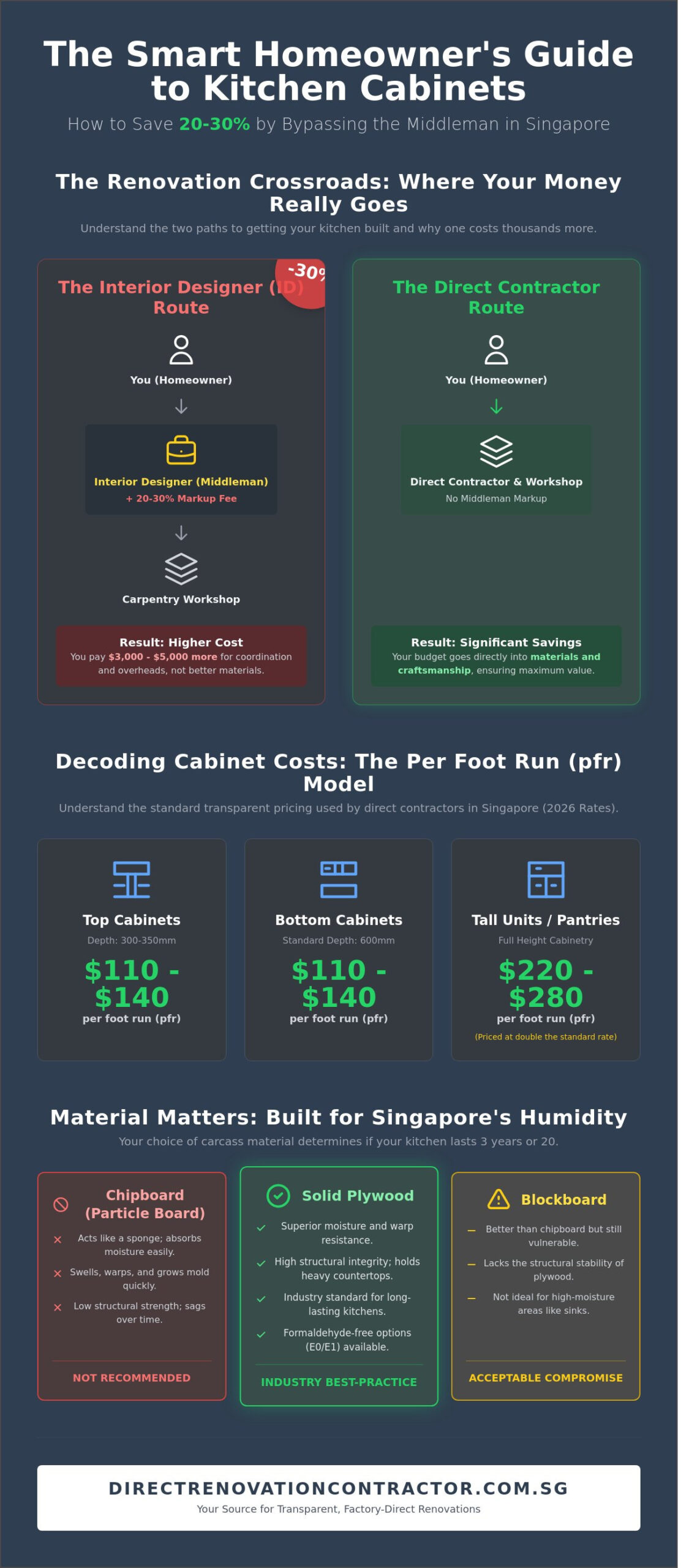
Renovating your kitchen involves significant financial decisions. In the Singaporean market, the price gap between an Interior Designer (ID) and a direct contractor usually sits between 20% and 30%. For a standard 20-foot kitchen layout, this difference often translates to $3,000 or $5,000 in extra costs. ID firms act as intermediaries; they don’t build the cabinets themselves. They outsource the work to local carpentry workshops and add a management fee on top to cover their office overheads and sales commissions. When you engage a direct contractor, you pay for the materials and labor without that middleman markup.
A standard carpentry quote from a direct contractor typically includes the carcass, internal white PVC finish, selected laminate for the exterior, and ABS trimming for all door edges. It also covers essential hardware like soft-close hinges and drawer tracks. Homeowners should verify if “standard” includes stainless steel dish racks or specialized pull-out baskets, as these often incur additional costs. By dealing directly with the builder, you get a transparent breakdown of where every dollar goes.
The Per Foot Run (pfr) Pricing Model
Per foot run is the standard measurement for Singaporean carpentry. This metric simplifies cost calculations for HDB and Condo owners. In 2026, market rates for kitchen cabinets singapore homeowners can expect range from $110 to $140 pfr for standard top or bottom units. A typical 10-foot bottom cabinet at $120 pfr would cost $1,200.
- Top Cabinets: Usually 300mm to 350mm deep, priced between $110 and $140 pfr.
- Bottom Cabinets: Standard 600mm depth to accommodate sinks and hobs, also priced between $110 and $140 pfr.
- Tall Units: These house ovens or pantries and are priced at double the rate, roughly $220 to $280 pfr, because they occupy the full height of the kitchen.
Why Eliminating the Middleman Saves You Thousands
IDs justify their 30% markup as “coordination fees.” They handle the scheduling of different trades like tilers and plumbers. If you’re a pragmatic homeowner, you can manage this yourself to keep your budget lean. Choosing a factory-direct model reduces lead times significantly. Our fabrication process happens in-house, which often cuts the wait time from the industry-standard four weeks down to just 14 days. This direct approach is the most efficient way to secure high-quality kitchen cabinet construction without paying for a designer’s flashy showroom.
For BTO owners on a tight timeline, factory-direct carpentry ensures that measurements taken on-site move to the production floor immediately. There’s no back-and-forth between a designer and a third-party workshop. This streamlined communication prevents errors in dimensions and material selection. For a deeper look at how these models differ across all renovation stages, check out our direct renovation contractor singapore comparison guide. Engaging a direct contractor means you’re hiring the person actually holding the tools, ensuring technical competence over sales talk.
Selecting Durable Materials for Singapore’s Humid Kitchens
Singapore’s average relative humidity often stays above 80%, which is a death sentence for poorly constructed furniture. Moisture causes low-grade wood to swell, warp, and grow mold within months. When you are investing in kitchen cabinets singapore, your material choice determines if your kitchen lasts three years or twenty. Chipboard, often used in mass-produced furniture, is essentially compressed sawdust and glue. It acts like a sponge near sinks. Blockboard is slightly better but lacks the structural stability of plywood. For a long-term home, we always recommend high-grade plywood because it resists moisture and holds weight without sagging.
For health-conscious families, we now provide formaldehyde-free plywood options. Standard glues in older carpentry often emit volatile organic compounds (VOCs) for years. Opting for E0 or E1 grade materials ensures your indoor air quality remains safe, especially in the enclosed spaces of HDB or BTO kitchens.
Carcass Materials: Why Plywood is King
Solid plywood is the industry standard for high-quality custom carpentry in Singapore. We use 15mm to 18mm thickness for carcass walls to ensure the structure won’t buckle under heavy stone countertops. Plywood is particularly vital for the sink unit, where minor leaks are inevitable. We often install PVC-coated interiors for these cabinets. This plastic layer makes cleaning spills effortless and provides an extra barrier against water.
In older resale HDB flats, termite resistance is a major factor. Solid plywood is less attractive to pests than the soft fibers found in chipboard. If you’re worried about long-term durability, you can request a material sample to see the density of our plywood compared to retail alternatives.
Laminates and Countertops: The Finishing Touch
The exterior of your cabinet needs to be as tough as the skeleton. High-pressure laminates (HPL) are the most popular choice because they resist scratches and impacts. However, the weak point is always the edge. We use 2mm thick ABS (Acrylonitrile Butadiene Styrene) trimming for all cabinet doors. Unlike older T-banding, ABS trimming is fused to the edge, so it won’t peel off when exposed to the heat of an oven or stove.
Choosing durable materials for Singapore’s climate also extends to your work surfaces. While you can choose various materials, three dominate the local market:
- Quartz: Composed of roughly 90% ground quartz and 10% resins, it’s non-porous and stain-resistant.
- KompacPlus: At only 6mm thick, this high-pressure kraft paper material is waterproof and fits a minimalist aesthetic.
- Sintered Stone: This material is nearly indestructible, resisting heat, scratches, and UV rays better than natural marble.
By sourcing these materials directly, we eliminate the 20% to 30% markup typically added by interior design firms, ensuring you get premium kitchen cabinets singapore at a fair factory price.
Custom Carpentry vs. Modular Cabinets: Which is Better?
Choosing between off-the-shelf modular units and bespoke carpentry is the first major decision for any kitchen cabinets singapore project. Modular systems like IKEA offer lower entry prices, but they rarely suit the 90-degree realities of HDB or BTO layouts. For DIY enthusiasts seeking more precision than standard retail units, CutByBEES offers custom-made flat pack cabinets that bridge the gap between modular convenience and bespoke sizing. Custom carpentry is built to your floor plan’s specific millimetre. This eliminates the 50mm to 150mm filler strips that modular systems use to hide gaps. For a standard 4-room HDB flat, custom work increases useable storage space by roughly 15% compared to modular setups. It’s an investment in square footage that off-the-shelf products can’t match.
The Problem with Standard Modular Sizes
Standard 600mm modular units assume your walls are perfectly straight. In reality, 85% of Singaporean homes have slight wall slants or structural beams that interfere with alignment. Modular units leave awkward gaps that collect grease and pests. Integrating a 595mm built-in oven into a 600mm standard carcass often leaves unsightly 2.5mm gaps on either side. Custom fabrication ensures a seamless fit. This exact fit extends to the ceiling, usually 2600mm in HDBs. By building to the soffit, you eliminate the 200mm dust trap found atop standard retail cabinets. This reduces cleaning time and keeps your kitchen more hygienic.
Bespoke Features: Internal Organisers and Hardware
Direct contractors provide high-end hardware at factory rates. In 2026, soft-close hinges from brands like Blum or Hettich are the non-negotiable standard. You shouldn’t accept anything less. While retail stores sell you a box, a direct contractor integrates the hardware into the structural design. This allows for specialized solutions that modular units don’t offer:
- Pull-out larders: These maximise narrow 150mm to 300mm spaces that would otherwise be wasted.
- Corner baskets: Solutions like LeMans trays or Magic Corners turn dead corners into accessible storage.
- Integrated lighting: Routed LED channels that are flush with the cabinet base, avoiding the messy exposed wiring of DIY kits.
Direct contractors handle the installation themselves; they don’t outsource to third-party sub-cons. This ensures accountability. If a hinge fails or a drawer misaligns after 6 months, you deal directly with the builder, not a retail customer service hotline. This level of technical oversight is vital for the long-term durability of your kitchen cabinets singapore.
Investing $10,000 in custom carpentry can boost property resale value by up to $15,000. Buyers in the 2026 market prioritize move-in ready kitchens with high-quality finishes. High-quality carpentry with 18mm plywood carcasses lasts 15 years or more. In contrast, particle-board modular units often swell and sag within 5 to 7 years due to Singapore’s 80% average humidity. Choosing custom work isn’t just about aesthetics; it’s a pragmatic financial decision for the lifecycle of your home. The same factory-direct approach that saves you money on kitchen cabinets also applies when you need a custom tv console singapore built to eliminate cable clutter and maximize your living room storage. For bedroom storage solutions that offer similar space-maximizing benefits, consider a pole system wardrobe singapore installation that provides floor-to-ceiling storage without the bulk of traditional built-in closets.
Planning Your Kitchen Layout: HDB and Condo Essentials
The work triangle is the core of efficient kitchen design, linking the sink, stove, and refrigerator in a functional flow. For kitchen cabinets singapore homeowners often prioritize, this layout determines whether your daily cooking is a breeze or a chore. A well planned triangle keeps the distance between these three points between 1.2 and 2.7 meters. This ensures everything is within reach without feeling cramped. Use this checklist for your layout:
- Sink to Stove: This is your primary prep zone; keep it clear of tall appliances.
- Fridge Placement: Position it near the kitchen entrance so family members can grab drinks without interrupting the cook.
- Clear Pathways: Ensure no major traffic paths cross through the triangle.
Navigating HDB Technical Constraints
HDB flats come with specific structural rules that impact your kitchen cabinets singapore installation. You cannot permanently seal gas pipes. We use removable carpentry panels or boxing that allows for easy inspection, ensuring you don’t breach HDB fire safety codes. Maintenance access is another priority. Your cabinet design must never block the floor trap. If a pipe leaks, you need immediate access to prevent water damage to your expensive woodwork. For more details on compliance, read our HDB renovation in Singapore guide.
Electrical trunking is often visible in older resale flats. Instead of leaving it exposed, we plan cabinet heights to conceal these wires within the top shelving units. This creates a flush, built-in look without the high cost of hacking walls to hide wires.
Ergonomics and Storage Efficiency
The standard counter height in Singapore is 850mm to 900mm. If you’re taller than 1.7 meters, we recommend the 900mm height to prevent back strain. For heavy cooking, hood placement is critical. Your hood should be 650mm to 750mm above the hob. Any higher, and the suction fails to catch grease; any lower, and it becomes a fire hazard.
We often face the “Concrete Base vs. Cabinet Legs” debate. A 50mm concrete base is the gold standard for Singapore kitchens. It prevents water from seeping under cabinets during floor washing and keeps pests out. While plastic or metal legs offer a modern look, they create gaps where dust and debris collect. For most HDB owners, the durability of a masonry base outweighs the aesthetics of legs.
Modern kitchens now demand more power. Plan for at least four 13A power points on your backsplash. This handles high-wattage appliances like the Thermomix (1500W) or an Air Fryer (2000W) without tripping breakers. Avoid using extension cords on kitchen counters; they are unsightly and dangerous near water sources. When planning storage solutions for other areas of your home, consider how modular systems like a pole system wardrobe can maximize space efficiency in bedrooms while maintaining the same factory-direct pricing advantages.
Getting Your Kitchen Cabinets Done Right with Direct Renovation
Choosing the right partner for your kitchen cabinets singapore project is the difference between a functional workspace and a costly mistake. Working with a direct carpentry contractor eliminates the standard 20% to 30% commission typically charged by interior design firms. We focus on the build, not the sales pitch. Our process starts with an itemized quote that breaks down every linear foot of cabinetry, internal carcass material, and hinge type. This level of detail ensures you won’t face surprise invoices halfway through the renovation.
Visualizing the design is a critical step in our workflow. Before we start any hacking or masonry work, we provide detailed 3D drawings. These aren’t just for aesthetics; they serve as a technical blueprint. We use these renders to verify fridge clearances, drawer heights, and power point placements. This preemptive planning saves homeowners an average of $500 to $1,200 in rectification costs that usually arise from miscommunication. You can browse our portfolio of over 500 completed HDB and Condo kitchen transformations to see how we maximize storage in compact Singaporean floor plans.
Our Direct-to-Factory Process
Our operations are headquartered at our Paya Ubi factory. This physical presence allows us to maintain 100% quality control over every laminate edge and cabinet joint. We don’t outsource our carpentry to third-party workshops where quality can fluctuate. The process is steady and logical:
- Site Measurement: We visit your HDB or Condo to take precise dimensions, accounting for uneven walls or existing pipework.
- 3D Design: Our team creates a layout that balances ergonomics with your specific storage needs.
- Direct Fabrication: Our Paya Ubi craftsmen build your cabinets using high-pressure laminates and solid plywood carcasses.
- Final Installation: Our in-house team handles the assembly and fitting to ensure a seamless finish.
By managing the entire chain, we reduce fabrication lead times to under 14 days for most standard layouts. Our “no hidden costs” promise is backed by a fixed-price guarantee. The price on your signed quote is the price you pay at the end of the project. We’ve built our reputation on this transparency, rejecting the “middleman markup” model that inflates renovation budgets across Singapore. The same factory-direct principles we apply to kitchen cabinets extend to every carpentry project in your home, including a bespoke tv console singapore unit designed to hide cables and integrate seamlessly with your living room layout. For a comprehensive breakdown of how direct carpentry singapore services can save you thousands on your BTO or HDB renovation, explore our detailed cost comparison guide.
Start Your Kitchen Transformation Today
Ready to upgrade your home with high-quality kitchen cabinets singapore? Book a site measurement today to get an accurate, obligation-free quote. We provide a comprehensive workmanship warranty on all carpentry, giving you peace of mind that your hinges and tracks will function smoothly for years. Our after-sales team remains available to handle adjustments long after the final handover. Don’t settle for vague estimates or flashy presentations when you can work directly with the builders who understand the technicalities of your home.
Build Your 2026 Kitchen with Direct Factory Expertise
Navigating the 2026 renovation market requires a sharp focus on material durability and cost efficiency. Choosing moisture-resistant plywood over standard chipboard is essential to prevent warping in Singapore’s 80% average humidity. By working directly with a factory, you eliminate the 20% to 30% markups typically added by interior design firms for project management. This straightforward approach ensures your renovation budget goes toward high-quality materials rather than middleman fees.
Getting your kitchen cabinets singapore project right involves balancing layout functionality with technical specifications. We provide HDB-registered expertise and include full 3D design support so you can visualize your HDB or condo layout before any carpentry begins. Every unit we manufacture features genuine Blum hardware and robust carcasses built to withstand daily use. You don’t have to compromise on quality when you have direct access to the workshop floor. We’ve streamlined the process to give you a kitchen that’s both functional and financially sensible.
Get a Direct Factory Quote for Your Kitchen Cabinets
We’re ready to help you build a kitchen that serves your home for years to come.
Frequently Asked Questions
How much does a typical 20-foot HDB kitchen cabinet cost in Singapore?
A standard 20-foot HDB kitchen cabinet set usually costs between $2,400 and $3,600 for carpentry work alone. This price reflects a 10-foot top and 10-foot bottom run using high-pressure laminates and internal PVC finishes. You’ll need to budget an additional $800 to $1,500 for a quartz or solid surface worktop. As a direct contractor, we provide factory prices by removing the 20% to 30% markup typically charged by interior design firms.
How long does it take to fabricate and install custom kitchen cabinets?
Fabrication takes roughly 14 to 21 days at our local workshop once we finalize site measurements and you’ve confirmed your laminate choices. The actual on-site installation for your kitchen cabinets singapore project usually finishes within 2 to 3 business days. This timeline includes mounting the carcasses and aligning all doors. If you’ve ordered a custom stone countertop, allow another 7 days for measurement and installation after the base cabinets are securely fixed.
Is it better to have a concrete base or plastic legs for my kitchen cabinets?
A concrete base is the superior choice for Singaporean kitchens because it prevents water from seeping under your cabinets during floor washing. We construct these bases at a standard height of 50mm and finish them with matching floor tiles for a seamless look. Plastic legs offer easier access for pest control but lack the structural longevity of masonry. Most HDB owners choose concrete bases to avoid cabinet rot caused by moisture in our 80% average humidity.
Can I change my kitchen cabinets without hacking the existing floor tiles?
You can replace your cabinets without hacking floor tiles if the new cabinet footprint covers the existing un-tiled area. Most HDB kitchens have tiles only up to the cabinet’s edge to save costs, leaving bare cement underneath the carpentry. If you change the layout, you’ll likely see these cement patches. In 90% of our replacement projects, we simply build over the existing footprint or use a slightly larger base to hide any tile gaps.
What is the best material for kitchen cabinets to prevent termite attacks?
Aluminum or stainless steel carcasses are the only 100% termite-proof materials available for cabinetry. While high-grade plywood is more durable than chipboard, it still contains cellulose that attracts pests. If your area has a history of infestations, choosing aluminum carcasses ensures your cabinetry remains intact for 20 years or more. These metal options are also completely waterproof and won’t warp or swell like wood-based materials do when exposed to leaks.
Do I need HDB permit for replacing my kitchen cabinets?
You don’t need an HDB permit for simple carpentry replacement or installing new kitchen cabinets singapore. However, a permit is mandatory if your renovation involves hacking existing walls or relocating the original sink position, which affects the floor slab. We handle the submission for any masonry or plumbing works that require HDB Professional Engineer endorsement. Always check your renovation guidelines to avoid a potential $5,000 fine for unauthorized works.
How do I maintain my kitchen cabinet laminates to prevent peeling?
Keep your kitchen well-ventilated and avoid using steam cleaners directly on cabinet edges to prevent glue failure. Most laminate peeling occurs when heat from ovens or kettles melts the contact adhesive used during fabrication. Use a damp microfiber cloth with mild soap for cleaning instead of harsh chemicals. We use industrial-grade adhesives that withstand temperatures up to 60 degrees Celsius, but consistent moisture exposure will eventually degrade any bond.
If your cabinet surfaces have already begun to show signs of wear or peeling, professional refinishing can be a cost-effective way to restore them. For homeowners looking for specialized expertise in this area, Cabinet Painting Denver offers professional painting services that can revitalize existing cabinets and provide a high-end, durable finish.
What is the difference between a direct contractor and an interior designer?
A direct contractor manages the actual fabrication and installation in their own workshop, while an interior designer acts as a middleman coordinator. By working with us, you save the 20% to 40% project management fee that IDs typically add to the final bill. We focus on technical execution and functional durability rather than 3D drawings or lifestyle concepts. You get factory-direct pricing because you’re communicating directly with the people building your furniture. For detailed insights on choosing the right carpenter singapore professional for your custom carpentry needs, explore our comprehensive guide on factory-direct savings and material specifications.