
A BTO renovation usually takes three to five months from key collection to move-in, with physical work typically taking eight to twelve weeks. This complete guide to BTO renovation in Singapore for first-time homeowners explains how to plan the schedule and avoid treating construction time as the whole timeline.
It’s easy to focus on finishes and furniture, but air-conditioning and electrical planning can affect equipment locations and power-point placement. Plan your electrical points around your intended setup before work begins.
You’ll learn how to organise pre-planning, set a practical budget, choose a renovation contractor and understand permit requirements. We’ll also cover air-conditioner installation and electrical loading, so you can make decisions in sequence and plan your move with fewer last-minute surprises.
Key Takeaways
- Secure required HDB renovation permits before work starts, and use a contractor listed in HDB’s Directory of Renovation Contractors.
- Shortlist contractors early and assess their written scope, workmanship terms and experience with BTO renovation work.
- Set aside 10 to 15% of your renovation budget as a contingency, then prioritise the work that matters most to your household.
- Plan air-conditioning and electrical requirements together; HDB air-conditioners must be installed by a BCA-trained installer.
HDB renovation permits and registered contractors
There is no universal exclusion list for flooring, doors and sanitary fittings in BTO flats. What’s provided depends on the options selected and the flat’s handover condition. Use the handover inventory to identify what needs work before finalising cabinets, storage and appliances.
- Confirm permit requirements before scheduling work. HDB permits must be obtained before renovation begins, and approval can take one to three weeks. Ask your contractor to identify permit-dependent items in the work schedule. Hacking or altering walls, changing door locations, replacing floor finishes, and raising floors in kitchens, balconies, bathrooms or toilets require permits.
- Use a contractor listed with HDB. HDB renovation contractors must appear in the HDB Directory of Renovation Contractors. Confirm that the contractor handling your BTO work is listed. For window installation or replacement, use a BCA-approved window contractor listed in that directory.
- Protect bathroom waterproofing. HDB restricts removal of existing bathroom and toilet floor and wall tiles for three years from the date the block was completed. If bathroom tiles are hacked, the waterproofing membrane must be redone and tested. Include this requirement in the work sequence before choosing replacement tiles or sanitary fittings.
- Build working hours into the schedule. Allowed renovation hours can vary by the type of work and applicable restrictions. Noisy work is restricted to weekdays from 9:00 AM to 5:00 PM. Noisy work is not allowed on weekends, public holidays or the eve of major public holidays; HDB also prohibits renovation work on Sundays and public holidays.
- Set a completion date with permit approval in mind. New BTO renovation works must be completed within three months of permit approval. Schedule noisy work, waterproofing, cabinets and appliance installation in that order where the scope requires it. A clear sequence reduces clashes and makes an overwhelming renovation easier to manage.
Choosing a renovation contractor
Shortlist renovation contractors 6 to 9 months before work begins. Compare how each option handles planning, site work, documentation and changes.
-
Compare Renovation Service Options
Decide whether you need design input, trade execution or both. An interior designer focuses on planning the look and layout; a contractor carries out specified work such as hacking, carpentry and painting. A design-and-build arrangement combines design and construction in one process. Compare the scope and responsibilities, not just the label. Avoid paying for design work you don’t need, and don’t assume a contractor’s quote includes design coordination.
-
Review Contracts and Avoid Renovation Scams
Read the written contract before paying a deposit. Renovation risks include vague descriptions, missing work items, unclear payment stages and extra charges for changes. Make sure the document identifies materials, quantities, locations, exclusions, completion stages and how variations are approved. Keep the agreed scope and payment records together. Check that the written workmanship-defect warranty covers at least one year.
- Match the contractor’s scope to your layout and priorities. For example, a kitchen plan should show cabinet dimensions, appliance positions and access routes before carpentry starts. Separate essential structural or hacking work from optional finishes, and account for HDB restrictions before approving changes. Clear drawings and an itemised scope help prevent disagreements about what the contract includes.
- Choose a practical design style by deciding how each room will be used. List daily needs, such as kitchen storage, a work area or space for appliances, then align painting and carpentry choices with those functions. For a compact bedroom, prioritise usable storage over decorative features that reduce circulation. If your plans are set and you need renovation work, BTO renovation support can be a relevant next step.
Setting a renovation budget and contingency fund
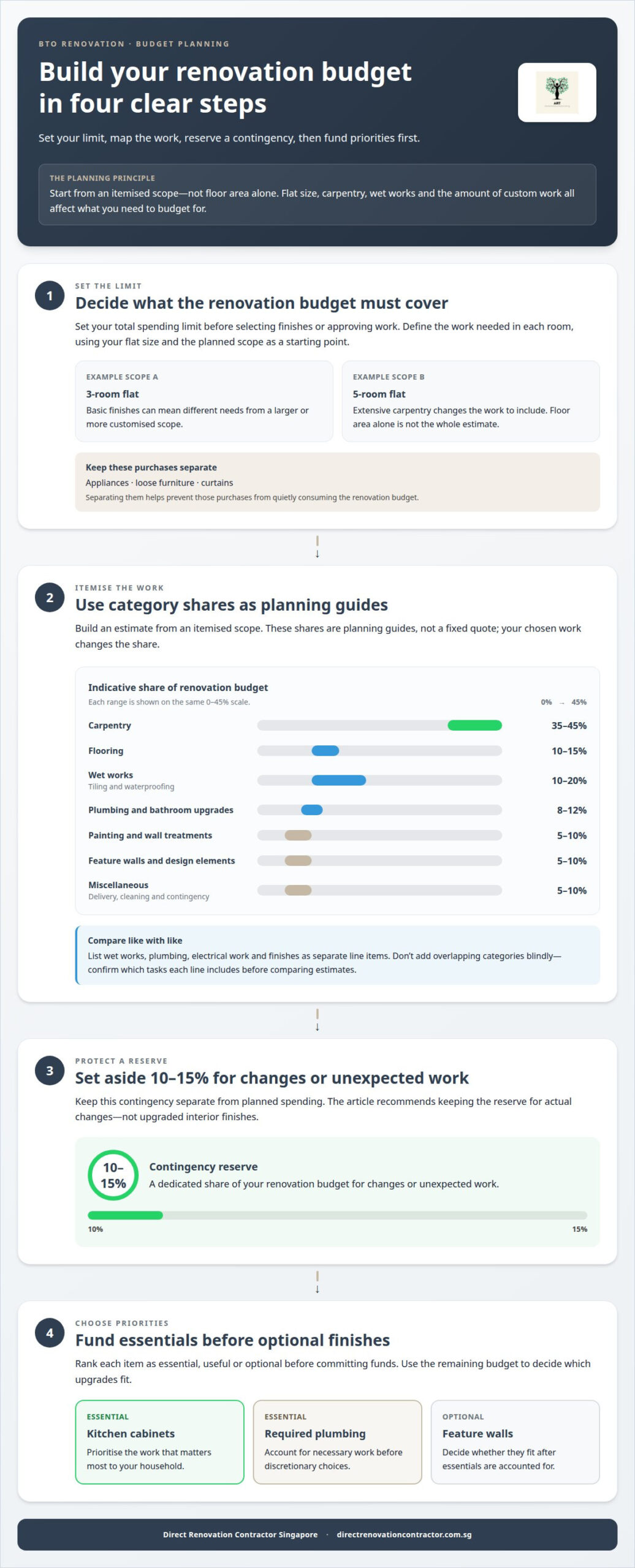
Set your total spending limit before selecting finishes or approving renovation work. Flat size, carpentry, wet works and the amount of custom work all affect the scope.
-
Estimate Budgets by BTO Flat Size
Start with your BTO flat size, then define the work needed in each room. A three-room flat with basic finishes has different needs from a five-room flat with extensive carpentry. Build your estimate from an itemised scope rather than treating floor area as the only cost driver. Separate renovation work from appliances, loose furniture and curtains so those purchases don’t quietly consume your renovation budget.
-
Break Down the Budget and Set a Contingency
Allocate funds by work category, then keep a separate contingency reserve. Set aside 10 to 15% of your renovation budget for changes or unexpected work. Carpentry can take 35-45% of a BTO renovation budget; flooring typically takes 10-15%, while painting and wall treatments take 5-10%. These are planning guides, not a fixed quote, and the chosen scope changes the share.
- List wet works, plumbing, electrical work and finishes as separate line items. Wet works such as tiling and waterproofing typically account for around 10 to 20% of a BTO renovation budget. Plumbing and bathroom upgrades typically take 8-12%. Don’t add overlapping categories blindly; confirm which tasks each line includes before comparing estimates.
- Rank each item as essential, useful or optional before committing funds. For example, prioritise kitchen cabinets and required plumbing, then decide whether feature walls fit the remaining budget. Feature walls and design elements typically take 5-10%; miscellaneous costs, including delivery, cleaning and contingency, typically take 5-10%. Keep the reserve untouched for actual changes, not upgraded interior finishes. This simple order helps your renovation journey transform the flat without letting optional details overtake practical needs.
Air-conditioner installation and electrical loading
Plan air-conditioning and electrical points before fixing wardrobes, flooring or lighting. A complete guide to BTO renovation in Singapore for first-time homeowners should treat equipment locations and power needs as part of the living layout, not as late add-ons.
- Map equipment and power needs room by room. A typical BTO flat has a single electrical point per room, so plan around actual appliance use. Mark air-conditioner locations, refrigerators, washing machines and entertainment equipment on the layout. Bedrooms are advised to have four to six power points, including USB charging ports beside the bed.
- Coordinate electrical points with carpentry. Set outlet positions before wardrobes and cabinets are installed. For example, place bedside charging points where they remain accessible beside the bed, not behind a wardrobe. A typical BTO flat has a ceiling-mounted light point in each room; plan additional lighting around how each area will be used.
- Arrange installation through a trained professional. Air-conditioners in HDB flats must be installed by a BCA-trained air-conditioner installer. Include the intended unit locations and electrical requirements in the renovation plan before flooring, ceiling or carpentry work restricts access to installation routes.
- Account for the flat’s electrical capacity and permit needs. HDB flats built after 1 January 1994 may not need an HDB permit for air-conditioner installation if equipped to handle a higher electrical load safely. The key issue is whether the flat’s electrical setup can safely support the planned load. Don’t assume the building date alone settles the requirement.
- Sequence work and inspect the finished installation. Coordinate wiring and air-conditioner routes before closing ceilings or fitting wardrobes. At handover, check that switches, lighting and air-conditioners operate as planned, and note any defect affecting installation or access. For first-time homeowners, a complete BTO renovation guide for Singapore should account for these electrical decisions before finishing work starts.
Include electrical wiring and installation in your renovation scope, and coordinate these details before finishing work begins.
Direct Renovation Contractor Singapore
Direct Renovation Contractor Singapore helps homeowners turn BTO renovation plans into coordinated work scopes. Its HDB BTO Renovation Packages cover new flats, while its other residential packages serve resale HDB flats, condominiums and landed properties.
If you want to manage parts of the project yourself, its DIY renovation approach provides 3D drawings and a curated list of direct contractors and material suppliers. This can help you organise decisions around layout, work sequence and materials while keeping the project practical. It’s suited to homeowners who want a clearer plan before coordinating renovation tasks.
Contact Direct Renovation Contractor Singapore to discuss your BTO renovation plans.
Turn Your Renovation Plan Into a Clear Scope
Your next step is to turn your priorities into a written project scope. Decide what needs to be completed before move-in, what can wait and which decisions depend on one another. This gives your renovation plan a practical direction instead of leaving choices to the final stages.
Use this complete guide to BTO renovation in Singapore for first-time homeowners as a working reference while organising your decisions. A clear brief can help align the intended layout, work scope and materials before renovation begins. Keep it focused on how you’ll use the home, not just how each room should look.
If you’re ready to discuss your renovation plans, contact Direct Renovation Contractor Singapore. Take the next step at your own pace and move forward with a plan that fits your home.
Frequently Asked Questions
How Long Does a BTO Renovation Actually Take?
Allow three to five months from key collection to move-in for a typical BTO renovation. The overall period includes planning before site work, construction, cleaning, furniture delivery and defect checks. The work scope affects the schedule: custom carpentry, wet works and late changes can add coordination time. Set your move date around completed work and handover, not just the day contractors enter the flat.
The “Big Three”: Where Does Your Money Really Go?
Custom carpentry, wet works and flooring are major budget drivers, but their shares depend on your chosen scope. A kitchen with extensive cabinets, for example, can take more of the budget than one using standard finishes. Compare estimates by work item and material, not just by total. This helps reveal whether a lower quote excludes necessary work or uses different specifications.
What is the average BTO renovation cost in Singapore in 2026 by flat size?
There isn’t one useful average that applies to every flat of the same size. The final renovation scope matters: a three-room flat with limited carpentry differs from one requiring extensive kitchen, bathroom and flooring work. Appliances, loose furniture and curtains also affect total move-in spending. Separate those purchases from renovation work, then compare quotations with matching scopes and material specifications.
How much do HDB BTO renovation packages cost, and what do they include?
Package pricing depends on the flat, selected work scope, materials and amount of customisation; the price is provided after a quote request. Assess an HDB BTO renovation package by its written inclusions, exclusions and specifications, not its name alone. Before comparing package quotes, check whether the proposed scope matches your priorities, such as kitchen cabinets, flooring, painting or electrical work.
What HDB renovation rules and permits apply to BTO flats in Singapore?
Obtain required HDB permits before renovation starts, and use a contractor listed in HDB’s Directory of Renovation Contractors. Permits apply to work such as hacking or altering walls, changing door locations, replacing floor finishes and raising certain floor levels. Bathroom tile removal has an additional restriction: existing bathroom and toilet floor and wall tiles cannot be removed for three years from the block’s completion date.
When can BTO owners start renovating, and what are the renovation hours and noise rules?
Renovation can begin after the required permit is approved. For new BTO flats, work is allowed on weekdays from 9am to 6pm and Saturdays from 9am to 1pm. Noisy work is limited to weekdays from 9:00 AM to 5:00 PM, and isn’t allowed on weekends, public holidays or the eve of major public holidays. Schedule drilling and hacking within those limits.