
Your renovation budget isn’t necessarily being drained by high material costs; it’s often being eaten by the undisclosed commissions hidden inside your interior design package. Many homeowners assume that a high price tag guarantees quality, yet they still face the frustration of peeling laminates and sagging shelves just months after moving in. If you want to avoid these common pitfalls, you need to understand the standards of a professional Carpenter Singapore; Industry’s Best Practices and Expert Advice. We believe that transparency is the only way to build trust and ensure your custom cabinetry stands up to Singapore’s 85% humidity levels.
It’s understandable to feel anxious about choosing between plywood and chipboard or worrying about hidden fees. This guide will help you master the technical standards and cost-saving strategies needed to ensure your built-in furniture is built to last. We’ll cover everything from the new 2026 CORENET-X digital submission requirements to the benefits of E0-grade low-formaldehyde materials. You’ll gain the specific knowledge required to spot construction defects and understand the direct-from-factory model that eliminates unnecessary markups. By the end, you’ll have a clear roadmap for a durable, cost-effective home makeover. For those looking to see how these professional standards are applied to full-scale custom homes, you can visit Jarvis Contracting to explore their portfolio.
Key Takeaways
- Identify the essential technical standards and material specifications required for a Carpenter Singapore; Industry’s Best Practices and Expert Advice to guarantee long-term durability.
- Learn why solid-core plywood remains the industry gold standard for moisture-prone areas like Singaporean kitchens and bathrooms.
- Understand how the direct-to-factory model eliminates hidden intermediary commissions and secures transparent, unmarked-up pricing for your cabinetry.
- Master the checklist for spotting common installation defects such as delamination and poor hardware alignment before they become permanent problems.
- Discover how the shift to tech-integrated fabrication and 3D drawings ensures your custom wardrobes fit perfectly within HDB and condo floor plans.
The Landscape of Carpentry in Singapore: 2026 Standards
Carpentry in Singapore has moved past the era of simple hand tools and manual sawing. Today, it’s a precision trade driven by technology. While the craft is still rooted in global best practices in carpentry, local workshops now use 3D modeling and automated factory cutting to achieve results that hand-cutting simply can’t match. This shift toward tech-integrated fabrication is not just about speed; it’s about eliminating the human error that leads to crooked cabinets or gaps in your joinery. When you engage a Carpenter Singapore; Industry’s Best Practices and Expert Advice specialist, you are hiring a professional who balances traditional skill with modern engineering.
As of October 2026, the industry has embraced even tighter digital standards. All new building projects must be submitted through CORENET-X, the Building and Construction Authority’s (BCA) BIM-based platform. This level of technical oversight ensures that contractors stay accountable to structural and safety regulations. For homeowners, this means your renovation is backed by more rigorous data and planning than in previous years. Working directly with a contractor like Direct Renovation Contractor Singapore, who operates their own workshop, allows you to see this tech in action while avoiding the heavy markups associated with middlemen.
Custom vs. Ready-Made: Why Singaporeans Choose Bespoke
Most HDB BTO and condo layouts have awkward corners, structural beams, or specific dimensions that ready-made furniture can’t accommodate. Bespoke joinery allows you to maximize every square inch of a compact floor plan. Beyond space, the real advantage is material control. You get to decide exactly what goes into your cabinets. While mass-market furniture often relies on thin particle board that swells in our 85% humidity, custom carpentry uses moisture-resistant plywood. This choice alone can double the lifespan of your kitchen cabinets, providing better long-term value than any flat-pack alternative.
Regulatory Compliance for HDB and Private Properties
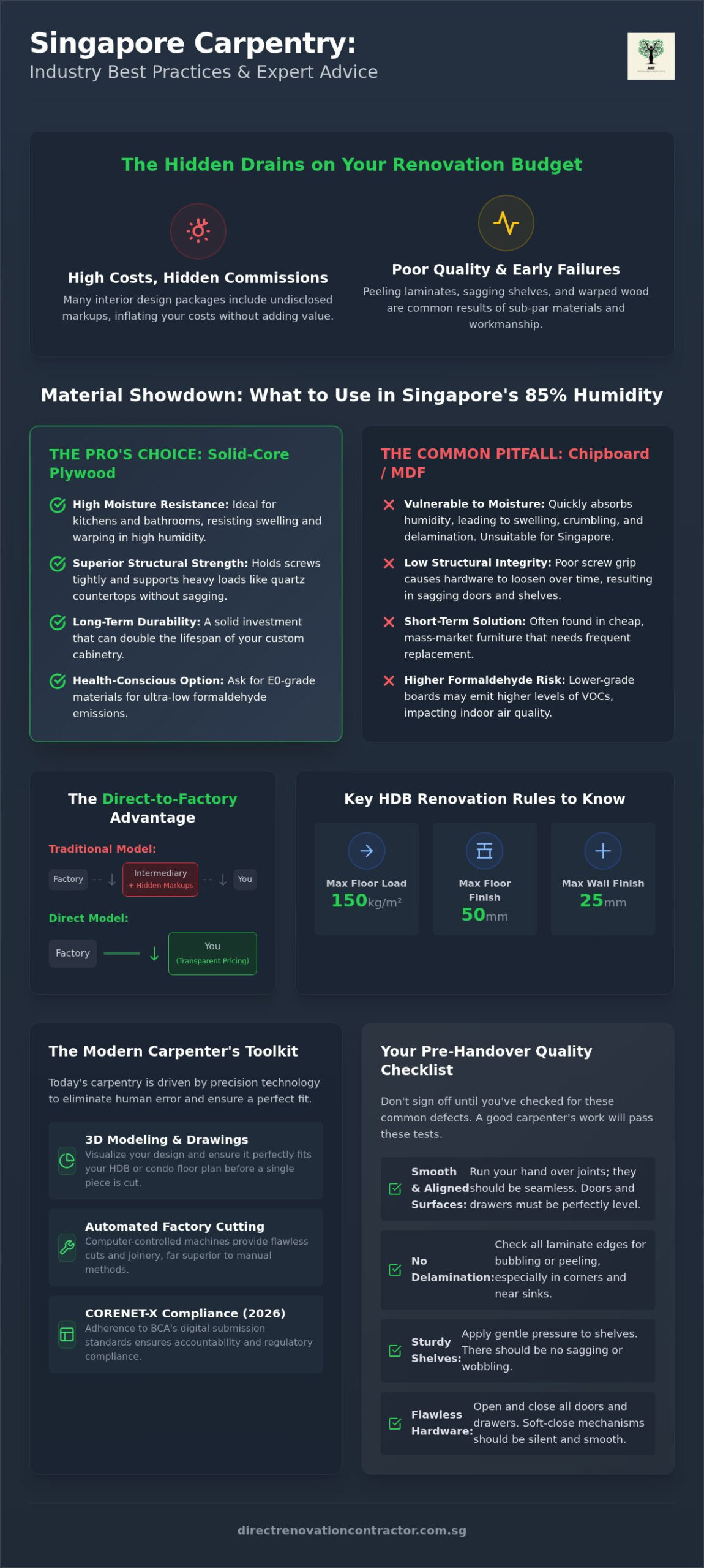
You can’t ignore the law when building permanent fixtures. HDB has strict structural limits that every contractor must follow. For instance, the maximum load for HDB floors is 150kg per square metre. If you’re planning heavy, floor-to-ceiling storage units, your contractor must ensure the weight is distributed safely. There are also thickness limits: new floor finishes and cement screed cannot exceed 50mm in total thickness, while wall finishes are capped at 25mm. In commercial office renovations, fire safety is the priority. All carpentry must meet specific flame-retardant standards to pass SCDF inspections. Following these rules isn’t just about passing an audit; it’s about the safety of everyone in the building.
Expert Advice on Material Selection: Plywood, Laminates, and Hardware
Selecting materials is where most homeowners make mistakes that lead to premature furniture failure. In Singapore’s tropical climate, the hierarchy of materials is clear and uncompromising. While solid wood is aesthetically pleasing, it’s prone to warping and is often cost-prohibitive for full kitchen setups. At the other end of the spectrum, MDF and Particle Board (chipboard) are common in mass-market furniture but are notorious for swelling when exposed to moisture. This is why solid-core plywood remains the industry standard for high-quality kitchen cabinets and wardrobes. It offers the structural integrity needed to support heavy quartz countertops while resisting the 75-85% humidity levels we face year-round. Adhering to BCA Safety and Standards ensures that these materials are used correctly to maintain the safety and longevity of your home fixtures.
Hardware is the unsung hero of any carpentry project. No matter how good the wood looks, cheap hinges will sag and runners will jam within two years. We prioritize heavy-duty, soft-close mechanisms from reputable brands like Blum or Hettich. These components don’t just provide a premium feel; they prevent the constant slamming that eventually loosens screws and cracks laminate joints. Investing in quality hardware at the start is a pragmatic move that eliminates the need for annoying repairs later.
The Plywood Debate: Solid Core vs. Hollow Core
Solid-core plywood consists of multiple layers of wood veneer glued together, creating a dense board with high screw-holding strength. Hollow-core alternatives or “honeycomb” boards might feel light and look thick, but they lack the durability required for heavy-duty use. If you see a “chipboard” or “sawdust” filler in a cross-section, it’s a sign of inferior quality that won’t hold up in a wet kitchen. For a Carpenter Singapore; Industry’s Best Practices and Expert Advice specialist, 18mm thickness for carcass sides is the non-negotiable standard to prevent sagging. This is especially critical for wardrobes that must support the weight of heavy winter coats or stacked linens. If you are planning a Kitchen Cabinet Carpentry project, choosing the right grade of plywood is the first step toward a kitchen that lasts twenty years instead of five.
Laminates and Edge Banding: The Secret to Longevity
A cabinet’s exterior is only as good as its finish. High-Pressure Laminate (HPL) is the preferred choice for its superior scratch and heat resistance compared to low-pressure melamine options. However, the most frequent point of failure is the edge. Traditional T-banding uses a plastic strip that often peels off over time. We use ABS (Acrylonitrile Butadiene Styrene) edge banding, which is fused more securely to the board and resists impact much better. For health-conscious owners, the 2026 trend focuses on low-VOC materials. Moving from the E1 standard to E0 grade plywood ensures better indoor air quality by keeping formaldehyde emissions below 0.050 mg/m³, well within the Singapore Standard SS 554:2016 safety limits.
Industry Best Practices: Fabrication and Installation
The transition from a digital design to a physical cabinet requires a level of technical precision that defines a Carpenter Singapore; Industry’s Best Practices and Expert Advice. We don’t just guess dimensions from a floor plan. Every project begins with a high-resolution 3D drawing that is programmed directly into our factory’s CNC machines. This ensures every cut is accurate to the millimeter, minimizing the need for on-site modifications that can compromise the structural integrity of the wood. Following a Carpenter Singapore; Industry’s Best Practices and Expert Advice approach means we never cut corners during the assembly or installation phases.
A critical step many homeowners overlook is the final site measurement. This must happen after the tiling and masonry works are finished. Even a 5mm discrepancy in wall thickness can cause a wardrobe to sit crookedly or leave unsightly gaps. By measuring the “as-built” environment, we ensure the joinery fits your space like a glove. If you’re curious about the financial side of this process, read our Carpenter Singapore: The 2026 Guide to Custom Carpentry and Direct Savings to see how factory-direct fabrication cuts out the middleman.
From Factory to Flat: The Fabrication Process
In our Paya Ubi workshop, we prioritize structural assembly over speed. We use a combination of industrial-strength adhesives and deep-seated screws for every carcass joint. Unlike mass-produced items that often use staples, our custom units are built to withstand the heavy loads of quartz countertops and full kitchen inventories. Every piece is inspected for edge banding quality and surface defects before it leaves the factory floor. This rigorous quality control prevents the common peeling laminate complaints that plague cheaper alternatives.
On-Site Installation Checklist for Homeowners
You don’t need to be an expert to spot a bad installation. Use this simple checklist when our team is on-site to ensure your project meets professional standards:
- The Spirit Level Test: Place a spirit level on top of the cabinets and against the sides. Everything must be perfectly horizontal and vertical to prevent hinge strain and door sagging.
- Joint Sealing: Ensure all joints in wet areas are sealed with anti-fungal silicone. This prevents water from reaching the plywood core and causing rot.
- Hardware Operation: Open and close every drawer. Movement should be smooth and silent, and the soft-close feature should engage without hitting the frame.
- Gap Inspection: Check the “scribing” where the wood meets the wall. It should be a tight fit with no visible daylight between the cabinet and the masonry.
Avoiding Common Carpentry Pitfalls and Defects
Poor workmanship isn’t always obvious on the day of handover. Many defects in Singaporean homes only surface after a few months of daily use. One of the most frequent issues is delamination, where the plastic laminate begins to peel away from the plywood core. This usually happens because the contractor used low-grade contact adhesive or failed to apply enough pressure during the bonding process. To avoid these headaches, you should look for a Carpenter Singapore; Industry’s Best Practices and Expert Advice specialist who prioritizes factory-controlled bonding over rushed on-site gluing. For a broader look at managing your project, consult our HDB Renovation in Singapore: The Ultimate 2026 Owner’s Guide.
The “new furniture smell” is another red flag that homeowners often ignore. That sharp, chemical scent is usually formaldehyde off-gassing from cheap adhesives and resins. Under the Singapore Standard SS 554:2016, the legal ceiling for indoor formaldehyde concentration is 0.1 mg/m³. High-quality workshops now use E1 grade (≤ 0.124 mg/m³) or the even safer E0 grade (≤ 0.050 mg/m³) plywood to ensure your indoor air quality remains healthy. If your new cabinets have a persistent, eye-stinging odor, it’s a sign that the materials used don’t meet modern safety benchmarks.
Structural Defects: Warping and Sagging
Shelves that bow in the middle are a classic sign of poor engineering. While we use 18mm thickness as a baseline, any shelf span exceeding 800mm requires additional support or a thicker 25mm board to prevent sagging under weight. Door warping is another common complaint, especially in high-humidity areas like bathrooms. This occurs when the internal tension of the wood isn’t balanced or if the laminate is only applied to one side. We also see many “dropping” doors caused by using undersized hinges that can’t support the weight of solid-core panels. A professional Carpenter Singapore; Industry’s Best Practices and Expert Advice will always match hinge capacity to the door’s actual weight.
Aesthetic Defects: Rough Edges and Poor Alignment
You can tell a lot about a contractor’s equipment by looking at the edges of your cabinets. Chipped laminate edges are usually the result of using blunt saw blades or hand-cutting pieces on-site instead of using a factory-grade table saw. While minor gaps of 1-2mm are sometimes necessary for door clearance, uneven or diagonal gaps are a clear sign that the carcasses weren’t leveled properly during installation. If you want to ensure your project avoids these amateur mistakes, you can get a transparent carpentry quote directly from our Paya Ubi workshop. Distinguishing between a minor cosmetic blemish and a major structural defect is key to a successful final inspection.
The final piece of the puzzle in mastering Carpenter Singapore; Industry’s Best Practices and Expert Advice is understanding the financial model behind your project. Most homeowners are unknowingly paying a “hidden tax” when they sign with an interior design (ID) firm. This isn’t necessarily for better materials or better labor; it’s a coordination fee that covers the ID’s overhead and profit margin. By choosing a direct-to-factory model, you eliminate these intermediaries. You pay for the actual craftsmanship and materials, not for a middleman to manage a WhatsApp group. This approach allows you to achieve high-end designer looks while keeping your budget focused on structural quality and durable finishes.
Our DIY Support Package is designed for savvy homeowners who want to take charge of their own renovation. It provides the technical backing of a professional workshop while giving you the freedom to manage your own timeline and sub-contractors. For a detailed breakdown of how this model stacks up against traditional services, see our Direct Renovation Contractor Singapore: The 2026 Comparison Guide. This transparency is the cornerstone of our business model and a guarantee of your savings.
Breaking Down the Cost: ID vs. Direct Contractor
In a typical ID quotation, the “coordination fee” or “management fee” can account for 20-30% of the total project cost. For a 4-room HDB carpentry package, you could be paying thousands of dollars just for the privilege of having a middleman. When you work directly with our Paya Ubi workshop, that money stays in your pocket or goes toward higher-grade materials like E0 plywood or premium hardware. Transparent, itemized quotes ensure you know exactly where every dollar is spent, which is crucial for staying within a strict BTO budget. We reject undisclosed fees and intermediary commissions as a matter of principle.
Working with a Direct Carpenter: Communication is Key
The biggest fear homeowners have with the direct model is a lack of design guidance. We solve this by providing professional 3D drawings that translate your ideas into technical reality; if you are interested in using augmented reality to preview your own concepts, click here to try a specialized design app. You don’t need a middleman to explain your vision; you can speak directly to the experts who will actually fabricate your cabinets. This direct line of communication reduces the risk of “lost in translation” errors and ensures that material specifications are locked into the contract. Visiting our workshop builds a level of trust that a flashy showroom can’t match. You see the machinery, you touch the raw solid-core plywood, and you meet the team responsible for your home’s transformation. This is the essence of Carpenter Singapore; Industry’s Best Practices and Expert Advice: technical competence paired with financial honesty.
Securing Quality Carpentry for Your Singapore Home
Building custom cabinetry is a significant investment that defines the functionality of your HDB or condo for years to come. You’ve learned that success depends on choosing the right materials, such as moisture-resistant solid-core plywood, and ensuring technical precision through 3D drawings and factory-controlled fabrication. By following a Carpenter Singapore; Industry’s Best Practices and Expert Advice approach, you protect your home from common defects like peeling laminates while maintaining healthy indoor air quality. Success in renovation isn’t about the flashiest showroom; it’s about the structural integrity of the joinery.
The most effective way to ensure quality without overpaying is to bypass the middleman and work directly with the source. Our Paya Ubi workshop specializes in HDB and BTO projects, offering full 3D drawing support to visualize your space before any wood is cut. You get high-end results with direct-to-owner pricing that eliminates undisclosed commissions and coordination fees. It’s time to take control of your renovation budget and build a home that stands the test of time.
Get a Direct Carpentry Quote from Our Paya Ubi Workshop Today and start your project with a partner who values straightforward communication. Your dream kitchen or wardrobe is just a technical assessment away.
Frequently Asked Questions
Is it cheaper to hire a direct carpenter or an interior designer in Singapore?
Hiring a direct carpenter is significantly cheaper because you eliminate the 20-30% coordination fee typically added by interior designers. When you work directly with a workshop, you pay for raw materials and labor without the middleman markup. This model is ideal for homeowners who have a clear vision and want to maximize their BTO budget. It allows for transparent pricing where every dollar goes toward the structural quality of your cabinets.
What is the best wood material for HDB kitchen cabinets?
High-grade, moisture-resistant solid-core plywood is the best material for HDB kitchen cabinets. Singapore’s humidity levels, often between 75% and 85%, make standard chipboard or MDF prone to swelling and rot. Solid-core plywood provides the necessary screw-holding strength to support heavy quartz countertops and withstand daily wear. For the best results, ensure your contractor uses 18mm thickness for the carcasses to prevent sagging over time and ensure long-term durability.
How long does custom carpentry typically take to install?
On-site installation typically takes between 3 to 7 working days, depending on the project’s complexity. However, the entire process, including site measurement and factory fabrication, usually spans 3 to 4 weeks. This timeline ensures that your 3D drawings are accurately translated into precision-cut panels before they arrive at your flat. Rushing this process often leads to poor alignment and visible gaps that compromise the final aesthetic and structural integrity of the joinery.
Do I need an HDB permit for built-in wardrobes?
You generally don’t need a specific HDB renovation permit for standard built-in wardrobes or kitchen cabinets. However, you must ensure the installation doesn’t involve hacking existing walls or relocating electrical and plumbing points without approval. Work must adhere to HDB’s floor loading limit of 150kg per square metre. Always check that your Carpenter Singapore; Industry’s Best Practices and Expert Advice specialist is an HDB-licensed contractor to ensure compliance with local safety regulations.
Can I change my laminates if they start peeling after a few years?
Changing laminates on existing cabinets is technically possible but usually impractical and costly. Removing old glue requires significant labor and can damage the underlying plywood. If your laminates are peeling, it’s usually more cost-effective to replace the cabinet doors entirely. This ensures a fresh bond and allows you to upgrade to ABS edge banding, which provides much better resistance to moisture and impact than traditional T-banding used in cheaper furniture.
What should I look for in a carpentry warranty?
A reliable carpentry warranty should cover structural defects like warped doors, sagging shelves, and delamination for at least 12 months. It’s equally important to check the separate warranties for hardware components. High-quality brands often offer limited lifetime warranties on their hinges and drawer runners. Ensure your contract explicitly states what constitutes a defect and the expected lead time for any necessary repairs or replacements to avoid future disputes with your contractor.
How do I maintain my custom cabinets to prevent termite issues?
Preventing termite issues starts with keeping your carpentry dry and ensuring there are no hidden plumbing leaks. Termites are attracted to moisture-damaged wood. While professional workshops use treated plywood, you should also conduct regular visual inspections for mud tubes or fine wood dust. Engaging a professional pest control service for a pre-renovation soil treatment is a pragmatic step if you are moving into a landed property or a ground-floor HDB flat.
Is solid wood always better than plywood for Singapore homes?
Solid wood isn’t always better for the Singapore climate. While beautiful, solid timber is highly reactive to humidity and can warp or crack if not properly seasoned. High-quality plywood is more dimensionally stable and less likely to move, making it the superior choice for large built-in structures like wardrobes and kitchen carcasses. A Carpenter Singapore; Industry’s Best Practices and Expert Advice professional will typically recommend plywood for its durability and cost-effectiveness in local residential settings.