
Your security deposit isn’t a guaranteed refund; it’s a hostage held by your commercial office reinstatement clause until the last partition is cleared and every sprinkler head is reset. Most Singapore tenants assume that “broom clean” condition is enough, but disputes over lease exit terms can delay your deposit return by 90 days or more. You’ve likely felt the stress of decoding ambiguous lease language or worrying that a middleman contractor will inflate the price of simple hacking and M&E works. It’s a valid concern because building management (MCST) and SCDF fire safety regulations don’t leave room for error.
We’re here to help you master the complexities of the commercial office reinstatement clause so you can protect your security deposit and avoid unnecessary markups. You’ll learn how to navigate strict building bylaws and ensure your site is handed over in perfect condition. This guide covers everything from transparent pricing for hacking to managing technical M&E requirements for a smooth, dispute-free exit in 2026.
Key Takeaways
- Understand how a commercial office reinstatement clause defines your legal obligation to return the space to its original state and protect your security deposit.
- Learn how to use your original Condition Report to audit your specific liabilities for dismantling partitions, carpentry, and reception counters.
- Discover the strategic benefit of planning three months in advance to engage a direct contractor and eliminate unnecessary middleman markups.
- Gain insights into the technical importance of SCDF fire code compliance and professional hacking to ensure a smooth handover to the landlord.
- Master the process of identifying “As-Built” modifications to avoid paying for reinstatement work that was not part of your original fit-out.
What is a Commercial Office Reinstatement Clause in Singapore?
A commercial office reinstatement clause is a standard legal provision found in almost every Singapore commercial lease agreement. It dictates that at the end of your tenure, you must return the premises to the landlord in its original, bare-shell condition. This isn’t just about moving furniture out; it involves active construction work to remove partitions, false ceilings, and custom floorings you installed. For 2026, landlords are increasingly strict about this because a clean, empty unit is easier to market to the next tenant without the baggage of your old layout.
The “As-Built” drawing serves as the definitive baseline for these expectations. This technical document, filed with the authorities when the building was first completed, shows the exact location of every wall, light point, and sprinkler. If your current office doesn’t match this drawing at the point of handover, you haven’t fulfilled your contract. Failing to comply can lead to the total forfeiture of your security deposit, which typically equals 3 to 6 months of rent. In recent years, we’ve seen more landlords also invoke ‘holdover’ clauses, charging up to 200% of the daily rent for every day the reinstatement work remains unfinished past the lease expiry date.
Common Legal Phrasing in Singapore Leases
Most leases include an exception for ‘fair wear and tear,’ but don’t assume this covers your modifications. Fair wear and tear refers to the natural aging of original materials, like a slight fade in original paint. It never covers the partition walls you built or the custom pantry you installed. Another common trap is the phrase ‘to the satisfaction of the landlord.’ This gives the landlord subjective power to reject your contractor’s work. You should push for objective standards, specifically separating architectural finishes from Mechanical & Electrical (M&E) systems like air-conditioning ducts and fire sensors.
The 2026 Regulatory Landscape: BCA and SCDF Standards
Reinstatement in 2026 is heavily governed by the Building and Construction Authority (BCA) and the Singapore Civil Defence Force (SCDF). BCA regulations require specific permits for structural hacking and strict adherence to debris management protocols to prevent noise and dust pollution in occupied buildings. Fire safety is the most scrutinized area of any handover. The SCDF’s role involves certifying that all fire sprinkler heads and smoke detectors are reinstated to their original positions to maintain the building’s fire protection integrity. You can’t simply cap off a sprinkler; it must be professionally relocated and tested by a Licensed Fire Scrutineer to ensure it meets current fire codes.
Decoding the Scope: What Does Reinstatement Actually Involve?
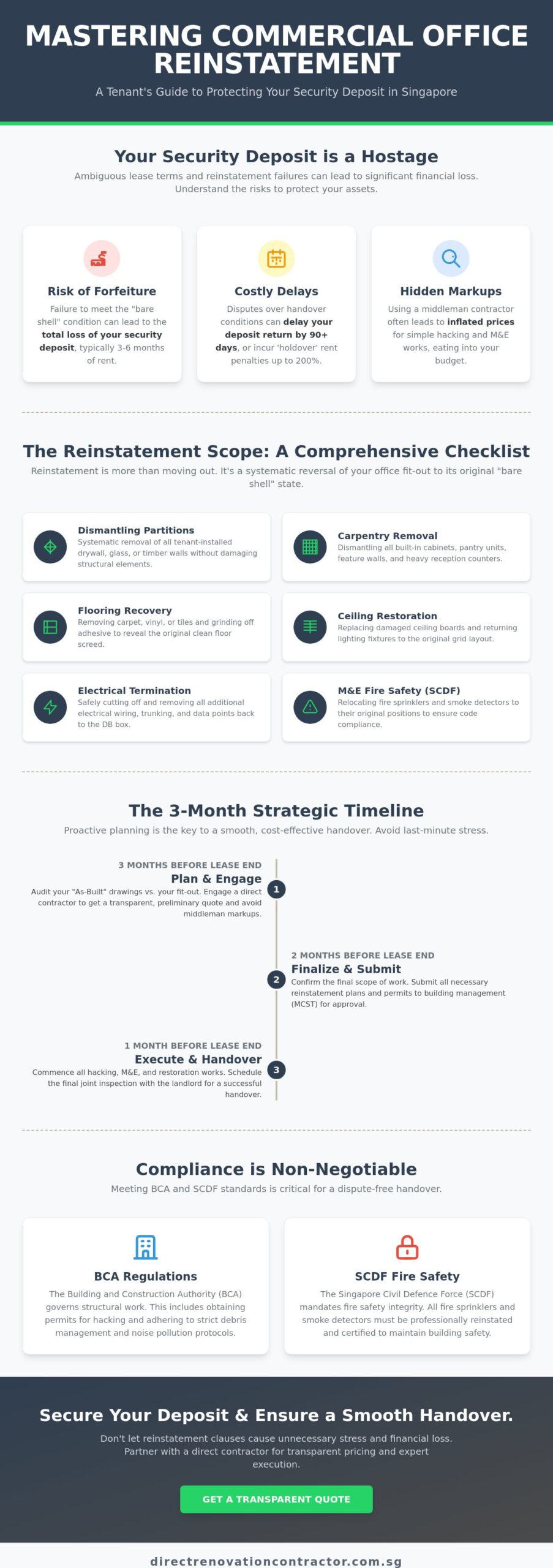
A standard commercial office reinstatement clause dictates that a tenant must return the premises to the landlord in its original “bare shell” condition. This process is far more intensive than a basic move-out. It requires a complete reversal of every modification made during your fit-out period. If you’ve occupied a Grade A office in the CBD for five years, the accumulation of custom fixtures can make this a high-stakes operation. You’re responsible for the systematic removal of all tenant-installed partitions, whether they’re made of drywall, glass, or timber. These structures must be taken down without damaging the building’s structural columns or perimeter walls.
The scope extends to every surface of the unit. You must handle the following tasks to satisfy the landlord’s surveyors:
- Carpentry Removal: Dismantling all built-in cabinets, pantry units, and heavy reception counters.
- Ceiling Restoration: Replacing damaged ceiling boards and returning lighting fixtures to the original grid layout specified in the handover plan.
- Electrical Termination: Cutting off and making safe all additional electrical wiring, trunking, and data points. All live wires must be properly insulated and tucked back into the original distribution board (DB) box.
- Flooring Recovery: Removing carpet tiles, vinyl sheets, or ceramic tiles to reveal the original screed or raised floor panels. Any adhesive residue must be ground off to ensure the floor is smooth and clean.
Mechanical & Electrical (M&E) Reinstatement
Technical compliance is where most tenants face delays. You can’t simply chop off wires and leave. You must relocate fire sprinklers and smoke detectors to their 2026 baseline positions to ensure the floor’s fire protection coverage is uniform. The Air-Conditioning and Mechanical Ventilation (ACMV) systems require professional rebalancing. This ensures that the air distribution returns to the landlord’s original design parameters. All these works must align with the Building Control Act, which governs the safety and integrity of Singapore’s built environment. You’ll need to provide testing and commissioning reports to prove the systems are fully functional before the keys are returned.
Hacking and Demolition Logistics
Managing the physical demolition in a live commercial building requires strict coordination. Hacking creates immense noise and dust, which 90% of building managements in Singapore prohibit during office hours. You’ll need to schedule work after 6:30 PM or on weekends. Proper disposal is another hurdle; all construction debris must be hauled to NEA-approved disposal sites. You don’t want to be caught fly-tipping or using the building’s general waste bins, as this leads to immediate fines. Coordinating with building management for loading bay access and lift protection is essential to avoid damaging common areas. Working with a direct renovation contractor allows you to manage these logistics efficiently while avoiding the 15% to 20% markups typically charged by interior design firms. Clear communication with the Management Corporation Strata Title (MCST) ensures the project stays on track and your security deposit remains intact.
As-Built vs. Fit-Out: Auditing Your Reinstatement Liability
Before you hire a contractor or sign a quote, you need a clear picture of what you actually owe the landlord. Most disputes regarding the commercial office reinstatement clause happen because the tenant lacks a documented baseline. You must locate your original ‘Condition Report’ from the start of your lease. This document, typically a thick folder of photos and notes from three or five years ago, is your primary defense against being charged for pre-existing floor cracks or ceiling stains.
Conduct a joint site walk-through with your facilities manager to identify every modification. You’re looking for every partition wall, built-in cabinet, and custom carpet tile installed during your tenure. Decoding the Scope of your initial fit-out helps you distinguish between your additions and the building’s core infrastructure. If you can’t prove a modification was there before you moved in, the cost of hacking it out will likely fall on you.
The Audit Checklist for Tenants
Compare your current floor plans with the landlord’s original ‘bare shell’ drawings. If you added high-density filing systems or heavy equipment, these often involve structural floor reinforcements. In Singapore, removing these structural elements requires a Professional Engineer (PE) to endorse the safety of the hacking process. You also need to audit your electrical load. If you upgraded the power for a server room or a pantry, the commercial office reinstatement clause usually requires you to decommission these non-standard lines and return the DB box to its original capacity. Check for any ‘gifted’ items too. Some landlords allow you to leave high-quality glass partitions or pantry cabinets if the next tenant wants them, which saves you thousands in disposal fees.
Negotiating ‘Cash-in-Lieu’ of Reinstatement
Hacking and hauling debris out of a CBD high-rise often costs more in logistics and night-shift labor than the actual demolition. In roughly 15% of commercial exits, landlords accept a ‘cash-in-lieu’ settlement. This is a lump sum payment where you pay the landlord to handle the reinstatement himself. It’s a pragmatic choice if your fit-out adds value to the property. However, you must value the work accurately. Get a detailed quote from a direct contractor first so you don’t overpay based on the landlord’s inflated estimates. Don’t forget the risks. If your settlement agreement isn’t airtight, a landlord might claim the S$15,000 you paid didn’t cover “latent defects” found after you vacated. Always demand a signed full discharge of liability once the payment is made.
How to Minimise Costs and Avoid ‘Middleman’ Markups
Managing the financial impact of a commercial office reinstatement clause requires a tactical approach. Many Singaporean businesses overpay by 20% or more because they hire design firms for what is essentially a construction and demolition job. You can protect your bottom line by following these five practical steps.
- Step 1: Start the planning process at least 3 months before your lease expiry. This window allows you to get multiple quotes and vet contractors without the pressure of a looming deadline.
- Step 2: Engage a direct renovation contractor to bypass interior design management fees. You don’t need a designer to hack walls, remove floor tiles, or dismantle ceiling grids.
- Step 3: Secure all necessary permits from the MCST and relevant authorities like the BCA or SCDF early. Permit delays are the primary cause of project overruns in Singapore.
- Step 4: Conduct a joint pre-handover inspection with the landlord’s representative. Document every existing scratch or mark to ensure you aren’t billed for damage you didn’t cause.
- Step 5: Obtain final clearance and the return of your security deposit. Don’t consider the job finished until you have the written sign-off from the building management.
The Advantage of Direct Contracting
Paying for “design” is unnecessary for demolition and restoration work. Reinstatement is about returning a space to its original state, not creating a new aesthetic. When you hire a direct renovation contractor singapore, you get factory pricing on essential services. Direct access to carpentry and masonry teams lowers your total bill because there’s no project management markup added to the sub-contractor’s rate. This transparency ensures you only pay for the actual labor, disposal, and materials required to satisfy your lease obligations.
Managing Timeline Risks
Liquidated damages in your lease make the reinstatement deadline non-negotiable. If the project finishes late, you could be liable for the landlord’s lost rent and legal fees, which often exceed S$500 per day for small units. We recommend building a 14 day buffer for unexpected M&E complications or material delays. Your contractor must provide a detailed schedule of works for MCST approval before any hacking begins. This schedule should include specific dates for debris removal and the restoration of fire safety systems. Clear planning prevents last minute panics that lead to expensive expedited labor charges.
Choosing the Right Partner for Office Reinstatement in Singapore
Selecting a partner for your exit strategy requires more than just a low quote. Technical competence in office renovation company roles directly impacts how smoothly you fulfill your commercial office reinstatement clause. Reinstatement is essentially a renovation in reverse. It demands a deep understanding of structural integrity and building services. An experienced office renovation contractor singapore ensures that every partition removed and every ceiling board replaced meets the original building specifications. This precision prevents costly disputes with building management during the final inspection.
Compliance with SCDF fire codes is non-negotiable in Singapore. If your reinstatement team fails to relocate sprinkler heads or fire sensors to their original positions, the landlord will reject the handover. We manage these technical details so you don’t have to face the 14-day rectification penalties common in Grade A office buildings. Direct Renovation Contractor Singapore provides transparent, unmarked-up pricing. You deal directly with the builders who do the work, ensuring your budget goes toward quality labor and materials rather than middleman commissions.
Our Direct Contractor Guarantee
We operate on a model of total transparency. You won’t find hidden fees or surprise “administrative charges” in our quotes. Our team handles the heavy lifting across all commercial property types, from shophouses to high-rise towers in the CBD. We’ve built a reputation with building managements in Jurong East, Changi Business Park, and Raffles Place, which helps expedite work permit approvals. Our core services include:
- Hacking and Demolition: Systematic removal of glass partitions, drywall, and custom built-in furniture.
- Masonry and Flooring: Restoring floor screed or replacing damaged tiles to match the original state.
- Electrical and M&E: Safe termination of power points and restoration of original lighting layouts.
Protecting Your Business Bottom Line
Efficiency in reinstatement allows for a smoother transition to your new office. Every day spent on a botched reinstatement is a day you’re potentially paying double rent. We focus on a “zero-defect” handover. This means we walk through the site with you before the landlord’s representative arrives, catching any minor issues that could delay your security deposit return. We also provide all necessary professional documentation and certifications, such as CS forms, for your corporate records.
You shouldn’t have to guess about the costs or the timeline of your exit. A clear, direct approach saves your business money and prevents legal friction. Contact us today for a non-obligatory site assessment and a direct quote to settle your commercial office reinstatement clause obligations once and for all.
Master Your Office Handover and Avoid Costly Exit Penalties
Navigating a commercial office reinstatement clause requires a clear understanding of your original tenancy agreement and current SCDF and BCA standards. By auditing your “As-Built” versus “Fit-Out” liabilities early, you prevent unexpected disputes during the final inspection. Many tenants face inflated costs due to hidden middleman markups from interior design firms. You can avoid these unnecessary expenses by working directly with a contractor who manages their own specialized teams for hacking, electrical works, and carpentry. This direct approach ensures technical accuracy and total financial transparency from day one.
Securing a smooth handover in 2026 starts with a professional site assessment that respects Singapore’s strict building regulations. Our team provides the technical expertise needed to restore your space to its original condition without the stress of hidden fees or delayed timelines. We focus on functional results and fair pricing so you can close your lease with absolute confidence.
Get a Direct, Transparent Quote for Your Office Reinstatement Today
Your office exit doesn’t have to be a source of financial strain when you have a pragmatic partner handling the heavy lifting.
Frequently Asked Questions
Can I leave my partitions behind if the next tenant wants them?
You can only leave partitions behind if you obtain written consent from the landlord and the incoming tenant through a legal indemnity or a Deed of Novation. Most tenancy agreements include a strict commercial office reinstatement clause that requires you to return the space to its original bare shell condition. Without a signed agreement transferring liability to the next occupant, you’re legally obligated to hack down all partitions and built-in structures before your lease ends.
How much does office reinstatement typically cost per square foot in Singapore?
Office reinstatement costs in Singapore generally range from S$5 to S$15 per square foot based on 2024 market averages. Your final bill depends on the volume of hacking required and the density of existing built-in carpentry or masonry. For a standard Grade A office in the CBD, costs often sit at the higher end because of strict building management rules and limited working hours for debris removal. We provide transparent, direct quotes to ensure there are no hidden markups.
Do I need a permit for office reinstatement hacking works?
You must obtain a Permit to Work (PTW) from the building management before starting any hacking or demolition activities. If your original renovation involved structural changes, you might also need a Professional Engineer to certify the works. Most commercial buildings in Singapore require contractors to submit a Method Statement and Risk Assessment (RAMS) before they grant site access. This process ensures the building’s fire safety and structural integrity remain intact during the project.
What happens if the landlord is not satisfied with the reinstatement quality?
If the landlord rejects the reinstatement quality, they’ll typically issue a punch list of defects for you to rectify within a specific grace period. If you fail to fix these issues, the landlord has the right to hire their own contractor and deduct the full cost from your security deposit. This often results in much higher fees than if you’d used a direct contractor to handle the job correctly the first time. It’s better to ensure a joint inspection happens before the final handover date.
Is ‘fair wear and tear’ enough to avoid repainting the office walls?
Fair wear and tear rarely covers the condition of the walls in a commercial setting, as most landlords expect the unit to be returned with a fresh coat of white paint. Scuffs, nail holes, and faded patches are considered your responsibility to fix. You should check your commercial office reinstatement clause, as it almost always specifies the exact brand and color code of paint required for the handover. Returning a unit with stained walls often leads to immediate deposit deductions.
Can I use my own contractor, or must I use the landlord’s approved list?
You can usually use your own direct contractor for general hacking and masonry, but you’re often forced to use the building’s appointed specialists for M&E and fire safety systems. Landlords insist on this because these specialists are familiar with the building’s central plant and sprinkler networks. We coordinate directly with these nominated contractors to ensure your reinstatement meets all building standards. This approach avoids the middleman markups often found with full-service design firms.
How long does a typical 2,000 sq ft office reinstatement take?
Reinstating a 2,000 sq ft office typically takes between 7 and 14 working days in a standard Singapore commercial building. The timeline depends on the volume of debris to be hauled away and whether we’re restricted to after-hours work. Demolition usually happens in the first three days, followed by electrical capping and wall patching. We provide a clear schedule at the start so you can plan your final handover inspection with the landlord without rushing.
What is an ‘As-Built’ drawing and where can I find it?
An ‘As-Built’ drawing is a technical floor plan that shows the exact final layout of the office, including electrical points, plumbing, and fire sprinklers. You’ll need this document to prove you’ve returned the space to its original configuration as specified in your lease. You can usually find these in the handover kit provided by your previous interior designer or renovation firm. If you’ve lost them, the building’s Management Office often keeps a master copy that you can access for a small administrative fee.