
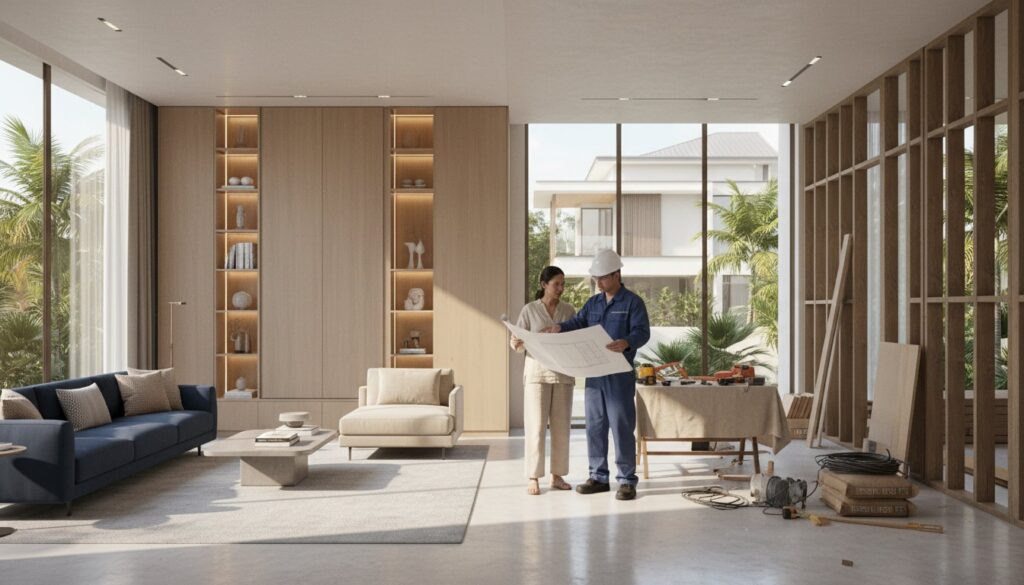
Why are you paying a 30% premium just to have a middleman pass instructions to the actual builders on your site? Most homeowners realize that renovating a landed house in Singapore is a complex operation where hidden structural issues can quickly drain a budget. You’re likely feeling the pressure of rising material prices and the lack of clarity in typical interior design quotes. It’s a common struggle to manage multiple sub-contractors while worrying about whether the final bill will match the initial estimate.
This guide provides a transparent, builder-first breakdown of the landed property renovation cost singapore for the 2026 market. We want to help you plan your project without the unnecessary markups that inflate your expenses. You’ll get a clear comparison between Additions and Alterations (A&A) and full reconstruction costs. We also preview the specific labor and material shifts expected in 2026 and show you how to secure high-quality masonry and carpentry at factory prices by working directly with the source.
Key Takeaways
- Understand how global supply chains and local labor shifts will impact your landed property renovation cost singapore for 2026 projects.
- Learn to differentiate budget requirements between Terrace, Semi-D, and Bungalow properties based on structural integrity and foundation needs.
- Get a transparent breakdown of trade-specific costs, including factory-direct rates for custom carpentry, masonry, and tiling.
- Discover how to identify hidden middleman markups in quotes to ensure you pay only for actual labor and materials in S$.
- Gain the technical clarity needed to manage your project directly with skilled builders for a more cost-effective and durable home upgrade.
Understanding Landed Property Renovation Costs in Singapore for 2026
Landed renovation costs represent the total financial commitment required for structural, aesthetic, and functional upgrades to a private property. This figure isn’t just about paint and tiles; it encompasses everything from foundational reinforcement to electrical rewiring and specialized carpentry. While public housing in Singapore follows a more standardized renovation path governed by HDB, landed properties are subject to complex URA and BCA regulations. These requirements directly influence your total landed property renovation cost singapore, as they often necessitate professional engineers and certified architects.
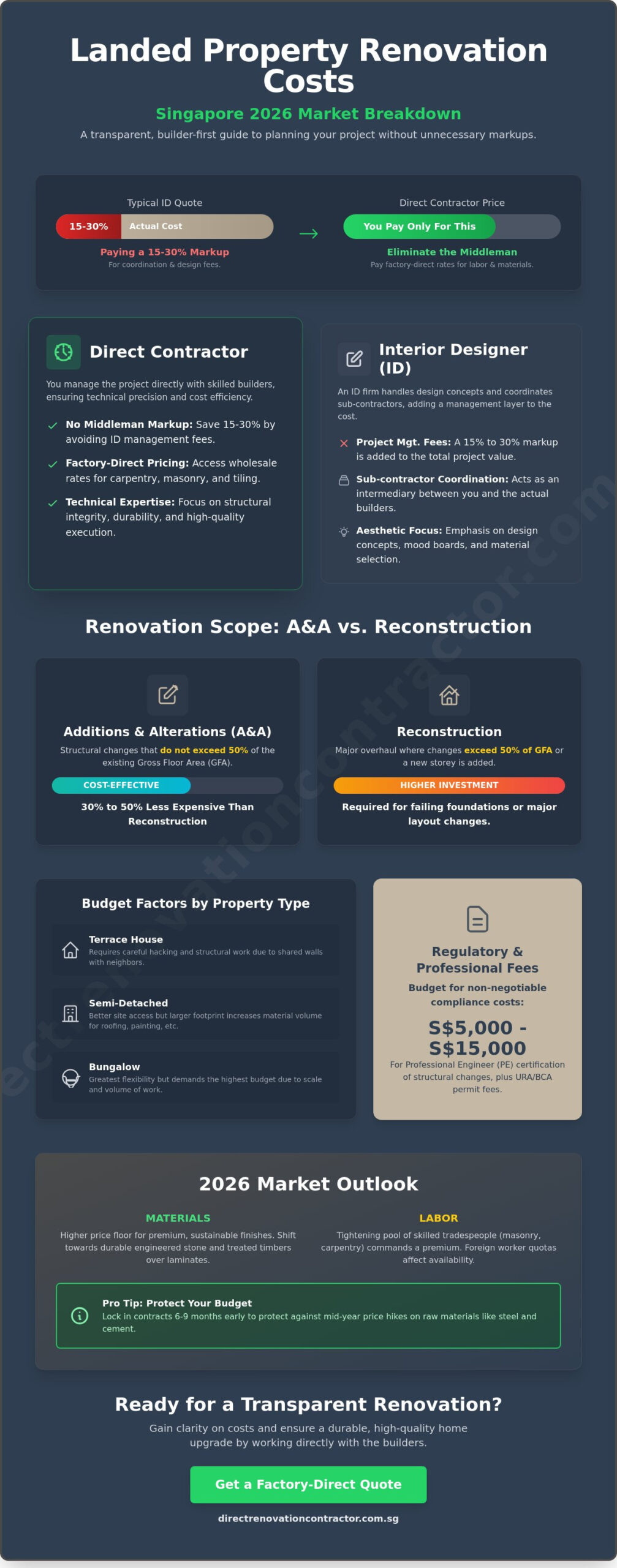
The 2026 cost landscape is defined by two primary factors: global logistics and local labor shifts. Supply chains for premium finishes have stabilized but at a higher price floor than previous years. Simultaneously, the local construction sector faces a tightening pool of skilled tradespeople. Homeowners must categorize their projects into three distinct scopes to manage budgets effectively. Interior-only renovations focus on cosmetic changes and cabinetry. Additions & Alterations (A&A) involve structural changes that don’t exceed 50% of the existing Gross Floor Area (GFA). Reconstruction is the most intensive category, involving major structural overhauls or GFA increases beyond the 50% threshold.
The 2026 Market Outlook for Landed Homeowners
Material costs in 2026 are heavily influenced by the demand for sustainable and high-durability finishes. Homeowners are moving away from cheap laminates toward carbon-neutral engineered stones and treated timbers that offer longer lifecycles. Labor availability remains a significant bottleneck. Specialized trades like masonry and bespoke carpentry require years of experience, and the current quota systems for foreign workers mean these skills command a premium. To secure 2026 contract rates, early planning is vital. Locking in a contract 6 to 9 months before the commencement of work protects you from mid-year price hikes in raw materials like steel and cement.
Direct Contractor vs. Interior Designer: The Price Gap
The choice between a direct contractor and an Interior Designer (ID) is the biggest factor in your bottom line. Typical ID firms charge project management fees ranging from 15% to 30% of the total project value. This markup covers their design conceptualization and coordination efforts. When you work with a direct contractor, you eliminate this middleman layer. We provide factory-direct pricing on carpentry and materials because we own the production process. For landed properties, technical expertise in structural works is often more valuable than aesthetic mood boards. A direct contractor focuses on the integrity of the hacking, tiling, and masonry, ensuring that the landed property renovation cost singapore stays grounded in practical execution rather than high-concept markups.
Key Factors That Influence Your Landed Renovation Budget
Calculating your landed property renovation cost singapore requires more than a simple per-square-foot estimate. Property type plays a massive role in the final bill. An intermediate terrace shares walls with neighbors, meaning we have to be extremely careful with hacking to avoid structural vibrations that affect the houses next door. Semi-detached homes and bungalows offer better site access, but their larger footprints significantly increase the volume of masonry, roofing, and painting works.
You also need to budget for professional fees and regulatory compliance. URA and BCA permits aren’t optional for landed projects. You’ll need a Professional Engineer (PE) to certify structural changes, which typically costs between S$5,000 and S$15,000 depending on the project’s complexity. For minor works, you can refer to the BCA guidelines for building works to see which modifications are exempt from formal approval. Skipping these legal steps leads to heavy fines or orders to reinstate the original structure at your own expense.
A&A vs. Reconstruction: Which Path is More Cost-Effective?
Choosing between Additions & Alterations (A&A) and reconstruction is the biggest decision affecting your landed property renovation cost singapore. A&A projects keep the existing framework and usually cost 30% to 50% less than a full rebuild. However, if your changes exceed 50% of the gross floor area or involve adding a new story, BCA classifies it as reconstruction. We often advise clients that if the foundation is failing or the layout is extremely inefficient, a full reconstruction is more cost-effective than spending hundreds of thousands on “patchwork” repairs that don’t solve underlying issues.
Property Age and Condition Assessment
Older homes built in the 1970s or 1980s often hide expensive surprises. Rewiring a whole house and replacing old galvanized pipes is a standard requirement for safety and modern water pressure. In specific Singapore neighborhoods like Katong or Marine Parade, soft soil conditions might require deep piling. This can add S$100,000 or more to your initial estimate before we even start the interior carpentry. Waterproofing is another non-negotiable investment. With Singapore’s heavy tropical rainfall, skimping on roof sealing or balcony membranes will lead to ceiling leaks and mold within 24 months. If you’re unsure about your home’s current state, our direct contractor team can conduct a site assessment to identify these hidden costs early.
- Structural Integrity: Reinforcing foundations for new attic levels or extensions.
- Built-up Area: Costs scale based on the total floor area, not just the land size.
- MEP Systems: Upgrading Mechanical, Electrical, and Plumbing systems for modern appliances.
Detailed Cost Breakdown by Renovation Scope and Trade
Estimating the landed property renovation cost singapore accurately depends on breaking down the project into specific trades. Unlike HDB flats, landed homes have larger footprints and structural complexities that demand specialized labor. Working directly with a contractor eliminates the 20% to 30% markup typically added by design firms, ensuring your budget goes into actual materials and workmanship rather than agency overhead.
Masonry, Flooring, and Structural Works
Masonry is often the largest expense because it involves heavy labor and raw materials. For 2026 projects, market rates for hacking and tiling generally range from S$15 to S$28 per square foot depending on the tile size and material choice. Structural works like removing load-bearing walls require a Professional Engineer (PE) certification and the installation of steel I-beams, which can cost between S$4,500 and S$9,000 per opening. While vinyl flooring is a cost-effective choice at S$5 to S$8 per square foot, many landed owners opt for natural stone or large-format porcelain for better long-term durability and higher resale value.
Direct Carpentry and Bespoke Cabinetry
Custom carpentry defines the functionality of your home. By using a direct contractor with an in-house factory, you save on middleman fees and gain better control over the finish. Kitchen cabinets are priced per foot run, with standard industry rates for 2026 hovering between S$150 and S$350 depending on the internal carcass material and laminate finishes. Wet kitchens require moisture-resistant materials like PVC or stainless steel carcasses, while dry kitchens focus on aesthetics with integrated appliances. Full-height wardrobes typically cost S$280 to S$450 per foot run. Direct fabrication ensures faster lead times and stricter quality control over the joinery joints.
Electrical, Plumbing, and Smart Home Integration
Rewiring a multi-storey landed house is a massive undertaking that shouldn’t be compromised. A full electrical overhaul for a 3,000 square foot terrace house can range from S$18,000 to S$35,000. This includes new DB boxes and points for smart home hubs. Plumbing costs are driven by the number of bathrooms and the complexity of the piping layout. In 2026, we see more homeowners budgeting for future-proof features. These technical upgrades are essential components of the total landed property renovation cost singapore for modern projects:
- EV charger point installation: S$2,500 to S$4,500 for cabling and hardware.
- Solar panel readiness: S$1,500 to S$2,500 for basic infrastructure and isolators.
- Integrated security: S$3,000 to S$7,000 for smart locks, sensors, and 4K CCTV arrays.
Prioritizing these technical trades ensures your home remains safe and compliant with current EMA standards. It’s better to invest in high-quality copper wiring and leak-proof piping now than to face expensive repairs once the finishes are installed.
Avoiding Hidden Markups and Managing Your Renovation Budget
Managing your landed property renovation cost singapore effectively starts with total transparency. Many firms hide their profit margins behind vague descriptions. You need to read a quote with the skepticism of a seasoned builder. Look for itemized breakdowns rather than “lump sum” packages. A professional quote lists every square foot of tiling, every running foot of cabinetry, and every specific material brand. If a line item just says “Living Room Works,” you’re likely paying for a hidden buffer that doesn’t benefit your home.
How to Spot and Negotiate Middleman Markups
Traditional interior design firms often act as coordinators. They hire sub-contractors and add a 20% to 30% management fee on top of the actual labor and material costs. You can spot these markups when a quote lacks technical detail. Red flags include “standard materials” without a brand name or origin. If a contractor owns their own carpentry workshop, they control the production line. This eliminates the middleman markup on your wardrobes and kitchen cabinets. Always ask for direct supplier certifications for items like quartz countertops or specialized floor finishes to ensure you aren’t paying for three different layers of profit.
Budgeting for Authority Approvals and Professional Fees
Landed renovations often involve structural changes that require legal clearance. You must account for Qualified Person (QP) fees and submissions to the Urban Redevelopment Authority (URA) and Building and Construction Authority (BCA). For major rebuilds or additions of Gross Floor Area (GFA), you might also need a Fire Safety Manager (FSM) to ensure compliance with SCDF regulations. These professional fees are separate from construction labor. A reliable contractor handles this paperwork to prevent regulatory fines. These fines can reach five figures if you hack a load-bearing wall or extend a balcony without the proper permits in place.
Structural surprises are common in older terrace houses or semi-detached units. You should set aside a 10% to 15% contingency fund specifically for “unforeseen” discoveries. This covers issues like termite infestations in old roof trusses, corroded plumbing hidden behind concrete, or outdated electrical wiring that doesn’t meet current EMA standards. If you don’t use this fund, it stays in your pocket. If you do need it, it prevents your project from stalling midway through the landed property renovation cost singapore planning phase.
If you prefer to manage the project yourself but lack technical plans, look for a DIY Renovation Support Package. This provides expert 3D drawings and technical blueprints. It gives you the visual clarity needed to guide workers without paying for a full-scale design service. This approach keeps your budget focused on high-quality materials and skilled labor rather than abstract consulting fees.
Why Direct Renovation Contractor is the Best Choice for Landed Homes
Choosing a direct contractor for your project is the most effective way to manage your landed property renovation cost singapore. Most interior design firms function as project management agencies that outsource 100% of the actual construction work. We operate differently. We provide homeowners with direct access to our own skilled masonry, carpentry, and electrical teams. By removing the middleman, you eliminate the typical 20% to 30% markup that agencies charge just to facilitate communication.
Our model focuses on financial transparency and technical precision. We offer unmarked-up pricing for high-end materials, ensuring your budget goes toward quality finishes rather than administrative overhead. We’ve established a proven track record in home renovation across Singapore, handling everything from terrace house extensions to bungalow modernizations. You’ll receive professional 3D documentation and full project management, providing the visual clarity of a design firm without the inflated price tag.
- Direct Labor: Our in-house teams handle hacking, tiling, and wiring directly.
- Material Savings: We pass our bulk supplier discounts directly to the homeowner.
- Technical Expertise: We focus on structural integrity and functional design that lasts 20 years or more.
Our Direct Contractor Model for Landed Properties
Taking the Next Step for Your Landed Renovation
The first step toward a successful renovation is a thorough site consultation. We visit your property to conduct precise measurements, as landed homes often have unique structural quirks that off-site estimates can’t account for. Following this, we provide a transparent, itemized quote. Whether you own a Terrace, Semi-D, or Bungalow, you’ll see a clear breakdown of costs for every stage of the build. This eliminates “hidden charges” and allows you to prioritize your spending effectively. It’s time to build a home that matches your vision and your budget.
Ready to start your project? Get a direct renovation quote for your landed property today and see how much you can save by going direct.
Secure Your 2026 Landed Renovation Budget Today
Planning a landed home overhaul in Singapore requires a firm grasp of technical trades and material costs. You’ve seen how avoiding the 20% to 30% middleman commissions typically charged by design firms can save a significant portion of your budget. By working directly with a builder, you eliminate the hidden markups that often inflate project totals. Our approach relies on in-house masonry and electrical teams to maintain high standards of workmanship across every floor. We also provide direct-from-factory carpentry prices, ensuring your custom cabinets and wardrobes are built with quality materials at a fair rate.
Navigating the landed property renovation cost singapore doesn’t have to be a guessing game. Focus on transparent pricing and technical expertise to ensure your home is built to last. We’re ready to help you manage every hacking and tiling detail with precision. Your 2026 renovation project can stay on track when you prioritize direct communication and honest building practices. Take the first step toward a well-built home that fits your financial plan. We look forward to building with you.
Request a Transparent Landed Renovation Quote
Frequently Asked Questions
How much does a typical 3-storey terrace renovation cost in Singapore for 2026?
A typical 3-storey terrace renovation in 2026 usually ranges from S$300,000 to S$600,000 for major works. This estimate includes extensive masonry, full electrical rewiring, and new plumbing across all levels. If you choose premium finishes like imported marble or high-end custom carpentry, the total can exceed S$800,000. Working with a direct contractor helps keep the landed property renovation cost singapore manageable by removing middleman markups on materials.
What is the difference between A&A and a full reconstruction in terms of cost?
Additions and Alterations (A&A) costs significantly less than a full reconstruction, generally ranging from S$200 to S$400 per square foot. Reconstruction involves demolishing more than 50% of the existing structure, which pushes prices above S$500 per square foot. While A&A works within the existing framework, reconstruction requires new foundations and structural supports. This makes reconstruction a much larger financial commitment that often starts at S$1 million for a standard terrace.
Are there hidden costs I should be aware of when renovating an older landed house?
Hidden costs in older landed houses often stem from corroded cast iron pipes and brittle electrical wiring that require total replacement. You might also encounter structural cracks or termite infestations that aren’t visible during the initial site measurement. It’s smart to budget an extra 10% to 15% of your total contract for these contingencies. We provide transparent pricing upfront, but structural integrity issues discovered during hacking are mandatory fixes for safety.
Do I need a Professional Engineer (PE) for my landed renovation?
You need a Professional Engineer (PE) if your renovation involves hacking load-bearing walls or altering the building’s structure. The PE must endorse the drawings and supervise the structural works to ensure the house remains safe and compliant with the Building Control Act. This is a legal requirement for any work that affects the integrity of the property. We coordinate directly with PEs to streamline the submission process for our clients.
How long does a full landed property renovation usually take?
A full landed property renovation usually takes between 6 and 12 months from the start of hacking to the final handover. Complex projects involving structural extensions or roof replacements often sit at the longer end of that scale. Factors like weather conditions and the speed of BCA or URA approvals also influence the timeline. We provide a detailed project schedule so you can track progress across every phase of the build without guesswork.
Can I stay in my landed home during a partial renovation?
Staying in your home during a major landed renovation isn’t recommended due to heavy dust, noise, and safety risks. If the work is limited to one floor or specific rooms, it’s possible but will likely extend the project duration by 20% or more. Workers need clear access to move materials and debris efficiently throughout the day. Most homeowners choose to rent temporary accommodation to avoid the daily disruption of masonry and carpentry work.
Is it cheaper to hire a direct contractor or an interior designer for landed properties?
Hiring a direct contractor is generally 15% to 30% cheaper than engaging an interior designer for landed properties. We manage our own workers and source materials directly, so you don’t pay for design commissions or project management markups. This direct model ensures your landed property renovation cost singapore stays focused on quality materials and skilled labor. You get the same technical expertise without the inflated overhead costs of a design firm.
What are the BCA and URA requirements for adding an extra floor to my house?
Adding an extra floor requires URA approval to ensure you don’t exceed the Gross Floor Area (GFA) or the designated storey height for your specific zone. You must also submit structural plans to the BCA to prove the existing foundation can support the additional weight. If the current structure is too weak, you’ll need to install micro-piles or strengthen existing columns. These regulatory steps are essential and must be completed before construction starts on site.