
Last Tuesday, a first-time owner in Toa Payoh watched their S$2,000 renovation deposit vanish simply because their contractor started hacking before the MCST permit was officially stamped. You likely feel that the line between a dream home and a legal headache is dangerously thin. It’s stressful to manage rigid URA regulations while worrying about hidden markups from interior design firms that inflate your final bill by 20% or more.
This 2026 manual simplifies the condo renovation guidelines singapore owners must follow to protect their deposits and avoid unnecessary friction with management. We provide a clear roadmap for permit approvals and explain exactly which structural changes are legally allowed in your unit. By the end of this guide, you’ll understand how to maximize your floor area and material quality while keeping costs low through a direct contractor model. We cover everything from masonry and carpentry standards to the specific paperwork required to get your project moving. You will gain the technical confidence to oversee your renovation without paying for overpriced middleman services or risking your hard-earned deposit.
Key Takeaways
- Navigate the legal complexities of condo renovation guidelines singapore by understanding how the BMSMA and MCST by-laws impact your structural and facade plans.
- Streamline your project approval with a clear checklist for obtaining the “Notice of Commencement” and managing essential insurance and floor plan documentation.
- Save significantly on your 2026 renovation by adopting a direct contractor model that removes the 20-30% markup typical of traditional interior design firms.
- Implement practical space-saving strategies for small condo interiors while maintaining strict adherence to estate uniformity and technical requirements.
- Avoid expensive delays and penalties by identifying non-negotiable restrictions on hacking, masonry, and external works before your project begins.
Understanding the Condo Renovation Landscape in Singapore
Renovating a private apartment in Singapore isn’t as simple as picking a color palette. You’re operating within a strict legal framework. These condo renovation guidelines singapore are a mix of national government regulations and estate-specific rules. The primary law governing your project is the Building Maintenance and Strata Management Act (BMSMA), which was established in 2004. This act gives legal power to your condo management to set and enforce rules. The Building and Construction Authority (BCA) oversees the safety and structural integrity of all buildings, ensuring that your contractor’s work doesn’t compromise the building’s stability.
In 2026, the gap between HDB and private renovations remains significant. HDB owners follow a single set of national rules. Private owners must deal with their specific Management Corporation Strata Title (MCST). While HDB permits are standardized, private condo approvals depend on your specific estate’s house rules. One development might allow balcony decking, while the neighbor forbids it to maintain a uniform facade. This variance exists because every MCST has the right to protect its property value and resident comfort through unique by-laws. We see this most often in older estates versus newer developments where modern construction materials change what’s technically possible.
The Role of the MCST in Your Renovation
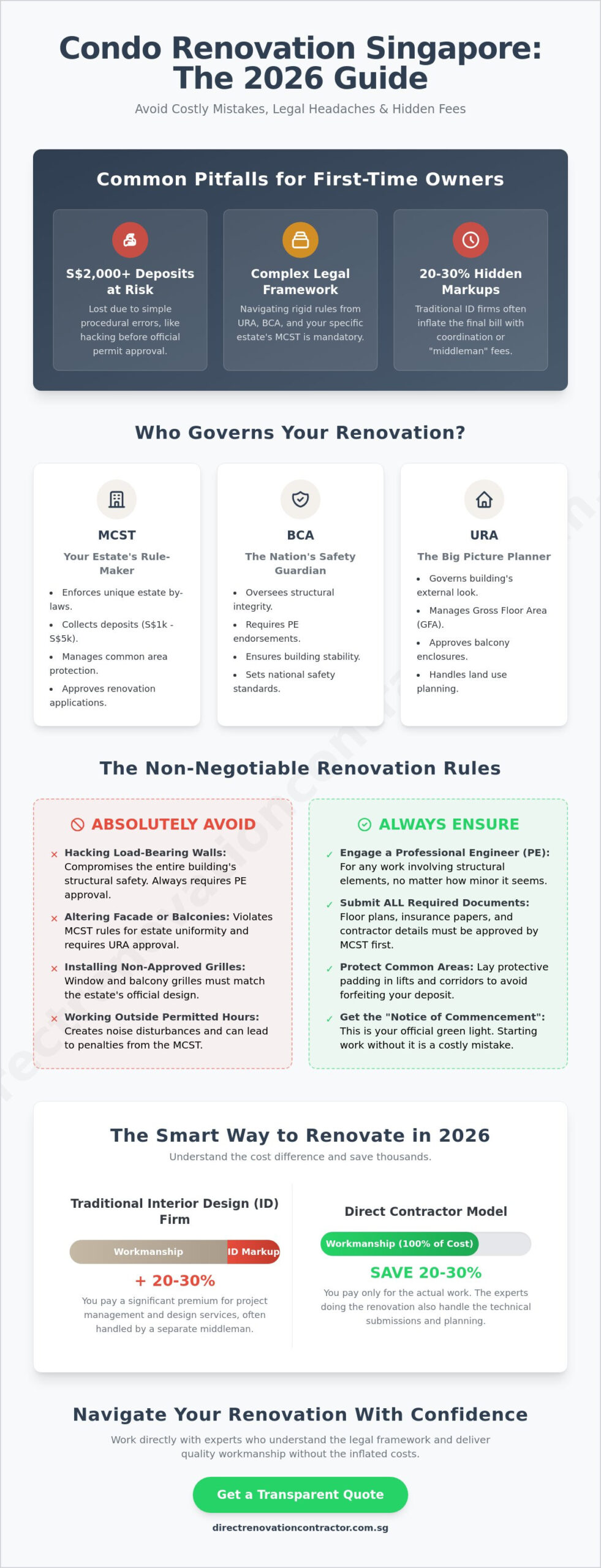
The MCST is the legal entity managing your estate. They have the authority to demand renovation deposits, often ranging from S$1,000 to S$5,000, to cover potential damage to common areas. They enforce standard by-laws from the BMSMA plus additional house rules. These rules protect common property like lifts and corridors while ensuring neighbors aren’t disturbed by noise outside of permitted hours. Your MCST manager is the gatekeeper for your condo renovation guidelines singapore, and they can halt work if rules aren’t followed.
URA Guidelines vs. MCST Rules
The Urban Redevelopment Authority (URA) handles land use and the building’s external appearance. If you’re increasing the Gross Floor Area (GFA), such as by enclosing a balcony or adding a loft, you need URA planning permission. MCST approval doesn’t mean you’ve cleared URA requirements. Your contractor must ensure the project complies with both sets of rules. Internal aesthetic changes like new carpentry usually don’t need URA’s nod, but structural hacking always requires a Professional Engineer (PE) and BCA clearance to ensure safety.
Working with a direct contractor helps you cut through the confusion. We handle the technical requirements and the paperwork directly, ensuring your renovation meets both the estate’s house rules and national safety standards. This direct approach eliminates middleman markups and ensures that the person doing the work actually understands the legal constraints of your specific unit.
Essential Condo Renovation Rules and Structural Restrictions
Renovating a private apartment involves more than just interior design. You are operating within a Management Corporation Strata Title (MCST) framework, where your actions affect the entire building’s integrity and value. Following the condo renovation guidelines singapore requires a clear understanding of what you can and cannot touch. Most restrictions are non-negotiable because they involve structural safety or the estate’s collective appearance.
Hacking load-bearing walls or structural columns is a major violation. These elements are the backbone of the building. Removing even a small portion can compromise the stability of units above and below yours. Before you plan any masonry work, review the original structural drawings. You can find more details on owner responsibilities in BCA’s guide for condo owners, which outlines the legal necessity of obtaining professional engineer (PE) endorsements for certain structural changes.
Safety regulations also extend to your windows and balconies. You cannot install window grilles that differ from the estate’s approved design. Invisible grilles are common in 2026, but they must still comply with the specific gap widths and materials mandated by your MCST. If you need a technical assessment of your floor plan, our direct renovation specialists can help identify which walls are safe to remove without risking your deposit.
External Facade and Estate Uniformity
MCST by-laws prioritize a uniform look for the building. You cannot change the colour, material, or design of windows and entrance doors facing the common corridor. This uniformity maintains the property’s market value. Air-conditioning ledges must only be used for their intended purpose; you cannot convert them into storage or garden spaces. External piping must remain in its original position and cannot be rerouted in a way that makes it visible from the street. For balconies, most condos require standardized sun-shading devices or blinds. You must use the specific brand, model, and colour approved by the management to ensure the facade remains consistent.
Gross Floor Area (GFA) and Loft Additions
Managing the Renovation Process: Permits, Deposits, and Timelines
You can’t simply start hacking walls the moment you get your keys. Following the condo renovation guidelines singapore homeowners must adhere to starts with obtaining a “Notice of Commencement” from your Management Corporation Strata Title (MCST). This document is your official green light. Without it, security will bar your contractors from entering the premises. The process is governed by the Building Maintenance and Strata Management Act, which grants the management the authority to regulate works that affect the building’s structural integrity or common property.
The workflow begins with a formal application. You’ll need to prepare a document package that includes your detailed floor plans, a clear work schedule, and valid insurance certificates. Most MCSTs require a renovation deposit to cover potential damage to common areas like lifts and corridors. This deposit typically ranges from S$1,000 to S$5,000. It’s fully refundable, provided your contractor doesn’t cause damage or leave debris in common areas. We’ve seen management offices take 7 to 14 days to process these permits, so plan your start date accordingly.
Securing the Renovation Permit
To avoid delays, ensure your contractor’s Public Liability Insurance and Work Injury Compensation policies are up to date. Most condos require a minimum coverage of S$1,000,000. If your plan involves removing any internal walls, you must submit a specific “hacking plan” highlighted in red. For structural changes, the MCST will demand a Professional Engineer (PE) certification to prove the building’s safety isn’t compromised. Accurate paperwork prevents the management from halting your project mid-way.
Renovation Hours and Noise Management
Noise is the biggest trigger for neighbor disputes. Standard working hours are strictly Weekdays from 9 am to 5 pm. Work is prohibited on Sundays and Public Holidays. Heavy drilling and hacking are further restricted, usually limited to a 2 to 4-hour window daily, such as 10 am to 12 pm or 2 pm to 4 pm. It’s your responsibility to ensure the contractor sticks to these blocks. Failure to comply often results in immediate work stoppage orders and forfeited deposits.
Logistics and Site Protection
Before any materials arrive, your contractor must install lift protection and floor padding along the common path. Most condos have strict loading bay height restrictions, often capped at 2.4 meters, which limits the size of delivery trucks. Illegal dumping is a serious offense. All renovation debris must be removed from the site daily. You cannot use the common estate bins for construction waste. Following these condo renovation guidelines singapore ensures a smooth final inspection where the MCST verifies that no common property was damaged before returning your S$1,000 to S$5,000 deposit.
Cost-Saving Strategies for Condo Homeowners
Renovating a condo in 2026 requires a sharp eye on the budget. Average costs have risen, with a standard 3-bedroom unit renovation often starting at S$65,000 and reaching upwards of S$130,000 for premium finishes. Following the condo renovation guidelines singapore strictly helps you avoid heavy fines from the MCST, but managing the actual dollars requires a strategic approach to procurement and project management.
The Direct Contractor Advantage
Hiring a direct renovation contractor singapore is the most effective way to cut costs. Traditional interior designers (IDs) typically add a 20% to 30% markup for project management and design fees. By working directly with the builder, you keep that money in your pocket. We provide 3D drawing support to help you visualize your home renovation without paying premium design firm prices. You’ll need to vet contractors for technical competence in condo-specific masonry and carpentry, as these projects require higher precision than standard HDB flats.
Hidden Costs and Contingency Planning
Don’t overlook the administrative requirements set by your building management. Most condos charge a non-refundable lift protection fee and require a renovation deposit ranging from S$1,000 to S$3,000. If your plans involve hacking non-load bearing walls, you must hire a Professional Engineer (PE) to certify the works. This usually costs between S$600 and S$1,500 depending on the complexity. For resale units, always set aside a 15% contingency fund. Old plumbing and wiring often hide issues that only appear once hacking starts. You can offset these costs by hiring a carpenter singapore who operates their own factory. Going factory-direct for wardrobes and kitchen cabinets eliminates another layer of middleman profit.
Focus your spending on items that are difficult to replace later. High-quality internal plumbing and heavy-duty electrical wiring are essential for long-term reliability. You can save money by choosing high-grade vinyl flooring over expensive marble or homogeneous tiles. Vinyl is faster to install and requires less hacking, which keeps your labor costs down while still complying with condo renovation guidelines singapore regarding noise and debris management. Choosing standard sizes for doors and windows instead of custom shapes also yields significant savings.
Ready to start your project without the middleman markup? Get a transparent quote from our team today.
Executing Your Condo Renovation with Direct Renovation Contractor
Choosing the right partner to execute your vision is the final, most critical step in the renovation process. Adhering to the strict condo renovation guidelines singapore authorities and individual MCSTs set requires a contractor who understands technical compliance as much as aesthetics. We’ve built our reputation on being a direct contractor, which means you bypass the 20 percent to 30 percent markups typically charged by interior design firms. Our team works directly on your site, handling the masonry, electrical, plumbing, and carpentry with a focus on structural integrity and cost-efficiency.
Our specialized approach to singapore small condo interior design prioritizes space optimization through technical precision. We don’t just suggest layouts; we calculate the exact dimensions needed for custom cabinetry to ensure every square centimeter of your unit is functional. This is vital in 2026, where new launch floor plates continue to shrink. We manage the entire MCST liaison process, from submitting architectural drawings to managing the S$1,000 to S$3,000 renovation deposits common in Singapore developments. Our familiarity with different condo bylaws ensures your project doesn’t face work-stop orders or heavy fines for noise violations.
Transparency is our core operating principle. You’ll receive a detailed breakdown of costs for every phase, including:
- Direct factory pricing for all custom carpentry fabricated in our local workshop.
- Unmarked-up rates for electrical rewiring and plumbing works.
- Clear masonry costs for hacking and tiling based on actual floor area.
- Strict adherence to the 9:00 AM to 5:00 PM noisy work window to protect your deposit.
Our Integrated Condo Renovation Packages
Quality Assurance and Compliance
Safety is non-negotiable. We use high-grade, Singapore-standard materials that pass all fire safety and load-bearing requirements. You’ll receive regular site updates via photos and videos, ensuring you’re informed of the progress without needing to be physically present every day. We guarantee that all work meets the BCA’s quality standards for residential buildings. Contact us today for a direct, transparent quote and let’s get your condo renovation started on the right track.
Take the Next Step Toward Your Ideal Condo Interior
Navigating the strict condo renovation guidelines singapore requires more than just a vision; it demands a clear understanding of URA and MCST protocols. You’ve learned that securing permits early and managing security deposits are essential steps to keep your project on track. By choosing a direct contractor model, you eliminate unnecessary middleman markups. These markups often inflate costs by up to 30% at traditional interior design firms. Our team focuses on technical competence and honest workmanship to turn these complex regulations into a seamless building process. We handle everything from masonry to direct factory-to-home carpentry. This ensures your private estate meets all structural requirements without any hidden fees. Our expertise in MCST and URA compliance for private estates means you won’t have to worry about costly delays or legal setbacks. You don’t have to overpay for a beautiful, compliant home when you work directly with the builders who actually do the work. We’re here to provide the technical expertise and financial transparency you need for a successful 2026 renovation. Let’s get your project started with a straightforward plan that respects your budget and your time.
Get a direct, transparent quote for your condo renovation from our expert team today.
Frequently Asked Questions
Do I need a permit for minor condo renovations like painting or changing light fixtures?
You don’t need a formal renovation permit for minor maintenance tasks like internal painting, wallpapering, or replacing existing light fixtures. These works don’t involve structural changes or affect the building’s electrical load significantly. However, you must still notify your Management Corporation Strata Title (MCST) office to register your workers and arrange for lift protection. About 15% of condo developments have specific bylaws regarding the types of paint fumes or the specific hours these minor works can occur.
How long does it typically take for the MCST to approve a renovation permit?
Most MCST offices take between 7 and 14 working days to process a standard renovation application. This timeline depends on the completeness of your submission, including your contractor’s All Risk Insurance and Public Liability policies. To keep your condo renovation guidelines singapore schedule on track, submit your detailed floor plans and hacking requests at least 21 days before your intended start date. This buffer allows for any technical clarifications the management might request regarding plumbing or electrical rewiring.
Can I renovate my condo balcony into a study room or an extended living area?
You cannot legally enclose a balcony with permanent walls or glass to create a study room because this increases the unit’s Gross Floor Area (GFA). URA regulations are strict about maintaining balconies as open outdoor spaces. You can only install URA-approved balcony blinds or glass curtains that meet specific transparency and porosity standards. Attempting to fully seal the area often leads to a legal notice from the authorities requiring you to reinstate the original layout at your own expense.
What happens if my contractor accidentally damages the common property or the lift?
Your contractor is liable for the damage, but the MCST will typically deduct the repair costs directly from your renovation deposit. If a worker scratches a lift panel or cracks a corridor tile, the management office will obtain a repair quote and subtract that amount, which can range from S$200 to over S$2,000. We recommend taking date-stamped photos of all common areas before work begins. This documentation protects you from being blamed for pre-existing cracks or stains in the building’s common areas.
Are there any specific rules for installing a loft or mezzanine floor in my condo?
Installing a mezzanine floor is highly restricted and usually requires both BCA and URA approval if the structure exceeds 5 square meters. Most condos have already reached their maximum allowable GFA, meaning additional floor surfaces are legally prohibited. Even for smaller furniture-based lofts, you must consult a Professional Engineer (PE) to certify that the weight doesn’t compromise the structural integrity of the floor slab. Unauthorized mezzanines are considered illegal structures and can prevent you from selling your property in the future.
How can I get my renovation deposit back from the MCST after the works are finished?
You can claim your deposit back by scheduling a joint final inspection with the building supervisor once all renovation works are complete. The MCST will check for damages to common property and ensure that all renovation debris has been cleared from the site. If everything is in order, the refund process typically takes 14 to 30 days to process the cheque. Ensure your contractor removes all floor protection and tape marks from the common corridors, as uncleared mess is a leading cause for deposit delays.
Can I change the main entrance door of my condo unit to a different design?
You can replace your main door, but the new design must match the original color, size, and appearance to maintain the building’s aesthetic uniformity. The most critical requirement is that the door must be fire-rated for at least 30 minutes to comply with SCDF safety codes. You must provide the fire-rated certificate from the manufacturer to your MCST for their records. Choosing a design that deviates from the estate’s standard look will likely result in a rejection of your renovation application.
Is it possible to do renovation works on Saturdays in a Singapore condominium?
Most Singapore condominiums strictly prohibit noisy renovation works on Saturdays, Sundays, and Public Holidays. While some MCSTs allow “light works” like painting or site cleaning between 9:00 AM and 1:00 PM on Saturdays, any hacking, drilling, or heavy masonry is forbidden. Statistics show that 90% of private developments restrict all contractor activity to weekdays to ensure residents aren’t disturbed. Following these condo renovation guidelines singapore helps you avoid immediate work stop-orders and potential fines from the management office.