
An interior design firm isn’t the only route to a finished home. An ID firm typically develops the design and coordinates the renovation, while a direct contractor focuses on carrying out renovation works; for HDB flats, contractors must be listed in HDB’s Directory of Renovation Contractors. This guide to home renovation in Singapore for HDB and condo owners explains the key differences, along with the permits and work-hour rules to plan around.
It’s reasonable to start with the budget, but your scope of work, approval process and material choices also shape the plan. This guide explains how to assess renovation costs without relying on a one-size-fits-all figure, what affects timelines, and how HDB requirements differ from condo management rules. You’ll also find practical guidance on choosing a contractor, planning a layout and selecting finishes for everyday use.
Key Takeaways
- Choose between an ID firm and a direct contractor by considering how much design development and project coordination you want handled for you.
- Plan permits and building-management approvals before work starts, and build the allowed work hours into your schedule.
- Choose layouts and materials around your household’s routines, storage needs and long-term use, not appearance alone.
- Estimate costs from the renovation scope, flat condition and material choices; resale and condo projects may involve different cost drivers than a new HDB flat.
1. Planning an HDB renovation and choosing an interior designer or contractor
List the work your HDB flat needs, then decide how much design and coordination you want. An interior designer can develop layouts and features; a direct contractor focuses on carrying out the agreed renovation work. Share your ideas, storage needs and moving plans so the design supports daily life. Before work begins, put the scope, materials and flooring choices in a written contract.
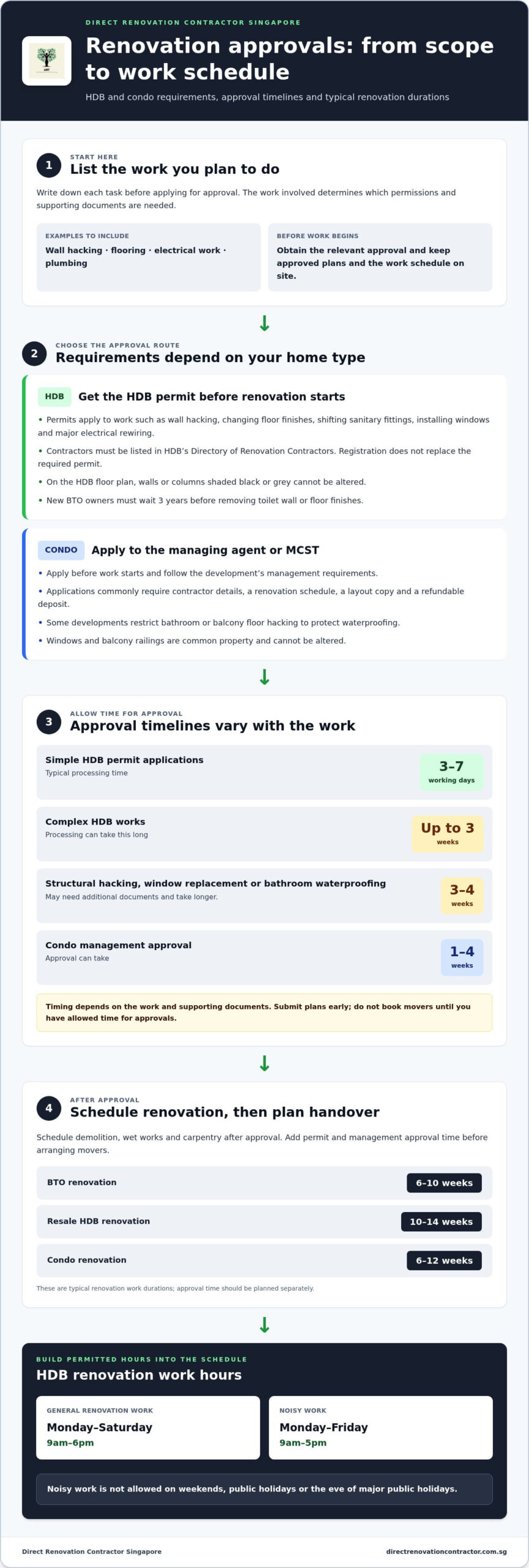
For HDB renovation, contractors must be listed in the HDB Directory of Renovation Contractors. Get all required HDB permits before work begins. Permits are required for work such as hacking walls, changing floor finishes, shifting sanitary fittings, installing windows and major electrical rewiring. General renovation work is allowed Monday to Saturday, 9am to 6pm. Noisy work is limited to Monday to Friday, 9am to 5pm, and isn’t allowed on weekends, public holidays or the eve of major public holidays.
Approvals depend on the work involved. HDB owners need a permit before altering walls or removing and replacing existing floor finishes. A contractor’s registration does not replace the permit: the work and contractor must both meet the applicable requirements. Allow time for approval before booking movers or arranging temporary accommodation.
Ask for an itemised bill of quantities (BOQ) that identifies each task, material and cost. The stated industry-standard upfront payment is 10-20% of the contract value. Link later payments to clear work stages, and record variations in writing. Renovation grants depend on the scheme and eligibility rules; renovation loans are typically available up to S$30,000 or six times monthly salary, whichever is lower. Hidden costs can arise from repairs or extra work uncovered after demolition.
Check progress against the contract and document defects with photos before handover. CASE’s 2026 data states that 74% of unresolved renovation cases involved contractors collecting advance payments exceeding 30% of project value. Avoid large advance payments, keep payment records, and ensure site work follows HDB’s permitted hours to reduce payment and safety risks.
2. HDB renovation permits and approval timelines
For an HDB flat, get the required HDB permit before renovation work begins. Permits apply to wall hacking, changing floor finishes, shifting sanitary fittings, installing windows and major electrical rewiring. A new BTO owner must wait 3 years before removing toilet wall or floor finishes. On the HDB floor plan, walls or columns shaded black or grey cannot be altered.
Approval time depends on the work and supporting documents. Simple HDB permit applications typically take 3-7 working days; complex works can take up to 3 weeks. Applications involving structural hacking, window replacement or bathroom waterproofing may require additional documentation and take 3-4 weeks. Submit plans early, then schedule demolition, wet works and carpentry after approval. Wall hacking costs vary with the wall and work scope, so include the approved scope in the renovation contract.
Condo owners must apply to the managing agent or Management Corporation Strata Title (MCST) before work starts. Applications commonly require contractor details, a renovation schedule, a layout copy and a refundable deposit. Approval can take one to four weeks. Some developments restrict bathroom or balcony floor hacking to protect waterproofing. External features, including windows and balcony railings, are common property and cannot be altered.
List each planned task, including hacking, flooring, electrical work and plumbing, and obtain the relevant HDB approval before work begins. Condo owners must follow their development’s MCST approval requirements. Keep approved plans and the work schedule on site, and make sure a storage or carpentry change does not expand into unapproved structural work.
Typical work durations differ by home type: a BTO renovation takes 6-10 weeks, a resale HDB renovation 10-14 weeks, and a condo renovation 6-12 weeks. Add permit and management approval time before booking movers. Use a clear HDB renovation planning process to map approvals, work stages and handover.
3. Popular HDB interior design styles and materials
Choose an interior style based on how your household uses each room. A minimalist layout can keep walkways clear, while Scandinavian-inspired finishes pair light colours with practical timber tones. Industrial details, such as dark metal accents, can overwhelm a compact HDB flat if used too heavily, though looking at design examples from custom fabricators like Iron Guys can offer inspiration on how tailored metal railings and fixtures can balance durability with clean aesthetics. Plan storage around daily habits, from where you leave your keys to where you use kitchen appliances, rather than adding cabinets by default.
Material choices affect cleaning and upkeep. For kitchen worktops and bathroom surfaces, compare how finishes handle moisture, stains and routine cleaning. Vinyl flooring feels softer underfoot than hard tile, while tile suits areas where water is common. For more sustainable options, look for materials certified under the Singapore Green Labelling Scheme, administered by the Singapore Environment Council. Water-efficient bathroom fittings with a WELS label help you compare products; more ticks indicate greater water savings.
BTO owners often need to plan storage and lighting around the existing layout. Measure appliances before finalising kitchen cabinetry, and position power points where you’ll use electrical devices. Plan the bathroom around daily movement, cleaning access and the fittings you select. Before work starts, submit any required renovation application for approval, and keep the approved scope consistent with your chosen materials.
In a condo, consistent flooring, clear sightlines and storage fitted to available wall space can make smaller rooms more usable. Keep doors, drawers and wardrobe openings clear of narrow walkways. In any home, test how each feature opens and closes before finalising its layout.
Renovation choices affect resale appeal and maintenance through durability, neutral finishes and the amount of upkeep a design demands. A well-renovated four-room HDB flat in a mature estate is estimated to command a S$30,000 to S$60,000 resale premium over a comparable flat in original condition in 2026. Prioritise sound workmanship and easy-care materials, then add personal style through replaceable details such as paint and lighting.
4. HDB and condo renovation cost estimates
Use Home Renovation Singapore: The Complete Guide for HDB & Condo Owners as a planning reference, then match estimates to your own scope. These ranges vary with the work and material specifications, so compare itemised tasks rather than headline totals. For a detailed Singapore renovation cost guide for HDB and condo homes, review the factors that shape your budget and plan a contingency.
Resale HDB flats often need more than surface upgrades. Resale projects typically cost 20-40% more than comparable BTO renovations. For a flat at least 25 years old, reserve a contingency of at least 15% for concealed wear or repairs discovered during work.
Condo projects are estimated to cost 15-25% more than comparable HDB renovations. Management requirements and access can affect the work sequence and scope.
Build a budget by separating demolition, kitchen cabinetry, flooring, electrical work, plumbing, painting and finishes. Include window work only when required. Request quantities, material specifications and exclusions in the bill of quantities, then compare equivalent layouts and work items. Carpentry can account for 35-40% of a standard mid-range 4-room HDB renovation, making kitchen and wardrobe choices significant cost drivers.
Keep a contingency: estimates recommend 8-12% of project value for unforeseen conditions. For a practical next step, use Home Renovation Singapore: The Complete Guide for HDB & Condo Owners to frame your budget, then plan your renovation budget around the required work, flat condition and finish choices.
Direct Renovation Contractor Singapore: HDB BTO Renovation Packages
Once your renovation scope is clear, Direct Renovation Contractor Singapore can help you move into execution. Its HDB BTO Renovation Packages, HDB Resale Renovation Packages and Condo Renovation Packages are designed for homeowners planning work in those property types. The company also handles landed property renovation, where larger layouts allow for custom outdoor entertaining features, braais, or pizza ovens inspired by specialist suppliers like decorfires.com.
For homeowners who want to manage the project themselves, its DIY renovation approach provides 3D drawings and a curated list of direct contractors and material suppliers. This can help you plan the layout and coordinate the work without engaging an intermediary interior designer. A specialized service fee applies to the drawings and curated list; project pricing depends on the scope and is provided after a quote request.
Contact Direct Renovation Contractor Singapore to discuss your renovation, or visit directrenovationcontractor.com.sg.
Set Your Renovation Plan in Motion
Renovation planning is easier when you know your next decision: identify what matters most in your home, then shape the project around those priorities. Use this complete guide to home renovation in Singapore for HDB and condo owners as a starting point, and turn your preferred layout, finishes and practical needs into a clear scope.
Direct Renovation Contractor Singapore offers HDB BTO Renovation Packages, HDB Resale Renovation Packages and Condo Renovation Packages. These give homeowners a practical route from planning to renovation work suited to their property type.
Before proceeding, collect your preferred layout ideas and note which parts of the home need the most attention. A focused brief makes it easier to discuss the work and define the project scope.
For a practical next step, contact Direct Renovation Contractor Singapore to discuss your renovation plans. A clear starting point can make the decisions ahead more manageable, so you can move forward with confidence.
Frequently Asked Questions
ID firm vs direct contractor, what is the difference?
An interior design firm typically develops the design and coordinates renovation work, while a direct contractor focuses on executing the agreed scope. The right fit depends on the support you need. For example, if your kitchen layout is settled, you may prioritise construction; if you’re still deciding room layouts, you may need more design development. Compare responsibilities and work items in writing rather than relying on a provider’s label.
Need Expert Advice for Your Project?
For a self-managed renovation, Direct Renovation Contractor Singapore provides 3D drawings and a curated list of direct contractors and material suppliers. This approach can suit homeowners who want to make project decisions and coordinate the work themselves. Prepare your floor plan, room priorities and preferred materials before reviewing the drawings. That gives you a practical basis for deciding whether the DIY approach fits your project.
What Drives Renovation Cost Up or Down?
The main cost drivers are the scope, existing condition, material choices and custom work. Keeping the kitchen layout may avoid some changes, while new cabinetry or rerouted plumbing adds tasks. Compare quotes by matching quantities, specifications and exclusions. For example, confirm whether demolition and disposal are included before comparing totals. Itemised estimates make differences easier to understand and help you decide which upgrades matter most.
Why resale costs significantly more?
Resale flats may need existing finishes or services removed or repaired before new work begins. Demolition can reveal issues that were not visible during initial planning, such as worn surfaces or services that need upgrading. As a result, two flats with the same room count can require different scopes. Separate essential repairs from optional improvements so you can assess where additional work is needed.
What is the average home renovation cost in Singapore for HDB flats and condos in 2026?
There is no single average that suits every property, because the scope and condition vary.
How do renovation costs vary by HDB flat type and condo size?
Use Home Renovation Singapore: The Complete Guide for HDB & Condo Owners to compare these benchmarks with your project scope.