
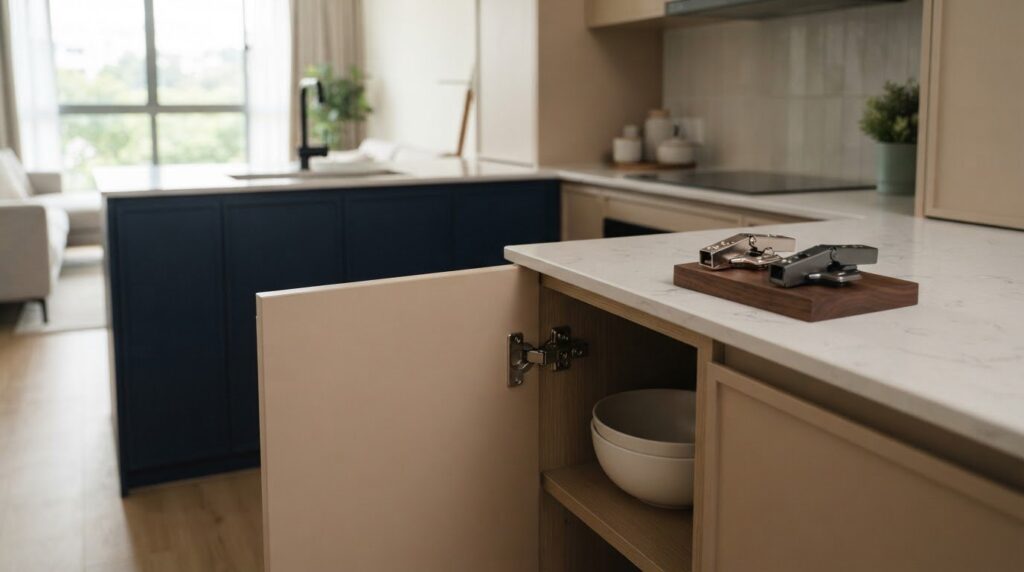
A quieter cabinet upgrade doesn’t always require replacing the cabinet. Soft closing hinges for cabinets are worth it when you want doors to close with less noise and impact, and existing cabinets can often be retrofitted without major modifications. The hinge catches the door about 2 inches before it closes, then slows its movement toward the frame.
It’s reasonable to weigh that quieter action against the cost of new hardware and the condition of your existing cabinets. This guide explains how soft-close hinges and drawers work, what they change about noise and everyday use, and what compatibility involves in older kitchens and bathrooms. You’ll also compare hardware options and learn which details affect fit, so you can decide whether a retrofit makes practical sense or whether another approach suits your cabinets better.
Key Takeaways
- Compare soft-close hardware with standard and self-close options by considering the quieter, cushioned movement you want and the added hardware cost.
- For older cabinets, assess hinge type, door weight, mounting holes and frame condition to identify whether replacement hinges or retrofit adjustments are the better fit.
- Choose hinges that can support the cabinet doors properly, and allow for careful alignment during installation so doors close smoothly.
- Keep the mechanism working smoothly by wiping hinges with a damp cloth, avoiding abrasive cleaners and checking screws and alignment occasionally.
Choosing and installing compatible hardware
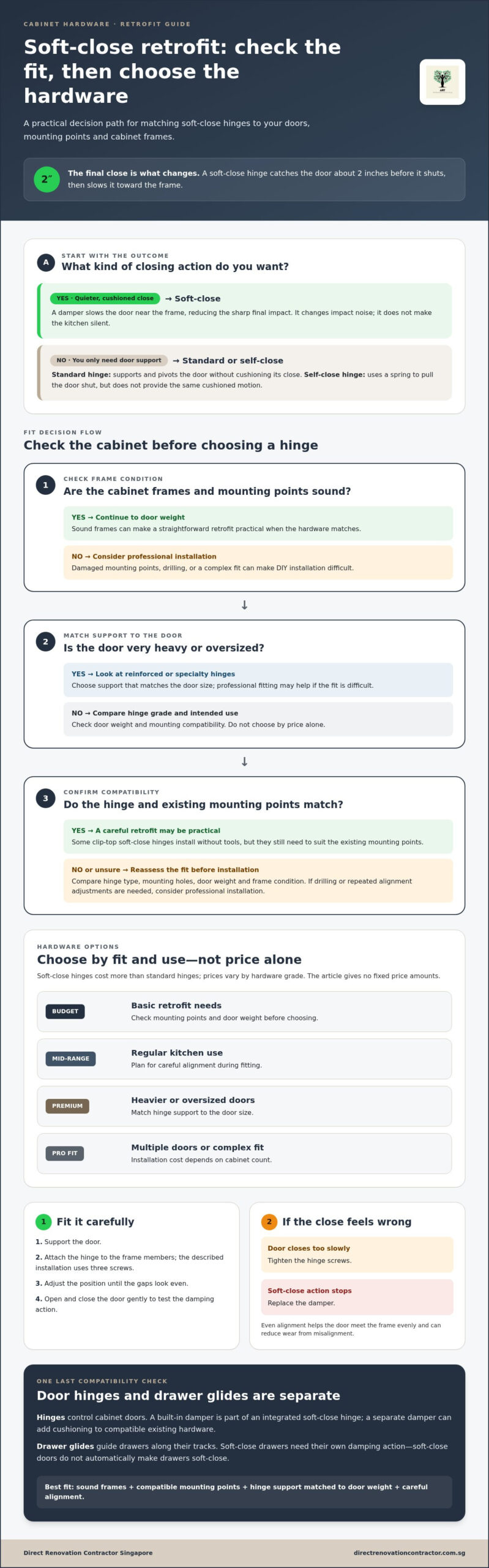
Compare hinge price, door weight, mounting points and your kitchen cabinet frames before choosing hardware. Common problems include slow closing or a door that stops soft-closing; tighten its hinge screws if it closes too slowly, or replace the damper if soft-close action stops.
Hinge Costs
Soft-close hinges cost more than standard hinges, with prices varying by hardware grade.
| Option | Cost | Fit and installation | Best suited to |
|---|---|---|---|
| Budget soft-close hinge | Check mounting points and door weight | Basic retrofit needs | |
| Mid-range soft-close hinge | Requires careful alignment | Regular kitchen use | |
| Premium soft-close hinge | Match support to door size | Heavier or oversized doors | |
| Professional installation | Cost depends on cabinet count | Multiple doors or complex fit |
Choose by door weight, mounting compatibility and the amount of alignment work required, not price alone.
Alignment and Common Fixes
Unlike standard hinges, soft-close hardware needs alignment so the door meets the cabinet frame evenly. The described installation uses three screws to attach the hinge to the frame members. Some clip-top soft-close hinges install without tools, but the hinge still needs to suit the existing mounting points.
For DIY installation, support the door, attach the hinge, then adjust its position until the gaps look even. Open and close the door gently to test the damping action. If it closes too slowly, tighten the hinge screws; if damping has stopped, replace the damper. These fixes can reduce wear and tear from misalignment.
Very heavy or oversized doors may need reinforced or specialty hinges for support. Choose professional installation when drilling, damaged mounting points or repeated alignment adjustments make a DIY fit difficult. For a straightforward retrofit with sound frames and matching hardware, careful DIY work may be practical.
What Are Soft‑Close Hinges and Drawers?
A soft-close hinge supports a cabinet door and incorporates a mechanism that slows its final movement. A soft-close damper is the cushioning component, either built into the hinge or fitted separately as a retrofit.
Soft-Close Hinge Operation
As a cabinet door closes, a hydraulic or piston-based damper controls its movement near the frame. The soft-close action can engage when the door is halfway closed; another common description is that it catches the door about 2 inches before shut. This controlled motion helps the door reach the frame smoothly instead of striking it.
Soft-Close and Standard Hinges
A standard hinge supports and pivots the door, but it doesn’t cushion the closing movement. Soft-close hinges add a damping mechanism, so the door slows as it approaches the cabinet frame. Self-close hinges use a spring to pull the door shut, but they don’t provide the same cushioned motion. For a Singapore kitchen upgrade, the difference is most noticeable on frequently used doors.
Hinges and Drawer Glides
Hinges control cabinet doors; drawer glides, also called drawer slides, guide drawers along their tracks. In a soft-close setup, a damper slows the drawer near the end of its travel, limiting a hard final impact. The hinge and glide mechanisms serve different moving parts, so a soft-close cabinet door doesn’t automatically mean its drawers have the same feature.
Hinges and Soft-Close Dampers
A soft-close hinge may contain its damper as one integrated unit. A separate damper adds the slowing action to compatible existing hardware, making it a retrofit option rather than a complete hinge replacement. The key difference is what gets replaced or added: an integrated hinge changes the door-support hardware, while a standalone damper supplies the cushioning mechanism.
Soft-close furniture hardware can be built in or added later. For a wider kitchen upgrade, kitchen cabinet carpentry can be considered alongside the choice of door and drawer hardware.
Noise reduction
Soft-close hardware changes the final part of a cabinet door’s motion, replacing a sharp impact with a slower close. In compact Singapore HDB flats and condos, that can make kitchen use less disruptive.
Reducing Noise and Slamming
A soft-close hinge slows a cabinet door as it approaches the frame, reducing the abrupt sound of slamming. The effect is most useful when several doors are used repeatedly, such as during meal preparation in a busy kitchen. Soft-close drawers apply the same principle along their slides, so they finish closing more quietly than drawers pushed shut at speed.
This change reduces impact noise rather than making a kitchen silent. A door can still make sound as it moves, and the closing result depends on the hinge’s adjustment and the door’s movement. Self-close hinges pull doors shut, but lack the same noise-dampening action. Soft-close hardware is therefore the more direct choice when the main concern is a loud final impact.
Protecting Cabinets from Noise
Slamming creates pressure on cabinet doors, panels and joints. By slowing the closing motion, soft-close hinges reduce that pressure and can limit wear and tear over repeated use. This helps protect the points where a door meets its frame, rather than simply masking the sound.
Soft-close drawers can also reduce shifting among their contents as the drawer closes. For example, utensils are less likely to jolt when a drawer’s final movement is controlled. The mechanism also reduces the risk of a cabinet door slamming on a child’s fingers, although it doesn’t remove that risk. Supervision and careful use still matter around moving doors.
For HDB and condo households, the practical benefit is most apparent where kitchen activity carries into nearby living areas. A quieter close can reduce repeated bangs during everyday use, while slower movement can help preserve cabinet joints. If noise persists, inspect the hinge adjustment and damping action; a poorly aligned or worn mechanism may not soften the impact as intended.
Compatibility with older cabinets
Most standard cabinets can take soft-close hinges without major modifications, so an upgrade doesn’t automatically mean replacing the kitchen. Whether soft closing hinges for cabinets are worth it depends on the existing hinge type, mounting points, door condition and whether the cabinet frame can support the new hardware.
Start by opening a door and examining its hinges and screws. Check whether each hinge sits securely, the door hangs evenly, and the frame around each mounting point remains intact. On older furniture, existing holes may not match replacement hardware, so re-drilling or bracket support may be needed. A loose screw or damaged fixing point can affect alignment and everyday functionality.
- Check the mounting points: Compare the existing hinge position with the replacement hardware before drilling.
- Inspect the frame: Look for loose screws, worn fixing points or damage where a support bracket may be needed.
- Assess the door: Very heavy or oversized doors may need reinforced or specialty hinges for adequate support.
These checks help distinguish a straightforward hinge upgrade from one involving carpentry adjustments. Cabinets with sound frames and suitable mounting points can often be retrofitted without replacing the whole kitchen or bathroom. If the holes don’t line up, re-drilling may be required. If the frame can’t hold the hinge securely, bracket support may provide a more stable fixing.
Compatibility also affects durability. A hinge that suits the door and frame can operate as intended, while a poor fit can leave the door uneven or interfere with soft-close functionality. The slower closing action can reduce the risk of doors slamming on children’s fingers, but it doesn’t remove the need for care around moving doors.
For older kitchen cabinets with worn frames or mismatched hinge points, arrange kitchen cabinet carpentry to address the fit as part of the upgrade. Decide whether soft closing hinges for cabinets are worth it by inspecting the frame and mounting points first, then matching the hinge to the door’s support needs.
Direct Renovation Contractor Singapore: HDB BTO Renovation Packages
Direct Renovation Contractor Singapore offers HDB BTO Renovation Packages for homeowners planning a wider renovation alongside cabinet hardware decisions. Considering soft-close hinges during the renovation helps you account for door movement and cabinet fit as part of the overall work, rather than treating the upgrade in isolation.
Its HDB Resale Renovation Packages, Condo Renovation Packages and Landed Property Renovation also serve homeowners planning work in those property types. If you’re reviewing older cabinets as part of a larger renovation, consider how their condition and hardware choices fit the project scope.
Contact Direct Renovation Contractor Singapore to discuss your renovation plans.
Plan the cabinet upgrade around your renovation
Deciding whether soft closing hinges for cabinets are worth it is one part of planning a functional home. Before work begins, identify which cabinets matter most in daily use and how the hardware choice fits your wider renovation priorities. That gives you a clearer basis for deciding whether to upgrade selected doors or include cabinet work in a larger project.
Direct Renovation Contractor Singapore offers HDB BTO Renovation Packages, HDB Resale Renovation Packages and Condo Renovation Packages. These options provide a route to discuss cabinet-related decisions alongside the renovation scope for your home, rather than treating each choice in isolation.
When you’re ready to plan the next step, contact Direct Renovation Contractor Singapore to discuss your renovation. A practical plan can help you make hardware choices that suit the home and the work ahead.
Frequently Asked Questions
What Are Self-Close Cabinet Hinges?
Self-close cabinet hinges use a spring to pull the door against the cabinet frame as it approaches shut. The pull engages when the door is close to closing, but the spring doesn’t cushion the movement like a soft-close damper. For example, a door left slightly ajar may pull itself closed, while a soft-close hinge slows its final movement. Choose based on whether automatic closing or quieter motion matters more.
What are the pros and cons of soft-close cabinet hinges?
Soft-close hinges reduce the noise and impact of closing, which can help limit pressure on cabinet doors, panels and joints. The trade-offs are higher hardware cost than standard hinges, more involved alignment, and the possibility that some mechanisms need extra force to close fully. They suit frequently used cabinets where quieter operation matters; standard hinges remain a simpler option when cushioning isn’t a priority.
How much do soft-close cabinet hinges cost in Singapore?
In Singapore, budget soft-close hinges cost S$3 to S$6 per piece, mid-range hinges cost S$7 to S$12, and premium options cost S$13 to S$22. The total hardware spend depends on how many hinges the doors require. Count the hinges needed for each cabinet door, then compare the tier against door weight and intended use. These figures cover hinges, not installation.
How much does it cost to retrofit cabinets with soft-close hinges in Singapore?
Retrofitting existing cabinets typically incurs labor charges of S$15 to S$30 per door, depending on the complexity of the work required by Direct Renovation Contractor Singapore. Add the hinge cost separately: budget hardware is S$3 to S$6, mid-range is S$7 to S$12, and premium is S$13 to S$22. The final retrofit spend therefore depends on the number of doors and hinges, plus the installation work required. Older furniture needing re-drilling or bracket support may need additional work.
Are soft-close hinges compatible with existing cabinet doors and hinge types?
Many standard cabinets can be upgraded without major modifications, but compatibility depends on the existing mounting points, frame condition and door weight. Before choosing hardware, compare the current hinge position with the replacement’s fixing pattern and inspect the screw holes. Older furniture may need re-drilling or bracket support. Very heavy or oversized doors may require reinforced or specialty hinges to support them properly.
How long do soft-close cabinet hinges last, and what is their warranty?
Soft-close hinges typically last more than 10 years with proper care and normal use. Their damping mechanisms can weaken after years of operation, and quality dampers can be replaced instead of replacing the entire cabinet. Warranty coverage depends on the particular hardware and its seller’s terms. Keep the purchase paperwork, clean hinges with a damp cloth, and avoid harsh chemicals or abrasive cleaners.