
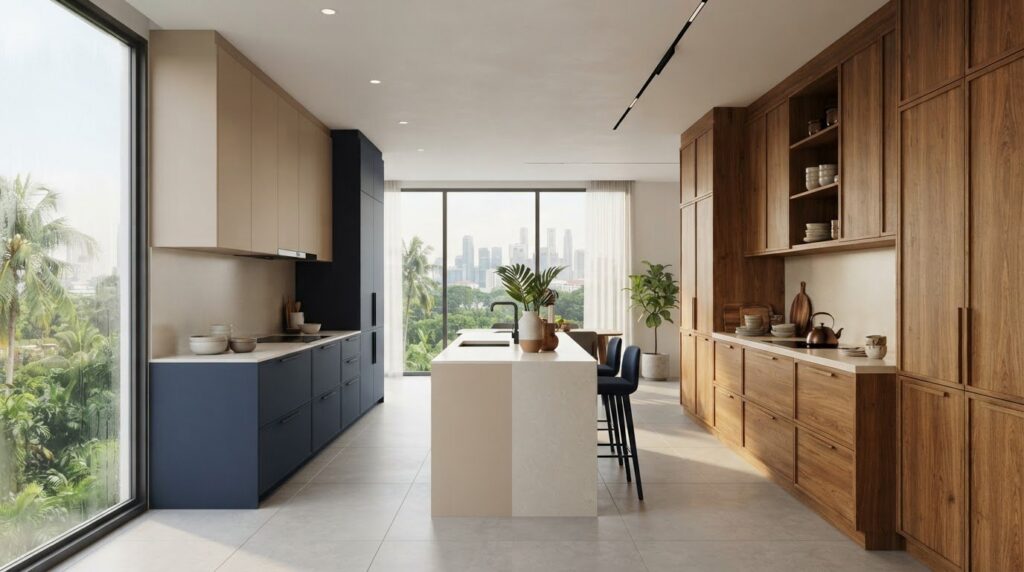
The most expensive material on a showroom floor might actually be the worst choice for Singapore’s heavy tropical humidity. When weighing laminate vs solid wood for cabinets, it’s easy to assume that traditional timber is automatically superior. Yet watching costly doors warp, swell, or stick after a few humid months is every homeowner’s quiet dread.
Between technical jargon like high-pressure laminates and internal carcases, combined with genuine anxiety over inflated interior design firm markups, making an informed choice isn’t straightforward. You shouldn’t have to gamble your renovation budget on guesswork or wonder if your kitchen will survive everyday steam and grease.
This guide cuts through sales talk to show you how both materials actually perform under daily household demands, focusing on moisture resistance, joint stability, and long-term lifespan. Here is your practical breakdown of core construction differences and fabrication realities, helping you secure durable bespoke carpentry without paying middleman commissions.
Key Takeaways
- Tropical humidity causes solid timber to expand and warp over time, whereas high-pressure laminate bonded to moisture-resistant plywood provides superior dimensional stability.
- When evaluating laminate vs solid wood for cabinets, zoning is critical; impermeable laminates excel in heavy-use wet kitchens, while solid wood is better suited for low-moisture dry zones.
- Modern laminate surfaces resist daily scratches, cooking grease, and water penetration without requiring the ongoing resealing and specialised maintenance demanded by natural wood.
- Fabricating your cabinetry directly with an experienced carpentry workshop eliminates interior design middleman markups while securing practical standards like heavy-duty ABS edge-banding.
Core Differences Between Laminate and Solid Wood Cabinets
Most showroom sales pitches treat cabinetry as purely a question of surface appeal. That approach ignores structural reality. When assessing laminate vs solid wood for cabinets, the critical distinction lies between a composite surface skin and a monolithic natural timber plank. Substrate engineering dictates how a carcase handles mechanical loads, daily impacts, and moisture migration over ten to twenty years.
A comprehensive study of kitchen cabinet materials shows that modern cabinetry separates structural carcase boxes from exterior decorative treatments. Solid wood cabinetry uses raw timber for both structural framing and door faces. In contrast, laminate systems apply an engineered protective shell over high-grade core panels.
What Are Laminate Cabinets and How Are They Engineered?
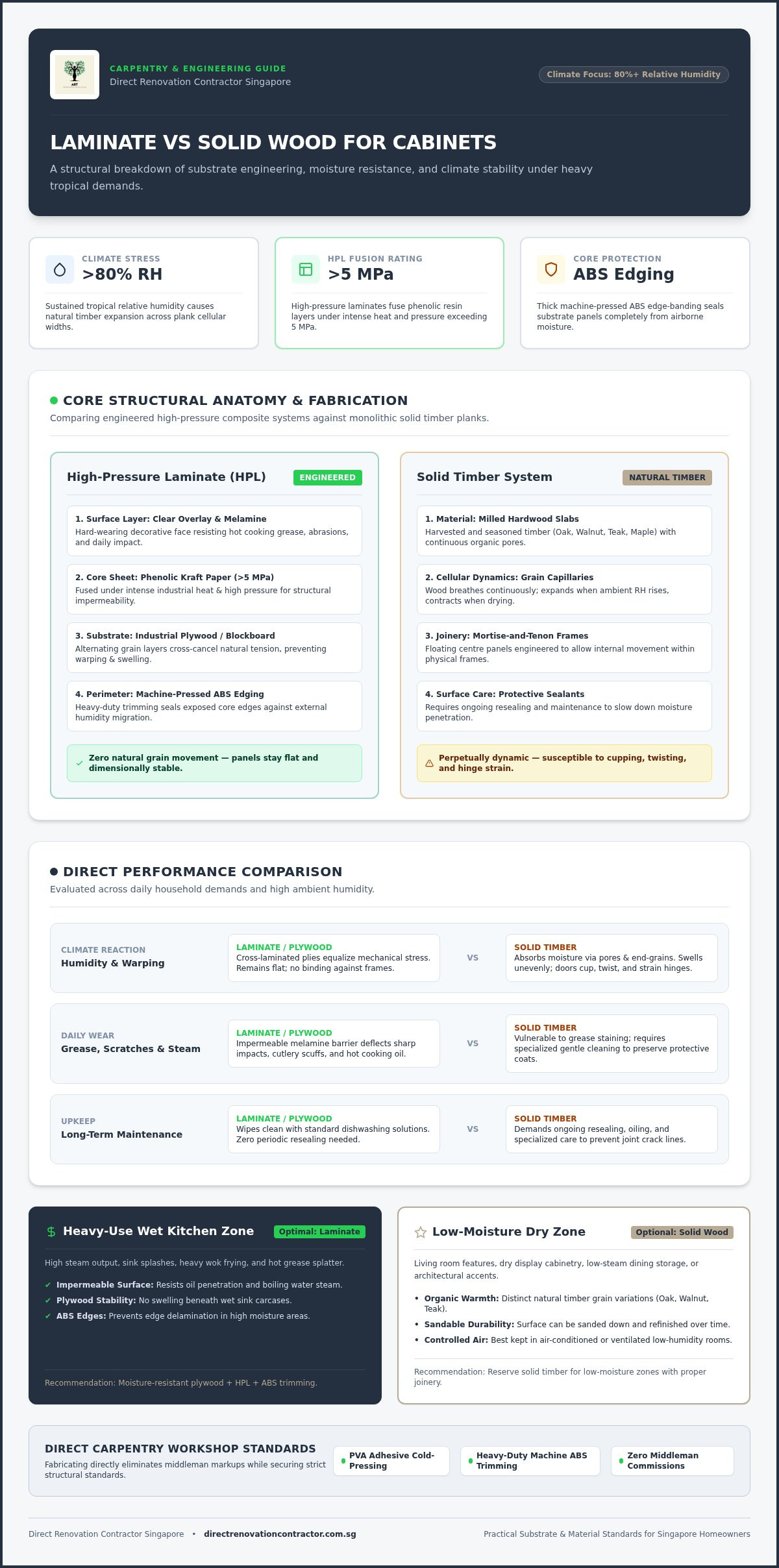
High-pressure laminate (HPL) is manufactured by fusing multiple layers of phenolic resin-impregnated kraft paper under intense heat and pressure exceeding five megapascals. A hard-wearing melamine decorative face rests on top, sealed with a clear overlay. Professional carpenters cold-press these sheets directly onto industrial-grade plywood or blockboard carcase panels using heavy PVA adhesives. The resulting surface forms a resilient, non-porous exterior skin that resists surface abrasions, oils, and moisture.
- Substrate Stability: Engineered plywood cores resist swelling because alternating grain layers cross-cancel natural tension.
- Edge Protection: Modern fabricators finish exposed panel edges with thick, machine-pressed ABS trimming to seal the core against external humidity.
- Pattern Range: High-definition decorative papers accurately replicate textured timber grains, sintered stones, and low-sheen architectural solids.
What Are Solid Wood Cabinets and Traditional Joinery Methods?
Solid wood cabinetry relies on natural timber harvested, seasoned, and milled from tree slabs such as oak, walnut, teak, or maple. Unlike engineered boards, natural wood continues to breathe throughout its physical lifespan. Grain capillaries expand across the plank width whenever ambient relative humidity rises, then contract as air dries out.
To keep large timber panels from splitting, traditional cabinetmakers use complex framing techniques like mortise-and-tenon joinery and floating centre panels. These manual joints allow natural movement within the frame. While solid timber delivers unmatched organic warmth, distinct grain variations, and sandable durability, the entire carcase remains perpetually dynamic, responding directly to every atmospheric fluctuation in your home.
Performance Comparison: Durability, Moisture Resistance, and Climate Stability
Evaluating laminate vs solid wood for cabinets requires looking beyond pristine showroom conditions. In Singapore, where ambient relative humidity regularly exceeds 80%, cabinetry materials face continuous atmospheric stress. How a material manages ambient moisture, heavy cooking grease, and everyday cleaning dictates whether your carpentry lasts twenty years or degrades within five.
Benchmarked against professional Architectural Woodwork Standards, structural longevity depends directly on how core components handle thermal and moisture expansion under heavy daily use.
High Humidity and Warping Risks in Tropical Climates
Solid timber absorbs ambient moisture continuously through exposed end-grains and microscopic pores. In tropical conditions, sustained humidity forces natural boards to swell across their cellular width. As timber expands unevenly, cabinet doors cup, twist, and bind hard against carcase face frames, putting heavy strain on metal hinges. In severe cases, joints crack open along glue lines.
High-pressure laminate bonded over moisture-resistant or marine-grade plywood eliminates this risk. The cross-laminated plies equalize mechanical stress, keeping panels flat and dimensionally stable regardless of weather swings.
Daily Wear, Scratch Resistance, and Heavy Kitchen Use
Kitchen cabinetry takes constant physical punishment. Melamine-faced laminates feature an impermeable barrier that deflects sharp impacts, metal cutlery scuffs, and hot cooking oil. Greasy residues from heavy wok cooking wipe away using standard dishwashing solutions without soaking into the substrate. Explore our comprehensive guide to custom carpentry for high-traffic homes to see how carcase specifications hold up under daily use.
Solid timber boards, while tough, dent easily under blunt kitchen impacts. Acidic liquids like vinegar, soy sauce, and lemon juice can etch into timber finishes if spills sit uncleaned on the counter perimeter.
Maintenance Routines and Long-Term Repair Feasibility
Daily maintenance highlights stark functional differences between these surfaces:
- Laminate Maintenance: Non-porous surfaces require zero waxing, oiling, or resealing. However, deep gouges that slice through the laminate layer cannot be sanded away.
- Solid Wood Upkeep: Timber demands periodic protective resealing to guard against surface rot and mould growth. The major benefit is repairability; deep scratches or chips can be sanded down, filled, and re-stained on site.
For busy homeowners who want reliable performance without constant maintenance chores, speaking with a direct renovation contractor ensures your carpentry carcases are engineered specifically for long-term climate resilience.
Aesthetics, Customisation, and Design Versatility
Visual appeal often drives initial renovation discussions, but surface choices also dictate long-term maintenance and design flexibility. When comparing laminate vs solid wood for cabinets, the decision involves balancing the organic individuality of authentic timber against the precise consistency of modern engineered surfaces. Understanding how each material takes shape helps homeowners achieve high-end aesthetics without compromising functional performance.
Practical assessments like Virginia Tech’s published Cabinet Materials Guide highlight that cabinet aesthetics depend heavily on how finishes interact with underlying substrates over time. While solid timber develops an organic patina, engineered laminates maintain exact visual uniformity across wide expanses.
Texture, Grain Variations, and Visual Realism
Solid timber offers an organic warmth that synthetic alternatives try to mirror. Every oak, teak, or walnut plank carries distinct knots, grain swirls, and colour gradations that cannot be perfectly cloned. For homeowners who prize natural imperfections, real timber provides unmatched character.
Modern high-pressure laminates bridge this gap using synchronized-pore embossing. In this process, the physical surface texture directly matches the printed woodgrain pattern beneath it, aligning visible grain lines with realistic tactile ridges. Laminates also eliminate visual mismatching across large full-height wardrobe runs or extended kitchen banks, delivering identical tone and grain consistency from end to end.
Edge Banding and Seamless Finish Techniques
A frequent objection to laminate cabinetry stems from older fabrication methods that left dark, dirt-collecting glue lines along door perimeters. Contemporary carpentry workshops resolve this by using precision edge-banders with colour-matched hot-melt adhesives or laser-applied ABS trims. These durable, heavy-duty ABS strips measure between 1mm and 2mm thick, creating clean, impact-resistant edges that protect against corner chipping.
Solid timber allows architectural profiles that laminate cannot match. Because solid wood is uniform throughout, carpenters can carve integrated finger-pull grooves, complex chamfers, and classic five-piece shaker profiles directly into the wood without needing edge banding.
Blending Laminates with Fluted Panels and Feature Accents
Smart renovation planning doesn’t require choosing one material exclusively. Combining both materials creates a balanced, functional interior:
- Hybrid Kitchens: Install flat-panel laminate fronts on high-splash base cabinets, paired with solid timber fluted panels on dry kitchen islands.
- Display Niches: Use scratch-resistant, fingerprint-free matte laminates for heavy-use carcase shelving, framed by solid timber open display ledges.
- Modern Japandi Styling: Combine warm woodgrain laminate lower cabinets with subtle fluted timber accent strips to capture natural Scandinavian warmth while maintaining wipe-clean durability.
Cost Analysis and Practical Selection Framework for Homeowners
Making a final call on laminate vs solid wood for cabinets requires matching your material choices to actual spatial demands rather than theoretical design preferences. Too many renovation budgets collapse because materials get selected based on catalog photos instead of room conditions, lifestyle wear, and linear run requirements. A systematic selection framework prevents costly retrofits down the road.
Follow this five-step decision matrix to evaluate your home:
- Step 1: Moisture Audit. Isolate high-steam zones from air-conditioned dry spaces.
- Step 2: Linear Foot Planning. Total your required runs across base cabinets, wall-hung units, and tall larders.
- Step 3: Cooking Intensity Check. Heavy stir-frying requires non-porous surfaces; light pantry prep allows decorative flexibility.
- Step 4: Substrate Specification. Insist on moisture-resistant plywood carcases regardless of exterior laminate choices.
- Step 5: Procurement Channel. Cut out intermediaries to keep fabrication costs focused entirely on material quality.
Evaluating Upfront Material Costs Versus Long-Term Value
Solid wood requires high raw timber procurement fees, extensive seasoning, and intensive bench joinery. That drives up upfront capital expenditure significantly. In contrast, high-pressure laminate on plywood cores delivers predictable fabrication times and lower material costs without sacrificing structural strength. Review our complete guide to HDB renovation in Singapore for project budgeting advice and scheduling frameworks.
Consider your property horizon. If you plan to sell or rent within ten years, durable laminate protects your capital outlay without demanding periodic oiling or sanding to maintain appearances.
Room-by-Room Suitability: Kitchens, Bathrooms, and Wardrobes
Matching material properties to specific rooms ensures your carpentry survives daily household routines:
- Wet Kitchens: High heat, sink splashing, and cooking steam demand high-pressure laminate bonded to moisture-resistant plywood carcases. Natural timber doors in these areas risk premature swelling and hinge strain.
- Bathroom Vanities: Daily shower humidity makes non-porous laminate paired with sealed ABS edging mandatory for sink base cabinets.
- Dry Bars and Living Consoles: These low-moisture zones are ideal for showcasing genuine solid timber open shelves, slatted feature dividers, or fluted panel accents.
- Full-Height Wardrobes: Heavy solid wood doors stress vertical hinges, leading to door drop over time. Lightweight plywood carcases clad in laminate keep multi-panel wardrobe doors straight, aligned, and effortless to glide.
Avoiding Middleman Interior Design Markups on Cabinetry
Most homeowners assume custom carpentry requires engaging an interior design firm. In practice, design firms regularly subcontract carpentry fabrication out to third-party workshops, tacking on management fees and coordinator commissions that inflate your bottom line. Homeowners often end up paying premium rates for standard materials.
Working directly with an experienced custom carpentry contractor eliminates those layers. You get clear fabrication pricing per linear foot, hands-on advice on laminate catalogues, and direct control over hardware specifications. To lock in durable cabinetry built directly to your layout specs, contact our carpentry team for a transparent, direct-to-owner fabrication assessment.
Fabricating Custom Cabinetry Directly with an Experienced Carpentry Team
Precision installation matters just as much as material selection. When deciding between laminate vs solid wood for cabinets, the real test of craftsmanship happens during workshop preparation and on-site alignment. Even the finest solid timber or premium high-pressure laminate will fail if carcases are assembled out of square or hinges are poorly anchored.
Precision On-Site Measurements and Workshop Fabrication Standards
Residential walls and floor screeds in local flats and private apartments are rarely perfectly plumb. Minor structural bowing can throw cabinet lines completely out of alignment if left unaddressed. Professional carpenters run detailed laser-measured surveys on site before cutting a single sheet, allowing them to scribe infill panels accurately against uneven structural beams and walls.
Fabricating cabinetry off-site in a dedicated workshop ensures strict quality control. Precision panel saws, automated edge-banders, and hinge boring machinery deliver square carcases, clean ABS trimming, and perfectly aligned door faces. Doing the heavy carpentry off-site also keeps dust, noise, and installation downtime in your home to an absolute minimum.
Hardware Selection: Soft-Close Hinges and Internal Organisers
Cabinet longevity depends heavily on the mechanical hardware supporting your panels:
- Soft-Close Hinges: Certified stainless steel damping hinges absorb closing momentum, preventing shock vibrations from loosening hinge screws in plywood carcases.
- High-Load Runners: Heavy-duty, full-extension undermount tracks carry the concentrated weight of cast-iron cookware and pantry stock without sagging.
- Built-In Storage Systems: Workshop fabrication allows seamless integration of pull-out spice racks, blind-corner carousels, and concealed cutlery trays tailored directly to your cooking workflow.
Direct Contractor Project Coordination for Flawless Handover
Fitting built-in cabinetry requires tight sequencing with adjacent trade works. An experienced contractor coordinates electrical socket trunking, plumbing stub-outs, and countertop templating directly around new cabinet frames. There is no miscommunication between a third-party design salesperson and the actual tradesmen holding the tools.
Cutting out design intermediaries gives you complete transparency, direct accountability, and responsive adjustments on site. Learn how our direct renovation contractor Singapore model guarantees transparent renovation pricing without intermediary markups. Speak directly with our carpentry team today to configure your custom kitchen cabinets and wardrobes with honest trade advice and dependable structural quality.
Build Resilient Cabinetry That Lasts Decades
Choosing between laminate vs solid wood for cabinets comes down to balancing everyday moisture risks with structural longevity. While authentic timber delivers distinct organic character for dry display features, high-pressure laminate bonded over moisture-resistant plywood carcases remains the undisputed workhorse for wet kitchens and high-traffic storage. Precision ABS edge-banding seals engineered panels against Singapore’s dense tropical humidity, protecting your investment from long-term swelling, warping, and misaligned hinges.
Securing bespoke carpentry shouldn’t involve paying inflated design consultancy markups. Through our direct-to-owner model, your cabinetry is fabricated in dedicated workshops using premium hardware, keeping pricing transparent and free of middleman commissions. Our experienced carpentry teams build durable, perfectly scribed installations tailored to HDB flats, condominiums, and landed estates nationwide. Take the practical next step and get a direct custom carpentry quote from Direct Renovation Contractor Singapore to bring reliable craftsmanship into your home.
Frequently Asked Questions
Is laminate or solid wood better for kitchen cabinets in high-humidity homes?
High-pressure laminate on moisture-resistant plywood is significantly better for high-humidity homes. Choosing laminate vs solid wood for cabinets in tropical environments protects against moisture absorption, swelling, and joint failure. Laminate surfaces create an impermeable shield against cooking steam and daily wash basin splashes, whereas raw timber continuously expands and contracts, leading to sticking doors and misaligned hinges.
Can laminate kitchen cabinets be repaired if the surface gets chipped or scratched?
Surface repairs for laminate are limited once the protective melamine wear layer gets chipped or breached. Minor hairline scuffs can sometimes be masked with colour-matched laminate repair paste or wax sticks, but deep gouges require replacing the entire door face or re-laminating the panel. Fortunately, high-pressure laminates resist impact exceptionally well, making catastrophic chipping rare under normal domestic kitchen use.
Do solid wood cabinets warp over time in tropical conditions?
Yes, solid timber cabinets will warp, twist, or cup in tropical climates if exposed to uncontrolled ambient humidity. Natural wood breathes constantly through its cellular pores. When relative humidity remains persistently high, wide timber planks absorb atmospheric moisture and expand across the grain. Without careful joinery allowances or continuous climate control, doors will bind against frames and split along glue lines.
What is the standard carcase material used behind laminate cabinet doors?
Industrial-grade moisture-resistant plywood is the standard structural carcase material used behind laminate cabinetry. Carpenters avoid basic particleboard or standard MDF for wet kitchens because engineered plywood provides superior screw-holding strength and water resistance. Alternating timber veneers within the plywood cancel internal stresses, keeping cabinet boxes rigid, square, and stable across decades of heavy domestic load.
How long do high-pressure laminate cabinets typically last with proper care?
High-pressure laminate cabinetry typically lasts fifteen to twenty-five years when bonded over quality plywood carcases. The primary factor determining their operational lifespan is edge-banding integrity. Applying heavy-duty machine-pressed ABS edging prevents steam and liquid water from penetrating underlying adhesive joints, ensuring the decorative panels remain flat, bonded, and completely bubble-free throughout decades of continuous daily cooking.
Is it possible to combine laminate cabinet doors with genuine solid wood feature elements?
Yes, combining laminate panels with solid wood accents is an effective way to balance durability and aesthetics. Homeowners frequently specify wipe-clean high-pressure laminate for high-splash sink bases and cooking runs, while reserving real timber for open display shelving, slatted breakfast bar dividers, or fluted island panels. This hybrid configuration keeps maintenance low while adding natural architectural warmth.
Why is custom carpentry fabricated by a direct contractor more cost-effective than interior design packages?
Direct contractor fabrication cuts out the middleman management markups and sales commissions routinely charged by design consultancy firms. When assessing laminate vs solid wood for cabinets, a direct contractor manufactures your custom units inside a specialised carpentry workshop and handles installation directly. Your renovation expenditure pays strictly for workshop labour, premium hardware, and solid materials rather than showroom overhead.