
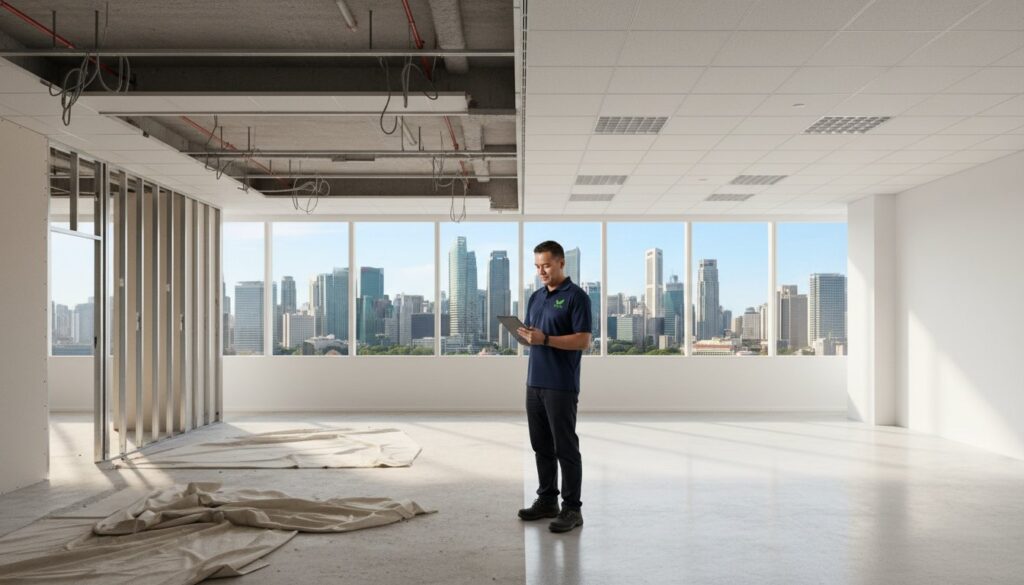
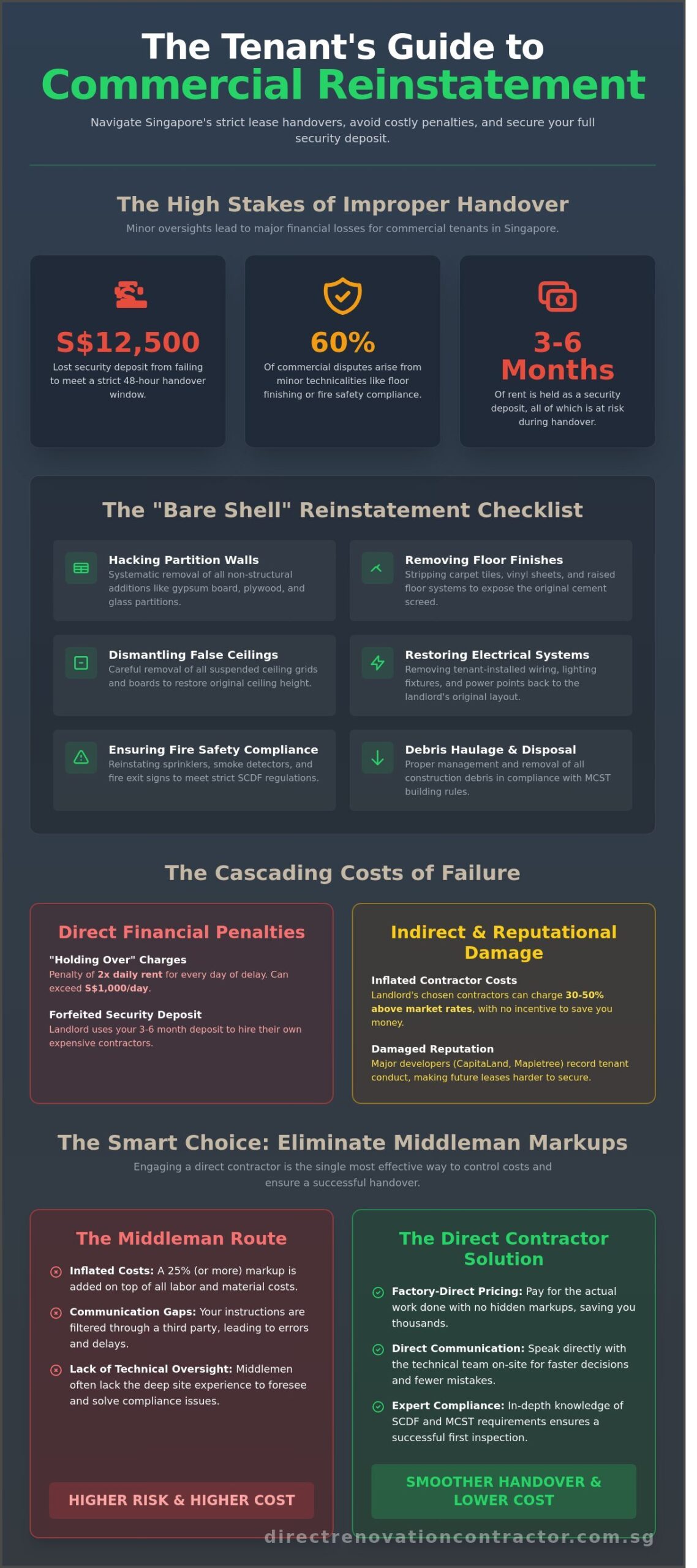
Last October, a retail tenant in Raffles Place lost S$12,500 of their security deposit simply because their reinstatement work singapore didn’t meet the landlord’s strict 48-hour handover window. It’s a common story in our local market where 60% of commercial disputes arise from minor technicalities in floor finishing or SCDF fire safety compliance. You likely feel that same pressure as your own lease expiry approaches. Most business owners worry about hidden costs in quotes and the fear of an MCST inspector rejecting the site during the final walk-through.
This guide shows you how to navigate the handover process without the typical 25% middleman markups. You’ll learn how to secure a successful handover on your first inspection and ensure your full security deposit returns to your bank account. We’ll break down the 2026 regulations, explain why factory-direct pricing saves you thousands on masonry and partition removal, and provide a step-by-step checklist to satisfy even the toughest building management teams. It’s time to stop overpaying for basic hacking and start working with a direct contractor who understands the technical demands of a Singaporean commercial site.
Key Takeaways
- Understand the legal “Original Condition” clause in your tenancy agreement to prevent landlords from unfairly forfeiting your security deposit.
- Identify the essential scope of reinstatement work singapore, from hacking non-structural partition walls to the systematic removal of false ceilings.
- Navigate complex SCDF fire safety codes and MCST building requirements to ensure your unit remains fully compliant after all modifications are cleared.
- Discover the latest 2026 market rates and learn how to manage cost-inflating factors like night works and specialized haulage.
- Learn why engaging a direct contractor eliminates middleman markups, providing factory-direct labor rates and technical expertise for a smoother handover.
What is Reinstatement Work in Singapore and Why is it Mandatory?
Reinstatement work in Singapore refers to the process of restoring a commercial property to its original bare shell condition before a tenant vacates. This isn’t just a simple cleaning job. It involves hacking away partition walls, removing floor finishes, dismantling false ceilings, and restoring electrical and fire safety systems to their baseline state. Understanding What is Reinstatement Work requires looking at the legal concept of dilapidations, where a tenant is contractually bound to repair any alterations made during the lease term. If you took over a unit with cement screed floors and white walls, you must return it exactly that way, even if you spent S$100,000 on high-end renovations.
Landlords in the commercial sector are strict because they need a “blank canvas” to market the unit to the next occupant. Residential “make-good” clauses usually only require a fresh coat of paint and professional cleaning. In contrast, reinstatement work singapore standards for offices and retail spaces involve heavy construction. You’ll need to manage debris removal and ensure all structural changes are reversed. Landlords won’t release your security deposit, which often equals three to six months of rent, until they sign off on a completed site inspection. They don’t want your custom built-in cabinets or expensive lighting fixtures; they want an empty box.
The Legal Framework: Tenancy Agreements in SG
Most Singapore commercial leases contain a “Yield Up” or “Restoration of Premises” clause. You’ll likely see phrasing that requires the tenant to “restore the premises to its original state and condition as at the commencement of the lease.” Don’t assume that “fair wear and tear” covers your modifications. While it might apply to the aging of original pipes, it never applies to the removal of a mezzanine floor or glass partitions you installed. The process officially begins with a Joint Site Inspection (JSI). During this walk-through, the landlord’s representative and your contractor identify every item that needs removal. This list becomes the definitive checklist for your handover. In 2024, most major landlords require these works to be completed at least 7 to 14 days before the lease officially expires.
Consequences of Improper Reinstatement
Cutting corners on reinstatement work singapore leads to immediate financial hits. If the work isn’t done to the landlord’s satisfaction by the lease expiry date, they can trigger “holding over” charges. This is a legal penalty where you’re billed double the daily rent for every day the unit remains un-reinstated. For a mid-sized CBD office paying S$15,000 a month, this penalty can exceed S$1,000 per day. If you abandon the job, the landlord will hire their own contractor to fix it. Because they have no incentive to save you money, they’ll often charge 30% to 50% above market rates, deducting the total from your security deposit. Beyond the cash loss, failing to reinstate properly damages your reputation with Singapore’s big developers. Major players like CapitaLand and Mapletree maintain records of tenant conduct. A messy exit can make it significantly harder to secure a lease in their other prime properties in the future.
Common Scope of Reinstatement Works: What Needs to Go?
Most commercial leases in Singapore require tenants to return the unit in a “bare shell” condition. This means you must erase every customization made during your tenancy. It’s a systematic process that involves more than just clearing out furniture; it requires a complete demolition of the interior fit-out. As a direct contractor, we’ve seen that skipping even one small item can lead to the landlord withholding your security deposit, which often equals 3 months of rent.
Hacking and demolition form the heavy lifting of any reinstatement project. You’re responsible for removing all non-structural partition walls, whether they’re gypsum board, plywood, or tempered glass. We typically encounter three main flooring types in Singapore offices: 500x500mm carpet tiles, vinyl sheets, and 600x600mm raised floor systems. Removing these requires specialized scrapers to strip away industrial-strength adhesive without damaging the underlying cement screed. If you’ve installed a mezzanine or heavy-duty racking, these must be dismantled according to BCA and Compliance standards to ensure the building’s structural integrity remains intact during the process.
Wall and Ceiling Restoration
Restoring the perimeter of the unit is a standard requirement. You must dismantle all gypsum partitions and glass walls carefully to avoid chipping the original masonry. If you installed a false ceiling to hide unsightly cables, you’ll need to tear it down to reveal the original T-bar grid or the raw concrete soffit. Once the partitions are gone, the walls and columns usually require patching and plastering to fix holes from shelving or décor. Finally, you’ll need to apply a fresh coat of ‘Landlord White’ paint. Most JTC or private landlords specify a standard matte finish, such as Nippon Matex, to ensure the unit looks uniform for the next occupant.
Electrical and Fire Safety Reversion
Mechanical and Electrical (M&E) works represent the most technical and high-risk phase of reinstatement work singapore. You can’t simply cut wires and leave them behind. Every electrical point, data socket, and trunking must be safely terminated at the Distribution Board (DB). Fire safety is even more critical because it involves SCDF regulations. If you relocated fire sprinklers or smoke detectors to accommodate your office rooms, you must move them back to their original positions on the building’s fire grid. In Singapore, you’re required to engage a Licensed Electrical Worker (LEW) to test the system and sign off on the works. This LEW endorsement is a mandatory document for the final handover, proving that the electrical system is safe and compliant.
If you’re unsure about the specific hacking requirements in your Tenancy Agreement, getting a site assessment from a direct contractor can clarify exactly what needs to be removed. We provide transparent pricing without middleman markups, ensuring your reinstatement work singapore stays within budget while meeting all management criteria. This straightforward approach eliminates the “hidden costs” that often surprise tenants during the final inspection.
Calculating Reinstatement Costs and Timelines for 2026
Reinstatement costs in 2026 reflect a steady 12% increase in labor and disposal fees compared to previous years. Most tenants should budget between S$5 and S$30 per square foot (PSF) for their reinstatement work singapore. The final price depends heavily on the complexity of the original fit-out. If you’ve installed extensive mezzanine levels or heavy masonry, your costs will sit at the higher end of that spectrum. We’ve seen average office handovers cost approximately S$8,000 for a 1,000 sq ft unit, provided there are no major structural changes.
Several variables can quickly inflate your initial quote. Night works are the most common culprit. Most Grade A office buildings and shopping malls in the CBD restrict noisy hacking to between 10:00 PM and 6:00 AM. This shift typically carries a 30% to 40% labor surcharge. Haulage difficulties also add to the bill. If your unit is located far from the cargo lift or requires manual carrying across long corridors, expect to pay an additional S$400 to S$600 per disposal trip. Complex hacking of reinforced concrete or fire-rated walls also requires more man-hours and specialized equipment.
Working directly with a contractor instead of an Interior Design (ID) firm can save you 20% to 30% on the total project cost. IDs often act as middlemen, outsourcing the actual labor to firms like ours while adding a management markup. By hiring a direct renovation contractor, you eliminate these middleman fees. We manage our own hacking crews and electrical teams, which allows us to provide transparent, factory-direct pricing without hidden commissions. You’re paying for the technical work and materials, not for a glossy 3D render you don’t need for a handover.
Estimated Price Guide by Unit Type
- Standard Office Unit: S$5 to S$12 PSF. This covers removing partition walls, dismantling workstations, and restoring the ceiling grid to its original state.
- Retail/F&B Units: S$18 to S$35 PSF. Think of a juice bar or a fresh beverage supplier like Tigercane. These units are more expensive to reinstate because you must remove grease traps, kitchen exhaust systems, and specialized floor traps. Restoring gas lines and plumbing to the landlord’s original provision is labor-intensive.
- Industrial/B1 Spaces: S$4 to S$9 PSF. Think of tenants like a logistics company or a specialized parts supplier like Brakes4uSG. While usually simpler, high ceilings require scaffolding rentals, and removing heavy-duty epoxy floor coatings or specialized power grids can also increase the price.
The Reinstatement Timeline
You must start the planning process at least 4 weeks before your lease expires. Rushing the process leads to mistakes and potential fines from your landlord. All works must comply with the Building Control Act to ensure the structural integrity of the building isn’t compromised during hacking. Here is how a typical 4-week schedule looks:
- Week 1: Site survey, final quotation, and MCST permit application. We’ll coordinate with the building management to place the required insurance deposits.
- Week 2: Hacking, dismantling, and debris removal. This is the most intensive phase where we clear out all non-original fixtures and haul them to approved disposal sites.
- Week 3: M&E restoration and painting. We fix the electrical wiring, fire sprinklers, and air-conditioning ducts. A fresh coat of white paint is applied to all walls.
- Week 4: Professional cleaning and final inspection. We conduct a walkthrough with you to ensure everything meets the landlord’s handover checklist before the keys are returned.
Procrastinating on your reinstatement work singapore often results in “double rent” scenarios where you pay for the space even after you’ve moved out. Securing your contractor early ensures you have enough buffer time for the final joint inspection with the landlord’s representative.
Navigating Landlord Requirements: SCDF, MCST, and Compliance
Completing reinstatement work in Singapore involves more than just physical labor. It requires a disciplined approach to administrative and safety compliance. Most commercial landlords or Management Corporations (MCST) require a renovation deposit before any hacking begins. This deposit typically ranges from S$2,000 to S$5,000 for standard office units. It acts as a guarantee that you’ll follow the building’s specific rules and won’t damage common property like lift lobbies or corridors. If your contractor scratches a marble tile in the hallway, the MCST will deduct the repair cost directly from this sum.
Dealing with MCST and Building Rules
You must treat the exit process as “Fitting-Out-In-Reverse.” Every building has a unique Fitting-Out Manual that dictates everything from the type of protective floor covering required to the specific hours for noisy work. In 90% of Singapore’s commercial buildings, hacking and heavy drilling are restricted to after 6:00 PM on weekdays or full days on weekends. You’ll also need to submit valid Public Liability insurance certificates, usually with a minimum coverage of S$1 million, and Work Injury Compensation (WICA) documents for all workers before the MCST grants a work permit.
Fire safety is the most critical hurdle. If your office layout involved adding partition walls, you likely shifted the original sprinkler heads or smoke detectors. SCDF regulations are strict about coverage. You can’t just remove the walls; you must ensure the fire protection system is restored to its original base-build configuration. If the modifications were extensive, the landlord will demand a Professional Engineer (PE) endorsement. A PE certification confirms that the restored unit meets all fire safety codes. Expect to pay between S$1,000 and S$2,500 for these professional endorsements depending on the complexity of the fire system.
We’ve seen many tenants lose their deposits because they ignored the “broom-clean” clause. This isn’t just a quick sweep. It means removing every single screw from the walls, scraping off floor adhesive, and ensuring the unit is ready for the next tenant to move in immediately. Any leftover debris or bulk waste left in the building’s bin center will result in a disposal fee, often charged at S$300 to S$500 per load by the building management.
The Handover Success Checklist
Use this checklist to verify your reinstatement work singapore project is truly complete before calling the landlord for the final walk-through:
- Electrical Termination: All power points must be safely terminated and capped with blank plates. No exposed wires should be visible.
- Fire Systems: Sprinkler heads must be upright or pendent as per the original plan, and smoke detectors must be tested for functionality.
- Ceiling Restoration: Replace any stained, cracked, or cut ceiling boards. Ensure the grid is level and aligned.
- Wall Condition: Patch all holes from shelving or partitions. Apply at least two coats of the original color paint, usually “Contractor’s White.”
- Floor Integrity: Remove all carpet glue or vinyl adhesive. If the original floor was screed, ensure it is smooth and free of cracks.
- Window Treatments: Remove all frosted film, company logos, or blinds that weren’t part of the original tenancy.
- Debris Removal: The unit must be “broom-clean” with all construction waste disposed of at an approved NEA site.
- Plumbing: Any pantry water lines must be capped off and pressure-tested to ensure no leaks occur after you leave.
- Air-Conditioning: Clean the filters and ensure the ducting is restored to the original layout.
- Final Documentation: Prepare all original keys, access fobs, and equipment manuals for the final handover meeting.
Failing any of these points can delay your deposit refund by weeks. If you want to avoid the headache of coordinating with the MCST and SCDF, work with a contractor who handles the paperwork for you. Get a transparent reinstatement quote from a direct contractor who understands Singapore’s strict compliance landscape.
Why Choosing a Direct Contractor Saves Your Handover (and Budget)
Choosing a direct contractor isn’t just a budget choice; it’s a risk management strategy for your security deposit. Most interior design firms and consultants in Singapore add a 20% to 35% markup on reinstatement work singapore because they outsource the actual labor to third-party builders. When you hire us directly, you eliminate this middleman fee. You pay factory-direct rates for labor and materials because we own the equipment and employ the workers who perform the hacking, tiling, and painting. This transparency ensures your budget goes toward the work itself, not someone else’s administrative overhead.
Technical expertise is where a builder outperforms a designer. Reinstatement isn’t about aesthetics; it’s about structural and regulatory compliance. We understand the specific requirements set by the Building and Construction Authority (BCA) and the Fire Safety and Shelter Department (FSSD). We know exactly which fire sprinklers need capping and which partition walls can be removed without affecting the building’s integrity. Designers focus on how a space looks; we focus on how the building functions. This technical focus prevents costly mistakes that could lead to a failed inspection from your landlord.
Accountability is the biggest advantage of the direct model. Having one point of contact for hacking, M&E (Mechanical and Electrical) works, and painting prevents the “blame game” often seen in multi-vendor projects. If a sub-contractor accidentally damages a concealed pipe, a middleman might spend days debating who is at fault. As direct contractors, we take full responsibility for the entire site. Direct Renovation Contractor Singapore handles the “dirty work” from start to finish. We manage the heavy labor of dismantling masonry, grinding floors, and the logistics of debris disposal at approved NEA sites.
- Direct labor rates with no hidden markups.
- In-house teams for hacking, electrical, and plumbing.
- Deep knowledge of Singaporean building codes and landlord requirements.
- Single-point accountability for the entire project duration.
The Direct Advantage for Commercial Tenants
Commercial leases in Singapore are legally binding and often include strict timelines. Missing your handover date by even 24 hours can trigger heavy financial penalties. We provide transparent, unmarked-up pricing for all material supply and labor. Our team provides hands-on project management to ensure every milestone is met before your lease expires. We’ve worked with major Singaporean landlords and MCSTs across the CBD and various industrial estates. We understand their specific checklists for ceiling board replacement and floor restoration, ensuring you get your full deposit back without disputes.
Get Your Reinstatement Quote Today
To get an accurate quote, you need to prepare for a site survey. Always have your original “As-Built” drawings ready. These documents are the blueprint for what the unit must look like upon return. We provide a detailed, itemized quote that breaks down costs by square footage and specific tasks. This prevents “hidden charges” that often appear in vague, lump-sum estimates from less professional outfits. You deserve to know exactly where every S$1.00 is being spent. Contact Direct Renovation Contractor for a no-obligation site survey to begin your stress-free handover process today.
Secure Your Security Deposit with a Professional 2026 Handover
Successful reinstatement work singapore requires more than just hacking down partitions; it’s about meeting strict SCDF fire safety standards and MCST requirements to ensure a smooth transition. Tenants who schedule their site clearance at least 21 days before the lease expiry avoid the common trap of late-handover penalties. By working directly with the builder, you bypass the 20% to 30% markups typically charged by agents or designers. This direct approach can save you over S$5,000 on medium-sized office reinstatements by removing unnecessary commissions. Whether you’re vacating an HDB shop, a B1 industrial unit, or a Grade A office, technical compliance is the only way to guarantee the return of your deposit.
At Direct Renovation Contractor Singapore, we prioritize technical competence and financial transparency. We provide itemized quotes that reflect the actual cost of labor and disposal without hidden fees. Our team has managed handovers for units ranging from small retail kiosks to 10,000 square foot commercial floors. Get a Reinstatement Quote from Direct Renovation Contractor Singapore with No Middleman Markups today. We’ll help you close this chapter efficiently so you can move forward with confidence.
Frequently Asked Questions
How much does reinstatement work cost in Singapore for a standard office?
Expect to pay between S$5 and S$15 per square foot for standard office reinstatement. For a 1,200 square foot unit, your total bill typically ranges from S$6,000 to S$18,000 depending on the volume of hacking and debris removal. We provide direct contractor pricing to keep these costs low; avoiding the 20% markups usually charged by middleman interior design firms.
Can I do the reinstatement work myself to save money?
You shouldn’t attempt DIY reinstatement because landlords require contractors to carry at least S$1,000,000 in Public Liability Insurance. Most tenancy agreements specify that reinstatement work singapore must be performed by registered businesses that can provide Risk Assessment documents. If your work doesn’t meet the original handover standards, the landlord will use your security deposit to hire their own professionals at a premium.
How long does a typical office reinstatement take?
A standard office reinstatement usually takes between 7 and 14 days to complete. Small units under 800 square feet might be finished in 5 days; however, larger spaces with extensive partition walls and false ceilings require at least 2 weeks. You should book your contractor 30 days before your lease ends to ensure the site is cleared before the final inspection.
What happens if the landlord is not satisfied with the reinstatement work?
The landlord will issue a formal defect list detailing items that don’t match the original condition. You’ll usually have 3 to 5 days to rectify these issues at your own expense. If you fail to fix them, the landlord will deduct the repair costs from your security deposit. This often results in a 30% higher cost than if you handled the repairs directly.
Do I need a permit for reinstatement work in an HDB or commercial unit?
Yes, you must obtain a renovation permit from HDB for commercial shops or clearance from the Building and Construction Authority (BCA) for structural changes. Most shopping malls and Grade A offices also require a Work Permit from the building management. We handle these submissions directly; ensuring all Method Statements and insurance certificates are filed 7 days before work begins.
Is it necessary to hire a Licensed Electrical Worker (LEW) for reinstatement?
You must hire an LEW to certify that all electrical points are safely terminated and the circuit board is restored to its original state. Building managements in Singapore won’t sign off on your handover without a formal endorsement from a licensed professional. This certification proves the unit’s electrical integrity is intact; preventing future fire hazards and protecting you from legal liability.
What is a ‘holding over’ charge and how do I avoid it?
A holding over charge is a financial penalty, often calculated at 200% of your daily rent, for every day you stay past the lease expiry. You avoid this by scheduling your reinstatement work singapore to finish at least 3 days early. This buffer allows time for the final walkthrough and any minor touch-ups; ensuring you hand over the keys exactly on the deadline.
Does reinstatement include professional cleaning of the premises?
Standard reinstatement contracts include a basic “broom clean” to remove construction debris, but they don’t include deep cleaning. Landlords require the unit to be returned in a “tenantable condition,” which usually means a professional chemical wash for floors and windows. You should budget an additional S$300 to S$600 for specialized cleaning services to ensure the return of your full security deposit.