

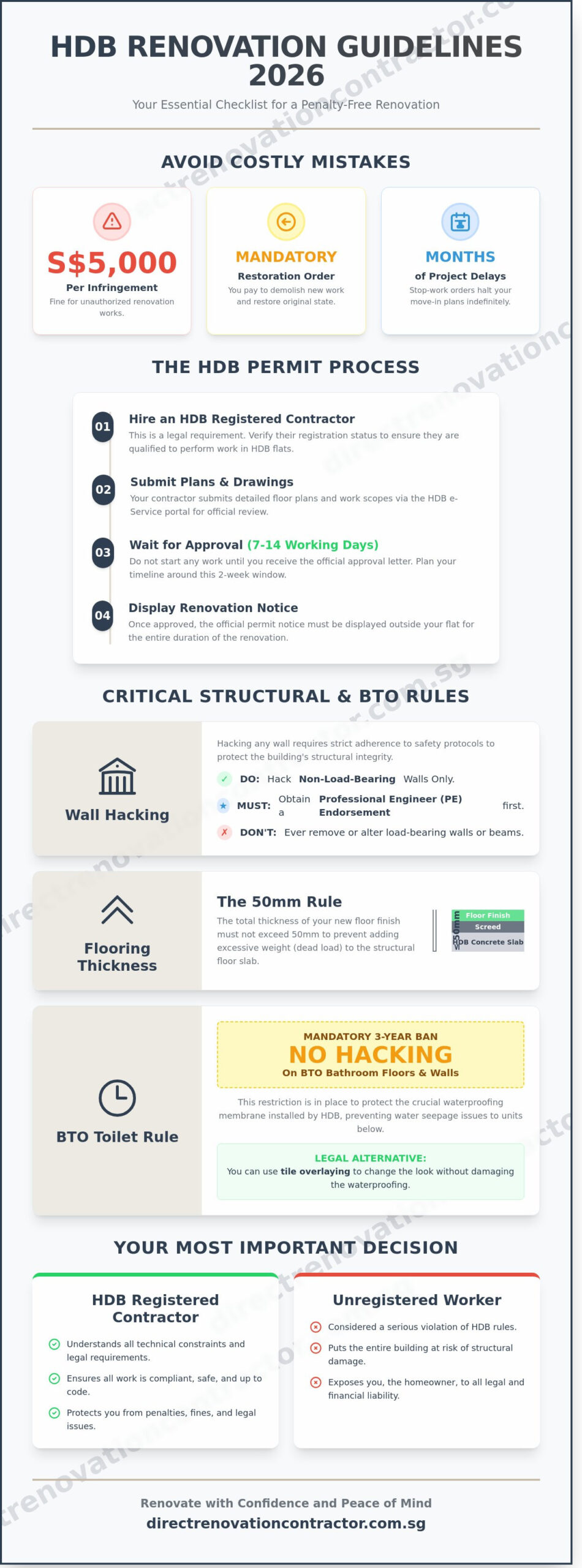
A single unapproved wall hack in your new flat can result in a S$5,000 fine and a mandatory restoration order that halts your move-in date for months. Most Singaporean homeowners find the technical jargon in official manuals confusing; the fear of structural damage penalties often leads to overspending on expensive interior design packages just for peace of mind. It’s frustrating to feel like you’re paying a premium just to ensure your home doesn’t violate a rule you didn’t know existed.
We believe renovation should be straightforward and transparent. This guide breaks down the updated hdb renovation rules and guidelines 2026 to help you navigate the permit process with total confidence and zero hidden fees. You’ll learn how to avoid the 3-year BTO toilet waterproofing trap and why hiring a direct contractor is the smartest way to ensure your masonry and flooring work meet HDB standards. We’re covering the essential hacking limitations and the specific paperwork required for a smooth, penalty-free handover.
Key Takeaways
- Master the 2026 permit timelines and mandatory approval processes to prevent project delays and ensure full compliance with HDB standards.
- Understand critical structural limitations, including the 50mm flooring thickness rule and the necessity of PE endorsements for hacking non-load-bearing walls.
- Navigate the updated hdb renovation rules and guidelines 2026 to maintain your estate’s uniform facade and meet specific electrical loading requirements.
- Learn the “Upper Floor vs. Lower Floor” responsibility rule for plumbing leaks to quickly resolve maintenance disputes and protect your home.
- Save on your renovation budget by working directly with a registered contractor to eliminate unnecessary interior design markups and hidden fees.
Essential HDB Renovation Permits and Timeline for 2026
HDB renovation permits are official approvals you must obtain before starting any works that impact the structural integrity or external appearance of your flat. These permits aren’t optional suggestions. They’re legal requirements. In 2026, the standard processing time for most permits ranges from 7 to 14 working days. You shouldn’t commit to a start date with your movers until this approval is in your hands. Planning your timeline around this 2-week window prevents costly delays and scheduling conflicts with your direct contractor.
You cannot legally hire just anyone to renovate your home. Every homeowner must engage an HDB Registered Contractor. These professionals have undergone specific training to understand the load-bearing limits and technical constraints of Singapore’s public housing. Hiring an unregistered worker is a serious violation of the hdb renovation rules and guidelines 2026. It puts the safety of the entire block at risk. We’ve seen cases where unauthorized hacking led to structural cracks, resulting in immediate stop-work orders and legal headaches for the owner.
This focus on verified expertise is why homeowners should always prioritize credentials; for a look at how a professional firm maintains these standards, you can visit Al-Pro Construction LLC.
The consequences of performing unauthorized works are severe and expensive. If you proceed without a permit or ignore the approved plans, HDB can slap you with fines reaching S$5,000 per infringement. Beyond the fine, you’ll be served a notice for mandatory reinstatement. This means you’ll have to pay your contractor to tear down the new work and restore the flat to its original state. It’s a double expense that destroys your renovation budget. Sticking to the rules is the only way to ensure your investment stays protected.
The 3-Year Restriction on BTO Toilets
If you’re moving into a new BTO flat in 2026, you’ll face a mandatory 3-year “no-hacking” rule for your bathroom floor and wall tiles. HDB implements this rule to protect the waterproofing membrane installed during construction. If you hack these tiles prematurely, you risk causing water seepage into the unit below. This restriction is consistent with the quality standards maintained in HDB’s Home Improvement Programme, which focuses on long-term structural health. Your legal alternative is tile overlaying, which allows you to refresh the look without breaching the membrane. Full hacking is only permitted after the 3-year period expires.
Permit Application Process in 2026
The application process is straightforward when you work with a registered professional. First, you must select your HDB Registered Contractor and provide them with your official floor plans. Your contractor will then prepare proposed sketches and technical drawings for submission. You’ll need to provide your contractor’s BCA/HDB registration details to verify their eligibility. Once the application is submitted via the HDB e-Service, you’ll receive a notification via SMS or the LifeSG app. Following the hdb renovation rules and guidelines 2026 ensures your project starts on the right side of the law. A Renovation Permit is the legal shield for every Singaporean homeowner.
- Step 1: Confirm your contractor’s HDB registration status.
- Step 2: Submit floor plans and detailed work scopes.
- Step 3: Wait 7 to 14 working days for the official approval letter.
- Step 4: Display the renovation notice outside your flat during the work period.
Structural Guidelines: Hacking, Flooring, and Walls
Structural integrity is the primary concern for any high-rise building. Under the hdb renovation rules and guidelines 2026, you cannot simply remove any wall to create an open-concept layout. Only non-load-bearing walls are eligible for removal. Before any work begins, you must obtain a Professional Engineer (PE) endorsement to confirm that the hacking won’t affect the building’s stability. This isn’t just a formality; it’s a safety requirement that protects every resident in your block. For a comprehensive list of what requires specific approval, always consult the Official HDB Renovation Guidelines before signing a contract.
The 50mm rule is another critical technical standard you must follow. The total thickness of your new floor finishes, including the screed and the tiles or laminate, must not exceed 50mm. This limit prevents excessive weight from being added to the floor slab. If your floor is too thick, it adds unnecessary dead load to the structure. Our team at a direct renovation contractor manages these measurements precisely to ensure your home stays within legal limits while providing a level surface.
Masonry standards have also evolved. Pre-packed screed is now the mandatory standard for all ‘dry’ areas like bedrooms and living rooms. This factory-mixed material ensures a consistent quality that site-mixed cement cannot match. It reduces the occurrence of hollow tiles and floor cracks. For wall finishes, avoid heavy stone cladding or thick marble slabs on internal partition walls. HDB restricts the weight of wall finishes to 30kg per square meter to prevent the walls from buckling or losing structural integrity over time.
The Household Shelter (HS) Forbidden Zone
The bomb shelter is a reinforced concrete core that you must leave alone. You’re strictly prohibited from hacking the walls, floor, or ceiling. You cannot drill deeper than 50mm into the internal walls, and you must never touch the ventilation sleeve. It’s okay to paint the shelter or install removable shelving, but the gas-tight door must remain the original HDB-issued model. Replacing this door is a serious violation because it compromises the airtight seal needed during an emergency.
Flooring and Tiling Compliance
Waterproofing is the most important part of any bathroom or kitchen renovation. HDB requires a mandatory 150mm ‘upturn’ for waterproofing membranes. This means the waterproof layer must climb 150mm up the wall from the floor level to prevent leaks from reaching the unit below. If you’re opting for vinyl flooring, it’s often a ‘permit-free’ option in 2026 as long as you aren’t hacking the existing floor tiles. However, if you decide to hack existing tiles to lay new ones, you must apply for a permit and strictly follow the noise schedule.
- Noise Window: Heavy hacking is only allowed between 9am and 5pm on weekdays.
- Weekend Restrictions: No hacking or loud drilling is permitted on Saturdays, Sundays, or Public Holidays.
- Notice Period: You must display a notice of renovation outside your unit at least 3 days before work starts.
Following these hdb renovation rules and guidelines 2026 prevents legal headaches and ensures your renovation doesn’t get halted by building inspectors. We focus on these technical details so you don’t have to worry about non-compliance issues later. By sticking to these standards, you protect your investment and maintain a good relationship with your neighbors by minimizing disruptions.
Electrical, Plumbing, and Gas Works Standards
Technical installations form the backbone of your home. If these systems fail, your renovation investment is wasted. HDB enforces strict hdb renovation rules and guidelines 2026 to ensure that individual flat upgrades don’t compromise the structural integrity or utility stability of the entire block. We see many homeowners focus on aesthetics while ignoring the load limits of their electrical boards. This is a mistake that leads to costly rectifications. You need to understand the technical constraints before you start hacking or wiring to avoid unnecessary delays and fines.
Electrical Wiring and Loading Limits
Every HDB block has a fixed electrical capacity. Exceeding this limit doesn’t just trip your own breakers; it can cause power outages for your neighbors. Most BTO flats built after 2003 come with a 40-amp main switch, providing roughly 9.2kVA of power. Older resale flats often operate on a 30-amp limit. You must verify your flat’s provision before buying high-draw appliances like steam ovens or multi-split air-con systems. If you’re planning a smart home with automated blinds and extensive LED strip lighting, your contractor must calculate the total wattage carefully. For resale renovations, you’re required to submit a Single Line Diagram (SLD) prepared by a Licensed Electrical Worker (LEW). This document is a mandatory part of the HDB renovation permit guide that ensures your new layout won’t overload the estate’s power grid.
Plumbing and Sanitary Guidelines
Water damage is the most common cause of neighbor disputes in Singapore. HDB uses a clear “Upper Floor vs. Lower Floor” rule. If a leak appears on your ceiling, the owner of the unit above is responsible for the repair costs because the floor slab falls under their maintenance purview. When renovating, you cannot move a toilet bowl more than 15cm from the original sewerage stack. Moving it further increases the risk of clogs and requires floor slab alterations that HDB rarely approves. We recommend keeping pipes exposed where possible. While concealed pipes look better, exposed pipes allow for immediate leak detection and cheaper maintenance. All plumbing works in your flat must comply with the PUB Code of Practice for 2026 to ensure water pressure remains stable and contamination is prevented.
Gas and Air-con Installation Safety
- Gas Works: You’re legally required to engage a City Energy-approved technician for any gas-related work. This includes relocating gas pipes or installing gas water heaters. Standard contractors aren’t licensed to touch these lines.
- Air-con Brackets: You must use stainless steel brackets for external compressors. These must be secured with 13mm diameter stainless steel bolts. Poorly mounted units are a safety hazard and can lead to heavy penalties.
- Drainage Routing: Air-con condensation pipes must lead directly to the nearest internal floor trap. Letting water discharge into the common corridor or onto the external building ledge is a violation of hdb renovation rules and guidelines 2026 and can result in a S$500 fine.
Our direct contractor model ensures that these technical standards are met without middleman markups. We don’t hide costs behind fancy design presentations. Instead, we focus on the engineering reality of your flat. Using the right materials and following HDB’s technical specs protects your home’s value. It also saves you from the headache of “stop-work” orders from HDB inspectors. We prioritize functional results and technical competence over abstract design concepts because a beautiful home that constantly trips the power is a failed project.
Modern 2026 HDB Features: BTO Aesthetics and Smart Tech
As we move into 2026, HDB’s focus on “Distinctive Features” has intensified. Newer BTO estates come with specific facade elements, such as unique sun-shading fins or integrated planter boxes. You cannot hack or alter these external features. Following the hdb renovation rules and guidelines 2026 ensures you don’t face heavy fines or orders to reinstate the original look at your own cost. We’ve seen cases where homeowners tried to remove pre-cast aesthetic components only to be told to put them back immediately. This is about maintaining the building’s structural integrity and architectural identity.
Window and grille restrictions remain strict to maintain a uniform facade. You can’t simply pick a trendy rose gold frame if the rest of your block uses charcoal grey. HDB mandates that all outward-facing elements match the estate’s designated color scheme. For balconies and service yards, the rules for 2026 are clear. You can install zip-tracks or blinds, but they must be of an approved design that allows for natural ventilation. Enclosing these spaces fully with glass is generally prohibited unless specified in your flat’s layout plan.
Sustainability is no longer optional. Under the 2026 standards, all new fittings must meet high Water Efficiency Labelling Scheme (WELS) ratings. We recommend installing 3-tick rated taps and mixers to comply with these green requirements. Energy-efficient LED lighting is also the baseline for all our projects. These choices lower your utility bills and ensure your home meets the latest environmental benchmarks set by the authorities.
Smart Home Integration and Hidden Wiring
Smart locks and doorbell cameras are standard in 2026, but they must not infringe on common corridor space. Your camera’s field of vision shouldn’t capture the interior of your neighbor’s home. For internal tech, false ceilings are the best way to hide messy cables. HDB rules require a minimum clearance height, typically leaving at least 2.4 meters from the floor. We also suggest planning for Cat6 or Cat7 Ethernet cabling in every room. Relying on mesh Wi-Fi alone isn’t enough for high-speed 10Gbps home networks. Proper planning prevents unsightly trunking running across your walls later.
Window Replacement Rules
You must use a BCA-approved window contractor for any replacement or repair work. This isn’t just a suggestion; it is a legal requirement in Singapore. Safety is the priority here. Homeowners are responsible for checking that rivets and fasteners are secure every 6 months. If we find corroded aluminum rivets during a site visit, we replace them with stainless steel ones immediately. Your new window frames must match the estate’s color exactly. We handle the permit applications to ensure your window installation stays 100% compliant with the hdb renovation rules and guidelines 2026.
Avoid middleman markups and ensure your smart home is built to the latest 2026 standards. Talk to a direct renovation contractor to get factory pricing on your BTO fit-out today.
Managing Your Renovation with a Direct Contractor
Managing a renovation project in 2026 requires a systematic approach to ensure your home remains structurally sound and legally compliant. Following the hdb renovation rules and guidelines 2026 isn’t just about avoiding fines; it’s about ensuring the long-term safety of your block. By following these five steps, you can navigate the process efficiently while keeping costs under control.
Step 1: Start by obtaining your official HDB floor plan through the My HDBPage portal. This document is your most important tool. You must identify the thick, bold lines that represent load-bearing walls. Hacking these is a serious violation that compromises the building’s integrity. The plan also highlights designated utility points for plumbing and gas, which dictates where your kitchen and bathrooms can be positioned.
Step 2: Engage a direct contractor like Direct Renovation Contractor Singapore. Traditional interior design firms often add a 15% to 30% markup on top of the actual construction costs to cover their project management fees and showroom overheads. By working directly with the builder, you bypass these markups, potentially saving between S$8,000 and S$20,000 on a standard 4-room BTO renovation. This direct relationship ensures your budget goes toward better materials rather than commissions.
Step 3: Always verify your contractor’s credentials. Use the HDB e-Service to check the Directory of Renovation Contractors (DRC). A contractor must be HDB-registered to even apply for the necessary permits. In 2026, HDB continues to hold contractors accountable for any damage to common property, so hiring an unregistered worker puts your renovation deposit at risk.
Step 4: Set a realistic timeline that respects HDB’s permitted working hours. General renovation work can occur between 8:00 AM and 6:00 PM on weekdays and Saturdays. However, noisy activities like hacking or drilling are strictly limited to 9:00 AM to 5:00 PM on weekdays only. Noisy work is prohibited on Saturdays, Sundays, and Public Holidays. Planning your schedule around these blocks prevents neighbor complaints and stop-work orders.
Step 5: Conduct a final joint inspection before the HDB permit expires. This usually happens within three months for BTO flats. You and your contractor should check every electrical socket, water inlet, and tiled surface against the approved permit. This final check ensures that the work performed matches the declared scope, protecting you from future compliance audits.
Why the Direct Model Works for HDB Compliance
Direct communication with the mason and carpenter ensures technical rules are followed to the letter. When you speak directly to the person performing the hacking, there’s no risk of a salesperson miscommunicating which walls are off-limits. This model provides total transparency; you pay for the specific work performed and the raw materials used. If a site condition changes during the project, you can make adjustments on-site instantly without waiting for a middleman to approve the change order.
Final Handover and Compliance Checklist
The final phase of your project must align with the hdb renovation rules and guidelines 2026 to ensure a smooth closing of your permit. Failure to follow disposal or external modification rules can lead to heavy penalties from the Town Council. Use this checklist for a clean handover:
- Ensure all renovation debris is cleared using HDB-approved disposal methods. Dumping materials in common chutes or void decks can result in a S$500 fine for the first offense.
- Verify that no unauthorized external changes were made, such as painting the corridor walls or installing non-approved window grilles that break the estate’s uniform facade.
- Check that all plumbing work is leak-free and that waterproof membranes in wet areas were given the required 24-hour ponding test.
Secure Your HDB Renovation Success in 2026
Adhering to the latest hdb renovation rules and guidelines 2026 is the only way to protect your investment and avoid heavy fines. You’ve seen that securing HDB permits now requires a minimum 21-day lead time before any hacking begins. You also know that structural safety isn’t negotiable; load-bearing walls remain strictly off-limits to ensure the integrity of your block. By focusing on these technical standards and integrating modern smart home features early, you’ll build a space that’s both functional and fully compliant.
Don’t let middleman markups drain your S$60,000 renovation budget. We operate as an HDB Registered Contractor, meaning we handle the paperwork and the physical labor ourselves. We offer direct factory pricing for all carpentry, effectively cutting out the 20% to 30% commissions typically charged by interior design firms. Our approach prioritizes technical competence and transparent pricing over flashy sales tactics. We manage your masonry, plumbing, and electrical works with the authority of a seasoned builder.
Get a Direct Contractor Quote for Your HDB Renovation today to see how we deliver quality results without the hidden costs. We’ll help you navigate the 2026 regulations while ensuring your home is built to last. Your renovation journey starts with straightforward advice and fair pricing.
Frequently Asked Questions
Do I need a permit to change my HDB bedroom door in 2026?
You don’t need an HDB permit to replace internal bedroom doors in 2026. However, if you’re replacing your main entrance door and it’s along a fire escape route like a corridor, it must be fire-rated. You must engage a licensed contractor to ensure the door and closer meet the 30-minute fire resistance standard set by the authorities.
Can I hack the wall between my kitchen and living room for an open concept?
You can hack non-structural walls between your kitchen and living room after obtaining written HDB approval. You must submit a floor plan to HDB to identify load-bearing walls, which are marked by thick black lines. Hacking structural pillars or beams is strictly prohibited and carries a fine of up to S$5,000 under current hdb renovation rules and guidelines 2026.
What is the penalty for renovating without an HDB permit?
Carrying out unauthorized works can lead to a fine of up to S$5,000 and a requirement to reinstate the flat to its original condition at your own expense. HDB inspectors conduct spot checks on 100 percent of reported cases and random audits on ongoing projects. You’ll also face delays in your renovation timeline as all work must stop until you resolve the legal breach.
Is it true that I cannot change my BTO toilet tiles for the first 3 years?
It’s true that you cannot hack or replace floor and wall tiles in BTO bathrooms for the first 3 years. This 36-month restriction protects the waterproofing membrane provided by HDB, which is under warranty. If you must change the look, you can opt for overlaying tiles using approved adhesives, which doesn’t involve hacking the original surface or compromising the membrane.
How long does it take for HDB to approve a renovation permit?
HDB typically takes 3 to 14 working days to process a renovation permit application. This timeline depends on the complexity of your request, such as hacking walls or relocating plumbing. You should submit your application at least 21 days before your intended start date to avoid scheduling conflicts with your direct contractor and ensure all paperwork is in order.
Can I install a bathtub in my HDB flat?
You can install a bathtub in your HDB flat as long as it doesn’t exceed the floor loading limit of 150kg per square meter. Most standard acrylic bathtubs are acceptable, but you must not fill the void beneath the tub with heavy cement or bricks. Ensure your contractor provides proper access panels for future maintenance of the drainage pipes to prevent long-term moisture issues.
Do I need to inform my neighbors before starting renovation works?
Yes, you must serve a written notice to your immediate neighbors at least 3 days before any renovation works begin. You should also display the HDB Renovation Notice outside your flat throughout the duration of the project. This is a mandatory requirement under the hdb renovation rules and guidelines 2026 to minimize disputes regarding noise and dust in the block.
Who is responsible if my renovation causes a leak in the unit below?
The flat owner is legally responsible for any damage caused to the unit below during or after renovation works. If a leak occurs within 7 days of hacking or tiling, it’s usually attributed to the ongoing work. You’ll need to pay for the repairs in both your unit and your neighbor’s unit, which can cost between S$500 and S$3,000 depending on the severity of the water damage.