

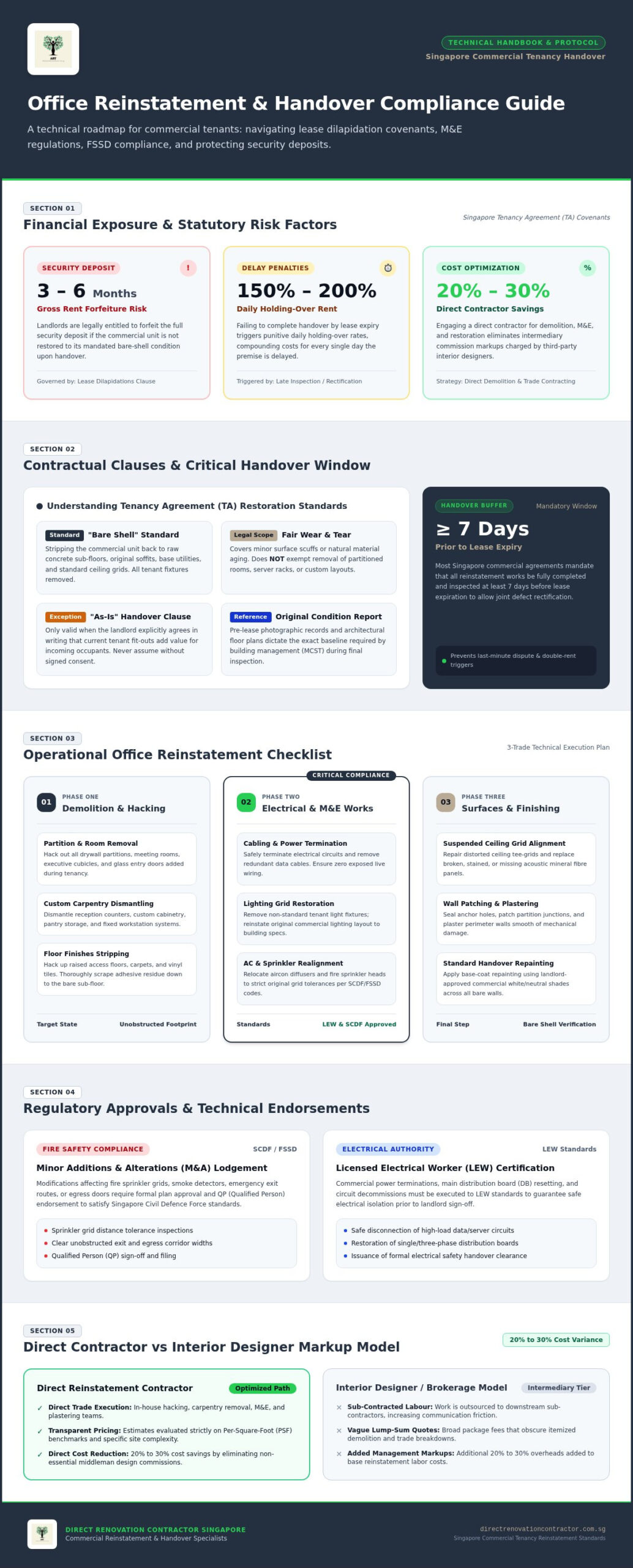
Did you know that three to six months of your gross rent is currently sitting in a security deposit that your landlord can legally forfeit if your office isn’t returned to its original state? In Singapore’s 2026 commercial market, failing to meet strict bare-shell requirements doesn’t just lose you that deposit; it can also trigger double rent charges for every day the handover is delayed. You’ve likely spent hours squinting at confusing Tenancy Agreement clauses about SCDF fire safety and partition removal while worrying about hidden costs from middleman markups.
We understand that the pressure of a lease expiry is enough to deal with without the fear of unexpected restoration fees. This guide provides a comprehensive office reinstatement checklist to help you manage the process with the technical authority of a seasoned professional. You’ll learn how to navigate SCDF Minor Additions and Alterations lodgements, ensure your electrical works meet LEW certification standards, and execute a cost-effective restoration. We’re stripping away the abstract jargon to give you a clear, step-by-step path to a successful landlord handover without the unnecessary designer fees or intermediary commissions.
Key Takeaways
- Identify your specific restoration obligations within your Tenancy Agreement to avoid performing work that isn’t legally mandated by the landlord.
- Utilize a comprehensive office reinstatement checklist to systematically manage hacking, M&E restoration, and surface finishing across all technical trades.
- Navigate SCDF and FSSD requirements by understanding which modifications to fire safety systems require professional certification and QP endorsement.
- Estimate restoration costs accurately by focusing on PSF benchmarks and built-in complexity rather than relying on vague lump-sum quotes.
- Save 20% to 30% on project costs by engaging a direct contractor for demolition and restoration works instead of paying management markups to an interior designer.
What is Office Reinstatement and Why is it Mandatory?
Office reinstatement is the technical process of restoring a leased commercial unit to its original “bare shell” or handover condition. In Singapore, this typically involves hacking out partitions, removing floor finishes, and restoring the ceiling grid to meet the building management’s standards. It’s a mandatory requirement because landlords need a clean slate to market the unit to the next tenant. Without this reset, the property remains customized to your specific needs, which might not suit the next business moving in.
Your Tenancy Agreement (TA) serves as the primary legal document governing this process. It outlines your specific leasehold dilapidations and repair covenants, which dictate exactly what must be removed or repaired. Ignoring these clauses is risky. The TA is the rulebook. Poor execution often leads to the forfeiture of your security deposit, which usually equals three to six months of gross rent. If the unit isn’t handed over by the lease expiry date, landlords often charge “holding-over rent” at 150% to 200% of your daily rate. Using a detailed office reinstatement checklist ensures you don’t miss technical requirements that could trigger these penalties.
Original Condition vs. Fair Wear and Tear
Singapore law generally allows for “fair wear and tear,” which covers minor scuffs on walls or natural aging of materials. However, this doesn’t excuse you from major restoration. Structural changes like new rooms, server racks, or custom plumbing are never considered wear and tear. You’ll need to reference your original Condition Report or pre-lease photos to prove the state of the unit at the start of your tenancy. If you’ve modified the layout, you’re responsible for restoring it. Improvements don’t exempt you from your obligation to return the space as you found it.
Common Reinstatement Clauses to Look For
Most TAs in 2026 include a “Bare Shell” clause. This means stripping the unit back to bare concrete floors and original soffits. Occasionally, you might find an “As-Is” clause if the landlord believes your fit-out adds value for future tenants, but don’t count on it without written confirmation. Pay close attention to the handover timeline. Most agreements require all works to be completed and inspected at least seven days before the official lease end date. This buffer allows for minor defect rectification. Having a clear office reinstatement checklist helps you coordinate these deadlines with your contractor to avoid last-minute disputes.
The Comprehensive Office Reinstatement Checklist
Managing a commercial handover requires a systematic approach to technical trades. This office reinstatement checklist serves as your operational roadmap, ensuring that demolition, mechanical and electrical (M&E) works, and surface finishing align with your landlord’s specific requirements. The ‘Bare Shell’ standard is the removal of all tenant-added fixtures to reveal the original concrete and utility points. By following a structured process, you prevent last-minute disputes and ensure the space is ready for the next occupant’s fit-out.
Demolition and Hacking Works
The first phase involves stripping away all non-original structures. You’ll need to remove all drywall partitions, glass doors, and internal rooms that were added during your tenancy. This includes dismantling built-in carpentry, workstations, and reception counters; if you previously worked with a carpenter in Singapore for custom fittings, these must be completely hacked out. Finally, you must hack up all raised floorings, carpets, or vinyl tiles to reveal the raw sub-floor, ensuring the surface is clear of adhesive residue or debris.
Electrical and M&E Restoration
Restoring M&E systems is the most technical part of the checklist. You must terminate and make safe all electrical points and data cables, ensuring no live wires are left exposed. All tenant-added light fixtures must be removed and the original lighting grid restored. It’s critical to relocate AC vents and sprinklers to their original grid positions. In 2026, building managements are strictly enforcing sprinkler grid tolerances. You should refer to the SCDF fire safety plan approval guidelines to ensure your modifications comply with current fire codes, especially if your layout changes affected egress paths.
Ceiling, Walls, and Painting
Once the heavy hacking and M&E works are done, focus on the unit’s surfaces. Remove all false ceilings to restore the original T-bar or concrete soffit. Any holes left in the walls from partition removal or shelving must be patched smoothly. Most Tenancy Agreements mandate repainting the entire unit to ‘Landlord White’ to provide a neutral base. The final step is a thorough cleaning of windows, sills, and any remaining original fixtures. Engaging a direct renovation contractor allows you to manage these diverse trades through a single point of contact, ensuring the project stays on schedule for a clean handover.
Navigating Permits and Fire Safety (FSSD) Compliance
Compliance isn’t a suggestion; it’s a legal mandate that directly affects your security deposit. Your office reinstatement checklist must account for the Fire Safety and Shelter Department (FSSD) regulations from day one. In Singapore, commercial units are part of a larger building’s ecosystem, meaning your changes affect the entire site’s fire safety integrity. You can’t simply hack out a room and leave the fire alarm dangling. Failing to restore these systems to their original zones triggers immediate rejection during the final joint inspection with the landlord.
Even minor adjustments, such as moving a single sprinkler head or smoke detector, require professional endorsement. Building managements won’t sign off on your handover without proof of certification from a Professional Engineer (PE) or a Qualified Person (QP). It’s helpful to review the BCA guidelines on building works not requiring approval to distinguish between insignificant works and those needing formal plan submissions. Choosing a main contractor singapore who understands these technical nuances is vital for avoiding costly regulatory delays in 2026.
SCDF and Fire Safety Requirements
Restoring fire alarm systems involves more than just reattaching hardware. You must ensure that heat detectors and call points are functioning within their designated zones according to the original base-building drawings. A common mistake is blocking sprinkler spray patterns with remaining storage or failing to maintain the mandatory 500mm clearance from the ceiling. For most Grade A offices, you’ll need a Registered Inspector (RI) to conduct a final site walk-through. This RI provides the fire safety clearance required by the landlord, confirming that the unit is safe for the next occupant’s fit-out.
MCST Liaison and Building Rules
Before any hacking begins, you must apply for a ‘Permit to Work’ from the building’s Management Office (MCST). This process usually involves placing a refundable renovation deposit, which typically ranges from S$3,000 to S$10,000 depending on the floor area. Building managers are strict about noise; hacking works are restricted to weekday evenings after 6:00 PM or weekends. Your office reinstatement checklist should also include a plan for debris disposal. You must use approved loading bays and provide adequate protection for common areas like lift lobbies to avoid deductions from your renovation deposit due to floor scratches or wall dents.
Estimating Costs and Timelines for Office Restoration
Budgeting for restoration requires a clear understanding of how contractors price these technical works. Most quotes are calculated on a per square foot (PSF) basis, which covers the general demolition and surface restoration of the entire unit. However, high-intensity tasks like wet pantry removal or server room decommissioning are often quoted as separate lump sums. The primary cost drivers in 2026 are the volume of built-in carpentry and the intricacy of your M&E systems. Using a detailed office reinstatement checklist during the initial site walk-through ensures your contractor captures these variables early, preventing hidden costs from surfacing mid-project.
The “Direct Contractor” model is the most efficient way to control your exit costs. By skipping the interior design firm, you avoid paying a 20% to 30% management fee on top of the actual labor and disposal costs. Reinstatement is a functional requirement, not a design project, so paying for artistic oversight is unnecessary. Engaging an experienced team directly ensures your funds go toward quality workmanship and technical compliance rather than intermediary markups. To secure a transparent breakdown of your restoration needs, you can request a direct reinstatement quote from our technical team.
Factors Influencing Your Reinstatement Quote
Several physical factors dictate the final price. Larger units or those with high ceilings require specialized scaffolding and additional man-hours for ceiling grid restoration. Flooring type also plays a significant role. Hacking up floor tiles or heavy masonry screed is far more labor-intensive than removing modular carpet tiles. Additionally, most CBD Grade A towers mandate that noisy works like hacking and drilling occur after 6:00 PM or on weekends. This “Night Work” premium covers the higher labor rates for after-hours shifts and is a standard industry practice in Singapore.
The Recommended 4-Week Reinstatement Timeline
Waiting until the final week of your lease is a recipe for financial disaster. If you overrun your lease period, you risk forfeiting your deposit and paying double rent. A standard office reinstatement checklist should follow a strict four-week sequence to ensure a smooth handover:
- Week 1: Conduct the site survey, apply for MCST permits, and file necessary FSSD paperwork.
- Week 2: Execute heavy hacking, remove all partitions, and clear demolition debris from the site.
- Week 3: Focus on M&E restoration, including sprinkler relocation and restoring the ceiling grid.
- Week 4: Complete the painting, perform a final deep clean, and conduct the joint inspection with the landlord.
Why Hire a Direct Contractor for Your Reinstatement?
Choosing the right partner for your exit is just as critical as choosing one for your fit-out. Many tenants mistakenly engage an Interior Designer (ID) for restoration, but reinstatement is a technical demolition project, not a creative exercise. Hiring a direct contractor singapore allows you to bypass the typical 20% to 30% project management markup that IDs charge for “coordination.” For a ‘bare shell’ restoration, you don’t need artistic flair; you need technical competence and financial transparency. Working directly with the builder ensures your budget pays for actual labor and materials rather than intermediary commissions.
Accountability is the primary benefit of the direct-to-consumer model. When you speak with us, you’re talking to the team that manages the hacking and electrical restoration. This eliminates the risk of instructions getting lost in translation through multiple management layers. We apply the same rigorous quality standards found in high-end home renovation projects to ensure your commercial space meets every building regulation. Using an office reinstatement checklist with a direct contractor means every task is handled by a trade specialist who understands the structural integrity of the unit.
Direct Access to Specialized Trades
A direct contractor maintains in-house hacking teams, which allows for a much faster debris turnaround compared to firms that outsource labor. This speed is vital when you’re racing against a lease expiry deadline. We provide direct electrical and plumbing services, ensuring that all M&E restoration is certified by licensed workers from the start. Our pricing model is straightforward. You receive a clear breakdown of costs for every trade, with no hidden ‘coordination fees’ or undisclosed markups. This transparency builds the trust necessary for a high-stakes project like a commercial handover.
Securing Your Deposit Refund
The ultimate goal of your office reinstatement checklist is the full return of your security deposit. Professional documentation is your best defense against difficult landlords or building managers who might attempt to claim for pre-existing defects. We provide the technical proof and certification required to ensure a ‘defect-free’ handover on the first attempt. This precision prevents costly rectification cycles that can bleed into the next month’s rent. If you’re ready to vacate your premises without the financial stress of middleman fees, get a direct reinstatement quote today and ensure a clean break from your current lease.
Protect Your Security Deposit with Professional Reinstatement
Reinstating your commercial space doesn’t have to be a source of financial anxiety or legal dispute. By following a structured office reinstatement checklist, you’ve already taken the first step toward reclaiming your full security deposit. You now understand that navigating SCDF and BCA regulations requires technical precision rather than design flair. Most importantly, you know that the direct contractor model is the most effective way to eliminate unnecessary markups and ensure your restoration is completed on time.
At Direct Renovation Contractor Singapore, we focus on the practicalities of commercial handover. Our in-house hacking and restoration teams handle everything from partition removal to certified M&E works without intermediary fees. We bring deep expertise in local regulatory standards to every project, ensuring your unit meets the landlord’s ‘bare shell’ requirements on the first attempt. If you’re preparing to vacate your premises in 2026, don’t leave your deposit to chance. Get a Transparent, Direct Quote for Your Office Reinstatement today and move forward with confidence. Your successful transition starts with a clear plan and a partner who values straightforward communication and quality workmanship.
Frequently Asked Questions
How much does office reinstatement cost in Singapore per square foot?
Office reinstatement costs in Singapore for 2026 generally range between S$8.00 and S$25.00 per square foot. Economy projects for simple open-plan layouts sit at the lower end; while CBD Grade A towers with complex server rooms or raised flooring reach the higher end. These figures are subject to the prevailing 9% GST rate. You should obtain a detailed breakdown from a direct contractor to avoid the 20% markups typically added by interior design firms.
Do I need to reinstate my office if the next tenant wants my current fit-out?
You may not need to reinstate if you negotiate a “fitted takeover” with the landlord and the incoming tenant. This usually requires a formal deed of transfer to release you from your restoration obligations. However; landlords often prefer a bare shell handover to ensure the unit is marketable to a wider range of occupants. Always get any waiver of reinstatement in writing to protect your security deposit from future claims.
How long does a typical office reinstatement take to complete?
Physical on-site works typically take one to two weeks for small offices under 2,000 square feet. Mid-sized units between 2,000 and 5,000 square feet usually require two to four weeks. You must also factor in an additional three to six weeks for planning; permit applications; and SCDF submissions. A professional office reinstatement checklist helps you manage this timeline to ensure you complete the final joint inspection before your lease expires.
Can I do the office reinstatement myself to save money?
Doing the reinstatement yourself is generally not possible for commercial units in Singapore. Building managements require contractors to have bizSAFE Level 3 certification and Public Liability Insurance before granting site access. Technical tasks like terminating electrical points must be performed by a Licensed Electrical Worker (LEW). Hiring a direct contractor ensures you meet these professional requirements while maintaining lower costs by removing the middleman markups associated with design firms.
What happens if I fail to complete the reinstatement before my lease ends?
Failing to complete restoration before your lease ends can lead to severe financial penalties. Landlords are legally entitled to charge holding-over rent; which is often double your daily gross rental rate. They may also forfeit your security deposit to hire their own contractor to finish the works at a premium price. Completing your office reinstatement checklist early prevents these disputes and ensures a clean legal handover of the premises to the landlord.
Is a fire safety (FSSD) submission always required for reinstatement?
An FSSD submission is mandatory if your reinstatement involves altering fire safety systems like sprinklers or smoke detectors. Minor changes may qualify for the SCDF Minor Additions and Alterations (MAA) Lodgement Scheme; but structural changes or egress path modifications require a full plan submission. You’ll need a Qualified Person (QP) to endorse these works. Failing to secure fire safety clearance often results in the landlord rejecting the entire handover until compliance is proven.
How do I ensure I get my full security deposit back from the landlord?
Securing your full refund requires strict adherence to the Tenancy Agreement and a thorough final inspection. Use your office reinstatement checklist to verify that all hacking; M&E restoration; and repainting meet the landlord’s standards. Document the completed state with high-resolution photos and ensure all technical certifications; such as LEW compliance; are submitted. This professional approach leaves no room for the landlord to justify deductions for alleged defects or incomplete works.
What is the difference between a bare shell and a fitted office handover?
A bare shell handover requires stripping the unit back to its raw concrete floor and original ceiling soffit with basic utility points capped. In contrast; a fitted office handover allows the tenant to leave behind partitions; flooring; and custom carpentry. Most Singapore commercial leases mandate a bare shell condition unless you’ve specifically negotiated otherwise. Understanding this difference is vital for accurate budgeting and preventing unexpected hacking costs during the final month of your lease.