
Your interior design firm is likely charging you a 30% markup just to act as a middleman between you and the people actually doing the masonry and plumbing. You probably already know that a toilet renovation singapore project is the most technical and high-risk part of a home makeover. It’s common to feel anxious about hidden costs buried in “all-in” packages or the fear of failing a mandatory HDB 24-hour waterproofing test. You want a leak-free, modern bathroom, but you don’t want to pay a premium for someone else to simply manage a WhatsApp group.
This guide will show you how to master the technicalities of hacking and tiling to save over S$3,000 by working directly with the source. We’ll provide a transparent breakdown of 2026 material costs, HDB regulation checklists, and the exact sequence of works from initial site measurement to final fitting. You’ll learn how to navigate HDB and MCST requirements with the confidence of a seasoned builder, ensuring your new bathroom is both compliant and built to last without any middleman markups.
Key Takeaways
- Navigate strict HDB regulations and the 3-year BTO waterproofing rule to avoid costly legal mistakes and voided warranties.
- Compare hacking versus overlaying methods to determine the most cost-effective approach based on your bathroom’s current technical condition.
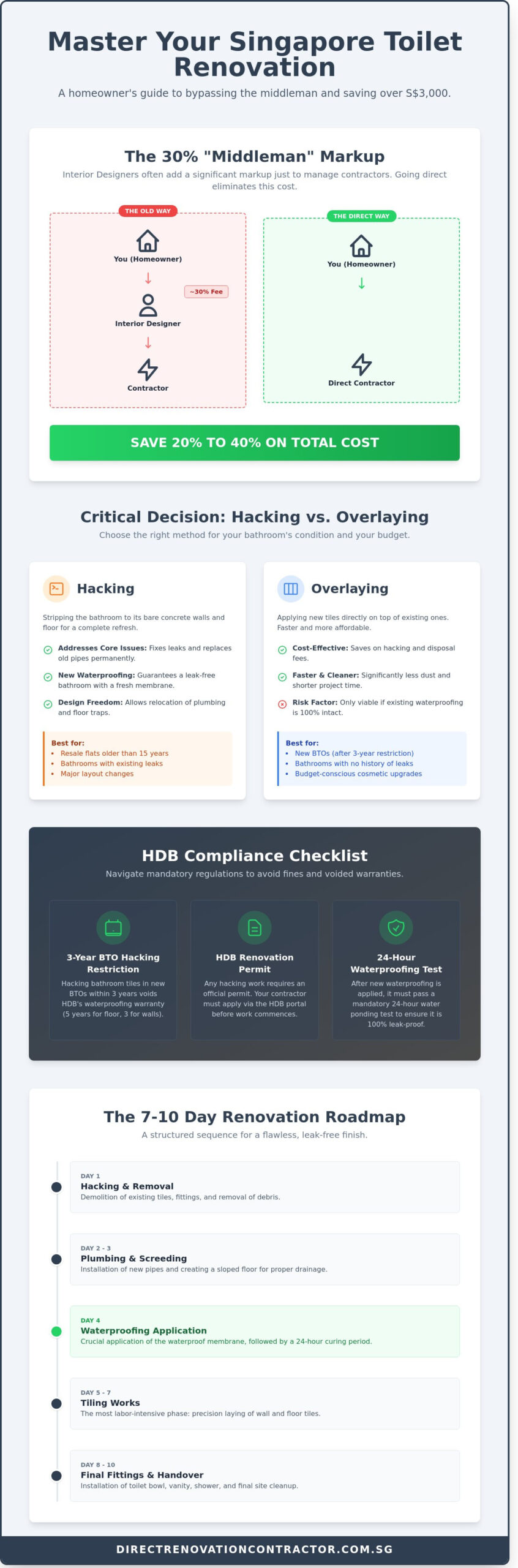
- Save 20% to 40% on your toilet renovation singapore by eliminating interior designer markups through a direct-to-contractor pricing model.
- Identify non-negotiable material standards, including R10 anti-slip tile ratings and durable sanitary ware, to ensure long-term safety and functionality.
- Follow a structured project management roadmap from initial site measurement at Paya Ubi to the final handover for a stress-free experience.
Understanding Toilet Renovation in Singapore: Rules, Permits, and Timing
Toilet renovation in Singapore is the most heavily regulated part of home improvement because water leakage causes immediate friction between neighbors. You aren’t just changing tiles; you’re managing a complex system of waterproofing and structural integrity. When planning a toilet renovation singapore, understanding the legal framework is your first step to avoiding heavy fines or voided warranties. HDB and MCST authorities take these rules seriously to prevent long-term damage to the building’s concrete slab.
HDB Waterproofing and Hacking Restrictions
HDB enforces a strict 3-year restriction on hacking floor and wall tiles in new BTO flats. This policy protects the original waterproofing membrane installed by the building contractor. HDB provides a 5-year warranty for floor leaks and a 3-year warranty for wall leaks in BTO units. If you choose to hack these surfaces before the period ends, you void this protection immediately. If a leak occurs later, you’ll be 100% liable for the repair costs of your neighbor’s ceiling. To proceed with any hacking, your contractor must apply for a renovation permit via the HDB portal using your Singpass authorization. For older resale flats, hacking is generally permitted, provided you engage a HDB registered contractor who follows approved masonry standards.
Timeline Expectations for a Standard Singapore Toilet
A professional toilet renovation singapore project typically takes 7 to 10 working days per bathroom. We follow a precise, logical sequence to ensure the waterproofing is foolproof and the finish is level. We don’t skip steps to save time because a rushed job leads to leaks within months. The process follows this timeline:
- Day 1: Hacking of existing tiles and removal of common bathroom fittings.
- Day 2 to 3: New plumbing pipework installation and floor screeding to create the correct fall for drainage.
- Day 4: Application of the waterproofing membrane. This layer must cure for at least 24 hours without disturbance.
- Day 5 to 7: Laying of new wall and floor tiles. This is the most labor-intensive phase requiring technical precision.
- Day 8 to 10: Final installation of the toilet bowl, vanity cabinet, and shower sets, followed by cleaning.
If you’re living in the unit during the works, you must plan for alternative toilet arrangements. You won’t have access to water or a functioning toilet in that specific bathroom for the entire duration. For condo owners, MCST regulations usually restrict noisy work to weekdays between 9:00 AM and 5:00 PM. We manage the protection of common areas, like lift lobbies and corridors, to ensure you don’t lose your renovation deposit due to site mess or damage.
Hacking vs. Overlaying: Which Method Fits Your Bathroom and Budget?
Choosing between hacking and overlaying is the most critical decision in any toilet renovation singapore project. Hacking involves stripping the bathroom down to its bare concrete walls and floor. Overlaying, often called “tiling over,” involves applying new tiles directly on top of the existing ones using a specialized bonding agent. While overlaying is faster, it’s only a viable option if your current waterproofing is 100% intact. If there’s even a minor leak, overlaying just masks a structural problem that will eventually cost more to fix.
You should also consider the physical space. Overlaying adds a new layer of tile and mortar, which reduces your bathroom dimensions by roughly 1cm to 2cm on every wall. In a compact HDB bathroom, this can affect how your vanity cabinet fits or how much clearance you have for a shower screen. As a direct contractor, we always evaluate the structural integrity of the base layer before recommending an overlay to ensure you don’t face “popping” tiles three years down the road.
When to Choose the Hacking Method
Hacking is mandatory if you notice brown water stains on the ceiling of the unit below or if your tiles sound hollow when tapped. These signs indicate that the original waterproofing membrane has failed. For resale flats older than 15 years, we recommend a full hack to replace aging internal pipes and apply fresh waterproofing. This method is also necessary if you plan to change the location of your floor trap or re-route plumbing. Before starting, check this guide on HDB renovation dos and don’ts to understand the specific permits required for hacking works.
The Pros and Cons of Tile Overlaying
Overlaying is the preferred choice for homeowners who want to minimize mess and noise, especially in occupied flats. It’s a cleaner process that eliminates the need for heavy demolition. The primary benefit is cost; you save on hacking labor and haulage fees, which typically range from S$400 to S$800 for debris removal. However, the risk lies in the “double layer” effect. If the original tiles aren’t firmly bonded to the wall, the weight of the new layer can cause both layers to buckle. We offer a straightforward site assessment to determine if your existing tiles are stable enough for this method.
- Cost Savings: Overlaying saves approximately S$1,000 to S$1,500 on labor and disposal.
- Speed: An overlay project is usually completed 3 to 4 days faster than a full hack.
- Durability: Hacking provides a 10 to 20-year peace of mind regarding leaks.
- Technical Limit: HDB regulations allow only one layer of overlay; you can’t overlay on top of an existing overlay.
Ultimately, your choice depends on the age of your property and your long-term plans. If you’re planning a quick toilet renovation singapore for a BTO flat that’s only five years old, overlaying is a smart, budget-friendly move. For older resale units, the technical security of hacking is almost always the better investment.
2026 Toilet Renovation Cost Breakdown: Direct Contractor vs. Interior Designer
The 2026 market for a toilet renovation singapore reflects a 12% increase in labor costs compared to 2024. Skilled masonry workers and licensed plumbers are in high demand, pushing the daily rate for a tiler to approximately S$180 to S$250. Material costs for cement and waterproofing membranes have also stabilized at a higher baseline. If you hire an Interior Designer (ID), you’ll likely face a 20% to 40% markup on these base costs. This premium covers their office overheads and design presentations; it doesn’t change the quality of the cement used in your bathroom.
Masonry remains the most expensive component of a toilet overhaul. For a standard HDB bathroom, tiling labor costs S$9.50 to S$13.00 per square foot. Pre-packed cement screeding, now mandatory for most HDB flooring works, adds roughly S$4.00 to S$6.00 per square foot. Plumbing and electrical installations are separate line items. You should budget S$150 to S$250 for installing a storage water heater and S$120 to S$180 per lighting point or power socket.
Estimated Price Guide for HDB Toilet Packages
Current market rates for a standard 2-toilet renovation package in Singapore generally fall into two categories based on the scope of work:
- Standard 2-Toilet Hacking Package: S$6,000 to S$9,000. This covers the removal of old tiles, haulage of debris, new waterproofing, stainless steel piping, and tiling labor.
- Standard 2-Toilet Overlay Package: S$3,500 to S$5,500. This is a faster option where new tiles are laid over existing ones, avoiding the mess and cost of hacking.
- Inclusions: Most packages include haulage, clearing of debris to the HDB designated dumping ground, and basic plumbing reconnection for the vanity and toilet bowl.
The Hidden Savings of Direct Contracting
Working with a direct contractor removes the middleman, putting roughly S$2,500 back into your pocket for a typical toilet renovation singapore project. You don’t pay coordination fees just to have someone relay messages to the tiler. You also gain control over material costs. Instead of accepting an ID’s limited catalog, you can buy tiles directly from suppliers like Hafary or Lian Seng Hin at trade prices. This transparency ensures you know exactly what you’re paying for each plumbing fitting and carpentry unit without hidden commissions or “designer” markups.
Essential Fittings and Material Selection for Longevity
Choosing materials for your toilet renovation singapore project requires a focus on moisture resistance over pure aesthetics. HDB bathrooms are compact and frequently wet, meaning poor material choices lead to costly repairs within 24 to 36 months. We prioritize functional durability to ensure your investment lasts a decade or more without the need for touch-ups.
Tile Selection and Grouting Standards
Safety is the priority for flooring. We always recommend tiles with an R10 or R11 anti-slip rating to prevent falls in wet areas. Homogeneous tiles are superior to ceramic options because the color and material are consistent through the entire tile body. If a homogeneous tile chips, the damage is barely visible, whereas a chipped ceramic tile reveals a different colored clay base underneath. Using 600mm x 600mm large format tiles reduces the number of grout lines, making the space feel larger and easier to scrub. To prevent black mould, invest in epoxy grouting. While it costs S$300 to S$600 more than standard cement grout, its non-porous nature means it won’t absorb dirty water or stains.
Sanitary Ware and Plumbing Essentials
The “Big 3” items, the toilet bowl, washbasin, and shower set, must be selected based on maintenance needs. One-piece toilet bowls are easier to wipe down because they lack the grime-catching gap found in two-piece models. For water heaters, 25-liter storage tanks provide consistent pressure for rain showers but require more wall space and a dedicated circuit. Instant heaters are better for tight BTO layouts but offer lower water pressure. Don’t buy cheap, unbranded mixers. High-quality taps prevent “water hammer” noises that eventually vibrate pipes loose and cause internal leaks. This is a common issue we see when homeowners try to save S$50 on a low-grade tap.
Vanity cabinets must use internal PVC carcasses rather than standard plywood or chipboard. PVC won’t swell or rot when the basin leaks. Pair this with a quartz or solid surface top to prevent water rings and staining. Finally, install a ventilation fan with a minimum 50 CFM rating to exhaust steam before it feeds mould growth on your ceiling. Proper planning during a toilet renovation singapore ensures you don’t face structural issues later.
Navigating the Renovation Process with Direct Renovation Contractor
Direct Renovation Contractor Singapore provides the professional oversight of an interior design firm without the 20% to 30% markup typically found in the market. Our team handles the heavy lifting, providing 3D drawings that visualize your layout and full project management from start to finish. You get a clear, technical roadmap of your toilet renovation singapore project before the first tile is hacked, ensuring no surprises once the work begins.
It starts with a visit to our office at Paya Ubi for precise site measurements. We manage the entire timeline, including HDB permit applications and material logistics. For homeowners who want to take a more hands-on approach, our DIY Support Package provides technical guidance. We help you manage your own sub-contractors while ensuring the structural integrity of the wet area remains intact. It’s a flexible solution for those who want to save on costs while maintaining professional standards.
Quality control is the final, non-negotiable step in our process. We perform a mandatory 24-hour flood test to verify that the waterproofing membrane is 100% effective. Our supervisors also conduct a manual “tap test” on every wall and floor surface to identify hollow tiles. These gaps can lead to cracks or water seepage within 12 to 18 months, so we rectify them immediately before the final handover. We don’t consider the job done until these technical benchmarks are met.
Why Choose a Direct Contractor Over an ID?
Cutting out the middleman means you talk directly to the site supervisor. This eliminates communication lag and ensures technical issues are solved on the spot rather than through a third-party designer. We also operate our own workshop, providing factory-direct carpentry for custom vanities at a lower price point. If you’re planning a larger project, explore our HDB resale renovation package for comprehensive home works that follow the same transparent pricing model.
Getting Started: Your Toilet Reno Checklist
- Step 1: Confirm your property type. HDB flats have strict 3-year waterproofing rules for new BTOs, while MCSTs in condos often restrict work to specific hours between 9:00 AM and 5:00 PM.
- Step 2: Decide on hacking vs. overlaying. Hacking takes 4 to 5 days and costs more, while overlaying can save you roughly S$2,500 in labor and debris disposal fees.
- Step 3: Contact us for a transparent, no-markup quote to get an honest breakdown of your toilet renovation singapore costs.
Secure Your Direct-to-Factory Bathroom Upgrade
Planning a toilet renovation singapore doesn’t have to be a guessing game of hidden costs and complex permits. You’ve learned that choosing the right method, whether it’s a full hack or a strategic overlay, can drastically impact your S$4,000 to S$7,000 budget. By cutting out the middleman, you’re looking at immediate savings of 20% or more compared to traditional interior design firms.
We eliminate the fluff by providing direct-to-factory carpentry prices and leveraging over 20 years of technical experience in the local market. As an HDB registered contractor, we handle the mandatory paperwork and technical execution so you don’t have to worry about HDB compliance or structural integrity. You’ll get professional results and transparent pricing from a team that understands the practicalities of Singaporean homes.
It’s time to stop overpaying for project management and start investing in quality workmanship that lasts. Get a Direct Contractor Quote for Your Toilet Renovation and see how much you can save on your 2026 project. We’re ready to help you build a bathroom that’s both functional and durable.
Frequently Asked Questions
How long does a typical HDB toilet renovation take in Singapore?
A standard toilet renovation singapore project takes between 10 and 14 working days to complete. This timeline includes 1 day for hacking, 2 days for waterproofing and ponding tests, and 4 days for masonry work. We allocate the final 3 days for plumbing installations and electrical wiring. If you choose an overlay instead of hacking, we can often finish the job in 5 to 7 days.
Do I need to apply for a permit for a simple toilet tile overlay?
You don’t need an HDB permit for a tile overlay as it doesn’t involve structural changes or hacking. However, if you decide to hack existing tiles, we must apply for an HDB renovation permit which takes 3 to 5 working days for approval. We handle all permit submissions to ensure your project complies with the 3 year waterproofing warranty rule for new BTO flats.
Can I stay in my house while the toilet is being renovated?
You can stay in your house during the renovation, but 85% of homeowners find the dust and noise levels challenging. Since we work from 9:00 AM to 5:00 PM, you’ll have no access to that specific toilet during these hours. If you only have one toilet, we recommend arranging alternative bathing options for the 10 day duration. We use plastic floor protection and dust screens to minimize the mess.
What is the difference between a direct contractor and an interior designer for bathrooms?
Will hacking my toilet tiles affect my neighbor downstairs?
Hacking can cause vibration cracks in the neighbor’s ceiling if not done carefully by experienced workers. We use lighter 2kg to 5kg jackhammers to minimize impact on the concrete slab. After hacking, we apply 2 layers of K11 waterproofing membrane to prevent any future leaks. We also perform a mandatory 24 hour ponding test to ensure the unit downstairs remains dry before we start tiling.
Is epoxy grout really necessary for a toilet renovation?
Epoxy grout isn’t mandatory, but it’s a superior choice because it’s 100% waterproof and stain-resistant. Standard cement grout often cracks or turns black after 12 to 18 months of use. While epoxy grout adds S$200 to S$350 to your total bill, it prevents mold growth and eliminates the need for aggressive scrubbing. It’s a practical investment that extends the lifespan of your toilet renovation singapore.
How much should I budget for toilet fittings like basins and taps?
You should budget between S$800 and S$1,500 for a complete set of mid-range bathroom fittings. This estimate covers a S$350 flushing toilet bowl, a S$200 vanity basin, and a S$120 mixer tap. Accessories like towel racks and mirror cabinets usually add another S$300 to S$500 to the total. We recommend brands like Baron or Rigel for reliable performance without the premium price tag of designer brands.
Can I change the location of my toilet bowl or floor trap?
You cannot change the location of the toilet bowl or floor trap in an HDB flat. HDB regulations strictly prohibit relocating the discharge pipe because it involves drilling through the floor slab. We can only adjust the position of your basin or shower head by extending the stainless steel piping. These fixed plumbing points are part of the building’s central sanitary system and must remain in their original spots.