
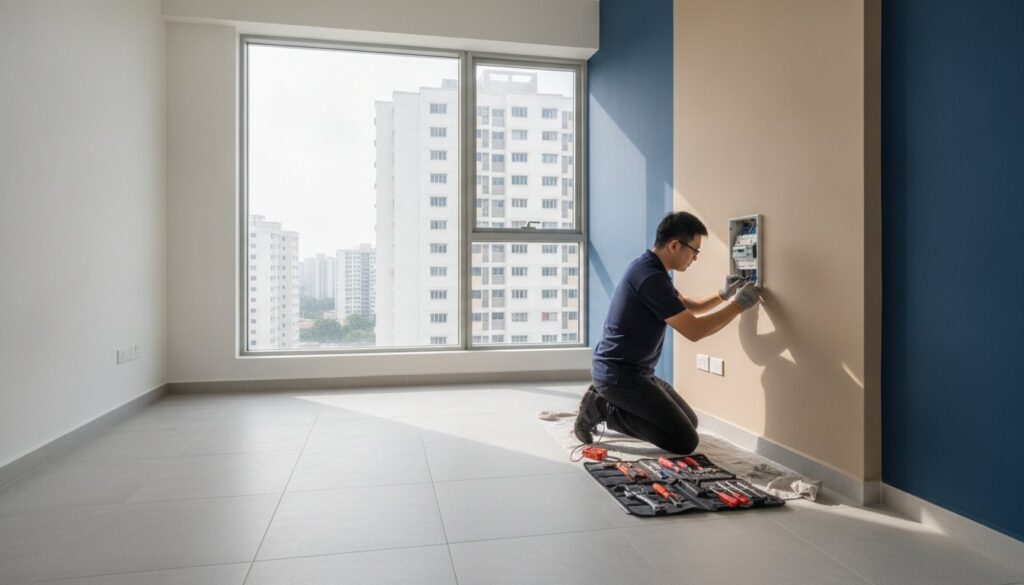
A cheap electrical quote often ends up being the most expensive mistake a homeowner can make. It’s natural to look for the best deal when renovating your HDB or condo, but cutting corners on wiring often leads to hidden costs or, worse, dangerous fire hazards. You need to know exactly who is entering your home and whether they have the technical competence to handle your power requirements safely.
Most homeowners just want a reliable expert who won’t disappear halfway through the job or hit them with “surprise” fees. This article outlines 10 Points To Look Out For And How To Avoid A Shady Electrician? so you can protect your property and your wallet. You’ll learn how to verify a Licensed Electrical Worker (LEW) through the EMA portal and what to demand in a contract to ensure your renovation meets Singapore Standard SS 638. We’ll show you how to spot red flags like high-pressure tactics and vague technical jargon before you sign anything, ensuring your home’s electrical system is safe, legal, and fairly priced.
Key Takeaways
- Understand why hiring a Licensed Electrical Worker (LEW) is a legal requirement in Singapore and how unlicensed work can void your home insurance.
- Master the 10 Points To Look Out For And How To Avoid A Shady Electrician? to protect your home from dangerous wiring and unexpected financial burdens.
- Learn to identify common red flags like “lump sum” billing and high-pressure sales tactics that often lead to massive price variations mid-project.
- Discover how to use the EMA online portal to verify licenses and why a direct contractor model ensures technical competence without middleman markups.
Why Hiring a Licensed Electrician in Singapore is Non-Negotiable
In Singapore, electrical work isn’t just a matter of technical skill; it’s a matter of law. The Energy Market Authority (EMA) strictly regulates who can touch your home’s wiring to prevent life-threatening accidents. If you’re starting a renovation, knowing the 10 Points To Look Out For And How To Avoid A Shady Electrician? is the first step to ensuring your family’s safety. Cutting corners by hiring an unlicensed worker might save a few dollars today, but it creates a massive liability for your property in the long run.
A Licensed Electrician in Singapore, specifically a Licensed Electrical Worker (LEW), has undergone rigorous training and certification. They’re the only individuals legally authorized to design, install, or repair electrical systems in residential units. Substandard wiring is a leading cause of residential fires. Short circuits and overloaded distribution boards don’t just trip your breakers; they can melt insulation and ignite surrounding materials. EMA standards exist to prevent these exact scenarios, ensuring every power point and switch meets the safety code SS 638.
The Difference Between a Handyman and an LEW
Many homeowners mistake a general handyman for a qualified professional. A handyman is fine for mounting a TV or fixing a leaky tap, but they lack the legal standing to handle circuit wiring. Simple tasks like changing a plug might seem easy, but an unlicensed individual often fails to identify deeper circuit issues that lead to power surges. Don’t fall for “ghost” contractors on social media who offer rock-bottom prices. They often lack the technical depth required for complex HDB or condo installations and will leave you stranded if things go wrong.
Insurance and Liability Risks
This is where the financial reality hits hard. If you use an unlicensed worker and a fire occurs, your home insurance provider has every right to void your policy. They’ll view the unauthorized work as a breach of contract, leaving you to pay for the damages out of pocket. There’s also the risk of injury. If an unlicensed worker gets hurt on your property, you could be held liable for their medical costs. A legitimate direct contractor carries Public Liability Insurance to protect both their team and your home. Understanding the 10 Points To Look Out For And How To Avoid A Shady Electrician? helps you verify these protections before the first wire is stripped.
10 Points to Look Out For When Engaging an Electrician
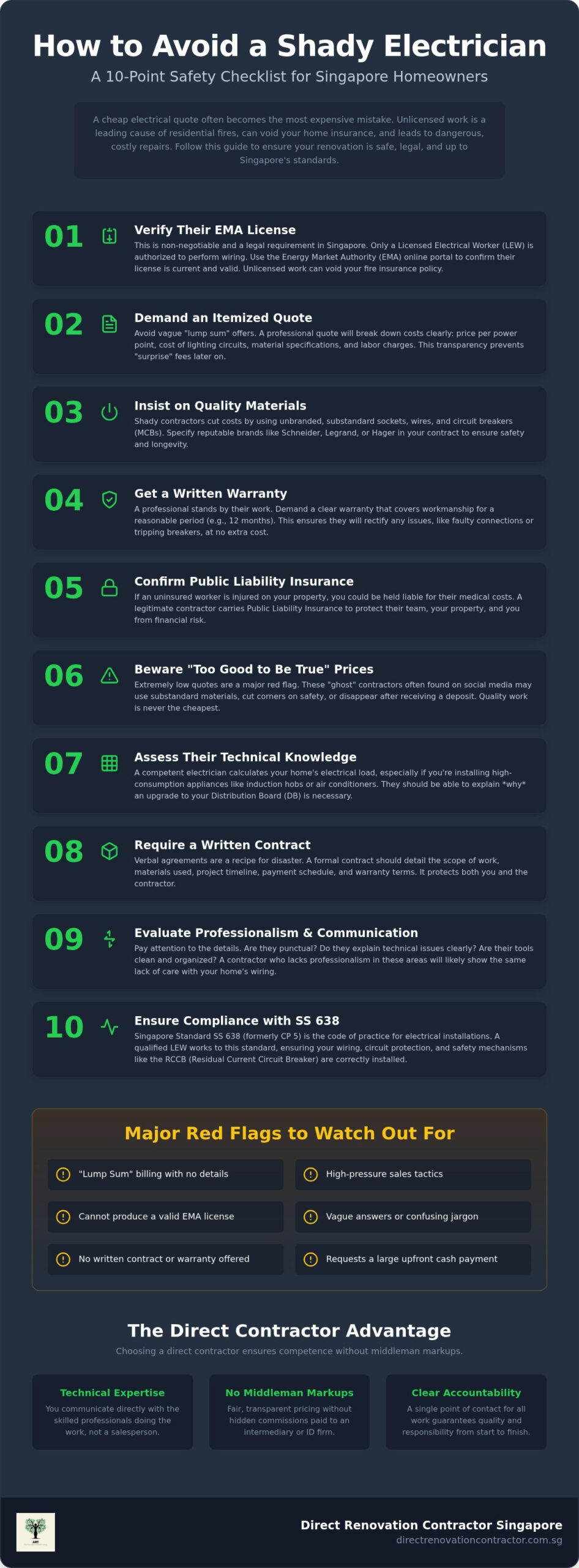
Hiring a contractor for electrical work involves more than just checking prices. You need a structured approach to vetting. Here are the 10 Points To Look Out For And How To Avoid A Shady Electrician? that every homeowner should memorize before starting a project. A professional approach starts with a valid EMA license. This is your primary trust signal. Without it, you have no guarantee that the worker understands Singapore’s strict safety regulations. Legitimate electricians will also provide transparent, itemised quotes, often utilizing professional software like Best Bid to ensure every cost is accurately accounted for. Avoid anyone who offers a “lump sum” figure for the whole house without breaking down the cost per power point or lighting circuit.
Material quality is another critical factor. Shady contractors often use generic, unbranded sockets or Miniature Circuit Breakers (MCBs) to pad their margins. Insist on reputable brands like Schneider or Legrand. Furthermore, a professional stands by their work with a clear warranty on workmanship. If a new wire trips your breaker a month later, they should return to fix it at no cost. Finally, watch for their safety protocols. A real pro uses specialized testing equipment, such as insulation testers, rather than just a simple test pen to verify the integrity of your circuits.
Professionalism and Communication
Pay attention to how an electrician explains the work. If they suggest a Distribution Board (DB) box upgrade, they should clearly explain the “why” based on your current electrical load. Punctuality and the condition of their tools are also strong proxies for quality. A contractor who shows up late with rusty, unorganized tools likely treats your wiring with the same lack of care. Always demand a written contract or service agreement. Following official advice on how to avoid a shady electrician can save you from high-pressure sales tactics and verbal-only promises that disappear once payment is made.
Technical Knowledge and Site Assessment
A technical expert doesn’t just look at your walls; they calculate your load requirements. This is vital if you are installing high-consumption appliances like induction hobs or ovens. They should also check the health of your Residual Current Circuit Breaker (RCCB) to ensure it trips correctly during a fault. In HDB flats, aesthetics matter too. Proper cable management and neat trunking installation show a level of pride in workmanship that “quick-fix” workers lack. For those looking for reliability, our team provides transparent electrical wiring and installation as part of a streamlined renovation process. Keeping these 10 Points To Look Out For And How To Avoid A Shady Electrician? in mind ensures your home remains a safe environment for your family.
Common Red Flags: How to Spot and Avoid a Shady Electrician
A rock-bottom quote is usually a bait-and-switch tactic designed to get a foot in your door. Shady electricians use low entry prices to secure the job, only to “discover” dozens of complications once your walls are already hacked. These sudden variations can easily double your final bill. If a quote seems significantly lower than the market average, it’s a major warning sign. Technical safety shouldn’t be a bargain-basement service. Understanding the 10 Points To Look Out For And How To Avoid A Shady Electrician? helps you recognize when a deal is too good to be true before you lose your deposit.
Pressure tactics are another hallmark of a dishonest worker. If a contractor tells you your house will burn down tonight unless you pay for an immediate, expensive DB box upgrade, they’re likely exploiting your fear. A professional will explain the technical fault, show you the readings on their tester, and give you time to verify the information. You should also check for a physical business address. Accountability matters in this industry. Our presence in Paya Ubi Industrial Park provides clients with a permanent point of contact. A “fly-by-night” operator with only a mobile number can easily disappear if your wiring fails next month.
Traceability is the best defense against scams. Never accept a verbal agreement or a handwritten scrap of paper as a contract. A legitimate firm provides official invoices and receipts that include their company registration details. Without these documents, you have no legal recourse if the work doesn’t meet EMA safety standards.
The Hidden Markup Trap
Many homeowners don’t realize that interior designers often act as middlemen, adding a 30% markup to the actual electrical subcontractor’s fees. By engaging a direct renovation contractor singapore, you eliminate these hidden commissions and deal directly with the people doing the work. Always scrutinize “per point” pricing. Shady contractors might quote a low price per point but then inflate the final count on the bill. Count your own sockets and switches during the site assessment to ensure the math adds up.
The ‘Cash Only’ Red Flag
Cash payments are untraceable and a favorite of unlicensed workers. Legitimate businesses prefer traceable methods like PayNow UEN, bank transfers, or crossed cheques. These create a digital paper trail that protects your interests. Don’t pay a large deposit upfront. A standard progress payment structure for a major rewiring project keeps the contractor motivated and ensures you only pay for completed milestones. Mastering these 10 Points To Look Out For And How To Avoid A Shady Electrician? ensures you maintain control over your renovation budget and the structural integrity of your home.
Step-by-Step: Verifying Your Electrician Before Work Begins
Verification is the final barrier between a safe home and a potential electrical disaster. Don’t take a contractor’s word at face value. Following a checklist of 10 Points To Look Out For And How To Avoid A Shady Electrician? is only effective if you actually verify the data provided. Start by checking the company’s ACRA registration status to ensure they are a legitimate business entity. A registered firm is far more likely to follow local regulations than an individual working under the radar. You should also request a portfolio of completed home renovation projects. This allows you to inspect the neatness of their trunking and the organization of their DB box wiring in real-world settings.
A physical site walk-through is non-negotiable before you sign any contract. A shady electrician might try to give you a quote over the phone, but a professional needs to see your existing setup. They should identify the age of your wiring and check for any existing faults that could complicate the new installation. This walk-through ensures the quote is accurate and prevents the “unforeseen circumstances” that lead to sudden price hikes mid-project.
Conducting the EMA License Check
Every Licensed Electrical Worker (LEW) carries a card issued by the Energy Market Authority. This card contains their photo, name, and a unique license number. You can verify this number instantly through the EMA’s ELISE portal. Pay attention to the class of the license. For most residential work, a Licensed Electrician is sufficient, but larger projects with high voltage requirements might need a Licensed Electrical Technician or Engineer. If a worker refuses to show their ID or claims they “left it at the office,” stop the project immediately. This is a primary step in the 10 Points To Look Out For And How To Avoid A Shady Electrician? protocol.
Reviewing the Quotation Detail
Compare the quotation directly against your floor plan. Count the number of power points, lighting points, and data sockets to ensure the numbers match exactly. A common tactic for shady contractors is to omit “hacking and making good” from the initial price. This means they’ll charge you extra to patch and paint the walls after they’ve installed the new conduits. Ensure this is included as a line item. Finally, verify the specific brand and model of the Distribution Board components. You want to see high-quality, local-standard parts rather than cheap, unbranded alternatives that may fail under load. For a reliable, transparent quote on your next project, get in touch with our electrical installation team to discuss your requirements without the middleman markups.
The Direct Contractor Advantage for Electrical Works
Choosing a partner for your electrical installation is the final step in securing your home’s safety. While we’ve discussed the 10 Points To Look Out For And How To Avoid A Shady Electrician?, the most practical way to ensure quality is to work with a direct renovation contractor. This model provides a level of accountability that fragmented sub-contracting cannot match. When one main contractor is responsible for the entire circuit, from the distribution board to the final lighting point, there is no room for finger-pointing if a fault occurs. You get a single point of contact who understands the structural integrity of your entire unit.
Our direct-to-homeowner approach ensures that electrical wiring is seamlessly integrated with other works like custom carpentry and masonry. To see how dedicated masonry and exterior specialists maintain structural standards, check out Brick Tech Contracting Corp. For instance, planning the internal wiring for a built-in wardrobe or kitchen cabinet requires precise coordination. A direct contractor handles this in-house, ensuring that cables are neatly concealed and sockets are placed exactly where your appliances need them. This integrated planning prevents the costly re-wiring fees that often arise when different trades don’t communicate. Whether you are looking at HDB BTO or Resale packages, our transparent pricing model ensures you pay for technical skill, not middleman markups.
Why Direct is Better for Your Budget
Design-heavy firms often add a 20% to 40% markup on electrical sub-contracts. These are essentially “coordination fees” that don’t add any functional value to your home’s safety. By cutting out the middleman, you save significantly on essential installations. You also benefit from direct communication with the actual tradesmen performing the work. This eliminates the “broken telephone” effect where technical requirements get lost between an interior designer and the electrician. We focus on functional quality and technical competence rather than expensive aesthetic “fluff” that doesn’t improve the performance of your power grid.
Ensuring Long-Term Electrical Safety
Planning a layout for an HDB renovation in Singapore requires a forward-thinking approach. We don’t just look at your current needs; we future-proof your home for high-consumption smart appliances and potential EV chargers. Every project concludes with rigorous final testing and commissioning. We verify every circuit under load to ensure the RCCB trips correctly and that all points are grounded according to SS 638 standards. Keeping the 10 Points To Look Out For And How To Avoid A Shady Electrician? in mind allows you to appreciate the value of a professional handover, where safety is proven through testing rather than just promised verbally.
Secure Your Home with Technical Competence and Transparent Pricing
Electrical safety is the foundation of any successful home renovation. You’ve learned that technical skill must be backed by a valid EMA license and a commitment to local regulatory standards like SS 638. By focusing on transparent, itemized billing and verifying your contractor’s credentials, you eliminate the typical anxieties of hidden costs and dangerous wiring. Mastering the 10 Points To Look Out For And How To Avoid A Shady Electrician? is your best defense against the high-pressure tactics and “lump sum” traps common in the industry.
We prioritize functional results over stylistic flair. As an experienced HDB-registered contractor, we provide direct-to-owner pricing that removes unnecessary middleman markups. Our team delivers comprehensive itemised quotations so you know exactly what you’re paying for before the work begins. Don’t settle for vague promises when it’s your family’s safety and your property’s structural integrity on the line. Get a Transparent, Direct Quote for Your Electrical Renovation Today and move forward with your project with total confidence.
Frequently Asked Questions
How do I check if an electrician is licensed by EMA?
You can verify a worker’s status through the Energy Market Authority’s e-Licence Information Services (ELISE) portal. Every qualified professional carries an official card with a unique license number. Inputting this number into the portal provides instant confirmation of their validity and license class. This step is a critical part of the 10 Points To Look Out For And How To Avoid A Shady Electrician? protocol to ensure your home’s safety.
What is the average cost of rewiring a 4-room HDB flat in 2026?
Market rates for full rewiring depend on the total number of power points and the complexity of your unit’s layout. While industry prices fluctuate, you should prioritize contractors who provide itemized quotes rather than fixed lump-sum figures. A transparent quote breaks down costs for the distribution board, socket installation, and hacking works separately. This prevents hidden markups and ensures you only pay for the actual work performed.
Is it illegal to do my own electrical wiring in Singapore?
Yes, it’s illegal for unlicensed individuals to perform electrical wiring or installation tasks in Singapore. The law requires all electrical works to be carried out by a Licensed Electrical Worker (LEW) registered with the EMA. Attempting DIY wiring is dangerous and violates local safety regulations. It also gives insurance providers a legal reason to void your fire insurance policy if a fault occurs later.
What should I do if an electrician causes a power trip and disappears?
Contact a licensed direct contractor immediately to assess the damage and rectify the fault safely. If the worker claimed to be licensed, you should report the incident to the EMA with any documentation you have. This unfortunate scenario is why following the 10 Points To Look Out For And How To Avoid A Shady Electrician? guide is essential. It helps you identify traceable businesses with physical offices before you commit any funds.
Do I need an HDB permit for electrical rewiring?
You generally don’t need a specific permit for rewiring alone, but the work must be performed by an LEW. However, if your project involves hacking walls or floors to conceal wires, you must obtain an HDB hacking permit. An HDB-registered contractor will manage these requirements for you. They ensure all works comply with the latest estate regulations and safety standards for structural integrity.
What is the difference between a 13A and 15A power point?
The difference lies in the electrical load capacity and the physical plug design. A standard 13A socket handles most household appliances like fans, chargers, and computers. A 15A socket is built for high-power appliances, such as large water heaters or industrial equipment, and features larger round pins. Using the correct socket for your appliance’s load prevents overheating and reduces the risk of electrical fires.
How many years of warranty should an electrician provide?
Reputable electricians typically provide at least one year of warranty on their workmanship. This guarantee ensures that if a circuit fails or a socket becomes loose due to poor installation, the contractor will return to fix it for free. Always insist on having this warranty period clearly stated in your written contract. It protects your budget from the costs of fixing substandard work left by “fly-by-night” operators.
Can a renovation contractor provide their own electricians?
Yes, a direct renovation contractor often provides their own licensed electricians as part of a comprehensive package. This integrated model is more efficient because it ensures electrical points are perfectly aligned with your carpentry and masonry works. Dealing with one main contractor also provides a single point of accountability. You don’t have to coordinate between different trades, which reduces the chance of technical errors and project delays.