
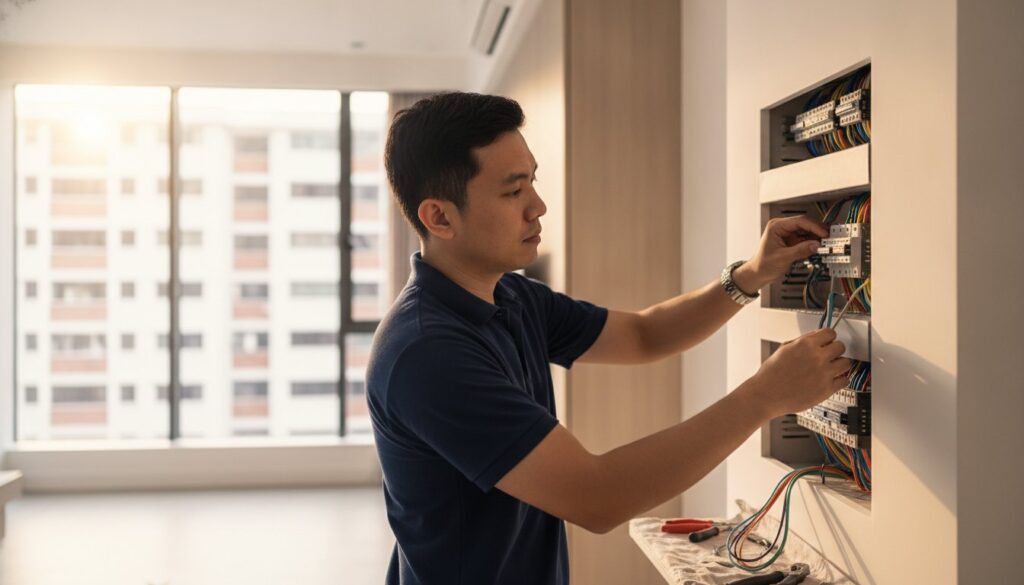
What if your “experienced” electrician finishes your home rewiring, but SP Group refuses to turn on your power because the work isn’t certified? It’s a common nightmare for Singapore homeowners who unknowingly hire unlicensed workers to save a few dollars. You want a home that’s safe from fire hazards, not a legal headache with the Energy Market Authority (EMA). This guide answers the critical question: What Is LEW Electrician And Why Do We Need It?
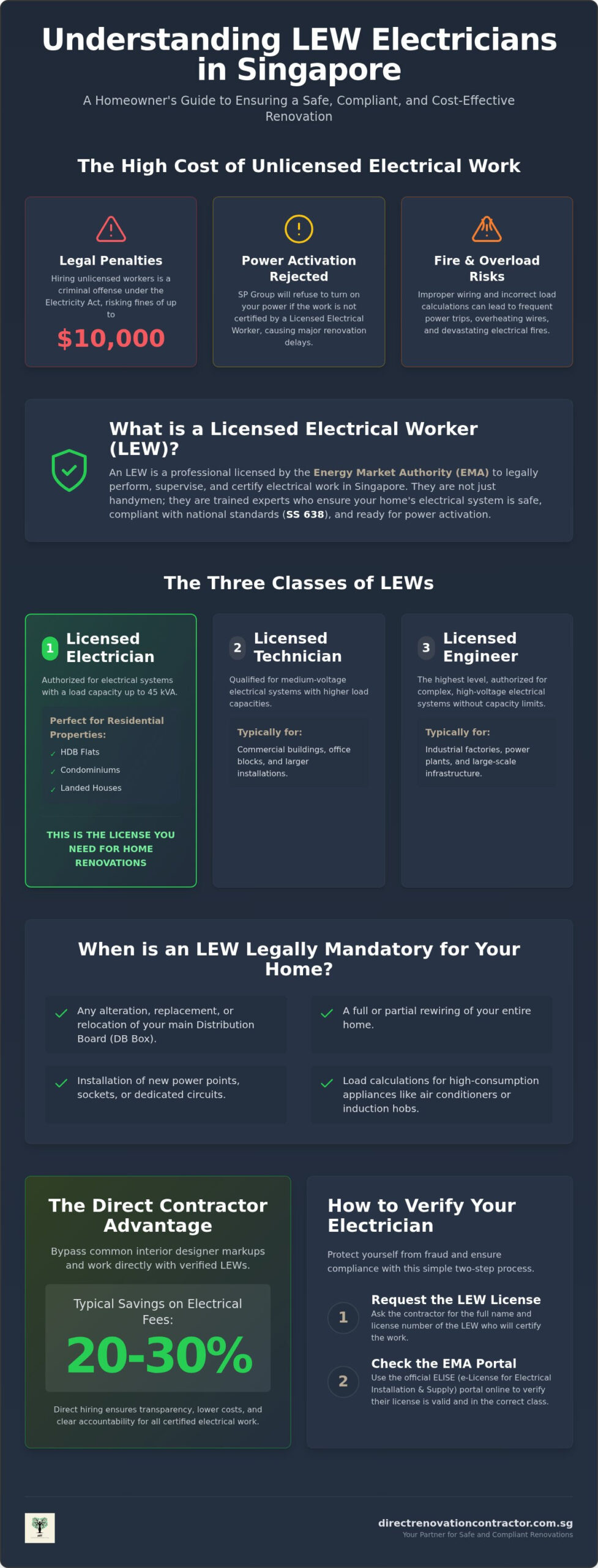
We understand that the technical jargon around licenses can be confusing. You need to know exactly which class of Licensed Electrical Worker is required for your HDB or condo project to avoid potential fines of up to $10,000. This article explains the differences between Licensed Electricians, Technicians, and Engineers. We’ll also highlight exactly when an LEW is legally required for your renovation, from altering your distribution board to installing new power points. By the end, you’ll have the clarity to hire a compliant contractor and ensure your home’s wiring is both safe and fully functional. We’ll show you how to navigate these requirements without the typical markups found in the industry.
Key Takeaways
- Learn about the different EMA license classes to answer the question, What Is LEW Electrician And Why Do We Need It?, before starting your home renovation.
- Identify the specific legal scenarios, such as DB box relocation or full rewiring, where an LEW’s certification is mandatory for SP Group power activation.
- Discover how to verify an electrician’s credentials on the official EMA portal to avoid the safety risks and heavy legal penalties associated with unlicensed work.
- Understand how hiring a direct renovation contractor can save you 20-30% on electrical fees by bypassing common interior designer markups.
- Ensure your home remains safe and compliant with Singapore Standard 638 through professional load calculations that prevent circuit overloads and fire hazards.
What Is an LEW Electrician? Defining the Licensed Electrical Worker
An LEW, or Licensed Electrical Worker, is a technical professional authorized by the Energy Market Authority (EMA) to carry out, supervise, and certify electrical works in Singapore. Unlike a general handyman or a “wireman,” an LEW has undergone rigorous training and testing to ensure they understand the complexities of the national power grid. Understanding What Is an LEW Electrician? is the first step in protecting your property. In our local context, the term “electrician” is often used loosely, but the law is very specific. Only individuals holding a valid EMA license can legally touch the wiring or distribution boards in your home.
Many homeowners ask, What Is LEW Electrician And Why Do We Need It? during the early stages of a renovation. The answer lies in the Electricity Act 2001. This legislation makes it a criminal offense for unlicensed individuals to perform electrical installation work. If you hire a freelance worker who lacks these credentials, you’re not just risking a short circuit; you’re risking significant legal penalties. Checking for an EMA license number should be your priority before any cables are laid or switches are installed. This verification ensures the person handling your power grid is qualified and accountable.
The Role of the Energy Market Authority (EMA)
The EMA acts as the primary regulator for Singapore’s energy industry. Their job is to ensure that every electrical installation, from a 3-room HDB flat to a massive commercial office, operates safely and reliably. They enforce the Singapore Standard 638 (SS 638), which is the mandatory code of practice for all electrical installations. The EMA oversees the licensing of workers to maintain a high standard of residential safety across the country. By regulating who can perform these tasks, the EMA protects homeowners from the dangers of substandard workmanship and faulty materials.
Why a Standard ‘Electrician’ Might Not Be Enough
A standard renovation contractor might have staff who are proficient at pulling wires through a ceiling, but that doesn’t make them an LEW. There’s a clear distinction between basic manual labor and certified electrical inspection. A licensed worker ensures your home meets all grounding and load requirements. Hiring an unlicensed worker often leads to failed inspections when SP Group comes to turn on your power. LEWs take full legal responsibility for the work they sign off on, giving you a safety net that a freelance contractor simply cannot provide.
Hiring an unlicensed worker might seem like a way to save on costs, but it creates significant risks. These individuals often bypass essential safety protocols, such as proper load calculations for high-consumption appliances like air conditioners or induction hobs. Without an LEW to verify the work, you might face frequent power trips or electrical fires caused by overheating wires. An LEW ensures your installation complies with the SS 638 standards, providing a level of technical competence that protects your family and your investment. When you work with a direct contractor, verifying their LEW credentials is the best way to ensure quality without paying unnecessary middleman fees.
The Three Classes of LEWs in Singapore
The Energy Market Authority (EMA) doesn’t issue a one-size-fits-all license. Instead, they use a tiered system to ensure that the complexity of an electrical project matches the technical expertise of the worker. This hierarchy is based on the electrical load, measured in kilovolt-amperes (kVA). Understanding these distinctions helps you answer the question, What Is LEW Electrician And Why Do We Need It?, especially when you’re comparing quotes for different property types. You can verify any worker’s current license class and validity period by visiting the EMA’s official ELISE portal. Checking this before signing a contract protects you from hiring someone who is technically unqualified for your specific power requirements.
Matching the right professional to your property type prevents unnecessary delays during the inspection phase. While a Class 1 license covers most homes, commercial spaces often trigger the need for higher-tier certification. By knowing which class your project falls under, you can avoid paying for an over-qualified engineer when a standard licensed electrician is more than sufficient for the task at hand.
Class 1: Licensed Electrician
A Class 1 Licensed Electrician is approved to design, install, and certify electrical systems with a load of up to 45 kVA. This capacity is more than enough for nearly every residential property in Singapore, including 5-room HDB flats and most executive condominiums. These professionals handle the bread-and-butter tasks of home improvement, such as full rewiring, relocating Distribution Board (DB) boxes, and installing new power points. Because they specialize in residential loads, they are the most common experts you’ll encounter during a home renovation. If you’re planning a standard residential makeover, our electrical wiring and installation services ensure your project stays within these safe, legal limits.
Class 2 & 3: Electrical Technicians and Engineers
Matching the right LEW tier to your property isn’t just about technical skill; it’s about cost efficiency. Hiring a high-voltage Engineer for a simple HDB rewiring is unnecessary and will significantly inflate your budget. Conversely, using a Class 1 Electrician for a high-load commercial kitchen is illegal and dangerous. A pragmatic contractor will always recommend the appropriate class of worker based on your site’s specific load requirements. This ensures your renovation is safe and EMA-compliant without wasting money on over-qualified consultants for straightforward tasks. We prioritize this transparency in every quote, ensuring you pay only for the expertise your specific property requires.
Why Do You Need an LEW for Your Renovation?
Hiring a Licensed Electrical Worker is about more than just following technical guidelines. It’s about establishing a clear line of legal accountability for your property. When homeowners ask, What Is LEW Electrician And Why Do We Need It?, they often overlook the legal and insurance consequences of cutting corners. In Singapore, an LEW is the only person who can take full legal responsibility for the integrity of your electrical installation. If a fire occurs due to faulty wiring, authorities will look for the certified professional who signed off on the work. Without that certification, the burden of liability falls entirely on the property owner.
There’s also the critical issue of insurance validity. Most home insurance policies in Singapore contain clauses that require all renovation works to comply with local regulations. If you engage an unlicensed “freelancer” to rewire your kitchen and a short circuit causes significant damage, your insurer has the right to void your claim. They view unlicensed work as a self-imposed risk. By ensuring an LEW supervises your electrical wiring and installation, you protect your financial investment and ensure your policy remains enforceable.
Turning on Your Electricity Supply
The most immediate reason you need an LEW is to actually get power into your home. For new installations or major alterations in resale flats, SP Group requires a “Certificate of Fitness” certified by an LEW. This involves submitting the CS/3 form, a mandatory document that proves the installation is safe for energized use. We often see renovation timelines stall because homeowners didn’t realize their contractor lacked the credentials to sign this form. An LEW is the only professional authorized to certify this document, ensuring your power is turned on without administrative delays or rejection from SP Group.
Ensuring Safety and Code Compliance (SS 638)
Safety in Singapore is governed by the SS 638 standard, formerly known as CP5. This code of practice dictates everything from the height of your power sockets to the thickness of the wires used for your water heater. An LEW ensures your home doesn’t suffer from “overloading,” a common problem where too many high-wattage appliances are placed on a single circuit. This prevents the frequent circuit trips that frustrate many homeowners. A vital part of their job is testing the Residual Current Circuit Breaker (RCCB). This device is designed to trip and cut off power instantly if it detects a leak, preventing fatal electric shocks. An LEW’s technical check ensures this life-saving component is functioning exactly as it should before you move in.
When Is an LEW Legally Required in Singapore?
While homeowners can handle minor tasks like replacing a lightbulb or resetting a tripped circuit breaker, most renovation works fall under strict EMA regulation. You must engage a Licensed Electrical Worker whenever your project involves installing, altering, or repairing the permanent wiring of a property. This is the practical answer to What Is LEW Electrician And Why Do We Need It? in a real-world setting. If your renovation involves relocating the main Distribution Board (DB) box or installing high-load infrastructure like EV chargers and solar PV systems, an LEW’s sign-off is a legal requirement. They ensure the new additions don’t compromise the building’s electrical integrity or create a fire hazard for your neighbors.
Beyond one-time installations, some properties require ongoing LEW involvement. For instance, commercial buildings or large estates with specific load thresholds must apply for an annual Electrical Installation Licence. This involves yearly inspections by an LEW to ensure the system remains safe and compliant with the latest SS 638 standards. Even in residential settings, applying for a new electrical sub-meter to track usage in a subdivided space requires professional certification. Failing to secure this expertise isn’t just a safety risk; it can lead to heavy fines and the immediate disconnection of your utility supply by SP Group.
Residential Scenarios: HDB and Condos
If you’re moving into a new BTO flat, you generally don’t need a new LEW sign-off because the original building’s wiring is already certified. However, the situation changes for a resale HDB renovation in Singapore. Older flats often have wiring that is 20 or 30 years old, which may not support modern high-wattage appliances. A full rewiring is often mandatory for safety, and this work must be certified. For condo owners, the MCST often demands an LEW’s endorsement before approving any electrical upgrades to ensure the estate’s shared power grid isn’t overloaded by your individual unit’s modifications.
Commercial and Office Requirements
The rules for business spaces are even more stringent. Any office or retail unit with an electrical load exceeding 45 kVA must have a valid Electrical Installation Licence, which is managed by an appointed LEW. During commercial renovation and reinstatement, an LEW must oversee the dismantling of old circuits and the design of new power layouts to meet industrial safety codes. Businesses are legally obligated to conduct regular inspections to maintain their license. We help business owners navigate these technical hurdles by providing direct access to qualified workers who understand the specific documentation required for commercial premises.
Whether you’re planning a major home overhaul or a commercial fit-out, we provide the technical expertise to keep your project compliant. Once your space is ready for business, you might also consider professional mobile advertising from TexWood Media to effectively launch your new location. Book a site assessment for your electrical wiring to ensure your project meets all EMA requirements from day one.
The Direct Contractor Advantage: Managing Electrical Costs
When planning a renovation, the electrical budget is often where hidden markups creep in. Interior designers (IDs) typically act as middlemen, often marking up LEW and electrical fees by 20-30% to cover their project management overhead. This is a significant expense that doesn’t actually improve the technical quality of your wiring. By working with a direct renovation contractor, you bypass these intermediary commissions. You gain a clearer understanding of What Is LEW Electrician And Why Do We Need It? by seeing the raw costs of labor and certification. We believe in financial transparency, which is why we provide quotes that clearly separate the physical installation labor from the mandatory LEW sign-off fees. This ensures you aren’t paying a premium just for the convenience of a single point of contact.
Working directly with a technical expert also eliminates the “lost in translation” errors that happen when a designer tries to relay technical electrical requirements. You get straightforward answers about what’s possible within your property’s load limits. This direct-to-owner model prioritizes functional results and structural integrity over stylistic flair, ensuring your budget is spent on high-quality workmanship and compliant materials rather than high-concept presentations.
Direct Sourcing for Electrical Components
One of the easiest ways to manage your budget is through direct sourcing of materials. You can save significantly on switches, sockets, and lighting fixtures by purchasing them directly from local suppliers instead of through a design firm’s marked-up catalog. Our team coordinates directly with our network of LEWs to ensure that the components you choose are fully compliant with Singapore safety standards. This approach eliminates the “package” pricing that often masks high material markups and “miscellaneous” service fees. We focus on providing a streamlined business model where you pay for technical skill and quality materials, not for undisclosed fees or intermediary commissions.
Planning Your Electrical Layout
Effective cost management starts before the first wire is pulled. We provide 3D drawings for electrical planning to help you visualize your socket placement before the LEW begins work. A well-planned layout reduces the need for future hacking or additional wiring works, which are expensive and disruptive. This process ensures your home’s infrastructure supports your lifestyle from day one, whether you need specific points for a home office or high-load circuits for a modern kitchen. Before any work starts, we provide a final checklist to verify your contractor’s electrical credentials. A legitimate direct contractor will never hesitate to provide their LEW’s license number for your verification on the EMA portal. This no-nonsense approach ensures your home is safe, legal, and delivered at a fair, transparent price.
Secure Your Property with Certified Electrical Expertise
Ensuring your home or office meets Singapore’s strict safety standards starts with hiring the right professional. You now have a clear answer to What Is LEW Electrician And Why Do We Need It? and how their certification protects your insurance validity and legal standing. Whether you’re managing a resale HDB rewiring or a complex commercial fit-out, matching the right license class to your load requirement is non-negotiable for a successful SP Group power turn-on. This technical certification is your only guarantee that the installation is safe for everyday use.
Choosing a direct contractor allows you to prioritize technical competence over aesthetic markups. We specialize in HDB and commercial electrical wiring, providing EMA-compliant workmanship without the typical 20-30% interior designer commissions. You get technical honesty, direct-to-owner pricing, and the peace of mind that your property’s infrastructure is built to last. Take the first step toward a safe and compliant renovation by working with a partner who values structural integrity and financial transparency.
Get a Transparent Direct Quote for Your Electrical Works Today
Frequently Asked Questions
Can I do my own electrical wiring if I am not an LEW?
You cannot legally perform your own electrical wiring in Singapore unless you hold a valid license from the Energy Market Authority. The Electricity Act 2001 prohibits unlicensed individuals from installing, altering, or repairing any permanent electrical wiring. Homeowners are only permitted to handle very minor tasks, such as replacing a lightbulb or resetting a tripped circuit breaker. Any work involving the distribution board, new power points, or internal cabling must be handled by a professional to ensure the property remains safe and legally compliant.
How do I check if my electrician is truly an EMA Licensed Electrical Worker?
You can verify an electrician’s credentials by using the EMA’s ELISE portal. Every legitimate professional carries a license card that displays their name, photo, and a unique license number. By entering these details into the portal, you can confirm their license class and its current validity. This verification step is the only way to be certain about What Is LEW Electrician And Why Do We Need It? for your specific home or office project. Always check this before any work begins to avoid hiring an unlicensed freelancer.
What is the difference between an LEW and a normal contractor?
The main difference lies in legal authority and technical accountability. A normal renovation contractor might have workers who understand how to pull cables, but they lack the EMA license required to certify that the work meets national safety standards. An LEW has passed rigorous technical examinations and is legally authorized to sign off on installations. This certification is mandatory for SP Group to turn on your electricity supply and is essential for keeping your home insurance policy valid.
Is an LEW required for simple light fixture replacements?
An LEW is legally required for any work that involves altering or repairing the permanent wiring of a property. While many homeowners replace a basic light fitting themselves, any task that involves adding a new light point or modifying the circuit behind the fixture requires a license. For the sake of safety and to maintain your property’s legal status, it’s best to engage a professional for any work that connects to your home’s internal electrical system.
How much does an LEW charge for a CS/3 sign-off in Singapore?
Fees for a CS/3 sign-off are distinct from the manual labor costs of the actual electrical installation. These charges vary based on the complexity of the project and the total electrical load of the property. When you engage a direct contractor, these certification fees are typically listed as a transparent, separate line item in your quote. This prevents the hidden markups and commissions that are often bundled into general renovation packages by middleman firms.
What happens if I renovate my electrical system without an LEW?
Renovating without a licensed professional carries severe legal penalties and significant safety risks. You could face a fine of up to $10,000, a jail term of up to 12 months, or both under the Electricity Act. Beyond the law, unlicensed work is a leading cause of electrical fires and frequent power trips in residential units. Furthermore, your home insurance provider will likely reject any claims related to fire damage if the electrical work was not certified by an LEW.
Why does SP Group require an LEW to turn on my power?
SP Group requires a CS/3 form certified by an LEW to ensure the installation is safe for energized use. As the utility provider, they cannot risk the integrity of the building or the national power grid by connecting to unverified wiring. The LEW’s signature on this document serves as a technical guarantee that the system complies with Singapore Standard 638 (SS 638). Without this certification, SP Group will not activate your electricity account.
Do I need a new LEW certificate every year for my home?
Residential properties generally do not require an annual LEW certificate. Once your initial renovation is certified and the power is activated, the certificate remains valid as long as no major alterations are made to the system. However, commercial properties and offices with an electrical load exceeding 45 kVA are legally required to have an annual Electrical Installation Licence. This involves a yearly inspection by an LEW to ensure the system continues to operate safely under heavy loads.